Terrence Abernathy Youth Services Specialist, WIOA Title I Milwaukee, 53212, United States [email protected] · (414) 555-2102
11 September 2026
Ms. Adaeze Okonkwo Program Director Bay View Youth Opportunity Program Milwaukee, United States
Application for Youth Services Specialist, Bay View Youth Opportunity Program
Dear Ms. Okonkwo,
I am applying for the Youth Services Specialist post with the Bay View Youth Opportunity Program. For the last three program years I have carried a WIOA Title I out-of-school youth caseload of 62 at Riverworks Youth Pathways, covering eligibility determination, objective assessment, individual service strategy, paid work experience placement and follow-up through the fourth quarter after exit.
The number I would point to is the education and employment rate in the second quarter after exit: 78 percent against a negotiated level of 68 percent, held across two program years. Credential attainment came in at 54 percent against a negotiated 45 percent, mostly GED and state-recognized manufacturing and healthcare certificates. In program year 2025 I placed 41 participants into paid work experience, which is the part of the contract that is hardest to staff and the part I most enjoy building. I document in Efforts to Outcomes and came through two state monitoring visits with no data validation findings.
Your posting mentions that the program is expanding its summer employment component and adding a transitional living site. Both are familiar ground: I have run summer placements against the work experience expenditure requirement, and I spent two years supporting a 20-bed basic center, so I know how differently a 21-day clock and a long-term stay have to be case managed. I would want to work on employer recruitment first, because that is usually where a summer component breaks.
I hold the Certified Workforce Development Professional credential from the National Association of Workforce Development Professionals and a bachelor's degree from the University of Wisconsin-Milwaukee, and I am available at four weeks' notice. Thank you for your time.
Sincerely, Terrence Abernathy
Summary
A youth services specialist cover letter names the funding stream you worked under, the performance measure that stream reports, and your own number against it. This guide gives you a full adaptable letter, the openings that work in a grant-funded agency, and what to write when the posting does not say which contract the role sits on.
Youth Services Specialist cover letter examples by experience level
A youth services specialist cover letter is a one-page letter naming the funding stream behind your experience, the measure that stream reports on, and the number you hit against it.
The reader is almost never a recruiter. It is a program director or a contract manager, short-staffed mid-program-year with a report due. A letter written for that reads very differently from one opening with a commitment to young people.
Guide to a youth services specialist cover letter
This guide and the corresponding youth services specialist cover letter example will cover:
- How to structure the letter, paragraph by paragraph
- Why the funding stream belongs in the first two sentences
- How to write to a posting that does not name the contract
- What to say when your program had no formal measures
How to write a youth services specialist cover letter
| Paragraph | Its job | Length |
|---|---|---|
| Opening | The post, the funding stream, your caseload | 2 to 3 sentences |
| Evidence | One measure, your result, the benchmark, the period | 4 to 5 sentences |
| Fit | Something specific about their program, and what you would take on | 3 to 4 sentences |
| Close | Credential, availability, thank you | 2 sentences |
Say which contract you have already reported on
An agency hiring a youth services specialist is filling a seat inside a live contract, and the question behind the interview is whether you will need six months of training before you can carry the reporting.
Write the answer into the first paragraph: "I have carried a WIOA Title I out-of-school youth caseload of 62 for three program years, including exit-based follow-up through the fourth quarter."
Coming from a different stream, say that and be precise. Someone who has run a Runaway and Homeless Youth basic center understands intake, bed nights, aftercare intervals and a 21-day clock. That transfers; vagueness does not.
A youth services specialist cover letter example you can adapt
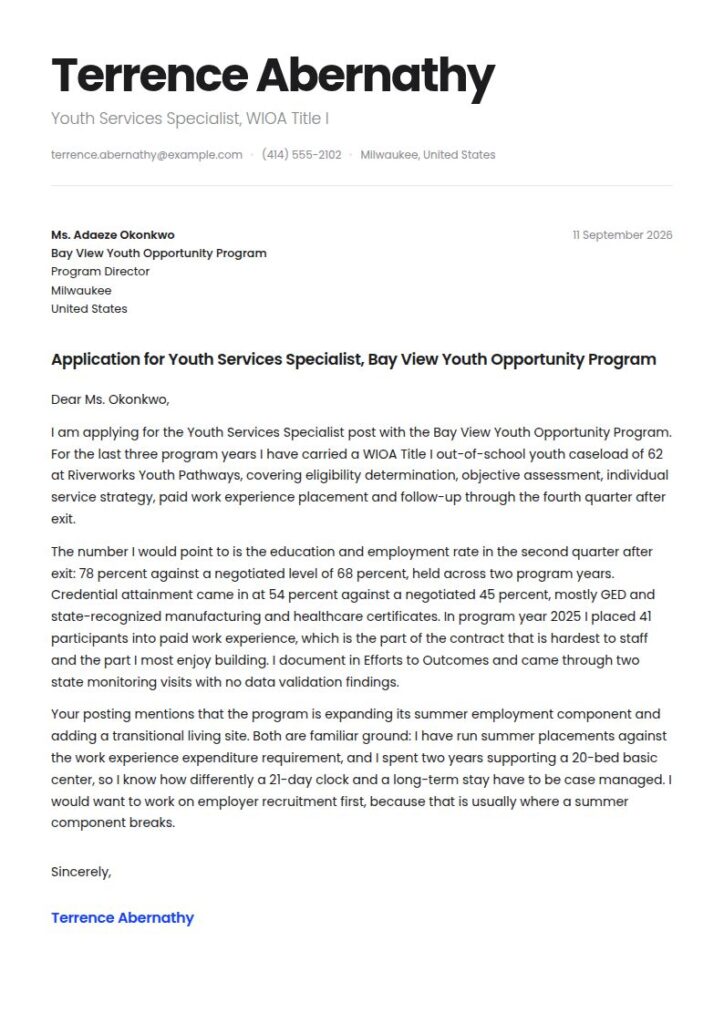
Dear Ms. Okonkwo,
I am applying for the Youth Services Specialist post with the Bay View Youth Opportunity Program. For the last three program years I have carried a WIOA Title I out-of-school youth caseload of 62 at Riverworks Youth Pathways, covering eligibility determination, objective assessment, individual service strategy, paid work experience placement and follow-up through the fourth quarter after exit.
The number I would point to is the education and employment rate in the second quarter after exit: 78 percent against a negotiated level of 68 percent, held across two program years. Credential attainment came in at 54 percent against a negotiated 45 percent, mostly GED and state-recognized manufacturing and healthcare certificates. In program year 2025 I placed 41 participants into paid work experience, which is the part of the contract that is hardest to staff and the part I most enjoy building. I document in Efforts to Outcomes and came through two state monitoring visits with no data validation findings.
Your posting mentions that the program is expanding its summer employment component and adding a transitional living site. Both are familiar ground: I have run summer placements against the work experience expenditure requirement, and I spent two years supporting a 20-bed basic center, so I know how differently a 21-day clock and a long-term stay have to be case managed. I would want to work on employer recruitment first, because that is usually where a summer component breaks.
I hold the Certified Workforce Development Professional credential from the National Association of Workforce Development Professionals and a bachelor's degree from the University of Wisconsin-Milwaukee, and I am available at four weeks' notice. Thank you for your time.
Sincerely, Terrence Abernathy
Openings that work
| Instead of | Use |
|---|---|
| I am passionate about working with young people | I have carried a WIOA Title I out-of-school youth caseload of 62 for three program years |
| I am writing to express my interest in this position | I am applying for the Youth Services Specialist post with the Bay View Youth Opportunity Program |
| I have a proven track record of positive outcomes | 78 percent of my exiters were in employment, education or training in the second quarter after exit, against a negotiated 68 percent |
Name the stream, and name its measure
Each stream keeps its own scoreboard, and using its vocabulary shows you have been inside the program rather than near it.
| Stream | What to name in the letter |
|---|---|
| WIOA Title I youth | Caseload, education and employment rate in the second and fourth quarter after exit, credential attainment, measurable skill gains |
| OJJDP Title II | Referral source, prevention program served, your part in the annual compliance report |
| Runaway and Homeless Youth | Bed count, length of stay, intake volume, aftercare intervals, safe-housing exits |
| 21st Century Community Learning Centers | Enrollment, regular attendance rate, alignment with the school day |
| Foundation or United Way grant | The contracted deliverable, the period, the number you reported |
The measures behind the first of those are the Department of Labor's primary indicators of performance: the education and employment rate in the second and fourth quarters after exit, median earnings, credential attainment, measurable skill gains and effectiveness in serving employers (U.S. Department of Labor, Employment and Training Administration, retrieved 17 September 2026). Two spending rules shape the caseload: under 20 CFR 681.410 not less than 75 percent of youth funds must go to out-of-school youth, and under 20 CFR 681.590 local programs must spend not less than 20 percent on work experience (Electronic Code of Federal Regulations, retrieved 17 September 2026).
Name the funding stream in the first two sentences. Give one measure with your result and the benchmark beside it. Say which case management system you documented in. Name one specific thing the program is doing, taken from the posting or their own site. Say when you can start, because grant-funded agencies hire against a contract date.
Do not open with your commitment to young people; every letter in the folder has one. Do not describe an individual young person or family, even anonymized. Do not claim experience with a stream you only observed. Do not send more than one page. Do not leave out the caseload number, which is the first thing the reader is trying to work out.
When the posting does not name the contract
Most postings do not. Two things usually tell you anyway.
The eligibility language. Ages 16 to 24, out-of-school status or an individual service strategy means a WIOA Title I youth role. Ages 12 to 17 with a court or school referral points at juvenile justice prevention money. Shelter, bed nights or a 21-day limit means a Runaway and Homeless Youth basic center.
The agency's own documents. An annual report and a Form 990 both name major government contracts, and state workforce boards publish subrecipient lists. Write to what you find and say where you found it.
The hiring market moves with the award calendar
Social and human service assistants, the Bureau of Labor Statistics occupation youth services specialists usually sit in, numbered 463,400 jobs in 2025, with employment projected to grow 7 percent from 2025 to 2035 and about 48,900 openings each year on average (BLS Occupational Outlook Handbook, May 2025 data and 2025 to 2035 projections, retrieved 17 September 2026). Most of those jobs sit with grant-funded employers: individual and family services holds 28 percent, local government excluding education and hospitals 11 percent (BLS Occupational Outlook Handbook, 2025 employment data).
So timing matters as much as content. Postings cluster after award letters and at the start of program years, and a letter that already speaks the contract's language gets read first mid-cycle.
Length, format and sending it
One page, four paragraphs, 250 to 400 words. PDF unless the portal says otherwise, named for yourself and the post: terrence-abernathy-youth-services-specialist-cover-letter.pdf.
Address a person. Program directors are named on almost every agency site, and a generic salutation on an otherwise specific letter wastes a signal. Keep letter and resume in agreement: our youth services specialist resume example is written with the numbers used here.
Key takeaways
- Name the funding stream and your caseload in the first two sentences.
- Give one performance measure with your result and its benchmark.
- Use the stream's vocabulary: measurable skill gains, bed nights, regular attendance.
- Say which case management system you document in.
- Name one real detail about their program.
- Keep every young person and family out of the letter.
- State your start date; grant-funded hiring runs against a contract calendar.
Write your youth services specialist cover letter in 10 minutes with our AI cover letter builder.
Youth services specialist cover letter questions, answered
How long should a youth services specialist cover letter be?
One page, four paragraphs, 250 to 400 words. The reader is a program director working between site visits and reporting deadlines, and a second page does not read as thorough.
What if my program had no formal performance measures?
Use what it did count: enrollment, attendance, completion, referrals made and referrals that connected, and any follow-up interval you recorded. Give the starting figure, the ending figure and the period.
Should I mention that I have been through a monitoring visit?
Yes. It is one of the strongest lines available to you, because it says your files held up under someone else's scrutiny. Name the funder, the year, and whether there were findings.
How do I write this letter as a career changer?
Lead with the transferable mechanics rather than the sector. Documentation under a contract, eligibility verification, working to an audited deadline and handling people in crisis are recognizable from teaching, healthcare, corrections and probation. Then say which stream you want to learn and what you already know about it.
Can I name the young people I worked with, even without full names?
No. Not initials, not an age with a circumstance attached, not a story that would identify one family in a small county. Describe the work and the group. A director who sees a case detail has learned the wrong thing about how you will handle their files.