Youth Program Aide, 21st CCLC Site Terrence Abernathy
Youth Program Aide, 21st Century Community Learning Centers Site
[email protected] | (414) 555-2102 | Milwaukee, United States
Profile
Youth program aide with three years in a 21st Century Community Learning Centers afterschool site serving 140 students across grades 6 to 12, running daily academic enrichment blocks and a Thursday career exploration group. Tracked attendance and enrollment for the site's local evaluation, which is the performance basis the program requires under ESEA Title IV Part B, and raised regular attendance from 58 percent to 71 percent of enrolled students across two program years. Hold an Associate of Applied Science in Human Services and Youth Mental Health First Aid certification. Bilingual in English and Spanish.
Work Experience
09/2020 - Present, Youth Program Aide, 21st Century Community Learning Centers Site, Harbor District Youth Center, Milwaukee, United States
- Run daily academic enrichment and a Thursday career exploration group for 140 students in grades 6 to 12 at a 21st Century Community Learning Centers site.
- Raised regular attendance from 58 percent to 71 percent of enrolled students across two program years, the site's core local performance measure.
- Log daily attendance and activity data used in the site's annual local evaluation and state report.
- Coordinate transportation, family contact and snack program compliance for an average of 95 students a day.
06/2019 - 08/2019, Summer Program Assistant, Harbor District Youth Center, Milwaukee, United States
- Supervised a summer group of 28 middle school students, including field trips, meals and daily sign-in and sign-out.
- Kept participation records for a city-funded summer enrichment contract.
Education
08/2018 - 05/2020, Associate of Applied Science, Human Services, Milwaukee Area Technical College, Milwaukee, United States
Coursework in case management, group facilitation and youth development. 180-hour field placement in a community afterschool program.
Skills
Academic enrichment facilitation, 75
Attendance and participation tracking, 85
Group facilitation, 70
Youth mental health first aid, 70
Family contact and engagement, 70
Crisis de-escalation, 60
Microsoft Excel, 70
Spanish language service delivery, 85
Languages
English, native
Spanish, fluent
Certificates
02/2023, Youth Mental Health First Aid, National Council for Mental Wellbeing
Eight-hour certification in recognizing and responding to mental health and substance use challenges in adolescents.
01/2023, Adult and Pediatric First Aid, CPR and AED, American Red Cross
Renewed every two years as required by the program contract.
Summary
A youth services specialist resume is a one to two page document naming the funding stream behind every role you have held, the performance measures that stream reports on, and your own numbers against them. This guide gives you three adaptable versions, the funding block most applicants leave out, and current Bureau of Labor Statistics pay and outlook data.
Youth Services Specialist resume examples by experience level
In short, a youth services specialist resume is a one to two page document that names the funding stream behind every role you have held, the performance measures that stream is judged on, and your own results against them.
Almost nobody writes it that way. However, most youth services resumes describe activities: mentored youth, ran groups, coordinated services. But this work is never paid for in general. In reality, it is paid out of a named program with a statute behind it, and that program decides what counts as success. A hiring manager at a workforce board, a juvenile justice subgrantee or a shelter reads your file to find out whether you have already been accountable to the measures they report next quarter.
Resume guide for a youth services specialist resume
For that reason, this guide and the corresponding youth services specialist resume example will cover:
- First, how to write a youth services specialist resume, section by section
- Then, why the funding stream belongs on the page, and where to put it
- Also, three adaptable summaries: aide, specialist and program coordinator
- In addition, the performance measures each major youth funding stream reports on
- Finally, what the job market looks like and what you can expect to earn
How to write a youth services specialist resume
Overall, six sections: contact header, summary, funding streams and programs, experience, education and certifications, and skills. One page for your first four or five years, two once you have carried a caseload under more than one grant.
Similarly, funding streams go high, immediately under the summary, for the reason a license goes high on a clinical resume. It is a gate. For example, an agency running a Workforce Innovation and Opportunity Act youth contract needs somebody who already understands exit-based reporting, and that is not a skill anyone can infer from "worked with at-risk youth".
| Section | What it is answering | Where it goes |
|---|---|---|
| Funding streams | Has this person been accountable to the measures I report? | Directly under the summary |
| Experience | What did they do with a real caseload, and what came of it? | Reverse chronological, with numbers |
| Education and certifications | Do they clear our minimum, and do they hold the training our contract requires? | After experience |
| Skills | Which case management system and which practice model? | Grouped, near the end |
Write the grant name, the period and your caseload on the same line
A youth services role sits inside a contract with a start date, an end date and deliverables. Put all three on the page. "Youth Services Specialist, WIOA Title I out-of-school youth contract, program years 2023 to 2026, caseload of 62" says more in one line than a paragraph about building relationships with young people.
It also tells them you know a program year and a calendar year are different things, which signals you have worked inside a federally funded program rather than adjacent to one.
Run the finished file through the ATS resume checker before you send it. Public agencies and large nonprofits both parse applications into a system before a person opens them.
Choosing the best resume format for a youth services specialist resume
Reverse chronological. The field runs on grant cycles and gaps between contracts are normal, so there is nothing a functional format would usefully hide.
In contrast, a functional layout does real damage here: it separates the work from the program that paid for it. A skills-first resume cannot show that you ran a summer work experience component one year, moved to a shelter contract the next, and carried the reporting for both. That sequence is the argument. However, two pages is fair once you have worked under two or more streams.
Include your contact information
| ✅ Right | ❌ Wrong |
|---|---|
| Terrence Abernathy | Terrence Abernathy |
| Youth Services Specialist, WIOA Title I and RHY programs | Youth advocate with a heart for young people |
| Certified Workforce Development Professional, NAWDP | Certified professional |
| (414) 555-2102, [email protected], Milwaukee, WI | (414) 555-2102, [email protected] |
Above all, the second header line is the most valuable line on the page, and most people waste it. In practice, naming the programs you have worked under does the job a license number does elsewhere: it lets a screener sort you in four seconds.
Make use of a summary
Specifically, four sentences: role and funding stream, years, caseload size, and one performance measure with your result on it.
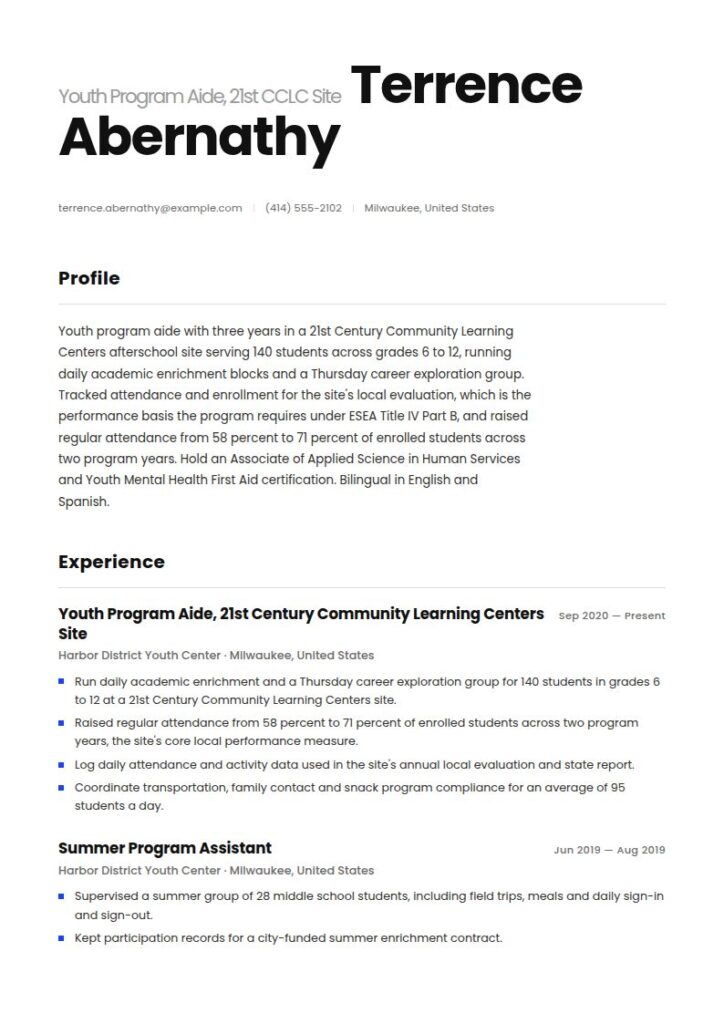
Youth program aide with three years in a 21st Century Community Learning Centers afterschool site serving 140 students across grades 6 to 12, running daily academic enrichment blocks and a Thursday career exploration group. Tracked attendance and enrollment for the site's local evaluation, which is the performance basis the program requires under ESEA Title IV Part B, and raised regular attendance from 58 percent to 71 percent of enrolled students across two program years. Hold an Associate of Applied Science in Human Services and Youth Mental Health First Aid certification. Bilingual in English and Spanish.
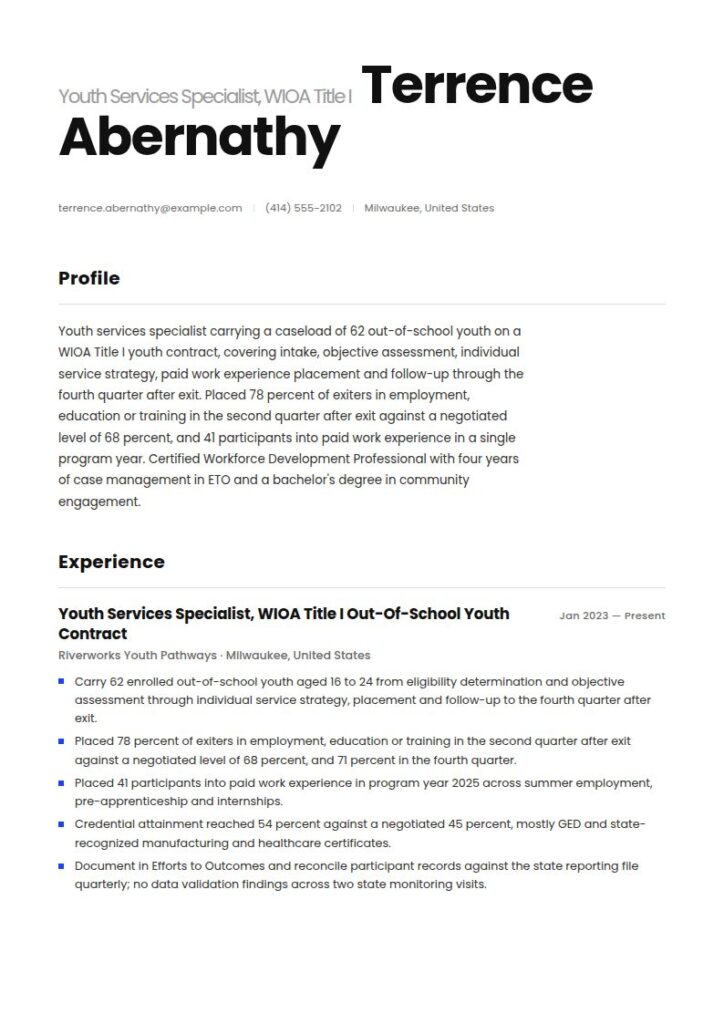
Youth services specialist carrying a caseload of 62 out-of-school youth on a WIOA Title I youth contract, covering intake, objective assessment, individual service strategy, paid work experience placement and follow-up through the fourth quarter after exit. Placed 78 percent of exiters in employment, education or training in the second quarter after exit against a negotiated level of 68 percent, and 41 participants into paid work experience in a single program year. Certified Workforce Development Professional with four years of case management in ETO and a bachelor's degree in community engagement.
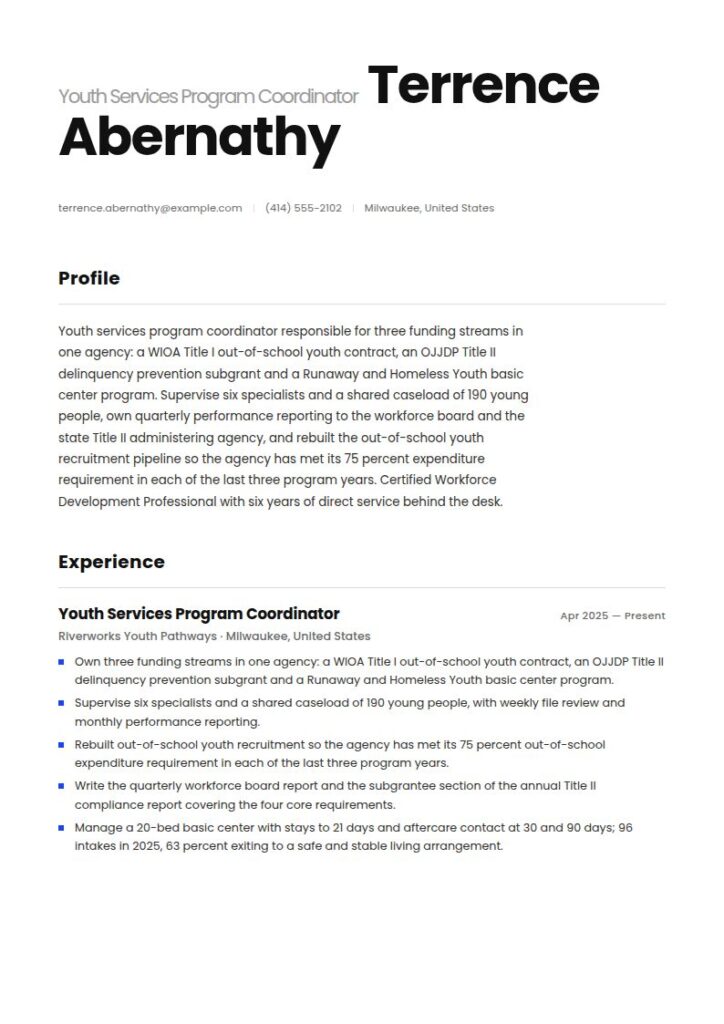
Youth services program coordinator responsible for three funding streams in one agency: a WIOA Title I out-of-school youth contract, an OJJDP Title II delinquency prevention subgrant and a Runaway and Homeless Youth basic center program. Supervise six specialists and a shared caseload of 190 young people, own quarterly performance reporting to the workforce board and the state Title II administering agency, and rebuilt the out-of-school youth recruitment pipeline so the agency has met its 75 percent expenditure requirement in each of the last three program years. Certified Workforce Development Professional with six years of direct service behind the desk.
Right vs wrong: the same youth services specialist summary, twice
| ✅ Right | ❌ Wrong |
|---|---|
| Youth services specialist carrying 62 out-of-school youth on a WIOA Title I youth contract. | Experienced youth worker committed to helping young people succeed. |
| Placed 78 percent of exiters in employment, education or training in the second quarter after exit against a negotiated level of 68 percent. | Achieved strong outcomes for program participants. |
| Placed 41 participants into paid work experience in a single program year. | Connected youth to a variety of opportunities and resources. |
On the other hand, the right column can be checked against a report the agency already files. Meanwhile, the left asks the reader to take your word for it, and a program manager facing a monitoring visit has no room for that.
Outline your experience
Next, put the organization, program, funding stream, city and dates on the header line. Then three to five bullets, each naming a measure, a volume or a compliance requirement.
| Instead of | Use |
|---|---|
| Worked with at-risk youth in a community program | Carried 62 enrolled out-of-school youth on a WIOA Title I youth contract, ages 16 to 24 |
| Helped young people find jobs | Placed 41 participants into paid work experience and 29 into unsubsidized employment in program year 2025 |
| Maintained accurate case files | Kept participant files audit-ready through two state monitoring visits, with eligibility documentation complete at enrollment |
| Coordinated services with partners | Built referral agreements with 9 partners covering GED instruction, driver license recovery, childcare and behavioral health |
| Tracked program outcomes | Reported five WIOA primary indicators quarterly, including measurable skill gains, credential attainment and median earnings after exit |
| Provided support to homeless youth | Managed intake and 21-day stays in a 20-bed Runaway and Homeless Youth basic center, with aftercare at 30 and 90 days |
Youth Services Specialist, WIOA Title I Out-of-School Youth Contract, Riverworks Youth Pathways, Milwaukee, WI, January 2023 to Present
Carry 62 enrolled out-of-school youth aged 16 to 24, from eligibility determination and objective assessment through individual service strategy, placement and follow-up to the fourth quarter after exit.
Placed 78 percent of exiters in employment, education or training in the second quarter after exit against a negotiated level of 68 percent, and 71 percent in the fourth quarter.
Placed 41 participants into paid work experience in program year 2025, across summer employment, pre-apprenticeship and internships, against the contract's work experience expenditure requirement.
Credential attainment reached 54 percent against a negotiated 45 percent, mostly GED and state-recognized manufacturing and healthcare certificates.
Document all activity in Efforts to Outcomes and reconcile participant records against the state reporting file quarterly; no data validation findings across two state monitoring visits.
Name the funding stream you served under, and its performance measures
Even so, this is the block that separates a youth services resume from every other one in the folder, and it is the one almost nobody writes.
After all, the work is defined by the grant that pays for it. Moreover, each stream carries its own eligibility rules, documentation burden and published measures of success. As a result, writing "provided case management to youth" throws all of that away.
WIOA Title I youth, program years 2023 to 2026. Caseload 62 out-of-school youth. Measures reported: education and employment rate in the second quarter after exit 78 percent, education and employment rate in the fourth quarter 71 percent, median earnings in the second quarter $6,140, credential attainment 54 percent, measurable skill gains 61 percent.
OJJDP Title II delinquency prevention subgrant, 2024 to 2026. Prevention groups for 48 youth referred before petition; wrote the subgrantee section of the annual compliance report covering the four core requirements.
Runaway and Homeless Youth Act basic center program, 2024 to 2026. 20 beds, stays to 21 days, aftercare contact at 30 and 90 days; 96 intakes in 2025 with 63 percent exiting to a safe and stable living arrangement.
21st Century Community Learning Centers, 2020 to 2022. Afterschool site serving 140 students in grades 6 to 12; regular attendance rose from 58 percent to 71 percent across two program years.
In fact, four streams cover most of the field, and each one is worth knowing by name.
WIOA Title I youth. The Department of Labor's Employment and Training Administration publishes the primary indicators of performance every youth contract reports on: the percentage of Title I youth participants in education or training activities or unsubsidized employment during the second quarter after exit, the same measure at the fourth quarter, median earnings in the second quarter after exit, credential attainment, measurable skill gains, and effectiveness in serving employers (U.S. Department of Labor, Employment and Training Administration, performance indicators page, retrieved 17 September 2026).
Two spending rules shape the job. Under 20 CFR 681.410, not less than 75 percent of youth funds must go to out-of-school youth, and under 20 CFR 681.590 local youth programs must spend not less than 20 percent of their allocation on paid and unpaid work experience (Electronic Code of Federal Regulations, retrieved 17 September 2026). Those two numbers are why a workforce board will ask about out-of-school recruitment and work experience placement.
OJJDP and runaway youth program grants
OJJDP Title II formula grants. Prevention money reaches states through the Title II formula program, and states must stay compliant with four core requirements of the Juvenile Justice and Delinquency Prevention Act: deinstitutionalization of status offenders, separation of juveniles from adult inmates, removal of juveniles from adult jails and lockups, and addressing racial and ethnic disparities, at 34 U.S.C. 11133(a)(11), (12), (13) and (15). A state that falls out of compliance loses 20 percent of its formula grant the following fiscal year (Office of Juvenile Justice and Delinquency Prevention, retrieved 17 September 2026). Saying you contributed to the annual compliance report is a specific, checkable claim.
Runaway and Homeless Youth Act programs. The Family and Youth Services Bureau funds two services that look alike from outside and are not. A basic center program provides up to 21 days of shelter for up to 20 youth aged under 18, with food, clothing, medical care, counseling, education and employment assistance, outreach and aftercare. A transitional living program serves youth aged 16 to under 22 for up to 540 days in group homes, family homes or scattered-site apartments (Administration for Children and Families, Family and Youth Services Bureau fact sheets, retrieved 17 September 2026). Name which one you worked in: the length of stay changes the whole job.
21st Century Community Learning Centers funding
21st Century Community Learning Centers. Under ESEA Title IV Part B, a community learning center provides academic enrichment and a broad array of other activities during nonschool hours, and local programs must be based on an assessment of objective data and carry an established set of performance measures aligned to the regular academic program (U.S. Department of Education, ESEA Title IV Part B statute, retrieved 17 September 2026). Attendance and academic alignment are the measures, so say what yours were.
Name the funding stream, the program years and your caseload on the job title line. Give your result next to the negotiated or target level, because a number without a benchmark is not evidence. Use the measure names the stream itself uses, such as measurable skill gains or credential attainment. Say which case management system you documented in. State plainly if you have written a quarterly performance report or been through a monitoring visit.
Do not write "at-risk youth" as though it were a program; it is a phrase, not a population. Do not describe a stream you only heard about in staff meetings. Do not give a percentage without the denominator, since 78 percent of nine exiters is a different claim from 78 percent of sixty. Do not name an individual young person, a family or any identifying case detail. Do not list the grant amount as though you managed the budget unless you did.
Build a snapshot of your key skills
Ten to fourteen entries, grouped so a reader sees the program side and the practice side at once.
Program and compliance: WIOA Title I youth eligibility and documentation, Exit-based performance reporting, OJJDP Title II core requirement compliance, RHY basic center intake and aftercare, Monitoring visit preparation
Direct practice: Objective assessment and individual service strategy, Motivational interviewing, Trauma-informed engagement, Group facilitation, Crisis de-escalation
Systems: Efforts to Outcomes, state workforce reporting, HMIS, Runaway and Homeless Youth Management Information System, Excel caseload tracking
Languages: English, Spanish
List your education and certifications
Degree, then certifications with the issuing body and year, then contract-required training. This is one of the few fields where short trainings earn their space, because grant contracts require them by name.
Bachelor of Science, Community Engagement and Education, University of Wisconsin-Milwaukee, Milwaukee, WI, 2024
Associate of Applied Science, Human Services, Milwaukee Area Technical College, Milwaukee, WI, 2020
Certified Workforce Development Professional (CWDP), National Association of Workforce Development Professionals, 2024
Youth Mental Health First Aid, National Council for Mental Wellbeing, 2023, renewed 2026
Adult and Pediatric First Aid, CPR and AED, American Red Cross, valid through 2028
Motivational interviewing, 16-hour foundational training, 2022
In general, for social and human service assistants, the occupation this job usually sits in, the typical entry-level education is a high school diploma or equivalent with short-term on-the-job training (BLS Occupational Outlook Handbook, May 2025, retrieved 17 September 2026). Even so, employers routinely ask for more, and specialist titles on federal contracts are often written at bachelor's level, so list the degree you have and do not apologize for the one you do not.
Choose the right layout and design
In short, single column, 11 or 12 point body type, clear headings, no photograph, no graphics. Public agency portals and nonprofit applicant systems parse the file into a structured record before a person reads it, and multi-column templates are where that parsing fails.
Keep the funding block as plain text lines rather than a table. Tables sometimes survive a parser and sometimes arrive as one run-on line, and this is the block you least want scrambled. Name the file for yourself and the post: terrence-abernathy-youth-services-specialist-resume.pdf.
Youth services specialist job market and outlook
Youth services specialists are usually counted by the Bureau of Labor Statistics within social and human service assistants, a large occupation growing faster than average with heavy annual turnover.
| Measure | Value |
|---|---|
| Social and human service assistant jobs, 2025 | 463,400 |
| Projected change, 2025-35 | 7 percent |
| Projected annual openings | about 48,900 |
| Typical entry-level education | High school diploma or equivalent |
| Median annual wage, May 2025 | $45,930 |
| Median hourly wage, May 2025 | $22.08 |
Source: U.S. Bureau of Labor Statistics, Occupational Outlook Handbook, May 2025 wage data as well as 2025 to 2035 projections, retrieved 17 September 2026.
Most of these jobs are one step from a grant award letter
Individual and family services employs 28 percent of social and human service assistants, local government excluding education and hospitals 11 percent, community food and housing and emergency and other relief services 10 percent, religious, grantmaking, civic and similar organizations 10 percent, and nursing and residential care facilities 10 percent (BLS Occupational Outlook Handbook, 2025 employment data, retrieved 17 September 2026).
Read that as a funding map rather than an employer list. Four of the five are dominated by organizations that draw down against government contracts and philanthropic grants, which is why hiring here moves in bursts when awards land. It is also why the funding block travels well: a specialist who has already reported WIOA primary indicators can be moved onto a new contract without a training period.
Where the pay sits:
| Setting | Median annual wage (May 2025) |
|---|---|
| Local government, excluding education and hospitals | $49,990 |
| Religious, grantmaking, civic, professional and similar organizations | $46,580 |
| Individual and family services | $45,500 |
| Community food and housing, and emergency and other relief services | $43,510 |
| Nursing and residential care facilities | $42,790 |
Source: U.S. Bureau of Labor Statistics, Occupational Outlook Handbook, May 2025, retrieved 17 September 2026.
What salary you can expect as a youth services specialist
To begin with, the median annual wage for social and human service assistants was $45,930, or $22.08 an hour, as of May 2025 (BLS Occupational Outlook Handbook, retrieved 17 September 2026). By setting, local government pays the highest median of the five largest settings at $49,990, while nursing and residential care facilities pay the lowest at $42,790, a spread of about $7,200.
In addition, two things move an offer inside that band. The first is the funding stream: a role written against a federal workforce contract at specialist level is usually graded higher than the same duties on a general youth development line, because the contract carries reporting and audit exposure the employer has to staff for. The second is whether you hold the credential the contract names, most often the Certified Workforce Development Professional credential from the National Association of Workforce Development Professionals.
Supervisory roles frequently move into a different Bureau of Labor Statistics occupation, social and community service managers, so look at that profile if you are costing a career step rather than a job change.
Key takeaways for a youth services specialist resume
- First, name the funding stream behind every role, with its program years, on the job title line.
- Give your caseload as a number, and say whether it was enrolled, active or served.
- Then report the stream's own measures, using its own names for them.
- Put a benchmark next to every result so the number means something.
- Next, name the case management system you documented in.
- Also, mention monitoring visits, compliance reports and audits you have been through.
- Finally, keep every young person and family anonymous; describe the work, never the case.
Build your youth services specialist resume in 15 minutes with our AI resume builder.
Related social work resume examples
- Juvenile counselor resume
- Case manager resume
- Community outreach coordinator resume
- Social worker resume
- Counselor resume
- Social work resume
- Child care resume
- Caregiver resume
- Babysitter resume
- Nanny resume
- Drug and alcohol counselor resume
- Healthcare social worker resume
Pair it with a matching youth services specialist cover letter.
Youth services specialist resume questions, answered
How long should a youth services specialist resume be?
One page for your first four or five years. Two once you have worked under more than one funding stream, because the funding block and the certification list need the room. Three is too many in a field where the hiring manager is a program director reading between site visits.
What if I do not know which funding stream paid for my role?
Find out before you apply anywhere else. Ask a former supervisor, read the organization's most recent Form 990, or check your state workforce board's subrecipient list. It is public in almost every case, and knowing it is the difference between a resume that reads as youth services and one that reads as general nonprofit work.
How do I show outcomes if my program had no formal measures?
Use what the program did count: enrollment, attendance, completion, referrals made and referrals that connected, repeat contact, and any follow-up interval you recorded. Give the before, the after and the period. A program that tracked nothing still tracked attendance, and two years of it with a start and an end figure is evidence.
Should I list short trainings like motivational interviewing?
Yes, when a contract names them. Trauma-informed care, motivational interviewing, youth mental health first aid, crisis de-escalation and mandated reporter training all earn their space. Give the hours if the training was substantial, and always the year.
Can I name the young people or families I worked with?
No, never, in any form. Not initials, not an age paired with a circumstance, not a story that could identify one family in a small county. Describe the work, the group and the outcome. A resume that leaks a case detail tells a hiring manager one thing, and it is not what you meant to say.