Mental Health Counselor Associate, Washington Seo-yeon Baek-Marlowe
Mental Health Counselor Associate
[email protected] | (253) 555-1948 | Tacoma, United States
Profile
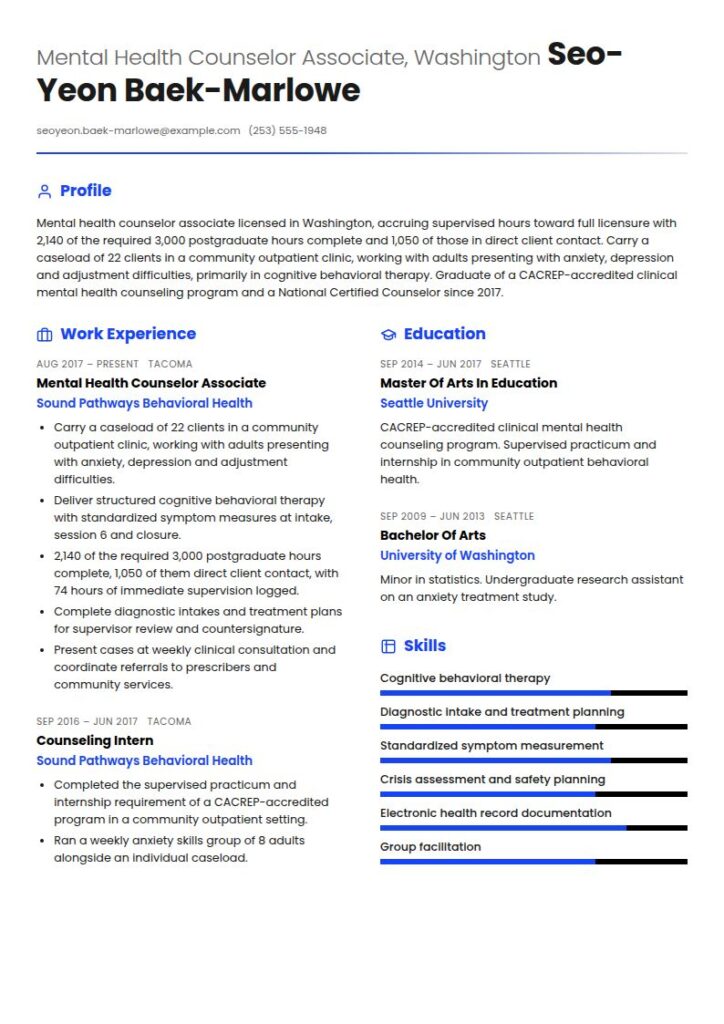
Mental health counselor associate licensed in Washington, accruing supervised hours toward full licensure with 2,140 of the required 3,000 postgraduate hours complete and 1,050 of those in direct client contact. Carry a caseload of 22 clients in a community outpatient clinic, working with adults presenting with anxiety, depression and adjustment difficulties, primarily in cognitive behavioral therapy. Graduate of a CACREP-accredited clinical mental health counseling program and a National Certified Counselor since 2017.
Work Experience
08/2017 - Present, Mental Health Counselor Associate, Sound Pathways Behavioral Health, Tacoma, United States
- Carry a caseload of 22 clients in a community outpatient clinic, working with adults presenting with anxiety, depression and adjustment difficulties.
- Deliver structured cognitive behavioral therapy with standardized symptom measures at intake, session 6 and closure.
- 2,140 of the required 3,000 postgraduate hours complete, 1,050 of them direct client contact, with 74 hours of immediate supervision logged.
- Complete diagnostic intakes and treatment plans for supervisor review and countersignature.
- Present cases at weekly clinical consultation and coordinate referrals to prescribers and community services.
09/2016 - 06/2017, Counseling Intern, Sound Pathways Behavioral Health, Tacoma, United States
- Completed the supervised practicum and internship requirement of a CACREP-accredited program in a community outpatient setting.
- Ran a weekly anxiety skills group of 8 adults alongside an individual caseload.
Education
09/2014 - 06/2017, Master of Arts in Education, Clinical Mental Health Counseling, Seattle University, Seattle, United States
CACREP-accredited clinical mental health counseling program. Supervised practicum and internship in community outpatient behavioral health.
09/2009 - 06/2013, Bachelor of Arts, Psychology, University of Washington, Seattle, United States
Minor in statistics. Undergraduate research assistant on an anxiety treatment study.
Skills
Cognitive behavioral therapy, 75
Diagnostic intake and treatment planning, 70
Standardized symptom measurement, 75
Crisis assessment and safety planning, 70
Electronic health record documentation, 80
Group facilitation, 70
Languages
English, native
Korean, native
Certificates
08/2017, Mental Health Counselor Associate, Washington, Washington State Department of Health, MC 60293114
Associate credential held while accruing the postgraduate hours required for full licensure under WAC 246-809-230.
09/2017, National Certified Counselor, National Board for Certified Counselors
Passed the National Clinical Mental Health Counseling Examination.
Summary
A counselor resume is a one to two page document that resolves an ambiguous job title into a specific license: the credential, the state that issued it, whether you practice independently or under supervision, and the populations and modalities you are competent to treat. This guide gives you three adaptable versions and current Bureau of Labor Statistics pay and outlook.
Counselor resume examples by experience level
"Counselor" is the most ambiguous job title in behavioral health, and a counselor resume has one job before any other: to end the ambiguity in the first four seconds.
A reader seeing that word alone cannot tell whether you are a fully licensed clinician who can diagnose and bill independently, a graduate accruing supervised hours, a school counselor, a credentialed substance use counselor, or someone in a role needing no license at all. Those are different hires, different scopes and different pay bands. Until the file says which one you are, it cannot move forward.
So the page's whole design is a resolution: put the license, the state and the tier where they cannot be missed, then build everything else behind them.
Resume guide for a counselor resume
This guide and the corresponding counselor resume example will cover:
- How to write a counselor resume, section by section
- The license block that resolves the title, and exactly what goes in it
- Three adaptable summaries: associate, fully licensed, and supervisor
- What the Counseling Compact changes about where you can practice
- What the job market looks like and what you can expect to earn
How to write a counselor resume
Six sections: contact header, license block, summary, clinical experience, education, and skills. One page while you are accruing hours, two once you carry a full caseload and supervise.
The license block sits above everything because it is the gate. An employer hiring for a post that bills insurance needs to know today whether your signature stands on its own or needs a supervisor's countersignature. That single fact changes the job description, the caseload and the salary offer.
| Section | What it is answering | Where it goes |
|---|---|---|
| License block | Which credential, which state, independent or supervised? | Header or immediately below it |
| Populations and modalities | Who can this person treat, and how? | Inside the summary and the skills block |
| Clinical experience | Caseload, setting, and what changed for clients | Reverse chronological, with numbers |
| Education | Degree, and whether the program was CACREP-accredited | After experience |
Write the license the way a credentialing department writes it
Employers, payers and credentialing departments all read the same four elements: the credential abbreviation, the issuing state, the credential number, and the expiry date. Give all four on one line.
"LMHC, Washington, credential LH 60418827, expires August 2027" can be verified against the state board in under a minute. "Licensed counselor" cannot be verified at all, and a credentialing specialist who cannot verify you asks the recruiter to move on.
If you are still accruing supervised hours, write that too, with the count and the target. Hiding it wastes everyone's time, because the first interview question will be about it.
Run the finished file through the ATS resume checker before you submit. Health systems and group practices parse applications into a credentialing record before a clinical manager reads them.
Choosing the best resume format for a counselor resume
Reverse chronological. Clinical hiring is built on continuity: which setting, which population, how long, and under whose supervision. A format that hides the timeline also hides the supervision chain, which is what a credentialing department is reconstructing.
One page while you are pre-licensed or in your first independent year, two once you carry a full caseload, supervise, or hold more than one credential. Keep dates to the month, because supervised hours are counted in months.
Include your contact information
| ✅ Right | ❌ Wrong |
|---|---|
| Seo-yeon Baek-Marlowe, MAEd, LMHC, NCC | Seo-yeon Baek-Marlowe |
| Licensed Mental Health Counselor, Washington, LH 60418827 | Licensed therapist and counselor |
| Approved clinical supervisor, telehealth and in-person | Passionate about mental wellness |
| (253) 555-1948, [email protected], Tacoma, WA | (253) 555-1948, [email protected] |
Put the credential letters after your name and the issuing state on the next line. In a title this broad, those two lines are the difference between a file that gets read and one set aside as unclear.
Make use of a summary
Four lines: license and state, caseload and setting, populations and modalities, and one outcome with a number attached.
Mental health counselor associate licensed in Washington, accruing supervised hours toward full licensure with 2,140 of the required 3,000 postgraduate hours complete and 1,050 of those in direct client contact. Carry a caseload of 22 clients in a community outpatient clinic, working with adults presenting with anxiety, depression and adjustment difficulties, primarily in cognitive behavioral therapy. Graduate of a CACREP-accredited clinical mental health counseling program and a National Certified Counselor since 2017.
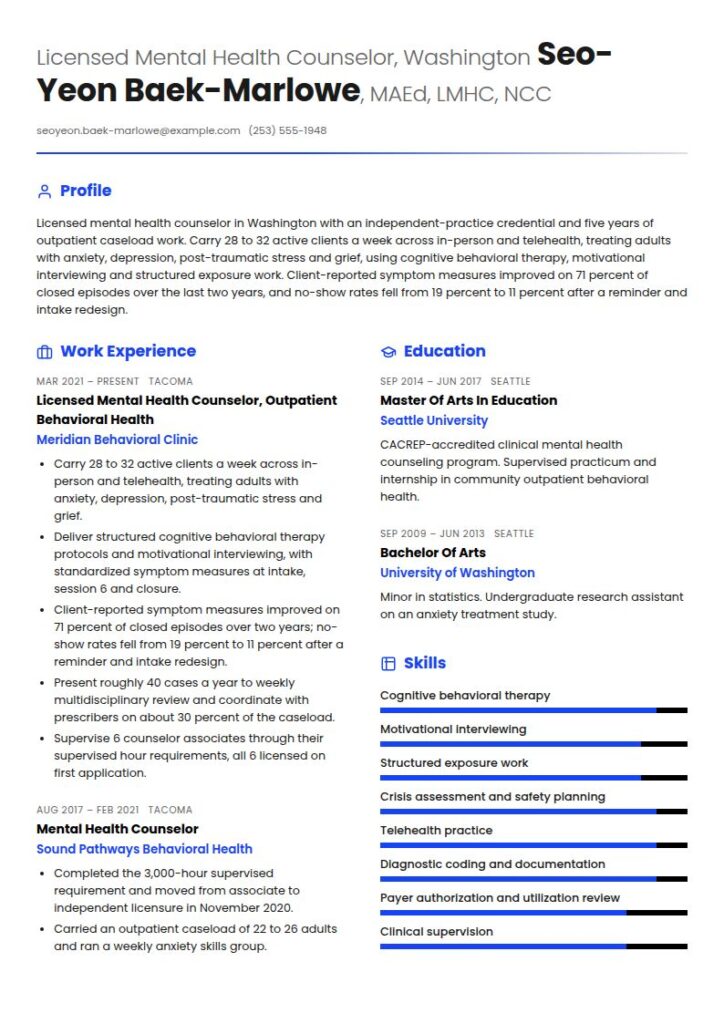
Licensed mental health counselor in Washington with an independent-practice credential and five years of outpatient caseload work. Carry 28 to 32 active clients a week across in-person and telehealth, treating adults with anxiety, depression, post-traumatic stress and grief, using cognitive behavioral therapy, motivational interviewing and structured exposure work. Client-reported symptom measures improved on 71 percent of closed episodes over the last two years, and no-show rates fell from 19 percent to 11 percent after a reminder and intake redesign.
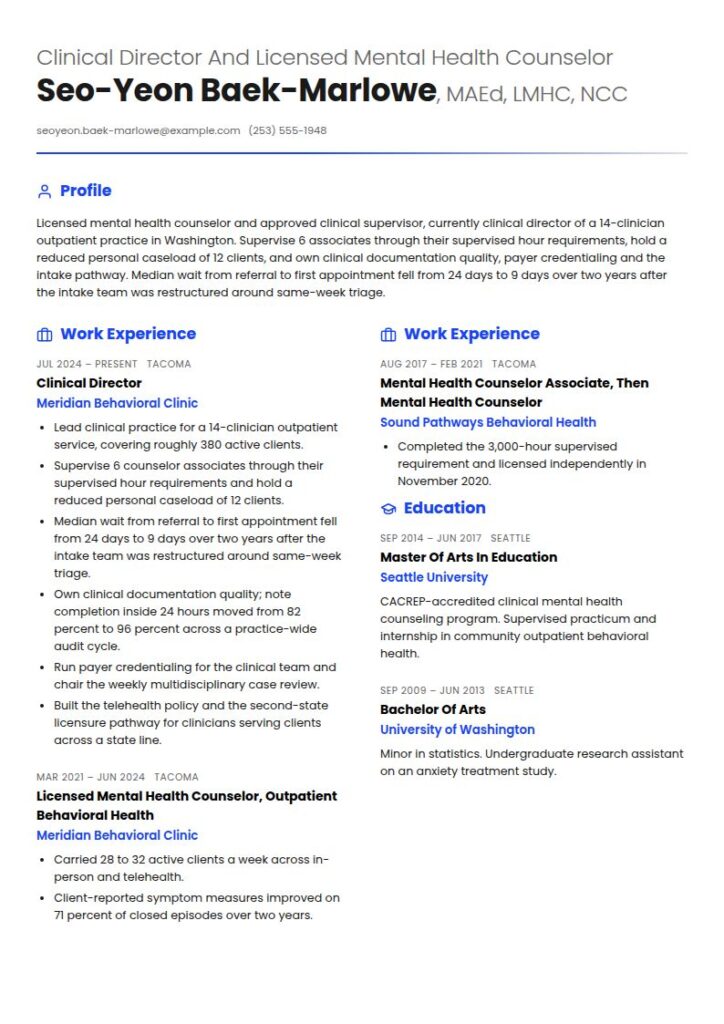
Licensed mental health counselor and approved clinical supervisor, currently clinical director of a 14-clinician outpatient practice in Washington. Supervise 6 associates through their supervised hour requirements, hold a reduced personal caseload of 12 clients, and own clinical documentation quality, payer credentialing and the intake pathway. Median wait from referral to first appointment fell from 24 days to 9 days over two years after the intake team was restructured around same-week triage.
Right vs wrong: the same counselor summary, twice
| ✅ Right | ❌ Wrong |
|---|---|
| Licensed mental health counselor in Washington with an independent-practice credential. | Experienced counselor with a passion for helping people heal. |
| Carry 28 to 32 active clients a week across in-person and telehealth. | Provide counseling services to a diverse range of clients. |
| Client-reported symptom measures improved on 71 percent of closed episodes over two years. | Committed to positive client outcomes and personal growth. |
The right column can be credentialed, scheduled and paid. The left column cannot, and the reader is doing all three.
Outline your experience
Employer, setting, city, and dates to the month. Then three to five bullets naming the caseload, the population, the modality and the measure.
| Instead of | Use |
|---|---|
| Provided counseling to clients | Carried 28 to 32 active outpatient clients a week, adults presenting with anxiety, depression and PTSD |
| Used evidence-based practices | Delivered structured cognitive behavioral therapy protocols and motivational interviewing, with symptom measures at intake, session 6 and closure |
| Maintained client records | Completed documentation inside 24 hours of session on 98 percent of notes across a two-year audit |
| Worked with a treatment team | Presented 40 cases a year to a weekly multidisciplinary review and coordinated with prescribers on 30 percent of the caseload |
| Supervised staff | Supervised 6 associates through their 3,000-hour requirements, all 6 licensed on first application |
| Helped improve access | Median wait from referral to first appointment fell from 24 days to 9 days over two years |
Licensed Mental Health Counselor, Outpatient Behavioral Health, Tacoma, WA, March 2021 to Present
Carry 28 to 32 active clients a week across in-person and telehealth, treating adults with anxiety, depression, post-traumatic stress and grief.
Deliver structured cognitive behavioral therapy protocols and motivational interviewing, with standardized symptom measures taken at intake, session 6 and closure.
Client-reported symptom measures improved on 71 percent of closed episodes over two years; no-show rates fell from 19 percent to 11 percent after a reminder and intake redesign.
Present roughly 40 cases a year to weekly multidisciplinary review and coordinate with prescribers on about 30 percent of the caseload.
Supervise 6 counselor associates through their supervised hour requirements, all 6 licensed on first application.
Say exactly which counselor you are, in one block
This is the section the whole page exists for. Write it as a labeled block near the top, not as a sentence buried in a paragraph.
The license alphabet changes at the state line
There is no national counselor license. Each state board issues its own title, and the letters differ even when the scope is close. Washington issues the licensed mental health counselor (LMHC) with a licensed mental health counselor associate tier beneath it. Ohio issues both the licensed professional counselor and the licensed professional clinical counselor, and the difference is not cosmetic: under Ohio law an LPCC may independently diagnose and treat mental and emotional disorders, while an LPC may do so only under the supervision of a psychologist, psychiatrist, licensed professional clinical counselor, independent marriage and family therapist or independent social worker (Ohio Revised Code 4757.21, effective 10 July 2014).
So write the state, always. "LPC" on its own tells a reader in another state almost nothing. "LPC, Ohio" tells them you practice under supervision. "LPCC, Ohio" tells them you do not.
| What to write | Why it matters |
|---|---|
| Credential letters and issuing state | The title alone does not resolve scope across state lines |
| Credential number and expiry | Lets credentialing verify you against the board in minutes |
| Independent or supervised | Decides whether your notes need a countersignature and whether you can bill |
| Supervised hours accrued against the requirement | The single most asked interview question for a pre-licensed applicant |
| Any second state license | Doubles the roles you are eligible for, especially in telehealth |
If you are still accruing hours, put the count on the page
Pre-licensed counselors lose interviews by being vague, not by being pre-licensed.
Washington publishes its requirement in rule: a minimum of 36 months of full-time counseling or 3,000 hours of postgraduate mental health counseling, of which at least 1,200 hours must be direct counseling with individuals, couples, families or groups, plus 100 hours spent in immediate supervision with a qualified licensed mental health counselor (WAC 246-809-230, amended effective 12 June 2025). Other states set their own totals, so quote your own board's numbers.
Then write your position against them: "2,140 of 3,000 postgraduate hours complete, 1,050 direct client contact hours, 74 supervision hours, anticipated full licensure March 2027." A hiring manager can staff around that. "Working toward licensure" tells them nothing they can plan with.
National certification and the program you graduated from
State licensure is the legal gate. National certification and program accreditation are the quality signals layered on top, and they travel across state lines when your license does not.
The National Certified Counselor credential from the National Board for Certified Counselors requires a master's or higher in counseling, graduate coursework of at least 48 semester hours across nine content areas, 3,000 hours of postgraduate counseling work over a minimum of 24 months, 100 hours of postgraduate supervision, and a passing score on the National Counselor Examination or the National Clinical Mental Health Counseling Examination (NBCC, 2026). NBCC states there are over 71,000 National Certified Counselors in more than 40 countries (NBCC, 2026).
Accreditation is worth naming because some employers and some state boards shorten the licensure path for its graduates. CACREP accredits over 969 master's and doctoral programs in counseling at 483 colleges and universities (CACREP, 2026). If your program was accredited, write "CACREP-accredited" beside the degree. If it was not, leave the phrase off rather than implying it.
The Counseling Compact, and where your license actually reaches
If you work in telehealth, this is now a hiring criterion.
The Counseling Compact lets a counselor licensed in one member state obtain a privilege to practice in another. As of September 2026, nine states are issuing the privilege: Arkansas, Arizona, Georgia, Indiana, Louisiana, Minnesota, Ohio, Tennessee and Wyoming, with Wyoming going live on 31 August 2026 and Tennessee on 1 September 2026, and Pennsylvania due to become a member state later in 2026 (Counseling Compact, counselingcompact.gov, September 2026).
Two conditions decide whether it applies to you. You must hold an independent-practice license in, and reside in, a member state. And counselors still completing supervised hours are not eligible for a privilege regardless of what their license title says, which the compact states plainly (Counseling Compact, September 2026).
The honest line on a resume is therefore narrow. If you hold an independent license in a member state, write "eligible for Counseling Compact privilege to practice" and name the states you hold privileges in. If your state is not yet issuing, say where you are licensed and add any second-state license. Washington was not an issuing member state as of September 2026, so a Tacoma counselor practicing across a state line is doing it on a second license, not a privilege. Write it that way.
Populations and modalities, stated as competence
Finish the block with what you actually treat. Name the age bands, the presenting concerns and the modalities, and keep the claims inside your training.
"Adults and older adolescents; anxiety, depression, post-traumatic stress, grief and adjustment; cognitive behavioral therapy, motivational interviewing and structured exposure work; in-person and telehealth" is precise. "All populations, all issues" is a claim no supervisor believes.
License: Licensed Mental Health Counselor, Washington State Department of Health, credential LH 60418827, expires August 2027. Independent practice, no supervision requirement.
Previously: Mental Health Counselor Associate, Washington, MC 60293114, 2017 to 2020. Completed 3,000 postgraduate hours including 1,340 direct client contact hours and 112 hours of immediate supervision.
National certification: National Certified Counselor, NBCC, since 2017. Passed the National Clinical Mental Health Counseling Examination.
Supervision: Approved clinical supervisor since 2023, 15 clock hours of clinical supervision training completed.
Practice: Adults and older adolescents. Anxiety, depression, post-traumatic stress, grief, adjustment. Cognitive behavioral therapy, motivational interviewing, structured exposure. In-person and telehealth.
Build a snapshot of your key skills
Ten to fourteen entries in three groups: clinical, populations, and documentation and systems.
Clinical: Cognitive behavioral therapy, Motivational interviewing, Structured exposure work, Crisis assessment and safety planning, Standardized symptom measurement, Treatment planning and episode closure
Populations: Adults, Older adolescents, Anxiety and mood disorders, Post-traumatic stress, Grief and bereavement, Co-occurring substance use
Documentation and systems: Electronic health record documentation, Diagnostic coding, Payer authorization and utilization review, Telehealth platforms, Clinical supervision documentation, Mandatory reporting
List your education and certifications
Degree first, with the accreditation if it applies, then licensure with numbers and dates, then national certification, then continuing education that is relevant to the post.
Master of Arts in Education, Clinical Mental Health Counseling, CACREP-accredited program, Seattle University, Seattle, WA, 2017
Bachelor of Arts, Psychology, University of Washington, Seattle, WA, 2013
Licensure and certification: Licensed Mental Health Counselor, Washington, LH 60418827 (2020, expires 2027). National Certified Counselor, NBCC (2017). Approved clinical supervisor, 15 clock hours clinical supervision training (2023). Mental Health First Aid instructor (2024).
Choose the right layout and design
Single column, plain type at 11 or 12 point, clear headings, no photograph. Health systems and group practices parse the file into a credentialing record before a clinical manager reads it, and two-column templates, text boxes and graphics are where that parsing breaks.
Spell out the credential in full once beside the abbreviation, because a keyword filter may be set for either. "Licensed Mental Health Counselor (LMHC)" matches both, and reads correctly to an out-of-state recruiter who does not know the local letters.
Put the credential letters, the state, the number and the expiry on one line. Say whether you practice independently or under supervision. If you are pre-licensed, give the hours accrued against the requirement and your expected licensure date. Name the populations and modalities you are trained in, and stop there. Add the Counseling Compact line only if you hold an independent license in a member state.
Do not write "licensed counselor" without the state; it resolves nothing. Do not use "therapist," "counselor" and "clinician" interchangeably across the same file. Do not imply a compact privilege while you are still accruing hours, because the compact excludes supervisees explicitly. Do not describe an identifiable client or case. Do not list an expired credential without marking it expired.
Counselor job market and outlook
One of the fastest growing occupations in the economy, driven by demand for treatment rather than by any change in the work itself.
| Measure | Value |
|---|---|
| Substance abuse, behavioral disorder and mental health counselor jobs, 2025 | 533,400 |
| Projected change, 2025-35 | 18 percent, +98,000 |
| Projected annual openings | about 50,500 |
| Typical entry-level education | Master's degree |
| Median annual wage, May 2025 | $59,350 |
Source: U.S. Bureau of Labor Statistics, Occupational Outlook Handbook, Substance Abuse, Behavioral Disorder, and Mental Health Counselors, May 2025 wage data and 2025-35 projections.
Growth is in demand, not in supply of licenses
Employment in this occupation is projected to grow 18 percent between 2025 and 2035, much faster than the average across all occupations, with about 50,500 openings a year (BLS Occupational Outlook Handbook, 2025-35 projections).
The treatment gap behind that is measurable. Among adults with any mental illness in 2024, 52.1 percent received mental health treatment in the past year, meaning nearly half did not (SAMHSA, 2024 National Survey on Drug Use and Health, published September 2025).
Together those two figures explain why the license block decides the screen. The demand is real and employers are hiring, but they are hiring for a specific scope: someone who can diagnose, document and bill within the rules of a particular state. Growth does not loosen that requirement, it sharpens it.
Where the jobs sit:
| Setting | Share of employment | Median annual wage (May 2025) |
|---|---|---|
| Offices of other health practitioners | 20% | $58,240 |
| Outpatient mental health and substance abuse centers | 16% | $58,750 |
| Individual and family services | 15% | $58,440 |
| Residential mental health and substance abuse facilities | 8% | $49,660 |
| Hospitals (state, local, private) | 7% | $63,310 |
Source: U.S. Bureau of Labor Statistics, Occupational Outlook Handbook, May 2025.
What salary you can expect as a counselor
The median annual wage was $59,350 as of May 2025, or $28.53 an hour, with the lowest 10 percent under $38,940 and the highest 10 percent above $97,590 (BLS, May 2025).
The spread inside that range is mostly license tier and setting. Hospitals pay a median of $63,310 while residential mental health and substance abuse facilities pay $49,660, a gap of roughly $13,650 for work that reads similarly on a job description (BLS, May 2025). The larger step is the move from an associate credential to an independent one, because an independently licensed counselor can be credentialed with payers and billed at a higher rate.
That is why the license block is also a salary document. An applicant who writes "2,140 of 3,000 hours complete, anticipated licensure March 2027" is telling an employer when the billing rate changes, and some will hire ahead of that date at a rate that reflects it. An applicant who writes "working toward licensure" has given them nothing to price.
Key takeaways for a counselor resume
- Resolve the title in the first four seconds: credential, state, number, expiry.
- Say independent or supervised, in those words.
- If you are accruing hours, give the count against the requirement and the expected date.
- Write "CACREP-accredited" beside the degree only if it is true.
- Add the Counseling Compact line only with an independent license in a member state.
- Name populations and modalities precisely, and claim nothing outside your training.
- Put a caseload number and one measured outcome in every clinical role.
Build your counselor resume in 15 minutes with our AI resume builder.
Related social work resume examples
- Social worker resume
- Drug and alcohol counselor resume
- Healthcare social worker resume
- Geriatric social worker resume
- Case manager resume
- Juvenile counselor resume
- Youth services specialist resume
- Community outreach coordinator resume
- Social work resume
- Life coach resume
- Caregiver resume
- Child care resume
Pair it with a matching counselor cover letter.
Counselor resume questions, answered
What should a counselor resume say if my job title was just "counselor"?
Keep the employer's title, then add the license in brackets or on the line beneath: "Counselor (Licensed Mental Health Counselor, Washington, LH 60418827)". The employer's title is what a background check confirms, and the license is what the reader needs. Never change a past job title to something you were not called.
Should I apply for jobs in another state before I hold that state's license?
Yes, but write the position honestly. Say which license you hold, whether the target state is a Counseling Compact member, and what your plan is: a privilege to practice if you hold an independent license in a member state and reside there, or licensure by endorsement if not. Counselors still completing supervised hours are not eligible for a compact privilege regardless of license title (Counseling Compact, September 2026).
How do I write about client outcomes without breaching confidentiality?
Aggregate everything. Caseload size, symptom measure improvement across closed episodes, no-show and attendance rates, wait times, episode length, treatment plan review compliance. Never describe an individual client, presenting problem or session content, even anonymized. A clinical manager reads a specific case as a confidentiality risk.
Does a CACREP-accredited program matter on the resume?
It is worth one phrase beside the degree if it applies. CACREP accredits over 969 master's and doctoral counseling programs at 483 institutions (CACREP, 2026), and some employers and state boards treat graduates of accredited programs differently in licensure review. Write the phrase only if your program held the accreditation.
What belongs on the resume of a counselor who is not clinically licensed at all?
Be exact about what you do hold. A state substance use disorder credential, a certified peer counselor credential, a school counselor certificate or a bachelor's-level human services role are all real qualifications with their own scope. Name the credential and the issuing body, describe the work in its own terms, and do not use "therapy" or "diagnosis" for work that is neither. Clarity reads as professionalism; blurring reads as a scope problem.