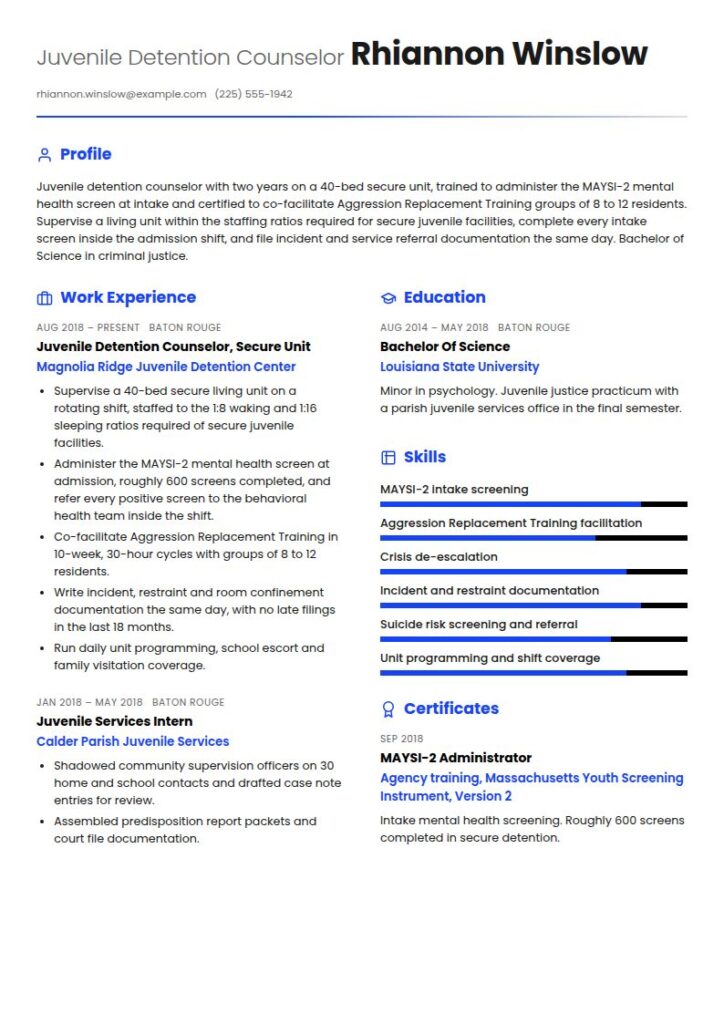
Juvenile Detention Counselor Rhiannon Winslow
Juvenile Detention Counselor, Secure Unit
[email protected] | (225) 555-1942 | Baton Rouge, United States
Profile
Juvenile detention counselor with two years on a 40-bed secure unit, trained to administer the MAYSI-2 mental health screen at intake and certified to co-facilitate Aggression Replacement Training groups of 8 to 12 residents. Supervise a living unit within the staffing ratios required for secure juvenile facilities, complete every intake screen inside the admission shift, and file incident and service referral documentation the same day. Bachelor of Science in criminal justice.
Work Experience
08/2018 - Present, Juvenile Detention Counselor, Secure Unit, Magnolia Ridge Juvenile Detention Center, Baton Rouge, United States
- Supervise a 40-bed secure living unit on a rotating shift, staffed to the 1:8 waking and 1:16 sleeping ratios required of secure juvenile facilities.
- Administer the MAYSI-2 mental health screen at admission, roughly 600 screens completed, and refer every positive screen to the behavioral health team inside the shift.
- Co-facilitate Aggression Replacement Training in 10-week, 30-hour cycles with groups of 8 to 12 residents.
- Write incident, restraint and room confinement documentation the same day, with no late filings in the last 18 months.
- Run daily unit programming, school escort and family visitation coverage.
01/2018 - 05/2018, Juvenile Services Intern, Calder Parish Juvenile Services, Baton Rouge, United States
- Shadowed community supervision officers on 30 home and school contacts and drafted case note entries for review.
- Assembled predisposition report packets and court file documentation.
Education
08/2014 - 05/2018, Bachelor of Science, Criminal Justice, Louisiana State University, Baton Rouge, United States
Minor in psychology. Juvenile justice practicum with a parish juvenile services office in the final semester.
Skills
MAYSI-2 intake screening, 85
Aggression Replacement Training facilitation, 70
Crisis de-escalation, 80
Incident and restraint documentation, 85
Suicide risk screening and referral, 75
Unit programming and shift coverage, 80
Languages
English, native
French, intermediate
Certificates
09/2018, MAYSI-2 Administrator, Agency training, Massachusetts Youth Screening Instrument, Version 2
Intake mental health screening. Roughly 600 screens completed in secure detention.
04/2019, Aggression Replacement Training Certified Facilitator, Agency-sponsored ART facilitator training
Ten-week, 30-hour cycles with groups of 8 to 12 residents.
06/2019, CPR and First Aid, American Red Cross
Summary
A juvenile counselor resume is a one to two page document naming the validated risk and needs instruments you are trained to administer, the evidence-based program models you can deliver, and whether you have worked in secure detention or community supervision. This guide gives you three adaptable versions and current Bureau of Labor Statistics pay and outlook.
Juvenile Counselor resume examples by experience level
A juvenile counselor resume is a one to two page document that names the validated instruments you are trained to administer, the program models you can deliver, and whether the young people you worked with were locked in or living at home.
Those three facts decide the screen. A juvenile agency is filling a post that has to produce an assessment the court will read, a case plan built from that assessment, and a group curriculum delivered with fidelity. A resume naming the instrument, the model and the setting can be matched to that post in ten seconds. One that says "worked with at-risk youth" cannot.
One thing to know before you start. The Bureau of Labor Statistics publishes no separate Occupational Outlook Handbook profile under the title "juvenile counselor." The work is counted in Probation Officers and Correctional Treatment Specialists, and that is the occupation whose pay and outlook figures appear later on this page.
Resume guide for a juvenile counselor resume
This guide and the corresponding juvenile counselor resume example will cover:
- How to write a juvenile counselor resume, section by section
- Which assessment instruments belong on the page, and how to write them
- Three adaptable summaries: detention counselor, community caseload, supervisor
- How secure and community settings change what a hiring manager wants
- What the job market looks like and what you can expect to earn
How to write a juvenile counselor resume
Six sections: contact header, summary, instruments and program certifications, experience, education, and skills.
The instrument block sits high because it is a gate, not an achievement. An agency that runs a validated risk instrument at disposition needs a counselor who can administer it on day one or be trained to within a quarter. A file that leaves the question open goes to the bottom of the pile.
| Section | What it is answering | Where it goes |
|---|---|---|
| Instruments and certifications | Can this person produce the assessment my court expects? | Under the summary |
| Setting | Secure detention, residential, or community supervision? | In every job title line |
| Experience | What changed for the youth on their caseload? | Reverse chronological, with numbers |
| Education | Is the degree the post requires met? | After experience, unless you are new |
Name the instrument, the version and who trained you
An instrument line is only worth writing if it carries three things: the tool, the level of training, and the body that certified you. "Familiar with risk assessments" is worth nothing. "Certified administrator, Structured Assessment of Violence Risk in Youth (SAVRY), agency certification 2021, 140 assessments completed" is a fact a supervisor can act on.
The screening and assessment distinction matters too. A screen is a short triage tool given to everyone at intake; a full risk and needs assessment is scored across domains and drives the case plan. Say which one you do.
Run the finished file through the ATS resume checker before you submit. Agencies parse applications into a civil service system before a hiring manager opens them.
Choosing the best resume format for a juvenile counselor resume
Reverse chronological. Public juvenile agencies hire against a civil service specification that counts years of qualifying experience, so a format hiding dates makes you harder to score, and harder to score means passed over.
One page through your first secure or residential post, two once you carry a community caseload with completion figures behind it. A functional resume reads as a gap you are hiding, and in an occupation with a background investigation attached that is the wrong first impression.
Include your contact information
| ✅ Right | ❌ Wrong |
|---|---|
| Rhiannon Winslow | Rhiannon Winslow |
| Juvenile Probation Counselor, SAVRY and MAYSI-2 certified | Youth advocate passionate about second chances |
| Corrections Juvenile Services Agent Curriculum, completed 2021 | Experienced working with at-risk youth |
| (225) 555-1942, [email protected], Baton Rouge, LA | (225) 555-1942, [email protected], Louisiana |
Put the instruments in the title line. An agency screening thirty applications is looking for the word SAVRY, YLS/CMI, YASI or MAYSI-2, and a header containing one of them survives the first pass.
Make use of a summary
Four lines: setting and years, the instruments you administer, the models you deliver, and one outcome with a number.
Juvenile detention counselor with two years on a 40-bed secure unit, trained to administer the MAYSI-2 mental health screen at intake and certified to co-facilitate Aggression Replacement Training groups of 8 to 12 residents. Supervise a living unit within the staffing ratios required for secure juvenile facilities, complete every intake screen inside the admission shift, and file incident and service referral documentation the same day. Bachelor of Science in criminal justice.
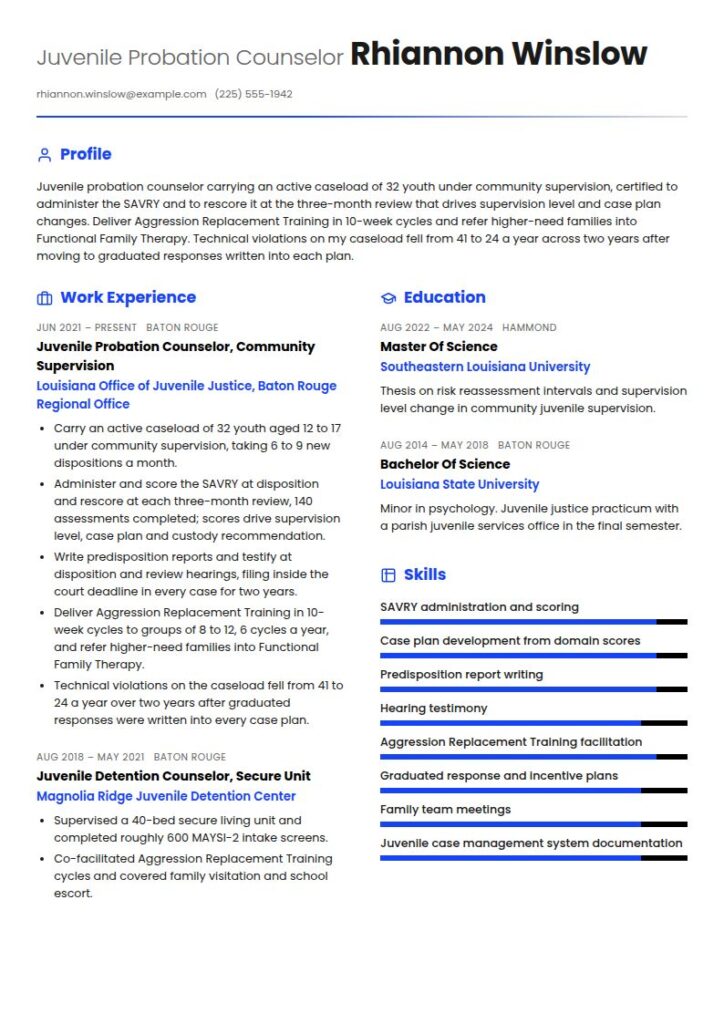
Juvenile probation counselor carrying an active caseload of 32 youth under community supervision, certified to administer the SAVRY and to rescore it at the three-month review that drives supervision level and case plan changes. Deliver Aggression Replacement Training in 10-week cycles and refer higher-need families into Functional Family Therapy. Technical violations on my caseload fell from 41 to 24 a year across two years after moving to graduated responses written into each plan.
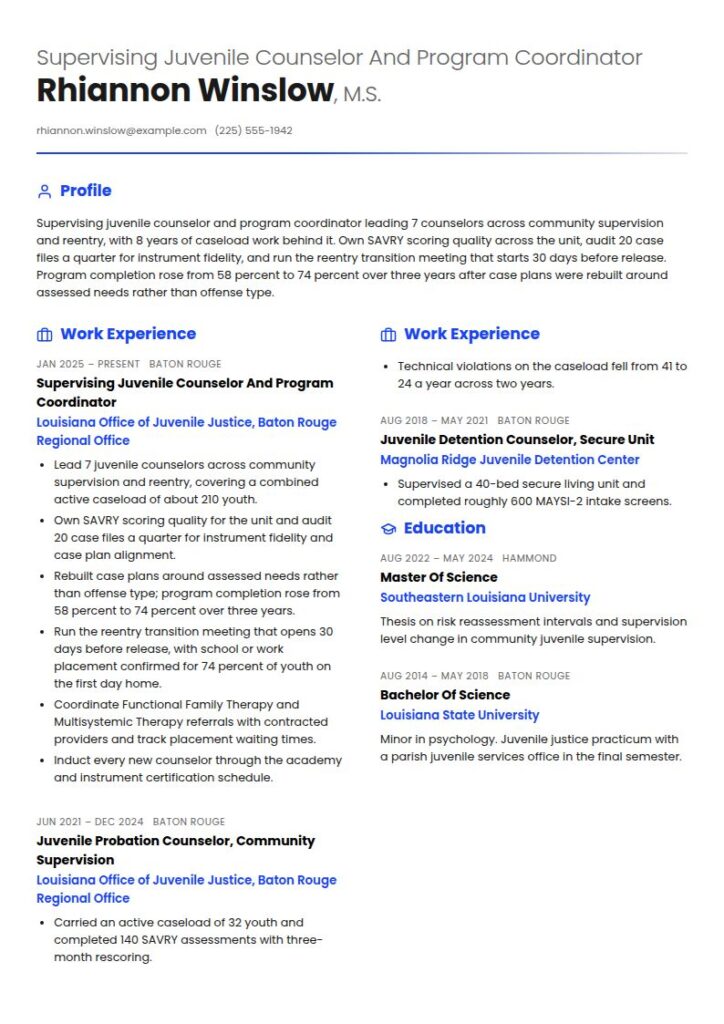
Supervising juvenile counselor and program coordinator leading 7 counselors across community supervision and reentry, with 8 years of caseload work behind it. Own SAVRY scoring quality across the unit, audit 20 case files a quarter for instrument fidelity, and run the reentry transition meeting that starts 30 days before release. Program completion rose from 58 percent to 74 percent over three years after case plans were rebuilt around assessed needs rather than offense type.
Right vs wrong: the same juvenile counselor summary, twice
| ✅ Right | ❌ Wrong |
|---|---|
| Juvenile probation counselor carrying an active caseload of 32 youth under community supervision. | Compassionate youth professional with a heart for troubled teens. |
| Certified to administer the SAVRY and to rescore it at the three-month review. | Experienced in assessing the needs of young people. |
| Technical violations on my caseload fell from 41 to 24 a year across two years. | Committed to helping youth turn their lives around. |
The right column can be assigned to a post and a court docket. The left column cannot.
Outline your experience
Agency, unit, city, setting and dates. Then three to five bullets, each naming an instrument, a model, a caseload number or a court product, and carrying a figure.
| Instead of | Use |
|---|---|
| Worked with at-risk youth | Carried an active community caseload of 32 youth aged 12 to 17, with 6 to 9 new dispositions a month |
| Completed assessments | Administered and scored 140 SAVRY assessments, rescoring each case at the three-month review |
| Ran groups | Delivered Aggression Replacement Training in 10-week cycles to groups of 8 to 12, 6 cycles a year |
| Worked with families | Ran monthly family team meetings and referred 18 families into Functional Family Therapy |
| Helped youth transition home | Started reentry planning 30 days before release; 74 percent had school or work placement on day one |
Juvenile Probation Counselor, Community Supervision, Baton Rouge Regional Office, Baton Rouge, LA, June 2021 to Present
Carry an active caseload of 32 youth aged 12 to 17 under community supervision, taking 6 to 9 new dispositions a month.
Administer and score the SAVRY at disposition and rescore at each three-month review, 140 completed to date; scores drive supervision level, case plan and custody recommendation.
Write predisposition reports and testify at disposition and review hearings, filing inside the court deadline in every case for two years. Technical violations on the caseload fell from 41 to 24 a year over two years after graduated responses were written into every case plan.
Name the assessment instruments you are trained to administer
This is the block almost nobody writes, and it is the one that decides the screen.
Juvenile agencies run on structured instruments. The Office of Juvenile Justice and Delinquency Prevention counted more than 20 different risk and needs tools implemented statewide across United States juvenile justice systems (OJJDP Model Programs Guide literature review on risk and needs assessments for youths, January 2015). Your value to an agency depends heavily on whether you hold training on the one they use.
The instruments worth naming
| Instrument | What it is | What to write |
|---|---|---|
| SAVRY | Structured Assessment of Violence Risk in Youth. 24 items across historical, social and contextual, and individual and clinical domains, plus six protective factors (OJJDP, January 2015). | Certification date, number completed, whether you rescore at review |
| YLS/CMI | Youth Level of Service/Case Management Inventory. 42 items across eight domains, scored 0 to 42 into low, moderate, high and very high bands (OJJDP, January 2015). | Certification date, and whether you build the case plan from domain scores |
| YASI | Youth Assessment and Screening Instrument. A 33-item prescreen and an 88-item full assessment across 10 domains (OJJDP, January 2015). | Whether you run prescreen only, or the full assessment |
| MAYSI-2 | Massachusetts Youth Screening Instrument, Version 2. A short intake mental health screen for triage, not diagnosis (OJJDP, July 2017). | How many administered, and what the referral threshold triggered |
State policy decides which instrument you will be trained on. Louisiana requires the SAVRY and uses it to inform predisposition investigation reports, disposition recommendations, supervision level, case plans and custody level for committed youth, with re-evaluations every three months, and it requires the MAYSI-2 in secure detention, probation and corrections settings (Juvenile Justice, Geography, Policy, Practice and Statistics, National Center for Juvenile Justice; SAVRY policy data 2020, MAYSI-2 policy data 2014). If you trained in another state, name the instrument you hold and add that you are available to certify on theirs.
The program models you can be certified to deliver
An instrument tells the agency what a young person needs. A program model is what you do about it, and the models have different training bars.
Aggression Replacement Training is one a counselor can typically be certified to facilitate without a clinical license. Its three components are Structured Learning Training, Anger Control Training and Moral Education, and it runs 10 weeks and 30 hours at three sessions a week with groups of 8 to 12 youth aged 12 to 17 assessed at moderate to high risk (National Gang Center Strategic Planning Tool, page dated 7 April 2021).
Functional Family Therapy runs the other way. FFT LLC states that its therapists hold master's degrees, that a standard caseload is 10 to 12 families per therapist, and that the model serves youth aged 11 to 18 referred for behavioral problems (FFT LLC, 2026). Multisystemic Therapy is a short-term intervention of typically three to five months with therapists available 24 hours a day (MST Services, 2026).
Put that distinction on the page in plain words. If you are a bachelor's-level counselor, you facilitate groups and refer into the clinical models. "Refer and coordinate FFT and MST placements, 18 family referrals in 2025" is accurate and useful; "FFT therapist" when you are not one fails the first reference check.
Certification and the academy
Nearly every state runs a mandatory preservice academy, and the requirement is public.
Texas is the clearest published example. A juvenile probation officer must hold a bachelor's degree, complete a minimum of 80 hours of initial training, pass the certification exam required by the Texas Juvenile Justice Department, then complete 60 hours of continuing education within the certification period. A juvenile supervision officer, the detention-side title, does not need a bachelor's degree but completes the same 80 hours of initial training and 80 hours of continuing education (37 Texas Administrative Code chapter 344, effective 1 April 2026).
Louisiana names its academy directly: the civil service specification for probation and parole officer, juvenile, requires completion of the Corrections Juvenile Services Agent Curriculum, plus a current driver's license (Louisiana State Civil Service job specification 146070). Write the academy by its real name and the month you finished it.
Secure detention against community placement
These are two different jobs, and a hiring manager wants to know in the first line which one you have done.
Secure detention and residential work is shift work on a living unit. The federal Prison Rape Elimination Act standards require each secure juvenile facility to maintain security staff ratios of at least 1:8 during resident waking hours and 1:16 during sleeping hours, and require employee refresher training every two years (28 CFR 115.313 and 115.331). Ratios, shift coverage, incident and restraint documentation, room confinement rules and the admission screen are the substance of that job, and they are what the resume should count.
Community supervision is caseload work: active caseload size, new dispositions a month, court deadlines met, violation and revocation rates, school enrollment, and how many cases closed successfully. A counselor who has done both settings should say so explicitly, because agencies value the crossover and rarely find it.
Family engagement and reentry planning
Reentry is where the case holds or falls apart, and it is measurable. Write the meeting you run and when it starts: "family team meeting monthly on every case" and "reentry planning begins 30 days before release" are both concrete. Then attach the outcome: school or work placement on day one, a behavioral health appointment scheduled before release, and how many cases had both in place.
Assessment: SAVRY certified administrator, 2021, 140 assessments completed with three-month rescoring. MAYSI-2 administrator, 2018, roughly 600 intake screens. Trained on YLS/CMI scoring logic, 2023.
Program delivery: Aggression Replacement Training certified facilitator, 2019, 6 cycles a year to groups of 8 to 12. Refer and coordinate Functional Family Therapy and Multisystemic Therapy placements, 18 family referrals in 2025.
Academy: Corrections Juvenile Services Agent Curriculum, completed 2021. PREA employee training, refreshed 2025. Crisis de-escalation, current.
Build a snapshot of your key skills
Ten to fourteen entries in three groups: assessment, direct practice, and court and systems work.
Assessment: SAVRY administration and scoring, MAYSI-2 screening, Case plan development from domain scores, Risk reassessment and supervision level change, Suicide risk screening and referral
Direct practice: Aggression Replacement Training facilitation, Crisis de-escalation, Family team meetings, Graduated response and incentive plans, Reentry transition planning
Court and systems: Predisposition report writing, Hearing testimony, Juvenile case management system documentation, Interstate Compact on Juveniles referrals, PREA reporting, Mandatory reporting
List your education and certifications
Degree first, then the academy, then instrument certifications with dates, then program models.
Master of Science, Criminal Justice, Southeastern Louisiana University, Hammond, LA, 2024
Bachelor of Science, Criminal Justice, Louisiana State University, Baton Rouge, LA, 2018
Certifications: Corrections Juvenile Services Agent Curriculum, Louisiana Office of Juvenile Justice (2021). SAVRY certified administrator (2021). MAYSI-2 administrator (2018). Aggression Replacement Training certified facilitator (2019). PREA employee training, refreshed 2025. CPR and first aid, American Red Cross (2026).
Choose the right layout and design
Single column, plain type at 11 or 12 point, clear headings, no photograph. Agency portals parse the file into a civil service record before a person reads it, and two-column templates, text boxes and graphics are where that parsing breaks. Keep instrument names in full at first use with the acronym in brackets, because a keyword filter may be set for either.
Name every instrument you are trained on, with the year and the number completed. Say whether the setting was secure, residential or community in every job title line. Give active caseload size and new intakes a month. Separate the models you facilitate from the models you refer into. Count court products: reports filed, hearings testified at, deadlines met.
Do not write "at-risk youth" or "troubled teens"; both are invisible to a screener searching for a tool name. Do not claim a clinical model you are not certified in, because a reference check will ask. Do not describe an identifiable young person, their offense or their family. Do not list an expired certification without marking it expired.
Juvenile counselor job market and outlook
A small, stable, almost entirely public-sector occupation, where hiring pressure comes from replacement rather than growth.
| Measure | Value |
|---|---|
| Probation officer and correctional treatment specialist jobs, 2025 | 93,700 |
| Projected change, 2025-35 | 3 percent, +2,800 |
| Projected annual openings | about 7,900 |
| Typical entry-level education | Bachelor's degree |
| Median annual wage, May 2025 | $66,270 |
Source: U.S. Bureau of Labor Statistics, Occupational Outlook Handbook, Probation Officers and Correctional Treatment Specialists, May 2025 wage data and 2025-35 projections. BLS publishes no separate Handbook profile for juvenile counselors; this is the occupation the work is counted in.
The population you serve is smaller than it was, and the needs are heavier
About 29,300 youth were held in residential placement in 2023, up from roughly 24,900 in 2021 but still below pre-pandemic levels, and the share detained or committed for a person offense rose between 2013 and 2023 (OJJDP, Trends and Characteristics of Youth in Residential Placement, 2023, published September 2025).
Mental health load is the other half of it. OJJDP's Model Programs Guide literature review reports that roughly two-thirds of youth in detention or correctional settings have at least one diagnosable disorder, against 9 to 22 percent in the general population (OJJDP, July 2017).
Together those facts explain what agencies hire for: fewer beds, a more clinically complex population in them, and a premium on counselors who can screen, assess and connect a young person to treatment rather than only supervise.
Where the jobs sit:
| Setting | Share of employment | Median annual wage (May 2025) |
|---|---|---|
| State government excluding education and hospitals | 51% | $66,270 |
| Local government excluding education and hospitals | 46% | $70,260 |
| Healthcare and social assistance | 2% | $45,830 |
Source: U.S. Bureau of Labor Statistics, Occupational Outlook Handbook, May 2025.
What salary you can expect as a juvenile counselor
The median annual wage for probation officers and correctional treatment specialists was $66,270 as of May 2025, or $31.86 an hour, with the lowest 10 percent under $46,840 and the highest 10 percent above $107,790 (BLS, May 2025).
The sector split is the number to plan a career around. Local government pays a median of $70,260 and state government $66,270, while healthcare and social assistance, where most private residential and nonprofit youth programs sit, pays a median of $45,830 (BLS, May 2025). That is a gap of roughly $24,000 between a parish or county juvenile services post and a private residential program doing similar-looking work. Counselors often start in the private setting because it hires faster, then move to the public agency once they have the academy hours and caseload experience the civil service specification asks for.
Inside the public scale, the resume moves money through the qualifying experience count and the certifications. Civil service specifications award steps for years of qualifying experience, for a relevant master's degree, and sometimes for a specialist assignment. Each is proven with documentation, so the file listing them with dates is the one scored at the higher step on the day the offer is written.
Key takeaways for a juvenile counselor resume
- Put the instruments in the header; SAVRY, YLS/CMI, YASI and MAYSI-2 are what a screener searches for.
- Separate screening tools from full risk and needs assessments.
- Say secure, residential or community in every job title line.
- Give active caseload size, new intakes a month, and court deadlines met.
- Split the models you facilitate from the models you refer into.
- Name the academy by its official title and the month you completed it.
- Count reentry: when planning starts, and what was in place on day one.
Build your juvenile counselor resume in 15 minutes with our AI resume builder.
Related social work resume examples
- Social worker resume
- Case manager resume
- Counselor resume
- Youth services specialist resume
- Drug and alcohol counselor resume
- Community outreach coordinator resume
- Social work resume
- Caregiver resume
- Child care resume
- Nanny resume
- Babysitter resume
- Life coach resume
Pair it with a matching juvenile counselor cover letter.
Juvenile counselor resume questions, answered
How long should a juvenile counselor resume be?
One page through your first secure or residential post, two once you carry a community caseload with assessment volume and outcome figures behind it. Public agencies score qualifying experience from the dates, so completeness matters more than compression.
Which assessment instruments should I list if my agency used a local tool?
List it by its exact name, say who validated it if you know, then add that you are trained on structured risk and needs scoring and available to certify on the hiring agency's instrument. Scoring logic carries across tools, and agencies would rather retrain someone who understands domain scoring.
Do I need a bachelor's degree to be a juvenile counselor?
It depends on the post and the state. The typical entry-level education for the occupation is a bachelor's degree (BLS, Occupational Outlook Handbook, 2025-35 projections). In Texas, a juvenile probation officer must hold one while a juvenile supervision officer, the detention-side title, does not, though both complete 80 hours of initial training and pass the certification exam (37 Texas Administrative Code chapter 344, effective 1 April 2026). Detention and residential posts are the usual entry point without a degree.
How do I write about outcomes without identifying a young person?
Count the group, never the individual: caseload totals, violation rates, completion percentages, school enrollment, reentry placements on day one. Never name, initial or describe an individual youth, their family or their offense. A hiring manager reads a specific case description as a confidentiality risk, not as evidence.
What if my experience is in a private residential program rather than a public agency?
Say so plainly and translate it. Unit size, shift ratio, intake screens, incident documentation, treatment team participation and discharge planning all map onto the public agency job. Private residential work pays a median of $45,830 in healthcare and social assistance against $70,260 in local government (BLS, May 2025), so the move is common and hiring managers expect it.