Geriatric Social Worker, Skilled Nursing Lorraine Petrosyan ASW
Social Services Designee
[email protected] | (818) 555-2108 | Glendale, United States
Profile
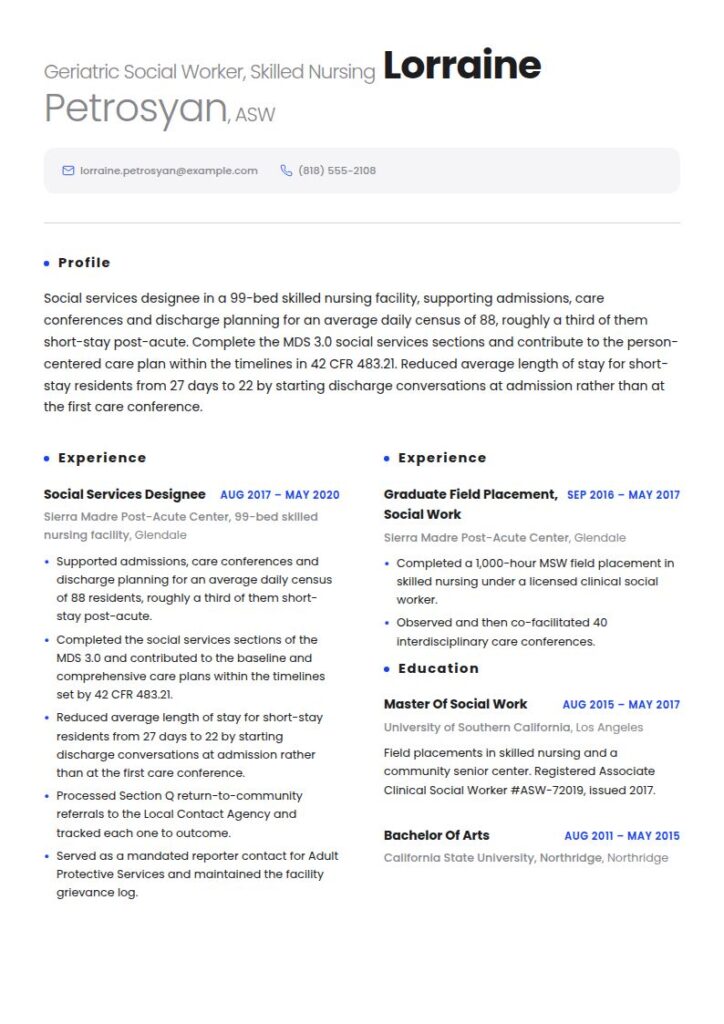
Social services designee in a 99-bed skilled nursing facility, supporting admissions, care conferences and discharge planning for an average daily census of 88, roughly a third of them short-stay post-acute. Complete the MDS 3.0 social services sections and contribute to the person-centered care plan within the timelines in 42 CFR 483.21. Reduced average length of stay for short-stay residents from 27 days to 22 by starting discharge conversations at admission rather than at the first care conference.
Work Experience
08/2017 - 05/2020, Social Services Designee, Sierra Madre Post-Acute Center, 99-bed skilled nursing facility, Glendale, United States
- Supported admissions, care conferences and discharge planning for an average daily census of 88 residents, roughly a third of them short-stay post-acute.
- Completed the social services sections of the MDS 3.0 and contributed to the baseline and comprehensive care plans within the timelines set by 42 CFR 483.21.
- Reduced average length of stay for short-stay residents from 27 days to 22 by starting discharge conversations at admission rather than at the first care conference.
- Processed Section Q return-to-community referrals to the Local Contact Agency and tracked each one to outcome.
- Served as a mandated reporter contact for Adult Protective Services and maintained the facility grievance log.
09/2016 - 05/2017, Graduate Field Placement, Social Work, Sierra Madre Post-Acute Center, Glendale, United States
- Completed a 1,000-hour MSW field placement in skilled nursing under a licensed clinical social worker.
- Observed and then co-facilitated 40 interdisciplinary care conferences.
Education
08/2015 - 05/2017, Master of Social Work, Older Adults concentration, University of Southern California, Los Angeles, United States
Field placements in skilled nursing and a community senior center. Registered Associate Clinical Social Worker #ASW-72019, issued 2017.
08/2011 - 05/2015, Bachelor of Arts, Gerontology, California State University, Northridge, Northridge, United States
Skills
MDS 3.0 social services sections, 70
Psychosocial assessment, 75
Care conference participation, 70
Discharge planning and community referral, 70
Adult Protective Services mandated reporting, 75
PointClickCare, 80
Languages
English, native
Armenian, native
Spanish, intermediate
Certificates
07/2017, Registered Associate Clinical Social Worker, California Board of Behavioral Sciences, ASW-72019
Registration held while accruing supervised hours toward clinical licensure.
03/2019, Certified Dementia Practitioner, National Council of Certified Dementia Practitioners
Summary
A geriatric social worker resume is a one to two page document that names the setting of every role, the regulation that governed it, and the assessment that drove the care plan. This guide gives you three adaptable versions, the setting block most applicants leave out, and current Bureau of Labor Statistics pay and outlook for social workers.
Geriatric Social Worker resume examples by experience level
In short, a geriatric social worker resume is a one to two page document that names the setting of every role you have held, the regulation that governed that setting, and the assessment instrument that fed the care plan you wrote.
Nothing else on the page tells a reader as much. After all, "Geriatric social worker" describes a population, not a job. For example, the same title covers a nursing facility social services director, a Medicaid waiver care manager working in people's homes, a hospital transitions worker, an Area Agency on Aging specialist and a hospice team member. However, those jobs share a population and almost nothing else: different regulators, assessments, timelines and documentation.
As a result, a hiring manager reads your resume for one question. Have you worked to my rules before, or will I be teaching them from the start?
Resume guide for a geriatric social worker resume
For that reason, this guide and the corresponding geriatric social worker resume example will cover:
- First, how to write a geriatric social worker resume, section by section
- Then, why the setting and its regulation belong on the page, and where to put them
- Also, three adaptable summaries: first role, facility lead, and program manager
- In addition, how to write assessment work without breaching confidentiality
- Finally, what the job market looks like and what you can expect to earn
How to write a geriatric social worker resume
Overall, six sections: contact header, summary, practice settings, professional experience, education and certifications, and skills. Generally, one page for your first five years, two once you have run a department or a caseload worth citing.
The settings block goes high, directly under the summary, because it is the fastest answer to the reader's only real question.
| Section | What it is answering | Where it goes |
|---|---|---|
| Summary | What population, what setting, how long, one result | Top of the page |
| Practice settings | Which rulebooks has this person worked under? | Directly under the summary |
| Professional experience | What did they assess, plan and document? | Reverse chronological, with numbers |
| Education and certifications | Degree, license and assessment credentials | Below experience |
| Skills | Instruments, systems and the benefits landscape | A grouped block, not adjectives |
In particular, three numbers change how a role reads, and most applicants give none: the census or caseload (148 certified beds, or 62 waiver participants), the mix (short-stay against long-stay, dual eligible, dementia diagnosis), and the throughput (admissions a month, or new assessments a quarter). Consequently, a reader who knows the setting converts those into a picture of your week in four seconds. Otherwise, without them they are guessing, and guessing means assuming the lighter version of the job.
Run the finished file through the ATS resume checker before you send it. Health systems, post-acute chains and county aging departments parse applications into a database before a person reads them.
Choosing the best resume format for a geriatric social worker resume
Reverse chronological, always. In other words, the reader is tracing a sequence: which settings, in what order, for how long, and what you took on each time you moved. In contrast, a functional or skills-first format buries exactly that, and it reads badly in a field where continuity with older adults is itself a qualification. In short, one page through your first five years, two once you have a supervisory line or a settings list long enough that abbreviating it costs you interviews.
Include your contact information
| ✅ Right | ❌ Wrong |
|---|---|
| Lorraine Petrosyan, LCSW | Lorraine Petrosyan |
| Geriatric Social Worker, Skilled Nursing and Community Aging | Compassionate professional who loves working with seniors |
| California LCSW #LCS-94168, RAC-CT | Licensed social worker |
| (818) 555-2108, [email protected], Glendale, CA | (818) 555-2108, [email protected] |
The second line is doing real work. For instance, "Skilled nursing and community aging" tells a hospital recruiter, a facility administrator and an Area Agency on Aging director three different useful things before they reach the summary. Put the license number on the page too: human resources verifies it against the state board anyway, and the file that lets them do it in ten seconds moves faster.
Make use of a summary
In practice, four lines: setting and population, years, the assessment system you work in, and one outcome with a number.
Social services designee in a 99-bed skilled nursing facility, supporting admissions, care conferences and discharge planning for an average daily census of 88, roughly a third of them short-stay post-acute. Complete the MDS 3.0 social services sections and contribute to the person-centered care plan within the timelines in 42 CFR 483.21. Reduced average length of stay for short-stay residents from 27 days to 22 by starting discharge conversations at admission rather than at the first care conference.
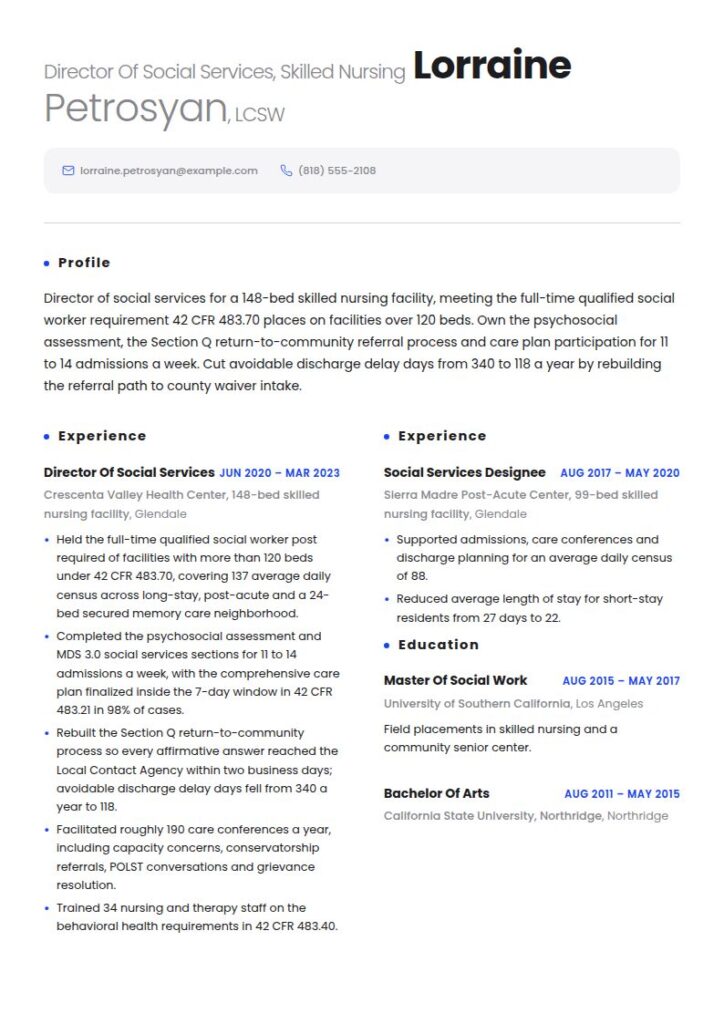
Director of social services for a 148-bed skilled nursing facility, meeting the full-time qualified social worker requirement 42 CFR 483.70 places on facilities over 120 beds. Own the psychosocial assessment, the Section Q return-to-community referral process and care plan participation for 11 to 14 admissions a week. Cut avoidable discharge delay days from 340 to 118 a year by rebuilding the referral path to county waiver intake.
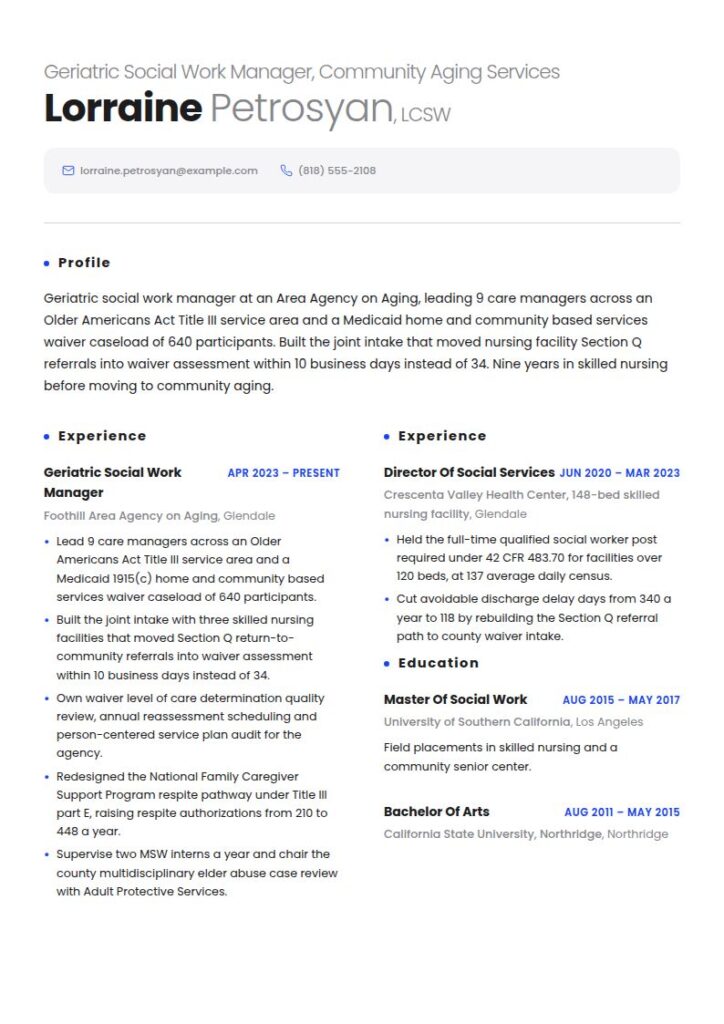
Geriatric social work manager at an Area Agency on Aging, leading 9 care managers across an Older Americans Act Title III service area and a Medicaid home and community based services waiver caseload of 640 participants. Built the joint intake that moved nursing facility Section Q referrals into waiver assessment within 10 business days instead of 34. Nine years in skilled nursing before moving to community aging.
Right vs wrong: the same geriatric social worker summary, twice
| ✅ Right | ❌ Wrong |
|---|---|
| Director of social services for a 148-bed skilled nursing facility, meeting the full-time qualified social worker requirement in 42 CFR 483.70. | Experienced social worker with a strong background in long-term care settings. |
| Own the psychosocial assessment, Section Q referrals and care plan participation for 11 to 14 admissions a week. | Responsible for assessments, care plans and discharge planning for residents. |
| Cut avoidable discharge delay days from 340 to 118 a year by rebuilding the referral path to county waiver intake. | Worked collaboratively with the interdisciplinary team to improve resident outcomes. |
On the other hand, the right column can be matched against a job description line by line. Meanwhile, the left column could belong to any social worker anywhere.
Outline your geriatric social work experience
Next, list the employer, setting type with its size, city, and dates. Then three to five bullets, each naming a task the reader recognizes and carrying a number. Above all, write the work, never the person: you can describe a caseload, a diagnosis mix, a barrier and an outcome without anything that identifies a resident or a family.
| Instead of | Use |
|---|---|
| Provided social services to elderly residents | Carried social services for 148 certified beds, average daily census 137, with 11 to 14 admissions a week |
| Completed assessments and care plans | Completed the psychosocial assessment and MDS 3.0 social services sections for every admission, with the comprehensive care plan finalized inside the 7-day window in 42 CFR 483.21 |
| Assisted residents with discharge planning | Rebuilt the discharge referral path to county waiver intake and In-Home Supportive Services, cutting avoidable delay days from 340 to 118 a year |
Director of Social Services, Crescenta Valley Health Center, 148-bed skilled nursing facility, Glendale, CA, June 2020 to March 2023
Held the full-time qualified social worker post required of facilities with more than 120 beds under 42 CFR 483.70, covering 137 average daily census across long-stay, post-acute and a 24-bed secured memory care neighborhood.
Completed the psychosocial assessment and the MDS 3.0 social services sections for 11 to 14 admissions a week, with the comprehensive care plan finalized inside the 7-day window in 42 CFR 483.21 in 98% of cases.
Rebuilt the Section Q return-to-community process so every affirmative answer reached the Local Contact Agency within two business days; avoidable discharge delay days fell from 340 a year to 118.
Facilitated roughly 190 care conferences a year, including capacity concerns, conservatorship referrals, POLST conversations and grievance resolution under the resident rights requirements.
Name the setting's regulation and the assessment that drives the care plan
Even so, this is what separates a geriatric social work resume from every other social work resume, and almost nobody writes it. Therefore, give it its own block: for each setting, one line naming the regulation or funding authority, and one line naming the assessment that produced the care plan.
Skilled nursing facility, 148 beds, 2020 to 2023. Governed by 42 CFR 483.40(d) on medically related social services, 42 CFR 483.70 on the full-time qualified social worker in facilities over 120 beds, and 42 CFR 483.21 on the baseline and comprehensive care plan. Assessment: MDS 3.0, including Section Q return-to-community referral, the BIMS cognitive interview and the PHQ mood interview.
Community aging services, Area Agency on Aging, 2023 to present. Governed by Older Americans Act Title III, parts B to E, and by a Medicaid 1915(c) home and community based services waiver. Assessment: state uniform assessment tool for waiver level of care, with annual reassessment and person-centered service planning.
Four things are worth knowing precisely enough to write, because hiring managers use them as shorthand.
The nursing facility social worker rule. The federal long-term care requirements say a facility "must provide medically-related social services to attain or maintain the highest practicable physical, mental and psychosocial well-being of each resident" at 42 CFR 483.40(d), and that "any facility with more than 120 beds must employ a qualified social worker on a full-time basis" at 42 CFR 483.70 (eCFR, retrieved 17 September 2026). If you held that post, say the bed count and say you held it. It is a federal staffing requirement, not a title the facility invented.
Care plan timing and the MDS schedule
The care plan clock. Under 42 CFR 483.21 a baseline care plan is required "within 48 hours of a resident's admission," and the comprehensive person-centered care plan "within 7 days after completion of the comprehensive assessment," by a team including the attending physician, a registered nurse, a nurse aide, a food and nutrition services member, and the resident and representative to the extent practicable (eCFR, retrieved 17 September 2026). Those deadlines are the rhythm of the job.
The assessment itself. The MDS 3.0 OBRA schedule sets the Admission comprehensive assessment at the 14th calendar day of admission, quarterly assessments at least every 92 days, the annual within 366 days of the previous comprehensive, and a Significant Change in Status Assessment within 14 calendar days of the determination (CMS RAI Version 3.0 Manual, Chapter 2, October 2025). Section Q asks residents whether they want to learn about living in the community, and a "yes" obliges a referral to the designated Local Contact Agency (California Department of Health Care Services, retrieved 17 September 2026). Social services usually owns that referral, so how many you made and what came of them is one of the strongest lines on this resume.
Geriatric social work in community aging programs
The community side. The Older Americans Act funds Title III supportive services under part B, congregate and home-delivered nutrition under part C, health promotion under part D and the National Family Caregiver Support Program under part E, delivered through 56 state agencies on aging and 618 area agencies on aging (Administration for Community Living, retrieved 17 September 2026). A Medicaid 1915(c) waiver lets a state cover case management, homemaker services, personal care, adult day health and respite for people who need "a Level of Care that would meet the state's eligibility requirements for services in an institutional setting" (Medicaid.gov, retrieved 17 September 2026). Name the waiver, the level of care criteria you applied, and the reassessment cycle you kept.
Say where your boundary work stopped
Three responsibilities are specific to older adult practice and are worth one line each, because a manager will otherwise assume you have not done them.
Mandated reporting to Adult Protective Services: give the number of reports you filed and say you tracked them to disposition, rather than that you are "familiar with" the obligation.
Capacity and surrogate decision making: say what you did. Requested a capacity evaluation, convened a family meeting, referred to the public guardian.
Advance care planning: a POLST is a portable medical order for people who are "seriously ill or have advanced frailty," it must be signed by a provider to be valid, and it differs from an advance directive, which is what a healthy person completes (National POLST, retrieved 17 September 2026). Writing that distinction correctly signals you have sat in those conversations.
Build a snapshot of your key skills
Specifically, four groups: assessment, care planning and regulation, benefits and community resources, and systems. Name instruments, not qualities.
Assessment: MDS 3.0 including Section Q, BIMS and PHQ mood interview, psychosocial assessment, caregiver capacity, waiver level of care determination
Care planning and regulation: 42 CFR 483.21 baseline and comprehensive care plans, care conference facilitation, PASRR level I and II, resident rights and grievance process, Adult Protective Services mandated reporting, advance directives and POLST
Benefits and community resources: Medicare Parts A and B coverage rules, Medicaid long-term care eligibility, dual eligible special needs plans, Older Americans Act Title III services, Long-Term Care Ombudsman referral, Social Security and SSI
Systems: PointClickCare, Epic, state MDS submission, county waiver case management system, SAMS for aging network reporting
List your education and certifications
Degree first, then the license with its number and state, then the certifications that map onto the assessments you named earlier. Similarly, licensure is not the spine of this page: keep it factual and let the settings section do the persuading.
Master of Social Work, Older Adults concentration, University of Southern California, Los Angeles, CA, 2017
Bachelor of Arts, Gerontology, California State University, Northridge, Northridge, CA, 2015
Licensed Clinical Social Worker, California Board of Behavioral Sciences, #LCS-94168, issued 2020, current through 2027.
Certifications: Resident Assessment Coordinator Certified (RAC-CT), AAPACN, 2021. Certified Advanced Social Work Case Manager (C-ASWCM), NASW, 2022. Certified Dementia Practitioner, National Council of Certified Dementia Practitioners, 2019.
Choose the right layout and design
In practice, that means single column, 11 or 12 point body type, plain section headings, no photograph, no skills bar charts. Post-acute chains, health systems and county human resources departments parse the file into a structured record before anyone opens it, and two columns, text boxes and graphics are where that parsing breaks.
Name the setting type and its size for every role, and the regulation or funding authority that governed it. Name the assessment instrument that fed the care plan. Give the caseload or census, the mix and the throughput. Put the license number and its state on the page. Say what you did on capacity, guardianship referral and advance care planning. Use the reader's vocabulary: MDS, Section Q, PASRR, care conference, waiver, level of care.
Do not write "elderly clients" or "senior population" where the setting name would be more useful. Do not describe a resident, a family or a case in enough detail to be identifiable. Do not claim an assessment you have only observed. Do not list the license twice, once in the header and again as an achievement. Do not let the page become a list of soft qualities, since empathy is assumed here and is not what is being screened for.
Geriatric social worker job market and outlook
In brief, a large, steadily growing occupation with heavy replacement demand. Note that the Bureau of Labor Statistics publishes no separate Occupational Outlook Handbook profile for geriatric social workers; instead, the occupation sits inside the social workers profile, and the specialty most geriatric roles report under is healthcare social workers.
| Measure | Value |
|---|---|
| Social worker jobs, 2025 | 816,100 |
| Projected change, 2025-35 | 6% |
| Projected annual openings | ~69,100 |
| Typical entry-level education | Bachelor's or master's degree in social work |
| Median annual wage, all social workers, May 2025 | $61,780 |
| Median annual wage, healthcare social workers, May 2025 | $67,880 |
Source: U.S. Bureau of Labor Statistics, Occupational Outlook Handbook, May 2025 wage data as well as 2025-35 projections, retrieved 17 September 2026.
The demand side of this job is already measurable
As of 1 July 2024 there were 61.2 million people aged 65 and older in the United States. Between 2020 and 2024 the older population grew 13.0 percent while the number of children fell 1.7 percent, and older adults now outnumber children in 11 states and 1,411 counties, close to 45 percent of all US counties (U.S. Census Bureau, Vintage 2024 Population Estimates, released 26 June 2025).
The institutional side is large and flat rather than growing: 14,742 CMS-certified nursing facilities with about 1.24 million residents as of July 2025, 73 percent of them for-profit (KFF, A Look at Nursing Facility Characteristics, published 17 December 2025).
Read together, those tell you where the hiring is. Bed counts are not rising, so growth is in the community: waiver care management, Area Agency on Aging programs, hospital transitions and home-based primary care. If your experience is facility-side, show that your assessment skills transfer. If it is community-side, name the waiver and the level of care tool, because those are what program directors screen on.
Where the jobs sit:
| Setting | Share of social worker employment, 2025 | Median annual wage (May 2025) |
|---|---|---|
| State and local government, excluding education and hospitals | 27% | $65,100 |
| Individual and family services | 17% | $51,980 |
| Ambulatory healthcare services | 15% | $63,710 |
| Hospitals; state, local, and private | 10% | $77,440 |
| Educational services; state, local, and private | 10% | $68,850 |
Source: U.S. Bureau of Labor Statistics, Occupational Outlook Handbook, May 2025, retrieved 17 September 2026.
What salary you can expect as a geriatric social worker
To begin with, the median annual wage for social workers was $61,780 in May 2025, and $67,880 for the healthcare social workers specialty most geriatric roles report under (BLS Occupational Outlook Handbook, May 2025).
Indeed, setting explains most of the spread, and in geriatric work the gap is wide. For example, hospital-employed social workers had a median of $77,440 in May 2025 against $51,980 in individual and family services, where a large share of community aging and home care employers sit. By comparison, state and local government, which includes county aging departments and many Area Agency on Aging posts, sat at $65,100 (BLS, May 2025).
Instead, what a resume can move is which band you are read into. Moreover, the assessment credential does it first: a facility hiring a social services director pays differently for someone who already holds RAC-CT and can complete the MDS sections unsupervised. Scope does it second, because owning the Section Q process, the PASRR workflow or the waiver level of care determination is a different job from supporting someone who owns them. Skilled nursing pay also tracks bed count and ownership, so the census figure next to each role is doing salary work as well as scope work.
Key takeaways for a geriatric social worker resume
- Name the setting for every role, with its size, because the setting is the job.
- First, name the regulation or funding authority that governed each setting, in its own block.
- Then name the assessment that fed the care plan: MDS 3.0 and Section Q, or the state waiver level of care tool.
- Next, give three numbers per role: census or caseload, the mix, and throughput.
- Also, write the work and never the person; describe the group, the barrier and the outcome.
- Finally, keep licensure factual and in the education block; let the settings section carry the argument.
Build your geriatric social worker resume in 15 minutes with our AI resume builder.
Related social work resume examples
- Social worker resume
- Healthcare social worker resume
- Case manager resume
- Caregiver resume
- Counselor resume
- Social work resume
- Community outreach coordinator resume
- Drug and alcohol counselor resume
- Youth services specialist resume
- Juvenile counselor resume
- Nanny resume
- Life coach resume
Pair it with a matching geriatric social worker cover letter.
Geriatric social worker resume questions, answered
How long should a geriatric social worker resume be?
One page for your first five years. Two once you have held a social services director post, supervised care managers, or worked across enough settings that the settings block is itself the argument.
What is the difference between a geriatric social worker and a medical social worker resume?
The population and the rulebook. A medical social worker resume is organized around an episode of care and a discharge. A geriatric resume covers long relationships across settings: a facility care plan cycle, a waiver reassessment cycle, a caregiver arrangement running for years. If you have done both, write both settings out and let the reader pick.
Do I need a master's degree to work as a geriatric social worker?
Not for every post. BLS lists the typical entry-level education for social workers as a bachelor's or master's degree in social work (BLS Occupational Outlook Handbook, May 2025), and the federal long-term care requirements define a qualified social worker as someone with at least a bachelor's degree in social work or a human services field plus one year of supervised experience in a health care setting (42 CFR 483.70, eCFR, retrieved 17 September 2026). Clinical and most supervisory roles do require an MSW and a clinical license.
How do I write assessment and care planning work without breaching confidentiality?
Describe the process and the population, never the person. "Completed the psychosocial assessment and MDS social services sections for 11 to 14 admissions a week" is specific and safe. A sentence giving one resident's age, diagnosis and family situation is a story, and in a field with mandatory privacy training it reads as a warning.
What should I put on a geriatric social worker resume with no paid experience yet?
Write your field placement as a job, because it is one. Name the setting and its size, the hours, the assessments you completed and how many, and the care conferences you attended. A new graduate who can name the MDS timelines and has sat in twenty care conferences is not an unknown quantity.