

Summary
A final round interview no longer asks whether you can do the job. It asks which of two to four qualified finalists the team wants, so your odds sit around one in three to one in two. The decision happens in that room and the debrief after it: Ashby's data shows 95% of candidates who clear the onsite pass the next stage. Prepare for senior interviewers, judgement questions and consistency checks, and close by inviting any reservation you could address.
A final round interview feels like the last hurdle of a test you have been passing all along. It is not. Every earlier stage asked whether you clear a bar; this one asks which of the people who cleared it The skills round that set that bar sits earlier in the process, and preparing for a technical interview covers it.
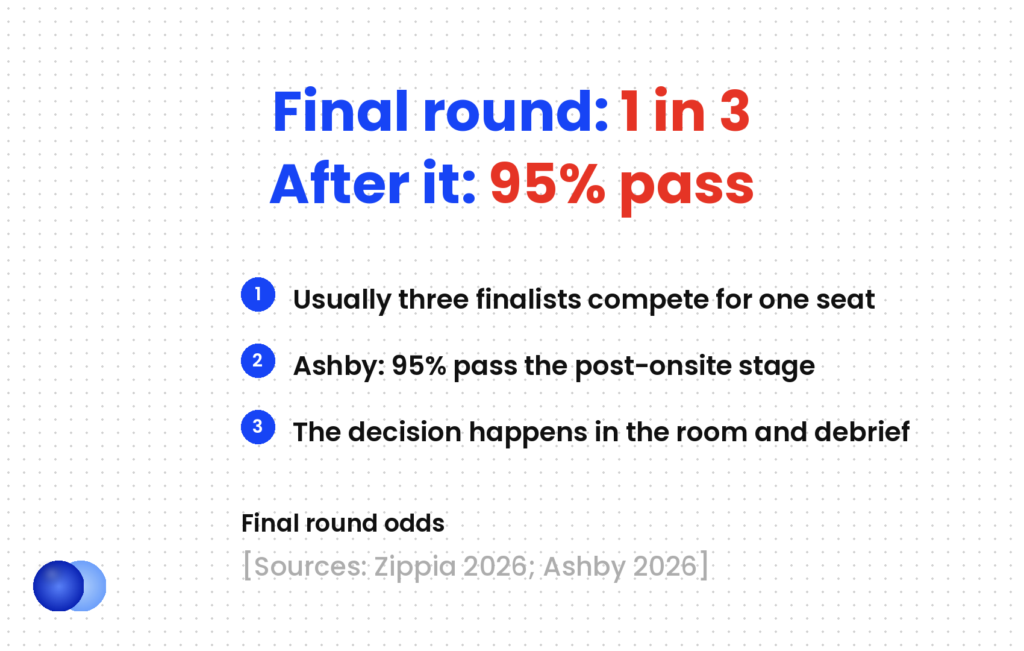
That shift changes the arithmetic. Zippia's analysis puts the typical final round at two to four candidates and your chance of an offer at roughly 25 to 50%. Yet once a candidate clears the onsite, Ashby's hiring data shows 95% pass the next stage. The odds are coin-flip going in and near-certain coming out.
So the decision is made in the room and in the debrief straight afterwards, not in the weeks of reference calls and approvals that follow. This guide completes the stage-by-stage series that started with the phone screen interview questions and continued through the second interview questions: what the last round measures, what to expect, and how to close.
What is a final round interview actually deciding?
Which finalist to hire, not whether you are qualified. By the final round, the company has already confirmed you can do the work. Senior interviewers now weigh judgement, consistency and whether they want to work with you for years, against two or three other candidates who also cleared the bar.
Earlier rounds test a threshold. The phone screen checks basics and salary alignment. The second interview checks depth: can this person actually do the work described in the posting?
The final round tests a ranking. One guide puts it bluntly: "Nobody is asking whether you clear the bar any more, because you cleared it. They are asking which of these finalists they want." Another describes the underlying question as moving from "Can this person do the job?" to "Do we want this person here for years?"
Competence answers stop differentiating. Every finalist can describe a project they led. Specific judgement calls — what you chose not to do, and why — separate you from people with similar resumes.
Consistency starts to matter more than peak performance. Senior interviewers compare notes. A story told one way to the hiring manager and another way to the director reads as a problem, and the site's position on the greatest weakness interview answer applies here in full: everything you say will eventually meet your references.
Small signals carry real weight. How you handle a challenge, and how you treated the coordinator who booked the room, become tie-breakers between near-equals.
What are your odds after a final round interview?
Roughly one in three to one in two going in, because most processes carry two to four finalists. Once you clear the final round itself, the odds jump: Ashby reports 95% passthrough at the post-onsite stage, and most of what follows is paperwork rather than a second decision.
Two numbers circulate, and they look contradictory until you see what each one measures.
| Stage | What the data shows | Source |
|---|---|---|
| Finalists per role | Usually 3; range 2–10 depending on the role | Zippia |
| Chance of an offer entering the final round | ~25–50% | Zippia |
| Screen to final interview | ~18 days technical, ~14 days business | Ashby |
| Recruiter screen passthrough | ~35% | Ashby |
| Post-onsite passthrough | 95% | Ashby |
| Offer stage (candidate accepts) | 81% | Ashby |
The 25–50% figure measures finalists competing for one seat. If three people reach the last round and one gets hired, each starts at about a third.
The 95% figure measures what happens after the team has chosen. Ashby's report covers 54 million applications across 93,000 jobs from 2021 to March 2026, and finds that later stages "see significantly higher conversion rates at 95% and 81%, respectively." Candidates who survive the onsite debrief almost always receive the offer.
Put together, the two figures locate the decision precisely. It happens during the final round and the debrief immediately after it. Reference checks, compensation approval and background screening rarely reverse it. Treating the final hour as a formality is the most expensive mistake a finalist can make.
What should you expect in the room?
More senior interviewers, less scripted questions and a longer format. Expect a department head or executive, peers you would work alongside, possibly a presentation or case, and questions about judgement, values and trade-offs rather than your technical basics.
Who you meet
A senior decision-maker. A director, vice president or founder who has not seen you yet and who often holds a veto.
Future peers or cross-functional partners. Treat them as interviewers even when the conversation feels casual.
Sometimes the whole group at once. If the final stage runs as a panel interview, the dynamics differ: you answer one person but persuade the table.
What gets asked
Judgement and trade-offs. "Tell me about a decision you'd make differently now." "How would you prioritise if the first quarter went badly?"
Motivation and horizon. Why this company, why now, and what the next two years look like for you.
Your view of their problems. Senior interviewers often When that turns into a structured exercise, how to prepare for a case interview gives you the framework to work through it out loud.
Compensation, occasionally. Some companies confirm numbers here. If the posting published a range, hold the position from the salary expectations answer: anchor near the top third, and never give a range whose bottom is below your real target.
How should you prepare differently from the second interview?
Stop rehearsing competence and start preparing judgement. Re-read your notes from every earlier round, fix one consistent version of each key story, research the senior interviewers specifically, and prepare a short view on the team's biggest problem that you can defend under challenge.
1. Audit your own consistency. List the three or four stories you have already told, the numbers you used and the reasons you gave for leaving your current role. Senior interviewers will have your earlier scorecards; Ashby's data shows around 38% of scorecard pairs already disagree by at least one point, so give the debrief no extra reason to split.
2. Research the people, not just the company. Read what the executive has written or said publicly, and tie a question to their stated priorities.
3. Prepare a point of view. Take the biggest challenge mentioned in earlier rounds and prepare a short, specific take: what you would look at first, and what you would avoid. You are showing reasoning, not delivering a finished plan.
4. Rehearse being challenged. Ask a friend to push back hard. Staying calm and specific under disagreement is exactly what senior interviewers test. The interview preparation tools let you run that practice against the actual job description.
5. Prepare a few questions, not a list. Three or four that build on earlier conversations beat a memorised dozen; our guide to questions to ask in an interview covers the full set.
Bring the earlier rounds into the room
Open one answer with a direct reference to a previous interview: "When I spoke with Priya last week, she mentioned onboarding was taking six weeks — I've been thinking about that." It proves you listened and signals continuity to a decision-maker who will read Priya's notes. Use it once; twice sounds like a technique.
How do you close a final round interview?
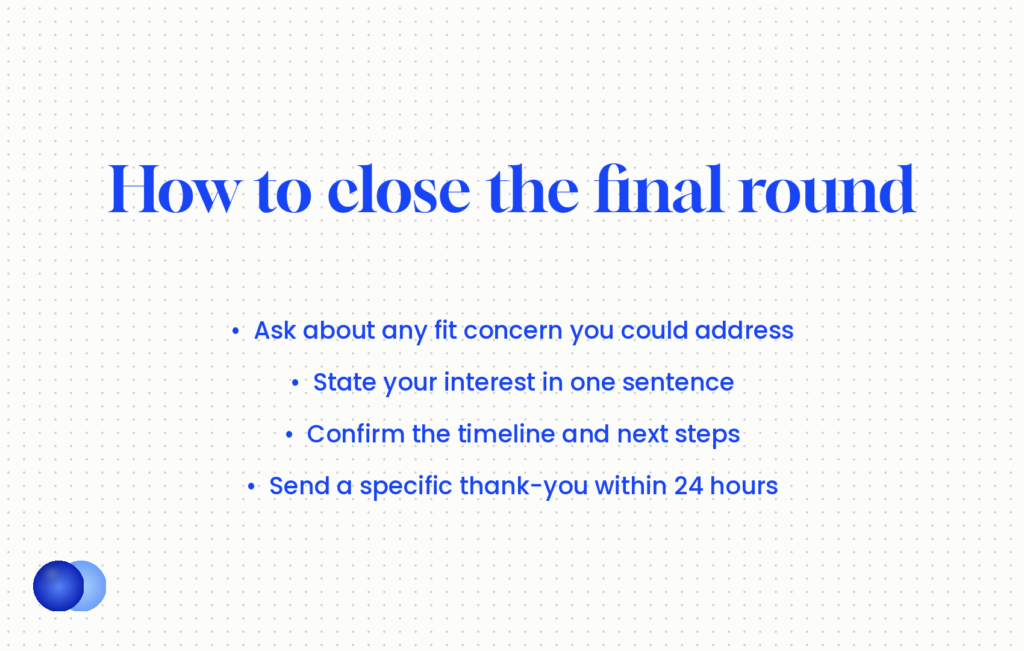
Invite any reservation you could still address, state your interest plainly, and confirm next steps. Phrase the reservation question softly — "is there anything about my fit I could address?" — because the blunt version can put a senior interviewer on the spot and backfire.
Here the advice genuinely splits, and the split is about phrasing rather than principle.
The case for asking directly. Final-round guides such as Articuler and GhostPilot recommend asking whether the interviewer has any hesitations about your fit. The logic is sound: a concern raised in the room can be answered; one raised in the debrief after you have left cannot.
The case against the blunt version. Alison Green of Ask a Manager calls hard-sell closing questions "too aggressive" and compares them to car-sales tactics. "Do you have any hesitations about me?" pins the interviewer down before they have compared notes with anyone.
The resolution is four words. Green's alternative adds "that I could address", which turns a confrontation into an offer of help and gives the interviewer an easy way to decline. You still surface the concern; you just stop demanding a verdict.
Are there any reservations you have about my fit for the position that I could address?
Then two more moves. State your interest in one sentence — finalists who assume enthusiasm is obvious sometimes lose to one who said it. Confirm the timeline: when the team expects to decide and who will be in touch.
Hard sell: "So, is there any reason you wouldn't hire me? Because I really think I'm the right person for this."
Soft close: "I've enjoyed this — the migration problem Sam described is exactly the work I want to be doing next. Is there anything about my background you'd like me to fill in before you decide? And what are the next steps on your side?"
The first demands a verdict the interviewer cannot give alone. The second invites a gap, restates interest specifically and ends on logistics.
What happens after the final round?
The debrief, usually within days, then references, approvals and an offer. Send a specific thank-you within 24 hours, prepare your references, and do not resign anywhere until the written offer arrives and every contingency, from references to background checks, has cleared.
Send the thank-you within a day. Reference one specific point from the conversation rather than restating your enthusiasm in general terms. The interview follow up email guide covers wording and timing.
Warn your references. Pin, citing SHRM, reports that 87% of employers check references, and the industry norm is to run them after a conditional offer. Tell your referees who may call and what the role involves, so their account matches yours.
Expect a quiet spell. Approvals, budget sign-off and scheduling the offer call take time. Silence for a few days after a final round interview means very little on its own.
Read the offer before you celebrate. Check base, bonus, start date and contingencies against what was discussed.
Do not resign early. An offer can be rescinded, even after you sign. Rescission is rare — around 1% — but it happens, usually when a background check, reference or budget changes. Clear every contingency in writing first. No US law requires a notice period, and an at-will employer can release you the day you resign, so an early resignation can leave you with neither job.
Wait for the written offer with every contingency cleared before handing in your notice anywhere.
Treat a warm goodbye from the executive as a verbal offer, because the debrief, the budget and the references have not happened yet.
What the final round cannot fix
Being honest about limits: some final rounds are decided before you walk in. An internal candidate, a budget freeze or a strong referral can settle the ranking regardless of your performance. A well-run final round interview improves your position in a comparison; it cannot change who else is in it. If you lose, ask for one piece of feedback; runners-up are often the first call when a role reopens.
Frequently asked questions
How many candidates make it to the final round interview?
Usually three, though the range runs from two to ten depending on the role, according to Zippia.
What are my chances of getting an offer after a final round interview?
Roughly 25 to 50% going in, because most final rounds carry two to four finalists. Once the team chooses you in the debrief, Ashby's data shows 95% of candidates pass the next stage.
Is the final round interview just a formality?
Rarely. The final round is where the team compares finalists who all cleared earlier bars, so it is usually where the decision is actually made.
Who will I meet in a final interview?
Typically a senior decision-maker such as a director or executive, plus peers or cross-functional partners.
Should I ask if they have any hesitations about hiring me?
Yes, but softly. Ask whether there is anything about your fit you could address, rather than demanding their hesitations, which can put a senior interviewer on the spot.
How long after a final interview will I hear back?
Often within a week, though approvals and reference checks can stretch it.
Do employers check references after the final round?
Most do. Pin cites SHRM data that 87% of employers check references, typically after a conditional offer, so brief your referees as soon as the final round ends.
Can I resign once I get a verbal offer?
No. Wait for the written offer and clear every contingency first, because offers can be rescinded and an at-will employer can release you the day you give notice.



Comments