

Summary
A group interview puts several candidates in one room with one or two observers, usually for retail, hospitality and other high-volume roles. Research on leaderless groups shows people who talk most get seen as leaders regardless of what they say, but careers services and assessors score how you work with others, not how much you talk. Treat airtime as a floor: speak early, then spend your turns building on others, drawing in quiet candidates and moving the group to a decision.
A group interview puts you in a room with four or five strangers competing for the same shifts, and every instinct says the loudest person wins. That instinct is half right, which makes it dangerous.
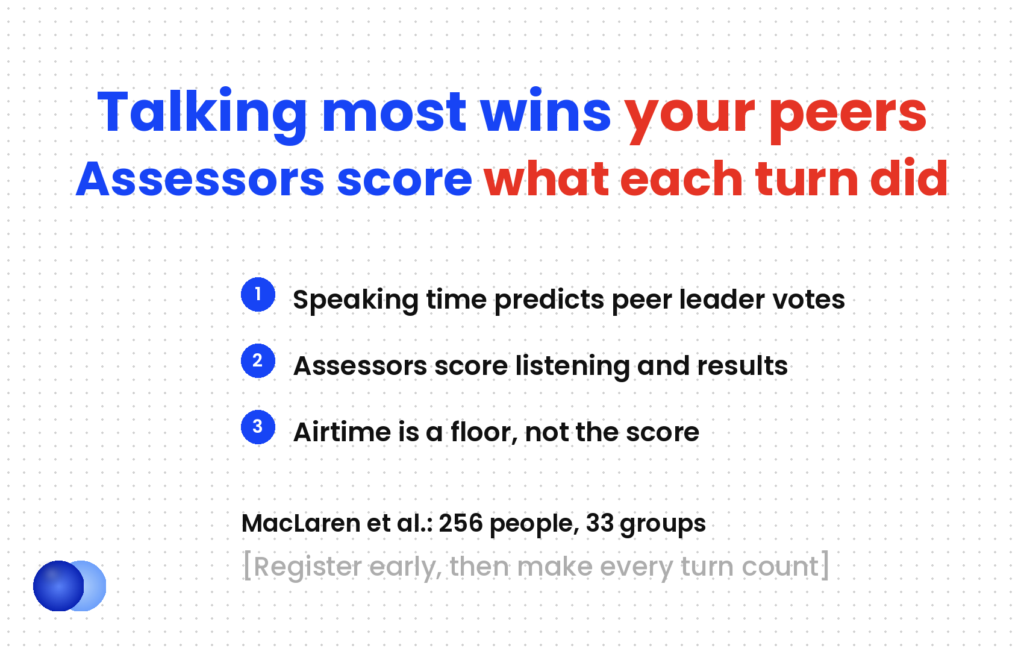
The half that holds up: in leaderless groups, speaking time predicts who gets seen as the leader. A study of 256 people in 33 groups found it did so regardless of intelligence or personality. Researchers call it the babble hypothesis.
The half that fails: the people who vote in those studies are fellow group members. In a hiring room, the person scoring you is an observer with a list of behaviours, and talking a lot is not on it. So the working rule is simple. Airtime is a floor you must clear, not the score you are chasing. Everything below follows from that.
What is a group interview, and how does it differ from a panel interview?
A group interview puts several candidates in front of one or two interviewers at the same time. A panel interview is the reverse: one candidate facing several interviewers. Group formats dominate high-volume hiring in retail, hospitality and call centres; panels suit professional and technical roles.
The terms get mixed up, and some HR glossaries even file panels under "group interview". If the invitation asks you to arrive at a set time with other applicants, it is a group session.
| Group interview | Panel interview | |
|---|---|---|
| Who is in the room | Several candidates, one or two interviewers | One candidate, several interviewers |
| Typical roles | Retail, hospitality, call centres, graduate schemes | Professional, technical, management |
| What it reveals | How you treat peers under social pressure | How you answer from different angles |
| Typical size | Four to six candidates | Two or more interviewers |
The HR glossary AllVoices puts the workable size at four to six candidates; beyond six, interviewers cannot watch individuals closely enough. For the other format, see the panel interview guide.
Seasonal retail is where most people meet this format for the first time. The National Retail Federation expected retailers to hire between 265,000 and 365,000 seasonal workers in 2025, down from 442,000 seasonal hires in 2024. Fewer seats is exactly when a manager runs one session for six people instead of six sessions for one.
What happens in a group interview?
Most sessions follow four stages: a round of introductions, an explanation of the role, questions answered in turn or open to the room, and a group task or role-play. Expect roughly an hour for retail and much longer at a graduate assessment centre. Every stage counts, including the waiting area.
The order varies by employer, but the parts rarely do.
Introductions. Keep yours to about 30 seconds: name, the role you want, and one concrete reason you fit it. The interviewer also watches whether you listen to everyone else's.
The briefing. A manager explains shifts, pay and expectations. Note one detail you can use later, such as the busiest day.
Round-robin or open questions. Sometimes each person answers in turn; sometimes the interviewer throws a question to the room and waits to see who picks it up. Classic prompts include "Tell us about a time you handled a difficult customer", which calls for a short story in the STAR method format, trimmed to a minute because four other people need time too.
The group task. A ranking exercise, a planning problem, or a role-play in which one candidate plays a customer. This is where most of the scoring happens.
Assessment centres run the same logic at length
Graduate schemes stretch the same format across a morning or a full day, with written exercises and a formal group discussion. The Cambridge Careers Service notes that each assessor usually observes one or two candidates at most, so your contribution "both verbal and non-verbal" gets noted the whole time.
Does talking the most win a group interview?
It wins with your peers, not necessarily with the assessor. Two studies found speaking time predicts who gets seen as the leader in small groups. But hiring observers score how you work with others, and a candidate who talks over people gives them evidence against teamwork.
The research side. MacLaren and colleagues put 256 students into 33 groups of four to ten and gave them an hour-long simulation. Speaking time was the strongest predictor of who the group named as its leader, and it held after controlling for personality and cognitive ability. A 2025 follow-up with 38 teams confirmed the link, running through perceived speaking time.
The careers side. Advice from targetjobs is blunt: contribute, but do not dominate; be assertive, but not aggressive.
Why both can be true. They measure different judges. In the studies, fellow group members voted on who led. In a group interview, one or two observers score each candidate against criteria such as listening, persuading and encouraging others. An observer with a checklist sees a candidate who interrupted twice and never asked anyone a question.
| Judge | Where they sit | What volume buys you |
|---|---|---|
| Other candidates | Inside the group | Perceived leadership, per the babble studies |
| Trained assessor | Outside, with a scoring sheet | Visibility only; the score depends on what each turn did |
| Untrained store manager | Outside, often no sheet | Some of both, which is the honest risk |
The third row matters for retail: a busy manager without a rubric is more exposed to the bias the research describes. So silence is never safe. Register early, then make every turn scorable.
What are interviewers actually scoring?
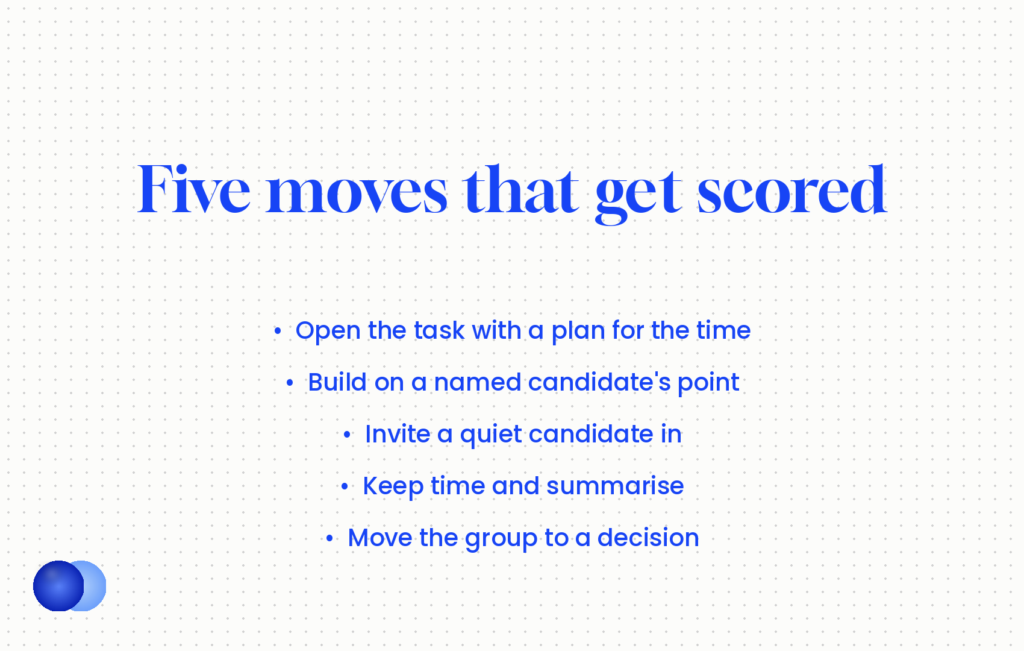
Behaviours they can write down: making a clear point, listening and building on others, drawing in quieter candidates, keeping the group on time, and helping reach a decision. The right answer to the task usually matters far less than the way you and the group arrived at it.
The Cambridge Careers Service lists three things assessors weigh: the quality of your contribution, your ability to make a point and achieve results, and how you listen to and encourage others. For customer-facing roles, assume one more: how you treat four nervous strangers previews how you would treat a customer.
You are not being primarily assessed on whether you reach the 'right' answer (often there isn't one), but on how you work with others.
As observable moves, that becomes a short list:
| Behaviour | What it sounds like | What it signals |
|---|---|---|
| Opening the task | "Shall we take two minutes to read, then agree what we're deciding?" | Structure, initiative |
| Building | "Priya's point about queues links to what Tom said about staffing." | Listening |
| Inviting | "Sam, you haven't had a say yet. What would you cut?" | Inclusion, customer manner |
| Timekeeping | "We've got five minutes left; can we lock the top three?" | Results focus |
| Summarising | "So we agree on A and B and still differ on C." | Clarity |
Notice what is missing: the number of ideas you proposed, and whether your idea won. One well-placed summary can outscore five stubborn suggestions.
How do you stand out in a group interview?
Speak within the first two minutes so the observer registers you, then use later turns to build, invite, keep time and summarise. Take one role the group needs rather than competing for leader, and treat every other candidate as a future colleague, because the interviewer is watching exactly that.
Five moves, in the order they usually arise.
1. Speak early. One short, useful contribution, such as proposing how to split the time, clears the airtime floor at once.
2. Use names. Learn them during introductions. It is the quickest audible proof that you listened.
3. Pick a role the group lacks. If someone has taken charge, do not fight for it. Timekeeper and summariser both give you regular reasons to speak.
4. Disagree with a reason and a path. "I'd rank safety first, because a customer injury closes the till for an hour; could we test that against Ana's view?" Disagreeing well is more impressive than agreeing with everyone.
5. Close the task. Groups often run out of time mid-argument. The candidate who says "Let's decide" and gets a decision stands out in every rubric.
Bring one fact from the briefing into the task
During the manager's briefing, write down one operational detail: the busiest trading day, the loyalty scheme, the returns window. Then use it once in the group task, for example "Saturdays are the peak, so whatever we choose has to work with a queue." It proves you listen when nobody is asking, which is the core of shop-floor work. It also gives the observer a specific note to write beside your name.
If you are naturally quiet
Quiet candidates lose group interviews by never registering, not by speaking too little overall. Two early contributions and one closing summary can be enough. Prepare an opening line in advance, such as a proposal for how to run the task.
What mistakes cost people the job?
Interrupting, dismissing other candidates, going silent for the whole task, and treating the session as a contest. Assume the waiting area and the goodbye count too. The mistakes that sink people are almost always about how they treat others, not what they know.
Candidate A: "No, that won't work. We should obviously put the window display first because it drives footfall. I've done this before." A pushes the idea three times, and it wins the ranking.
Candidate B: "Jess, I like the staffing point. Could we put the window display second, though? It drives footfall on Saturdays, which the manager said is the peak." The group adopts a mixed ranking.
A's idea won, but the observer's notes read "interrupted twice, dismissive". B's notes read "built on others, used briefing detail, moved group to decision". B gets the call back.
Two more traps:
Performing for the interviewer. Addressing the manager instead of the group looks like you misread the task.
Checking out between turns. Looking at your phone while someone else answers is visible and damaging.
Treat the other candidates as future teammates: learn their names, build on their points and thank them at the end.
Stay silent to avoid mistakes, since an observer who never hears you has nothing to write down and a blank row never gets a call back.
How should you prepare for a group interview?
Prepare three one-minute stories, a 30-second introduction and an opening line for the group task. Research the store or brand, dress a step above the staff uniform, and arrive early. Afterwards, send a short thank-you that mentions one moment from the group task.
Before. Prepare three short stories: a busy period, a difficult customer, a time you helped a teammate. Make sure your resume matches them; the resume for a part-time job guide covers availability and short roles.
On the day. Arrive 10 minutes early and talk to the other candidates in the waiting area. It warms you up, gives you names, and you cannot know when the observation starts.
At the end. Ask one question that shows you listened; the questions to ask in an interview guide has a bank to adapt.
After. A brief interview follow-up email that mentions one specific moment helps a manager who met six people in an hour remember you.
To rehearse the stories and the one-minute timing out loud, Rezoom's interview preparation tool will run you through practice questions.
What can this advice not fix?
It cannot remove observer bias or a manager who hires on energy alone. Research shows untrained observers reward talkers, and some retail sessions have no rubric at all. What you control is clearing the airtime floor and giving whoever is watching specific, positive things to write.
Being honest about the limits matters here. The babble research shows that people inside a group reward volume, and a store manager without a scoring sheet is closer to that than to a trained assessor. And in seasonal hiring, your shift availability may decide the outcome before your behaviour does.
What you can control is narrow but real: speak early enough to register, make every later turn do something an observer can name, and treat the other candidates as the colleagues some of them will become. That approach works with a rubric, and it holds up reasonably well without one.
Frequently asked questions
What is a group interview?
A hiring session in which several candidates meet one or two interviewers at the same time, usually with introductions, questions and a group task. It is common in retail, hospitality, call centres and graduate assessment centres.
What is the difference between a group interview and a panel interview?
In a group interview, several candidates face one or two interviewers. In a panel interview, one candidate faces several interviewers, and the format suits professional and technical roles.
How long does a group interview last?
Retail and hospitality sessions often run about an hour. Graduate assessment centres can take a morning or a full day, with the group exercise as one part among several.
How many people are in a group interview?
Commonly four to six candidates. Fewer than four and the group dynamic does not show; more than six and an interviewer struggles to observe each person fairly.
Should I try to lead the group?
Only if nobody else has, and never by talking over people. Timekeeper and summariser are equally visible roles and often score better, because both show results focus and listening.
What if I am shy in a group interview?
Plan an opening line for the task and say it within the first two minutes. Then aim for a couple of building comments and one summary; registering early matters more than total speaking time.
What should I wear to a retail group interview?
One step smarter than the staff uniform you would wear on the job. Clean, neat and practical beats formal, and it shows you understand the setting.
Should I follow up after a group interview?
Yes, with a short thank-you within a day. Mention one specific moment from the group task so a manager who met several candidates can place you.


Comments