

Summary
Your questions do two jobs: they shape how the interviewer remembers you, and they tell you whether to take the job. Harvard research found follow-up questions drive liking while abrupt topic switches do not, so tie each prepared question to something the interviewer said. Around three in ten new hires report job regret, which makes the due-diligence job just as important. Prepare 50, ask three to five.
Most lists of questions to ask in an interview treat the final five minutes as a performance: memorise six clever lines and recite them when invited. The research on question-asking points somewhere more specific.
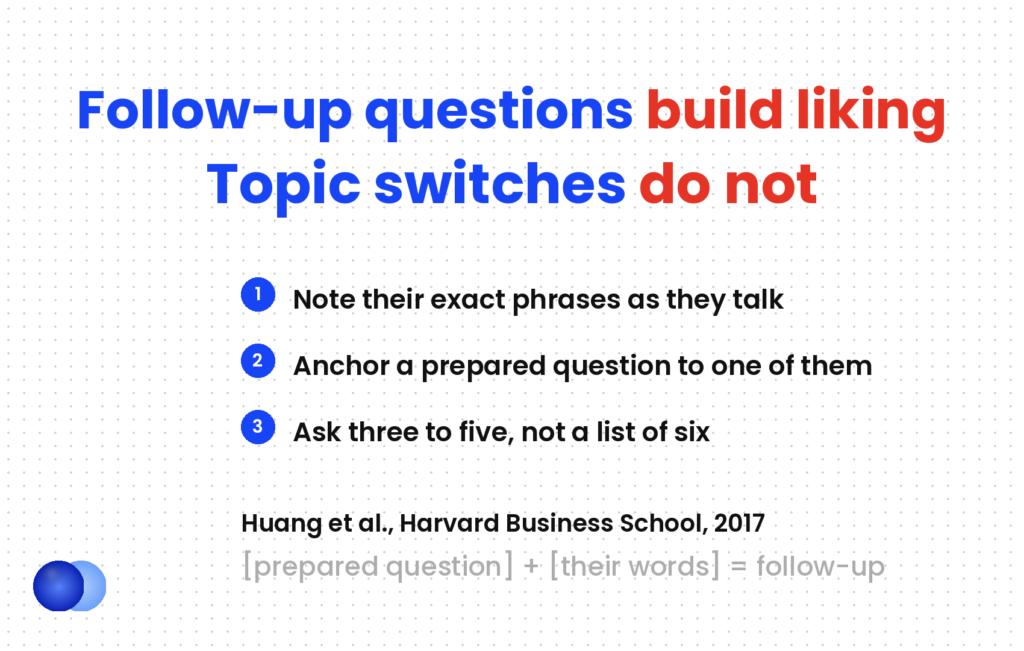
A Harvard Business School study found that people who ask more questions come across as more likeable, but the effect came mainly from follow-up questions that built on what the other person had just said. Questions that jumped to an unrelated topic did not increase liking. A prepared question read off a notepad is, by definition, a topic jump.
Your questions also do a second job most lists ignore: finding out whether you want the job. Below are 50 questions grouped by purpose and stage, plus a method for turning any of them into a follow-up.
Why do the questions you ask in an interview matter?
Because they do two jobs at once. They shape the interviewer's final impression of you, and they are your only structured chance to test whether the job matches the posting. Follow-ups help most with the first job; specific, evidence-seeking questions help most with the second.
The impression. In the Harvard studies, which covered chat conversations and speed dating, people who asked more follow-up questions received higher liking ratings and more second-date requests. The authors also note that too many questions can annoy a partner, especially if you reveal nothing in return.
Due diligence. ZipRecruiter's Q4 2025 survey of new hires found 69.2% had not experienced "new job regret", so roughly three in ten had. BambooHR's onboarding study put first-week second thoughts at 44%.
| Finding | Source | What it tells you |
|---|---|---|
| Follow-ups drive liking; topic switches do not | Huang et al., Harvard, 2017 | Tie questions to the conversation |
| 32% of hiring managers named weak questions a damaging mistake | CareerBuilder, 2012 (dated) | "No questions" costs you |
| 44% had second thoughts in week one | BambooHR, 1,565 employees, 2023 | Early doubt is common |
| ~31% reported new job regret | ZipRecruiter, 1,500+ new hires, Q4 2025 | Lasting regret is rarer, but real |
The two regret figures only look contradictory. BambooHR measured a first-week wobble; ZipRecruiter asked people hired within six months whether they had regretted the move. Good questions are the cheapest defence against the lasting kind.
How many questions should you ask, and at which stage?
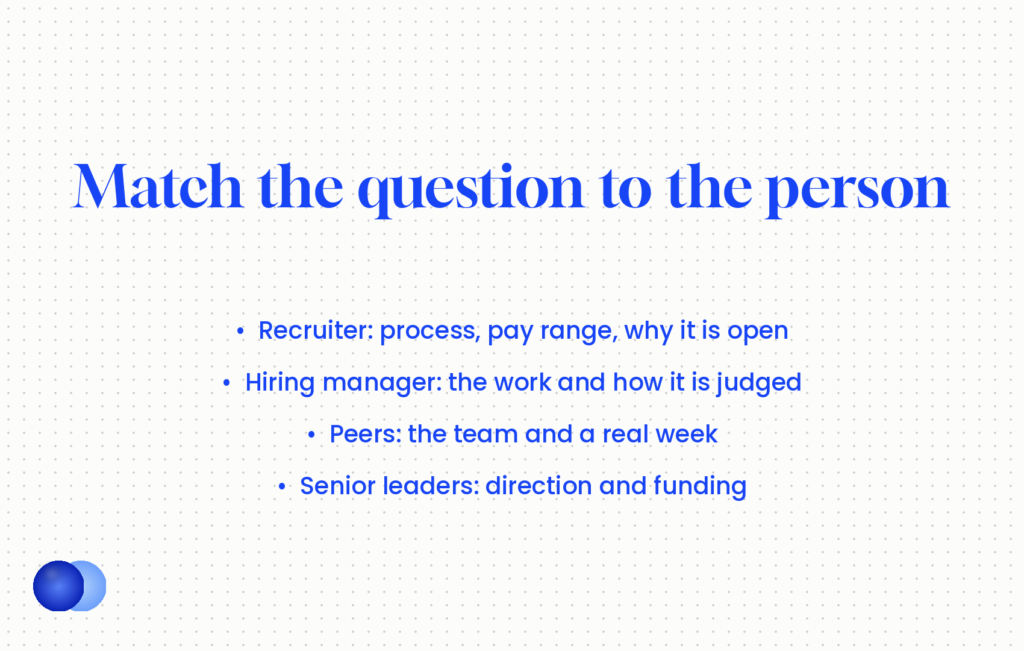
Prepare far more than you need and ask three to five per conversation, chosen for the person in front of you. Recruiters answer process and pay questions; hiring managers answer questions about success and management; peers can tell you what a normal week feels like.
| Stage | Who you usually meet | Best question groups | Ask |
|---|---|---|---|
| Phone screen | Recruiter | Process, pay range, why the role is open | 2–3 |
| First interview | Hiring manager | The work, success measures, management | 3–5 |
| Panel or peer round | Future colleagues | Team, workload, a real week | 2–3 each |
| Second or final round | Senior leaders | Direction, funding, close | 3–4 |
The phone screen interview questions guide covers the recruiter call, and second interview questions covers later rounds, where fit with the wider team becomes the main test. This article is the question bank both draw from.
Which questions to ask in an interview about the role?
Ask about the work as it actually happens, how success will be measured, and why the role is open. These questions expose any gap between the posting and the job, which is where most early regret starts.
The posting describes the job someone wanted to advertise. These reveal the job you will actually do.
The work itself
- What does a typical week look like, and how much of it matches the posting?
- What's the most urgent problem this person needs to solve in the first three months?
- Why is this role open: is it new, or did someone move on?
- Which part of this job does the posting undersell or leave out?
- Which parts of the role are fixed, and which can the new person shape?
- Which tools and systems will I use every day?
- Where does most of the work come from: planned projects, other teams' requests, or firefighting?
Question 3 carries the most information per word. A new role means you will define it; a replacement means someone has already set expectations.
Success and measurement
- What would you want this person to have achieved after a year?
- How will you know, at six months, whether this hire has worked out?
- What separates people who do well here from people who struggle early on?
- Can you describe someone who excelled in this role and what they did differently?
- What does the first 30 days look like in practice?
- Which decisions will I own outright, and which need sign-off?
- Who outside the team will I work with most closely?
If the manager cannot answer question 9, expect your review to rest on impressions rather than results.
Which questions reveal the team and the manager?
Questions about feedback, disagreement, workload and tenure. The manager you report to predicts your day-to-day experience more than the company does. Ask peers the same questions and compare the answers.
The manager
- How would you describe your management style, and how do you give feedback?
- How often do you meet one to one with your reports, and what do those meetings cover?
- Do you prefer to hear about a problem early and rough, or later with a proposed fix?
- When did you last change your mind because someone on the team pushed back?
- How do you support people who want to grow beyond their role?
The team
- What's this team's biggest strength, and where is it stretched thin?
- How long have most people on the team been here?
- Where have people in this role gone next?
- How does the team settle disagreements about priorities?
- What does a bad week look like here, and how often does one happen?
- How do evenings, weekends and on-call work in practice rather than on paper?
- For hybrid teams: how do decisions get made when people aren't in the same room?
Questions 21 and 22 together give you a tenure signal without asking anyone to criticise a colleague. In a panel interview, put question 24 to a peer rather than the manager; peers answer it more candidly.
What should you ask about the company and its direction?
Ask what the business is prioritising, how this team contributes, and whether the role has secure funding. These suit later rounds and senior interviewers, and they double as a check on headcount risk.
- What are the company's priorities for the next 12 months, and how does this team contribute?
- What's the biggest challenge the business faces right now?
- How has the company changed over the past two years?
- If there was a restructuring recently, how did it affect this team?
- Is this role funded for the full year, and how does headcount planning work?
- What does leadership talk about most in company-wide meetings?
- What do you personally enjoy about working here, and what would you change?
- How does the company decide when the data and someone's instinct disagree?
Question 31 matters more than it used to. The site's ghost jobs research puts the defensible floor at roughly one listing in five with no real hire behind it, and a direct question about funding helps separate a live requisition from a hopeful one. Hesitation is informative.
Which questions to ask in an interview about growth, pay and process?
Ask how reviews, promotions and pay rises actually work, confirm the salary range with the recruiter, and close by asking about next steps. With around 60% of postings now publishing a range, confirming it is a normal question rather than a risky one.
Growth
- How do performance reviews work, and how often do they happen?
- How do promotions and pay rises get decided, and who is involved?
- How much budget or time is there for training?
- How does internal mobility work if I wanted to move teams later?
Pay
- The posting lists a range; is that still accurate for this level?
- How is total compensation split across base, bonus and equity?
- Which parts of the package do people here value most?
Question 39 simply confirms what the employer has already published. Timing, wording and what to do when no range exists are covered in how to ask about salary in an interview; in short, pay questions belong with the recruiter, and hiring-manager time is better spent on questions 8 to 19.
Process and close
- What are the next steps, and when should I expect to hear back?
- Who else will I meet during the process?
- Is there anything in my background you'd like me to expand on?
- Is there anything I can send you that would help your decision?
Question 44 is a softer version of "Do you have any concerns about my fit?" Both let you address a doubt before the debrief, but the softer wording avoids putting the interviewer on the spot.
How do you turn a prepared question into a follow-up?
Anchor it to something the interviewer said. "You mentioned the reporting rebuild; what does done look like?" asks the same thing as a prepared question about priorities, but it proves you listened, which is the quality the research links to liking.
Note two or three things the interviewer mentions in passing, such as a project, a problem or a change, then use one of these frames.
- "You mentioned [X]. What's driving that?"
- "When you said [the team is rebuilding reporting], what would done look like?"
- "You said last quarter was difficult. What did the team learn from it?"
- "How did you personally handle [the challenge they described]?"
- "If I started on Monday, which of the things you've described would land on my desk first?"
Question 50 makes a strong closer, because it asks the interviewer to picture you in the role.
Prepared: "What are the team's priorities for next year?" The manager gives the polished overview six other candidates heard this week.
Anchored: "Earlier you mentioned the Salesforce migration slipped twice. Is fixing that the main thing this hire is for?" The manager gives a candid answer about the real job, and remembers who picked up on the migration.
Write their words down, not yours
During the interview, jot down the interviewer's exact phrases rather than your reactions: "rebuilding reporting", "last quarter was rough", "stretched on analytics". Those phrases become the raw material for questions 46 to 49, and quoting their language back signals attention better than any prepared line. On video, say at the start that you'll take a few notes. Three phrases are enough.
One specific, responsive question that comes from actually listening will almost always outperform a list of six prepared questions.
What questions should you avoid asking?
Anything the careers page already answers, anything that leads with perks before the work, and "Did I get the job?" The problem is often the framing rather than the topic, so reword a question before you drop it.
Harvard Business Review makes the same point: framing matters as much as content. "How much holiday do I get?" in a first interview reads as your priority; "How do people manage workload around busy periods?" covers similar ground as a question about the work.
Research the company first so every question you ask in an interview goes beyond what its website and recent news already say.
Say "No, I think you've covered everything", because the interviewer hears a lack of curiosity even when you meant thoroughness.
If you have genuinely run out, anchor one: "You covered the role in detail. What made you join?" A forgotten question can also go in your interview follow up email.
What good questions cannot do
A strong set of questions will not rescue weak answers earlier in the interview. The question-asking research comes from casual conversation rather than hiring panels, so treat it as a strong steer, not a guarantee. And questions cannot surface what an interviewer will not say: a manager planning to leave will still describe the team warmly. What they can do is lower your odds of joining the three in ten who regret the move. To rehearse answers and questions together, Rezoom's interview preparation tool runs practice interviews against a real posting.
Frequently asked questions
How many questions should I ask in an interview?
Three to five per conversation, chosen for the person in front of you. Prepare more so you can drop the ones already answered.
What is the best question to ask at the end of an interview?
A follow-up on something the interviewer said earlier, since research links follow-ups most strongly to liking. As a fallback, "If I started on Monday, what would land on my desk first?" works almost anywhere.
Is it bad to have no questions at the end of an interview?
Usually. Interviewers tend to read it as a lack of curiosity, and a dated CareerBuilder survey found 32% of hiring managers called weak questions a damaging mistake.
Can I ask about salary in an interview?
Yes, preferably with the recruiter. Around 60% of postings now publish a range, so confirming it is routine.
Should I ask "Do you have any concerns about my fit?"
It can work, but it puts some interviewers on the spot. "Is there anything in my background you'd like me to expand on?" opens the same door more gently.
Should I ask every interviewer the same questions?
Ask the manager and peers the same two or three team questions, then compare. A clear mismatch deserves a follow-up.
Is it okay to read questions from notes?
Yes. Just anchor at least one to something said during the conversation so it does not sound recited.
What questions should I avoid asking?
Anything the company website answers, perks before the work in a first interview, and "Did I get the job?"



Comments