

Summary
To answer "What do you know about our company?", share two or three specific, current facts, such as a product, a recent announcement or a stated priority, then connect one of them to the work you would do in the role. Research takes about 30 minutes: the company site and newsroom, the annual report or 10-K, LinkedIn and employee reviews, and the job description. Keep the answer under 90 seconds and never guess.
When an interviewer asks "What do you know about our company?", give two or three specific, current facts and connect one of them to the job. A strong answer proves you did the homework and shows you understand where you would fit.
The good news: you do not need hours of research. A focused 30-minute plan covers what most interviewers expect. This guide gives you that plan, a three-part answer formula, sample answers for different company types, and the mistakes that get candidates written off.
Why do interviewers ask "What do you know about our company?"
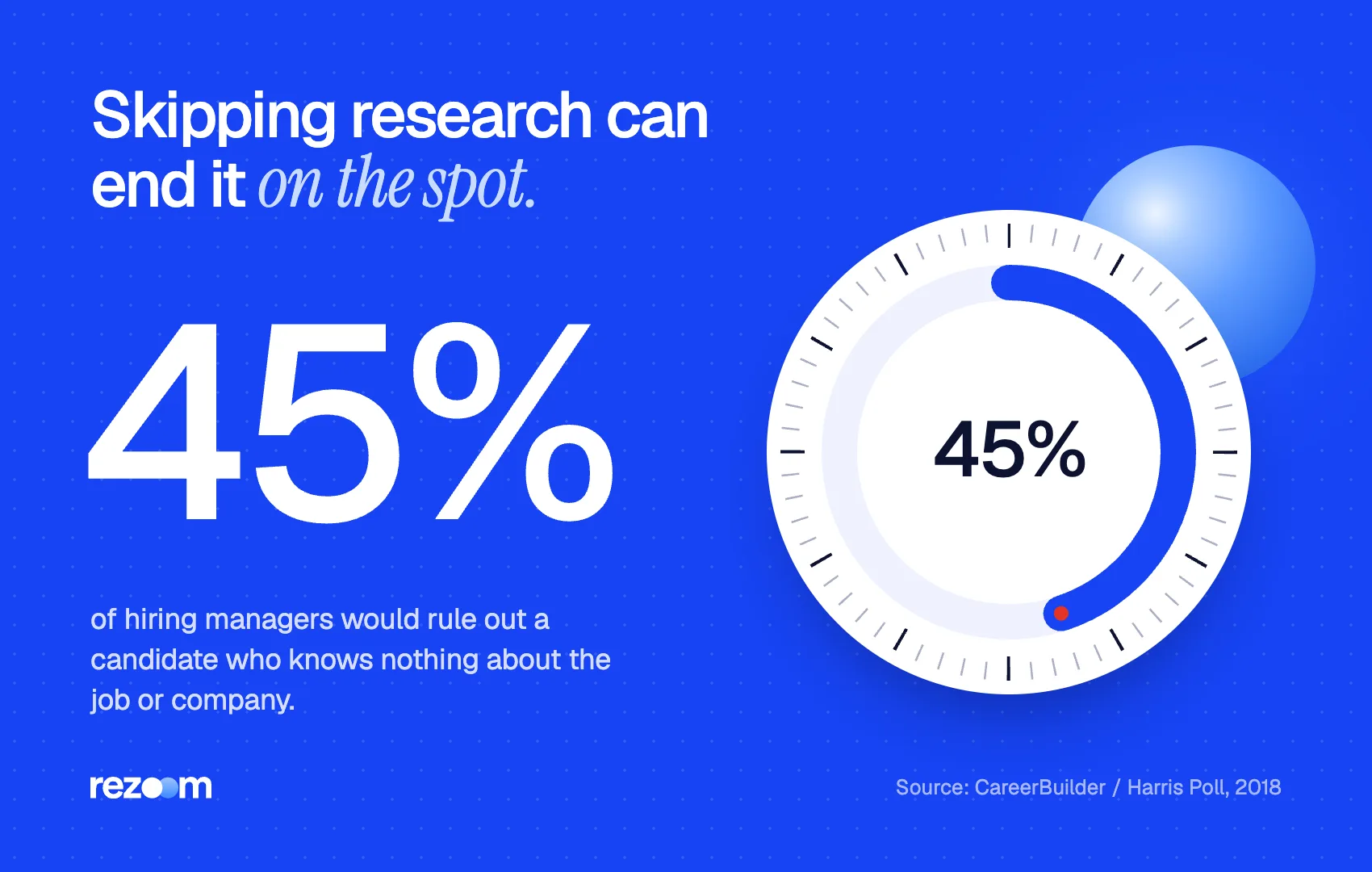
This question is a fast filter. In a Harris Poll survey of 1,014 hiring managers for CareerBuilder, 45% said a candidate who knows nothing about the job or company would be written off immediately. Another 35% said the same about knowing nothing about the industry or competitors.
HR leaders put it even more bluntly. A SHRM article on classic interview questions says "nothing should eliminate a candidate from consideration faster than a lack of research" into the employer.
Behind the question, the interviewer is checking three things:
- Effort. Did you prepare, or are you improvising?
- Interest. Do you want this job, or any job?
- Fit. Do you understand what the company does well enough to contribute?
How do you research a company in 20 to 30 minutes?
Research a company in four timed blocks: the website and newsroom, the annual report or 10-K, LinkedIn and employee reviews, then the job description. Write down five facts as you go, and keep the three most relevant to your role. Thirty minutes is enough for a first interview.
Set a timer. The goal is not to know everything; it is to find three facts you can discuss with confidence.
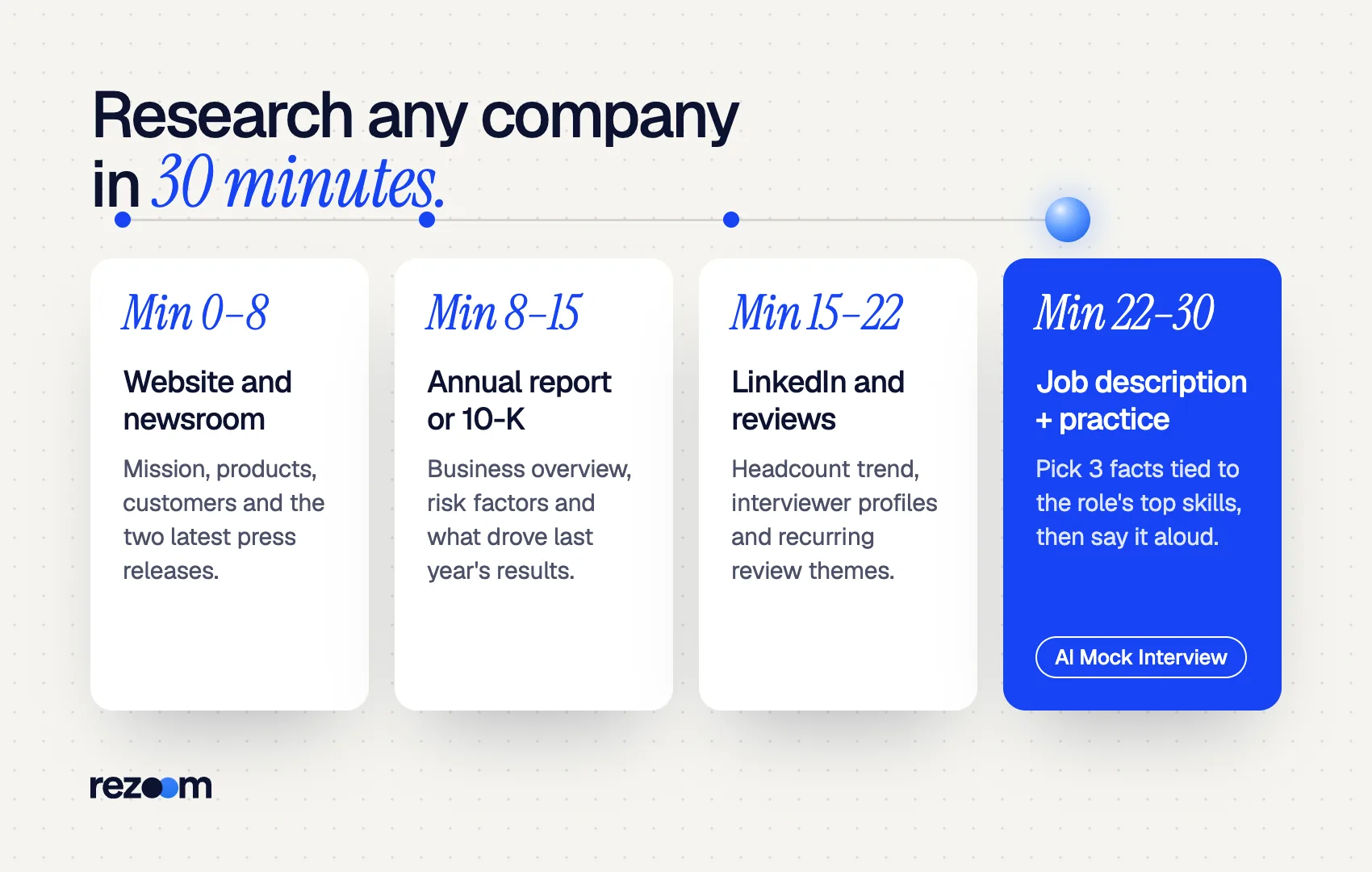
| Time | Source | What to note |
|---|---|---|
| 0–8 min | Company website and newsroom | Mission, main products or services, customers, the two latest press releases |
| 8–15 min | Annual report or 10-K (public companies) | Business overview, top risks, what leadership says drove results |
| 15–22 min | LinkedIn and employee review sites | Headcount trend, recent hires, interviewer profiles, recurring review themes |
| 22–30 min | Job description | The top three skills, the team's goals, and how your facts connect to them |
Website and newsroom. The University of Florida's career center calls the company website "the first course of action" for mission, history, culture and products. Then open the newsroom for anything from the last six months.
Annual report or 10-K. For public companies, the SEC's EDGAR database is free. Investor.gov explains that a 10-K includes audited financial statements, the company's material risk factors, and management's discussion of the prior year's results. Skim the business overview and risk factors; that is where you find what leadership worries about. Nonprofits often publish annual or impact reports, and private companies may have investor or funding announcements.
LinkedIn and employee reviews. UConn's career center notes that LinkedIn company pages show employees, open postings and organization insights, and that review sites often include past candidates' interview questions. Look up your interviewers too. Treat individual reviews as anecdotes, not facts.
Job description. Finish here. Pick the fact that connects most directly to the work you would do. NACE reports that more than 80% of employers highlight the key skills needed in their job descriptions, so the posting tells you which facts matter.
Find the one thing leadership worries about
Most candidates quote the mission statement. Few read the risk factors or the CEO's annual letter. Mention one priority leadership has named publicly, such as expanding into a new market or cutting delivery times, and say how your role supports it. That turns a research answer into a contribution answer.
How do you answer "What do you know about our company?"
Use this formula for your answer to "what do you know about our company":
- What you do (one sentence). Products, customers and scale, in your own words.
- What's new (one or two sentences). A recent launch, expansion, report or stated priority.
- Where I fit (one or two sentences). How your experience connects to that fact.
- Optional close. A short question about that priority.
"From what I've read, [company] helps [customers] with [product or service], and you've grown to [size or reach]. What stood out to me was [recent development], especially [specific detail]. That connects to my experience with [relevant skill or result], so I'd be able to help with [team goal from the job description]. Is that initiative something this team is involved in?"
Sample answers for different company types
Tailor your facts to the company type. For a public company, cite the annual report or a stated strategy. For a startup, mention funding, product and stage. For a nonprofit, use mission and program outcomes. For a hospital or local business, focus on community, services and reputation.
Each example below is written to be spoken. The company details are placeholders; replace them with facts you have verified.
"I know you're one of the largest regional grocery chains, with around 300 stores across five states. In your latest annual report, leadership named e-commerce growth and supply chain efficiency as priorities, and I saw you opened a new automated distribution center this year. I've spent three years improving warehouse fill rates, so I'd be excited to help this team scale the new site. How far along is the rollout?"
"You're building scheduling software for independent clinics, and you closed a Series A this spring to expand beyond physical therapy practices. I also noticed you've nearly doubled your customer success team on LinkedIn this year. That tells me onboarding is a priority. I built an onboarding playbook at my last SaaS company that cut time to first value by two weeks, and I'd like to do the same here."
"Your organization provides free tax preparation and financial coaching for low-income families in the metro area. In your most recent impact report, you shared that you served more families than the year before and added a second coaching site. I volunteered as a tax preparer for three seasons, so I understand the client side, and I'd love to help grow the coaching program as you expand."
"I know you're a teaching hospital with a Level I trauma center, and your newsroom recently announced a new cardiac care unit. I also read that you're investing in nurse residency programs for new graduates. As a new grad who completed my capstone in cardiac step-down, that's exactly the environment where I want to start and grow."
"You've been a family-owned HVAC company here for over 25 years, and your reviews consistently mention fast response times and technicians who explain the work clearly. I saw on your site that you've added commercial service. With my experience scheduling technicians for both residential and commercial clients, I could help keep those response times fast as you grow."

How is this different from "Why do you want to work here?"
These two questions often come together, and candidates blur them. Keep them distinct:
- What do you know about our company: evidence of research. Facts first, then fit.
- Why do you want to work here: your motivation. Values, growth and goals first.
If you get both, use different material. For the motivation answer, see our guide to why do you want to work here. Your research also fuels the end of the interview, so save one fact for your questions to ask in an interview.
What mistakes should you avoid?
Avoid saying you know nothing, reciting the About page word for word, quoting outdated or wrong facts, dwelling on negative news or reviews, and listing facts without connecting them to the role. Accuracy matters more than volume: three correct facts beat ten shaky ones.
Use two or three facts you can explain if asked a follow-up do: Cite something from the last six months when you can do: Connect at least one fact to the role you are interviewing for do: Mention industry context or competitors briefly if you know them well
Say "Not much, I was hoping you could tell me" dont: Read the mission statement back word for word dont: Lead with layoffs, lawsuits or harsh employee reviews dont: Guess at numbers you are not sure about
Industry knowledge is part of the test. The same CareerBuilder survey found 35% of hiring managers would rule out a candidate who knows nothing about the industry or competitors. The UF career center suggests researching competitors because it "can provide some information into the industry."
Then practice saying it aloud. Run the question in Rezoom's AI mock interview to check that your answer stays under 90 seconds. For the rest of your prep, review our common interview questions and tell me about yourself guides.
Frequently asked questions
What if I can't find much about the company?
Use what exists: the website, the job description, LinkedIn employee profiles and local news. Then show industry knowledge and ask a thoughtful question. Never invent facts to fill the gap.
How many facts should I mention?
Two or three. Pick facts you understand well enough to discuss, and connect at least one to the role.
Should I mention negative news about the company?
Usually not as your lead. If a challenge is public and relevant to the role, frame it as a problem you could help solve, and keep the tone neutral.
How long should my answer be?
About 60 to 90 seconds. That is long enough for a few facts and one connection to the job, without turning into a recitation.
Where do I find a company's annual report or 10-K?
Public companies post annual reports on their investor relations page. You can also search the SEC's free EDGAR database by company name and filter for Form 10-K.
Is it OK to bring notes to the interview?
Yes, a short page of notes is fine, especially for virtual interviews. Glance at them; do not read your answer word for word.



Comments