

Summary
Tell me about yourself frames the whole interview. In one study of 189 structured mock interviews, competence impressions formed in the first few minutes correlated .42 with final scores and .22 with internship offers. Give a 60-90 second answer: what you do now, one result that proves it, and why this role comes next. Choose a headline your resume and references would repeat.
Tell me about yourself sounds like a warm-up, and most candidates treat it as one. The research suggests the warm-up decides a good deal of the interview.
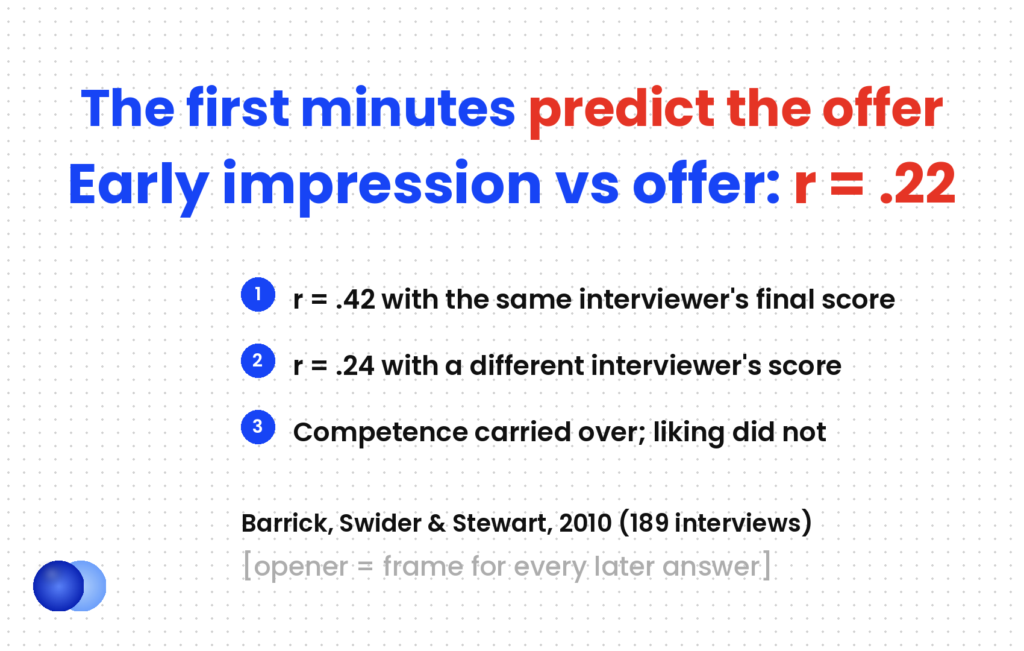
In a Journal of Applied Psychology study, Barrick, Swider and Stewart found that impressions formed in the opening two to three minutes correlated .42 with the interviewer's own final scores and .22 with real internship offers. Those early judgements concerned competence, not charm.
So your answer is not small talk. It frames every later answer, and your resume and references will test it. Below: a structure that holds up and 15 short sample answers by role.
Why does tell me about yourself carry so much weight?
Because it lands in the opening minutes, when interviewers form a first judgement of your competence. In one study that judgement predicted final scores and job offers, and interviewers tend to confirm first impressions rather than test them.
Early judgements stick. Across 189 structured mock interviews, ratings from a short rapport phase predicted the same interviewer's final scores at .42, a different interviewer's scores at about .24, and internship offers at .22. Liking and similarity did not carry across interviewers. Competence did.
Interviewers confirm what they already think. Dougherty, Turban and Callender followed three interviewers through 79 real interviews. As Judge, Higgins and Cable summarise it, a positive first impression led interviewers to sell the company harder and share more, and candidates responded more warmly, confirming the impression.
So the first answer should carry evidence of competence, not personality adjectives.
What will your answer be checked against?
Your resume, your later answers and your references. A reference check asks about duration, biggest accomplishment, strengths and why you left. Tell me about yourself touches all four, so your headline should be something a former manager would describe the same way.
It is the same consistency test behind the greatest weakness interview answer: a claim nobody else can confirm scores nothing.
Indeed's standard reference-check questions map almost line for line onto a good answer:
| What your answer says | The reference question that checks it |
|---|---|
| "For the last three years I've…" | "How long did the candidate work for your company?" |
| "The result I'm proudest of is…" | "What was one of this candidate's biggest accomplishments?" |
| "What I'm best at is…" | "What are this candidate's greatest strengths?" |
| "I'm looking to move because…" | "Why did this candidate leave your company?" |
Lead with "turning around failing accounts" when your manager remembers process documentation, and the panel hears two different people. Your headline should also match the one you give when asked what are your strengths in an interview.
How should you structure your answer to tell me about yourself?
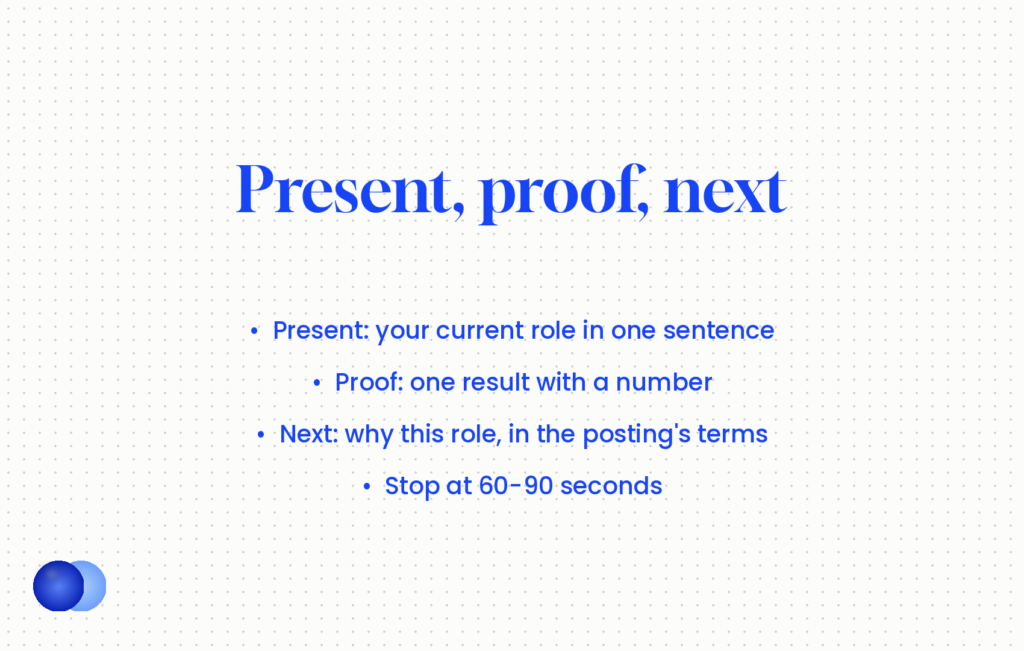
Present, proof, next. Say what you do now in one sentence, give the single result that proves you are good at it, then explain why this role is the logical next step. Keep it to 60-90 seconds and stop, so the interviewer can choose what to ask next.
The usual present-past-future formula works, but the "past" section is where answers drift into a life story. Swap it for one piece of proof.
Present. Your current role and scope in one sentence.
Proof. One result, told briefly: a compressed STAR method interview answer with a number.
Next. Why this role, in the posting's terms. It shows you chose them rather than applying everywhere.
How long should the answer be?
Harvard's career office, in a 2026 guide written with Forage, suggests 30 to 90 seconds and warns that past two minutes it "can start to feel like too much". The Interview Guys propose 90 to 120 seconds.
| Source | Recommended length |
|---|---|
| Harvard FAS / Forage, 2026 | 30–90 seconds, never past two minutes |
| The Interview Guys, 2026 | 90–120 seconds |
| Rezoom recommendation | 60–90 seconds; up to two minutes for senior roles |
Seniority explains the gap: a director may need a sentence of career arc. Two minutes is the ceiling either way.
Write the reference call first
Before drafting your tell me about yourself answer, note how your last manager would describe you in two sentences. Build your answer around that headline, not the one you wish for. Then brief that manager on the role, so your project is fresh when the call comes. Two sources telling one story turn a claim into evidence.
Tell me about yourself: sample answers for professional and technical roles
Technical and analytical roles reward a measurable proof point: a cost saved, a time cut, an error rate reduced. Each sample below is illustrative, with invented employers and numbers. Replace every detail with your own, because borrowed details fail the reference check at once.
Each is the spine of an answer, about 30 seconds spoken. Add context to the proof to reach 60–90 seconds.
1. Software engineer
"I'm a backend engineer at a payments company, working on refunds. After a run of duplicate refunds I rebuilt our retry logic, and incidents dropped from about eight a month to one. Your posting stresses reliability at scale, the work I want more of."
2. Data analyst
"For three years I've supported a regional sales team of 40. I replaced their weekly spreadsheet with a dashboard managers actually use, cutting reporting from a day to an hour. Your role sits closer to product decisions, where I want my analysis to land."
3. Accountant
"I'm a staff accountant at a manufacturer, running month-end close on two entities. When close kept slipping past day ten, I rebuilt the reconciliation checklist; we now close on day six. You're growing through acquisitions, and clean integration is exactly what I've been doing."
4. Product manager
"I manage a scheduling app for small clinics. We interviewed 30 clinic managers, shipped a simple SMS reminder, and no-shows fell by about a fifth. This role serves a larger healthcare user base with the same problem, which is why I applied."
5. Marketing manager
"Right now I run lifecycle email for a subscription meal kit. Rewriting the cancellation flow kept roughly 11% of customers who had started to cancel. Your posting focuses on retention, and that's where my experience is deepest."
Which sample answers fit people-facing roles?
People-facing roles reward observed behaviour: what a patient, customer or manager saw you do, ideally with feedback someone else gave. These samples are illustrative too. The strongest version names a person who would confirm it, such as a supervisor who is also a reference.
6. Sales representative
"I've spent four years in inside sales, selling software to operations managers. Last year I focused on fewer, better-qualified leads and finished at 118% of quota. Your team sells to a similar buyer on a longer cycle, where qualification matters most."
7. Customer service representative
"I handle escalated billing complaints for a telecoms provider. After a year of satisfaction scores in the team's top three, my supervisor started routing her hardest calls to me. Here I'd like to shape how a team handles escalations."
8. Registered nurse
"I've been a registered nurse on a surgical ward for five years. I led our switch to bedside handovers, and my manager then asked me to train two other wards. Your hospital is expanding day surgery, and patient flow is what I care about most."
9. Teacher
"I teach maths to 11- to 14-year-olds and lead catch-up support. Moving our sessions from after school into short in-class groups helped more of those pupils reach their target grade. Your school runs the same model, and I'd like to take it further."
10. Administrative assistant
"I support three directors at a property firm: diaries, travel and board papers. When board packs kept going out late, I set up a shared timetable with contributors, and they've gone out on time for a year. Your role supports a larger team, the scale I'm ready for."
Which sample answers fit different career stages?
Graduates, career changers, returners and people recently laid off should answer the question asked, not the one they fear. Name the situation in one clause, give proof, and point forward. Senior candidates can add one sentence of career arc.
11. Recent graduate
"I've just finished an economics degree; my final-year project modelled local bus ridership from open data. Part-time, I trained new starters at a café. Your graduate scheme mixes analysis with client work, the combination I enjoyed most."
12. Career changer
"I taught secondary school for six years, and course design was my strongest skill. Since then I've earned an instructional design certificate and built an e-learning module now used by 300 charity volunteers. Adult training continues that work."
13. Recently laid off
"Until March I was a logistics coordinator at a retailer that closed its regional warehouse. Before that, I cut our average delivery delay from three days to one by reworking carrier schedules. Scheduling is central to your role."
14. Returning after a career break
"I was an HR adviser for seven years, then spent three years caring for a family member. Meanwhile I kept my certification current and sat on a school's staffing panel. Your generalist role matches my experience, and I'm ready to return."
15. Senior manager
"I've spent 15 years in operations, the last five running four distribution centres. My career has been fixing underperforming sites; here I took our worst-rated centre to second-best on safety in two years. You're opening new sites, and the early years are where I add most."
What mistakes make this answer backfire?
Reciting the resume, telling a life story, listing adjectives, and saying something your references would contradict. The last costs most, because an early inconsistency frames the rest of the interview in the wrong direction.
Reciting the resume. The panel has it already.
Starting at birth. "I grew up in…" spends prime minutes on irrelevant facts.
Adjectives, not evidence. Competence travels between interviewers; liking does not.
Over-explaining a gap. One sentence is enough; how to explain an employment gap covers the wording.
Life story: "So I grew up in Leeds, studied history, fell into recruitment, then started thinking about HR…"
Present, proof, next: "I'm an HR adviser at a 600-person logistics firm. Last year I rewrote our absence policy with site managers, and short-term absence fell by about a fifth. You're centralising HR across your sites, and policy work at that scale is what I want next."
Lead with the headline a former manager would give, prove it with one result, and stop within 90 seconds.
Memorise a sample answer word for word, because borrowed details collapse at the first follow-up question.
Interviewers with positive first impressions of an applicant sell the applicant more on the company, do more recruiting, and tell them more about the company.
What can't a good answer fix?
Barrick's candidates were students, so treat the exact correlations as indicative.
A polished tell me about yourself answer also cannot survive a resume that contradicts it. If your bullets list duties, your proof has nothing behind it.
Nor does it replace later answers. The opener sets the frame; behavioral interview questions test it.
What it can do is make the first judgement accurate. Rehearse it aloud against a real posting with Rezoom's interview preparation tools, and time it.
Frequently asked questions
How long should my answer to tell me about yourself be?
60 to 90 seconds, and never past two minutes.
What is the best structure for tell me about yourself?
Present, proof, next: your current role, one result that proves you are good at it, and why this role follows.
Should I start with my personal background?
No. Start with your current role; personal details belong only if they explain why you want this job.
Are the sample answers real?
No. All 15 are illustrative, with invented employers and numbers. Replace every detail with your own verifiable results.
Does the answer really affect the outcome?
Evidence suggests so. In one study of student candidates, early competence impressions correlated .42 with final scores and .22 with offers.
Should my answer match my resume?
Yes, and your references. Reference checks commonly ask about your biggest accomplishment, strengths and reason for leaving.
How do I answer if I was laid off?
Name it in one factual clause, give a result from the role, and point to this job. No apology, no blame.
Is the answer different in a phone screen?
Same structure, shorter end of the range. Recruiters usually move quickly on to logistics and salary.



Comments