

Summary
Behavioral interview questions are scored against a rubric, and in the US government's structured interview model the thing that separates a low rating from a high one is the difficulty of the situation you describe and how little guidance you needed. The same question can earn a 1 or a 5. So preparation is mostly story selection: pick harder situations, keep your own actions visible, and have a real result ready for the follow-up probe.
Behavioral interview questions look like the easy part of an interview, because every candidate knows the format: describe a time when something happened, then say what you did. That familiarity is the trap. Most people prepare the delivery and neglect the one choice that actually moves the score.
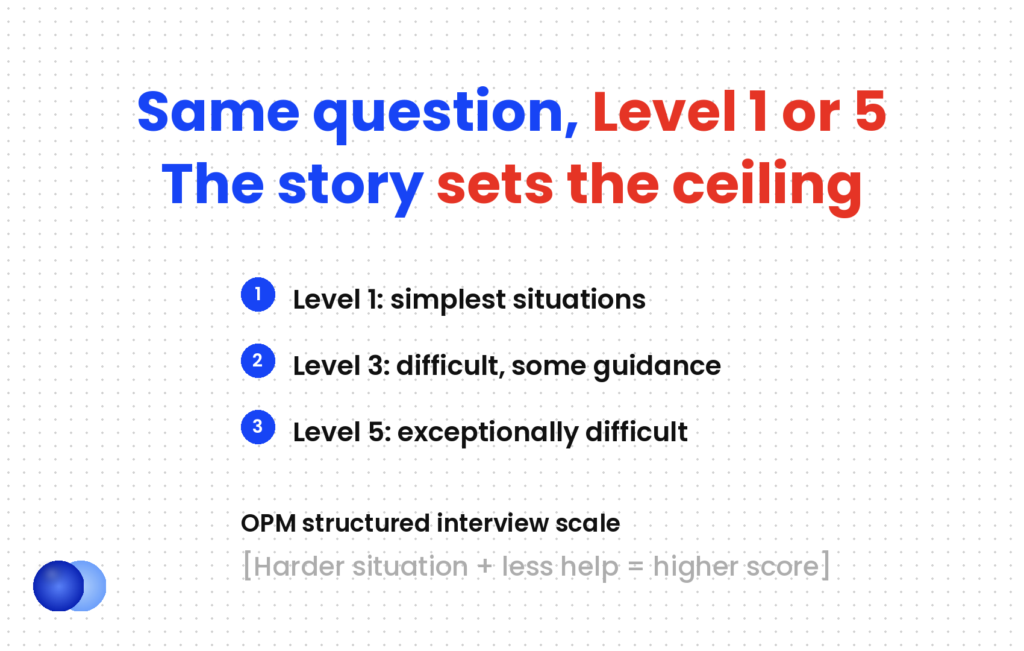
In a structured interview, your answer goes onto a rating scale. The US Office of Personnel Management's model runs from Level 1, applying a skill "in the simplest situations", to Level 5, applying it "in exceptionally difficult situations". The question stays the same for every candidate. The situation you choose to describe does not — and that choice caps your rating before you say a word about what you did.
So this guide gives you 40 questions grouped by the competency each one tests, a note on what a strong answer contains, and a method for choosing stories that score at the top of the scale rather than The opener that comes before them works differently, and how to answer the tell-me-about-yourself question covers that separately.
What do behavioral interview questions actually score?
A specific competency, rated on a fixed scale. Structured interviews anchor each point on that scale to example behaviours, and the anchors rise with two things: how difficult the situation was and how little help you needed. Polish, confidence and length are not on the scale.
Each behavioural question starts as a competency from a job analysis and exists to draw out a past example of it. OPM's Structured Interview Guide states the premise directly: the best predictor of future behaviour is past behaviour under similar circumstances.
Here is OPM's five-level scale, with its own examples for interpersonal skills:
| Level | Definition (OPM) | Interpersonal-skills example |
|---|---|---|
| 1 · Awareness | Simplest situations; close, extensive guidance | Greeting job applicants |
| 2 · Basic | Somewhat difficult; frequent guidance | Helping with a benefits problem |
| 3 · Intermediate | Difficult; occasional guidance | Resolving a conflict between angry co-workers |
| 4 · Advanced | Considerably difficult; little or no guidance | Fostering co-operation during a negotiation |
| 5 · Expert | Exceptionally difficult; advises others | Defusing an emotionally charged stakeholder meeting |
Nothing in the right-hand column concerns how well the candidate told the story. The anchors describe what kind of situation it was, so a flawless answer about greeting applicants still sits at Level 1. Private employers vary in formality, but structured behavioral interview questions mostly work this way: a question, standard probes, and a score per competency.
Why does structure matter so much to your score?
Because structured interviews predict job performance far better than conversational ones, employers who care about hiring well use them. Schmidt and Hunter put structured interview validity at 0.51; Sackett and colleagues' 2022 re-analysis puts it at 0.42 against 0.19 for unstructured.
Schmidt and Hunter's 1998 meta-analysis put structured interviews at a validity of 0.51. Sackett and colleagues revisited the estimates in 2022, fixing an overcorrection in the older method. Their revised figures came in at 0.42 for structured interviews against 0.19 for unstructured ones — roughly twice the predictive power.
SIOP's summary of the study reports that they had the highest mean operational validity of any predictor examined, ahead of cognitive ability at 0.31.
Two consequences follow. The questions are fixed: you cannot steer the conversation towards your strengths, because every candidate hears the same behavioral interview questions in the same order. And the notes matter more than the mood: a warm conversation that left thin notes scores below a stiff one that produced a clear situation, action and result.
Choose the harder story on purpose
When two stories fit a question, pick the one with the more difficult situation, even if the outcome was messier. Rating anchors climb with difficulty, so a partly successful answer about an angry client with a contract at risk can outscore a tidy answer about a mildly confused one. Name the difficulty explicitly in your first two sentences: the stakes, the deadline, who was upset. An interviewer cannot rate complexity you never mentioned.
Which behavioral interview questions come up most?
Eight competencies account for most of them: teamwork, conflict, leadership and influence, problem-solving, failure and accountability, adaptability, communication, and initiative. Below are five questions for each, forty in total, with what a strong answer needs to contain.
Each line gives the question and the element that separates a high score from a middling one. Answer in the STAR structure — the STAR method interview guide covers the mechanics, so this list concentrates on story choice.
Teamwork and collaboration
- Tell me about a time you worked on a team that wasn't getting along. Show what you changed, not how the team eventually settled.
- Describe a project where you relied on someone else's work. Name the dependency and how you managed the risk of it.
- Give an example of helping a colleague who was struggling. Pick one where helping cost you something, such as time on your own deadline.
- Tell me about a time you had to share credit. A strong answer shows you credited others without erasing your own contribution.
- Describe working with someone whose style was very different from yours. Land on a specific adjustment you made, not on mutual respect.
Conflict and difficult people
- Tell me about a disagreement with your manager. Choose one where you held your position with evidence, whichever way it ended.
- Describe a time you dealt with an upset customer or stakeholder. State what was at risk; the difficulty of the situation drives the score.
- Give an example of a conflict between two colleagues you helped resolve. Show the mechanism you used, such as a shared metric or a joint meeting.
- Tell me about receiving criticism you thought was unfair. Separate what you accepted from what you pushed back on.
- Describe a time you had to say no to someone senior. The result should include how the relationship held up afterwards.
Leadership and influence
- Tell me about a time you led without formal authority. Name the lever you used: data, a prototype, or an ally.
- Describe persuading someone who initially disagreed with you. Show that you understood their objection before you answered it.
- Give an example of delegating something important. Include how you checked progress without taking it back.
- Tell me about motivating a team through a difficult period. Concrete actions beat descriptions of your attitude.
- Describe a decision you made that was unpopular. Show your reasoning, and whether it proved right.
Problem-solving and judgement
- Tell me about a complex problem you solved. Spend more time on how you diagnosed it than on the fix.
- Describe a decision you made with incomplete information. Say what you knew, what you assumed, and how you limited the downside.
- Give an example of spotting a problem before others did. The signal you noticed is the most interesting part.
- Tell me about a time you used data to change a plan. Give the number that changed your mind.
- Describe choosing between two good options. Name the criteria you weighed and what you gave up.
Failure, mistakes and accountability
- Tell me about a time you failed. Pick a real failure with real consequences; a disguised success scores poorly.
- Describe a mistake you made at work and how you handled it. Show that you reported it before someone else found it.
- Give an example of missing a deadline. Explain what you changed in your process afterwards, with evidence it worked.
- Tell me about feedback that changed how you work. The before-and-after needs to be observable, not just felt.
- Describe a project that didn't go as planned. Own your share without blaming circumstances.
Adaptability and pressure
- Tell me about a time priorities changed suddenly. Show how you decided what to drop.
- Describe working under a very tight deadline. Quantify the deadline and the trade-offs you made to hit it.
- Give an example of learning something new quickly. Name the skill, the timeframe, and what you produced with it.
- Tell me about adapting to a major change at work. A reorganisation or new system works well; show early action rather than tolerance.
- Describe handling several urgent tasks at once. Explain your triage rule, not just that you coped.
Communication
- Tell me about explaining something complex to a non-expert. Include how you checked that they understood.
- Describe a time you had to deliver bad news. Timing and framing are what the interviewer rates.
- Give an example of a written document that made a difference. Say what it caused someone to decide or do.
- Tell me about a misunderstanding you had to fix. Show what caused it and what you changed to prevent a repeat.
- Describe presenting to a sceptical audience. Name the toughest question you faced and your answer.
Initiative and results
- Tell me about a time you went beyond your role. Make sure it was needed, not just extra.
- Describe improving a process nobody asked you to fix. Give the before and after in numbers.
- Give an example of setting yourself a goal and hitting it. Stretch goals score higher than safe ones.
- Tell me about your proudest achievement. Choose the most difficult one, not the most prestigious.
- Describe a time you had to get something done with limited resources. Name exactly what was missing and how you replaced it.
How do you choose the right story for each question?
Build a bank of five to eight strong stories and map each to the competencies it can cover. MIT's career office suggests starting with three to five. Then, for each likely question, pick the story with the hardest situation and the clearest personal action, not the most impressive employer.
Forty questions do not need forty stories. MIT's career advising office recommends preparing three to five, and one good story often covers several competencies. A launch that went wrong can answer failure, pressure, conflict or communication questions, depending on which slice you tell.
| Story | Competencies it can answer |
|---|---|
| Rescued a delayed client launch | Pressure, conflict, problem-solving |
| Pushed back on a manager's forecast | Conflict, influence, judgement |
| Missed a reporting error for two cycles | Failure, accountability, process change |
| Trained a new hire during a reorganisation | Leadership, adaptability, communication |
| Rebuilt an onboarding process unasked | Initiative, results, collaboration |
Three checks for every story
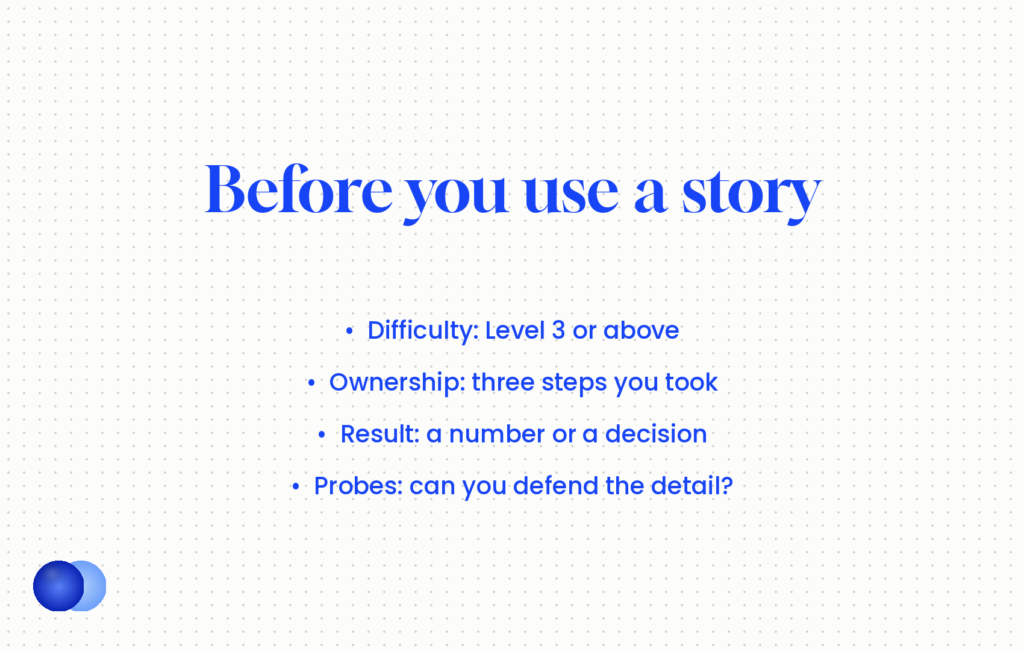
Difficulty. Would it sit at Level 3 or above on the OPM scale? If a stranger would find the situation routine, find a harder one.
Ownership. Can you name three concrete steps you took? MIT's guidance warns that "we" statements make your skills hard to see.
Result. Is there a number, a decision or an observable change? If the honest result was mixed, say so and add what you learned.
Question: "Tell me about a time you dealt with a difficult stakeholder."
Level 2 story: "A colleague in finance kept asking for my report in a different format. I set up a quick call, agreed a template, and sent it that way from then on."
Level 4 story: "Our largest client's operations director threatened to pull a £400,000 renewal after a data migration broke their dashboards. I had 48 hours before their board meeting. I ran a call with their team to rank the eight broken reports, rebuilt the three the board used, and sent daily progress notes to the director. They renewed, and asked for me on the next project."
Both candidates speak clearly. The second story wins on difficulty, stakes and independence, which is exactly what the anchors measure.
How do you handle the follow-up probes?
Expect them, because structured interviews use standard probes for every candidate. They usually ask what led up to the situation, what exactly you did, and what the outcome was. A thin answer to any of the three caps the score, however strong the opening was.
OPM's guide lists probes such as "What factors led up to the situation?" and "What was the outcome?", and tells interviewers to use very similar probes for everyone. A probe does not mean you are failing; the interviewer is filling a gap in their notes.
Most gaps come from three habits:
Staying at team level. If your answer says "we", expect "what was your part?" Pre-empt it.
Skipping the result. Close every story with the outcome and one sentence on what you would repeat.
Choosing a story you can't defend in detail. Probes go deeper than a rehearsed answer. If a reference or your resume would tell the story differently, the gap shows — the same consistency test the greatest weakness interview answer guide describes.
Hypothetical questions ("what would you do if…") follow different rules. Those belong to situational interview questions, where no past example is required.
Open each answer by naming the stakes in one sentence, so the interviewer can place the situation on the scale before you describe your actions.
Answer a behavioural question with what you would do in general; without a real past event, there is nothing for the interviewer to rate.
What can't preparation fix?
Story selection raises your score only as far as your real experience allows. A graduate asked about influencing senior leaders will not have a Level 5 story, and interviewers calibrate for the role. A strong Level 3 answer for a junior post beats an inflated one that collapses under the first probe.
Applies the competency in exceptionally difficult situations. Serves as a key resource and advises others.
Structure also cannot remove every bias, and plenty of employers still run loose, conversational interviews where rapport counts for more than it should. Preparing for behavioral interview questions with harder stories helps in both settings, because a specific situation with a clear result reads well Rounds that test skills rather than stories need their own preparation, which is what preparing for a technical interview is for.
To practise out loud, Rezoom's interview preparation tool generates behavioral interview questions from the job posting and lets you rehearse your story bank against them.
Frequently asked questions
What are behavioral interview questions?
They ask you to describe a specific past situation that shows a competency, such as teamwork or problem-solving. The premise is that past behaviour under similar circumstances predicts future behaviour on the job.
How many stories should I prepare?
MIT's career office suggests three to five as a starting point. Five to eight well-chosen stories can cover most of the 40 common questions, because one strong story usually answers several competencies.
How are behavioural answers scored?
In structured interviews, each competency receives a rating on a fixed scale, often 1 to 5. In OPM's model, higher levels reflect more difficult situations and less need for guidance, not a more polished delivery.
Should I use the STAR method?
Yes, as the structure. STAR keeps the situation, your actions and the result in order, which is what the interviewer's notes need. The story you choose to put into that structure matters more than the structure itself.
Can I use the same story twice in one interview?
Avoid it where you can. Interviewers score each competency separately, and reusing a story makes your experience look narrow. Use a different slice of a big project if you must return to it.
What if I don't have an example?
Say so briefly, then offer the closest real example, even from study or volunteering. A hypothetical answer gives the interviewer nothing to rate on a behavioural question.
How long should a behavioural answer be?
Around two minutes is a common target. Give enough detail on the situation to establish its difficulty, spend most of the time on your actions, and always finish with the result.
Are behavioural interviews better than other interview types?
Structured interviews predict job performance better than unstructured ones: Sackett and colleagues' 2022 re-analysis found 0.42 against 0.19. Behavioural questions are one of the most common ways employers structure them.



Comments