

Summary
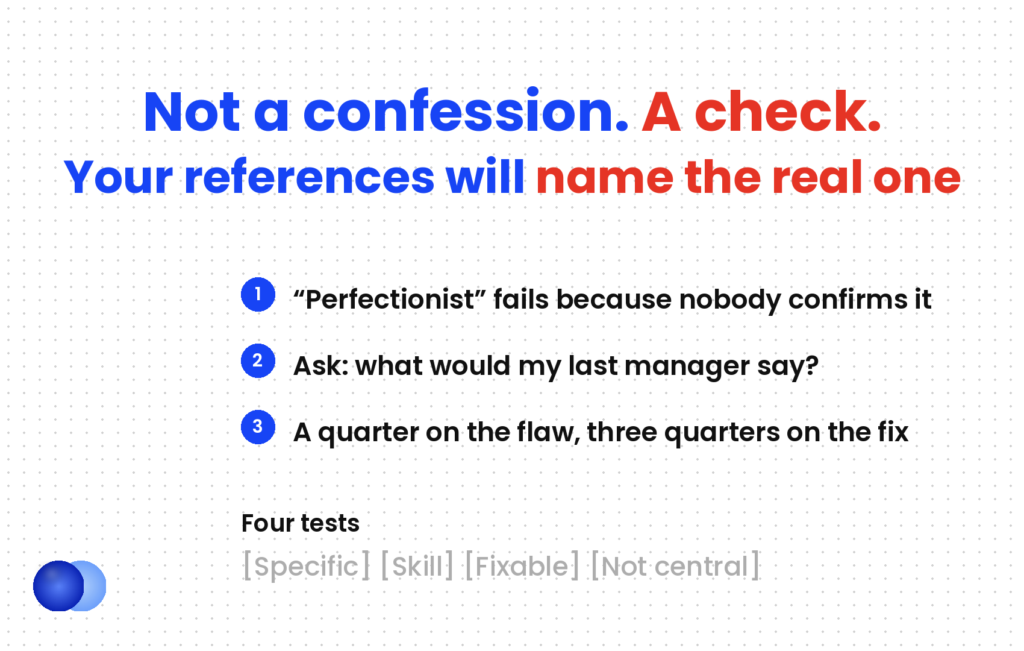
The greatest weakness question is usually framed as a trap to survive. It is better understood as a consistency check. The interviewer has your resume, will speak to your references, and often already suspects the answer — the test is whether yours matches what they will hear. That is why "I'm a perfectionist" fails: it is the one answer no reference will ever confirm.
Almost every guide treats the greatest weakness interview answer as a trap to survive. Avoid the clichés, disguise a strength, survive it and move on.
Here is a more useful way to see it. The interviewer already has your resume, has watched you for forty minutes, and — if you go further — will ask your references directly what you could improve. As career adviser Suzy Welch put it, a good hiring manager can often tell from those sources what you struggle with already. What they want to know is whether you know.
So the greatest weakness interview answer is not a confession. It is a consistency check. And that reframe explains every rule you have been told about it.
Why does "I'm a perfectionist" fail?
The standard explanation for a failed greatest weakness interview answer is that interviewers have heard it too often. True, and it misses the point.
The deeper problem is that nobody would confirm it. Imagine the reference call. "What's one area where Sam could improve?" A real manager answers with something real — delegating, speaking up in meetings, estimating timelines. They do not say "Sam is simply too diligent."
So the humblebrag does two kinds of damage at once:
It signals evasion. The interviewer notices you dodged, which raises the question of what you are avoiding.
It fails the later check. When the reference names something genuine, your answer and theirs no longer agree.
The same applies to "I work too hard", "I'm too dedicated" and "I don't really have weaknesses" — the last being the worst of all, because it signals an absence of the very self-awareness the question assesses.
Ask what your last manager would say
Before the interview, answer one question honestly: if someone asked your previous manager about one area where you could improve, what would they actually say? Whatever comes to mind first is usually your answer. It is real, it is the one most likely to come up in a reference check, and choosing it means your interview and your references tell the same story — which is precisely what a careful hiring manager is looking for.
What makes a good weakness to name?
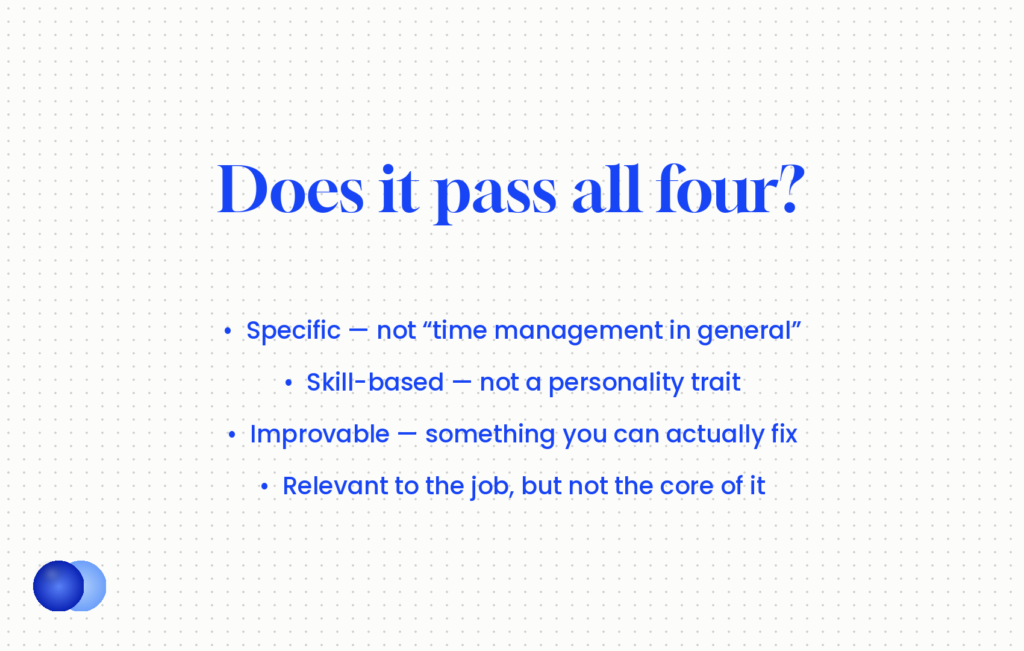
Four tests — specific, skill-based, improvable and relevant but not central to the role. "I'm too shy" fails as personality; "I didn't go to a target school" fails as unfixable; "I'm bad at organisation" fails for a project manager because it is the job.
| Test | Passes | Fails |
|---|---|---|
| Specific | "Estimating how long complex tasks take" | "Time management in general" |
| Skill-based | "Giving critical feedback directly" | "I'm too shy" (personality) |
| Improvable | "Delegating when workload spikes" | "I'm not a native speaker" (not a skill gap) |
| Relevant, not central | Public speaking, for an analyst | Attention to detail, for an accountant |
That fourth row is where people most often go wrong in both directions. Pick something irrelevant — "I can't stand numbers" for a customer service role — and it reads as a non-answer. Pick something central — "I'm bad at writing" for a content role — and you have disqualified yourself.
The target is a real gap adjacent to the job, not inside it.
How do you structure the answer?
Three parts in about 60 seconds — name the weakness plainly, give one concrete moment it caused a problem, then describe the specific step you have taken and what changed. The third part should be the longest, because that is where the assessment actually happens.
1. Name it plainly (one sentence). No softening, no preamble.
2. One real moment (one or two sentences). A specific time it caused a problem. This is what makes it credible.
3. What you did and what changed (the rest). A concrete step, and evidence it is working.
The proportion matters. Interviews increasingly use structured scorecards, and vague answers score poorly on them — a concrete action with a result is what earns the marks. Spend roughly a quarter of the answer on the weakness and three quarters on what you are doing about it.
Weak: "I guess I sometimes struggle with delegation because I'm a bit of a perfectionist and like things done right."
Strong: "I've been slow to delegate when workloads spike. Last quarter I held onto a reporting project too long and my team lead had to step in to hit the deadline. Since then I've used a written handover brief and a mid-point check-in instead of doing it myself — and on the two launches since, I delegated both reports and we delivered early."
Same weakness. The first slides back into the perfectionist cliché and offers no evidence. The second names it, proves it with a real moment, and spends most of its length on a concrete fix with a result.
Twenty greatest weakness interview answers by type
Grouped by kind rather than by job, so you can find the one that matches your real gap. Each works only if it is genuinely yours — a borrowed weakness collapses under a follow-up question or a reference call.
Execution
- Estimating how long complex tasks will take
- Taking on too much before saying no
- Getting absorbed in detail on low-stakes work
- Starting before the brief is fully clear
Communication
- Giving critical feedback directly
- Speaking up early in large meetings
- Presenting to senior audiences
- Writing concisely under time pressure
Collaboration
- Delegating when workloads spike
- Asking for help early rather than late
- Pushing back on scope changes
- Following up on work others own
Technical and analytical
- Analysis paralysis — wanting every angle before deciding
- A specific tool or skill the role uses lightly
- Documentation of your own work
- Keeping up with a fast-moving area of the field
Management (for leadership roles)
- Letting a struggling report continue too long before intervening
- Staying too close to hands-on work
- Communicating decisions before they are final
- Balancing team development against delivery pressure
Pick the one that is genuinely true. The list is a vocabulary for your real answer, not a menu of safe choices — the STAR method gives you the structure for the "one real moment" part.
Keep your answer consistent with what your references would say, and brief your references on the role before they are called — the resume reference page covers how.
Volunteer health conditions or personal circumstances. The question asks about a professional skill gap, and you are not obliged to disclose anything medical or personal in answering it.
What if they ask for a second weakness?
Have one ready. A follow-up often probes whether your first answer was rehearsed, so a second genuine weakness — in a different category from the first — shows the self-awareness was real rather than scripted.
Some interviewers ask "and another?" to get past a rehearsed greatest weakness interview answer.
Prepare two, from different categories. If your first is execution, make your second communication or collaboration. Two from the same group reads as one idea stretched. In a panel interview, the second ask often comes from a different person in the room.
Keep them coherent with your strengths. If you have said your strength is stakeholder alignment, a weakness in "communicating with senior audiences" contradicts it. The pair should make sense together.
Hold the same structure. Name it, one moment, what changed. Brevity is fine here — the second answer is checking authenticity rather than looking for depth.
Answers like "I'm a perfectionist" or "I'm a workaholic" are the red flags of phoniness.
How should you prepare?
Ask what your last manager would say, check it against the four tests, find one real moment, and write down the specific step you took. Then rehearse it aloud until it takes about sixty seconds and sounds like something you actually believe.
Preparing your greatest weakness interview answer takes four steps:
1. Find the real answer. What would your last manager name? Start there.
2. Run the four tests. Specific, skill-based, improvable, relevant but not central.
3. Find the moment and the fix. One concrete instance, one concrete step, one result.
4. Rehearse aloud. Sixty seconds. Reading it silently tells you nothing about whether you can say it without sounding scripted.
Because the answer is only as good as its match with your references, signs an interview went well is worth reading alongside this — the strongest signals come later in the process, when what you said gets checked against what others say.
Frequently asked questions
What is a good answer to "what is your greatest weakness"?
A real, specific, skill-based weakness that is relevant but not central to the role, followed by one concrete moment it caused a problem and the specific step you have taken to improve.
Why shouldn't I say I'm a perfectionist?
Because no reference will ever confirm it. The question works partly as a consistency check against what your former manager will say, and "too much attention to quality" is not something they will name.
What weaknesses should I avoid mentioning?
Anything central to the role, personality traits you cannot change, things that are not skill gaps at all, and clichés like "I work too hard." Also avoid saying you have no weaknesses.
How long should my answer be?
About sixty seconds. Spend roughly a quarter on the weakness itself and three quarters on what you have done about it.
What if they ask for another weakness?
Have a second genuine one ready, from a different category than your first. Follow-ups often test whether the first answer was rehearsed.
Do I have to mention a health condition?
No. The question is about a professional skill gap, and you are not obliged to disclose anything medical or personal.
Should my weakness match my references?
Ideally, yes. The strongest answer is the one your former manager would name themselves, so your interview and your references tell the same story.
Is it okay to name a technical skill as a weakness?
Yes, if the role uses it lightly rather than centrally. A tool you are still building proficiency in is a good answer; the core skill of the job is not.



Comments