Describe a Time You Untangled a Confusing Customer Request: Answers
How to answer a confusing customer request interview question: what it tests, a STAR plan for multi-issue requests, 5 sample answers by job and a template.

On this pageWhat does the confusing customer request question test?
- What does the confusing customer request question test?
- How do you structure a STAR answer for a multi-issue request?
- Sample answers to the confusing customer request question by job
- How do you build your own answer? A fill-in-the-blank template
- What should you say if they push back?
- What mistakes ruin a confusing customer request answer?
- How do you show these skills on your resume and in your letter?
- FAQ
- Sources
To answer "describe a time you untangled a confusing customer request," pick one real case with two or more products or issues. Show how you asked clarifying questions, split the request into separate parts, fixed or routed each part, and followed up. End with a clear result, such as one contact instead of three, and what you changed afterward.
To answer a confusing customer request question, tell one true story where a customer mixed two or more problems. Show that you asked questions, split the request into parts, owned each part and followed up until it closed.
This question shows up in customer support, retail, bank and telecom screens. You will often meet it in an online assessment or a one-way video interview. So you need a tight answer you can say in about two minutes.
Most guides give one generic "angry customer" answer. This one gives a STAR plan built for multi-issue requests. It also has five word-for-word answers by job and a script for follow-up questions.
Quick answers by situation
| Your situation | What to stress | Example line |
|---|---|---|
| Call center or support rep | Clarifying questions and a recap | "I repeated back the three issues so we agreed on the list." |
| Retail associate | Splitting a return, exchange and price issue | "I handled the return first, then the price match." |
| Bank or telecom rep | Accounts, billing and a fix in one call | "I split it into the fee, the plan and the device." |
| SaaS support | Separate tickets and clear owners | "I logged two tickets and told her who owned each one." |
| No job experience | School, volunteer or family example | "At the food bank, I sorted one donor's three questions." |
What does the confusing customer request question test?
The confusing customer request question tests four skills. Do you ask clarifying questions before acting? Do you break a messy request into parts? Then do you own each part until it is done and follow up? It also checks that you stay calm and kind when the customer cannot explain the problem well.
Customers rarely bring one neat problem. A caller might want a refund, a plan change and help with a login in the same breath. So the interviewer wants proof that you can sort the pieces without losing any of them.
The four skills behind the question
- Clarifying questions: You ask what the customer needs before you start fixing things.
- Breaking it down: You turn one long story into a short list of separate issues.
- Ownership: You solve what you can and hand off the rest to a named person, not a void.
- Follow-up: You confirm each part is closed, often with a recap email or a callback.
Big employers ask versions of it too. Hello Interview lists a similar Amazon question4 and says strong answers find the customer's underlying need.
The Bureau of Labor Statistics lists listening as a core quality for customer service representatives1.
Representatives must listen carefully to ensure that they understand customers in order to assist them.
U.S. Bureau of Labor Statistics, Occupational Outlook Handbook
Why employers care so much
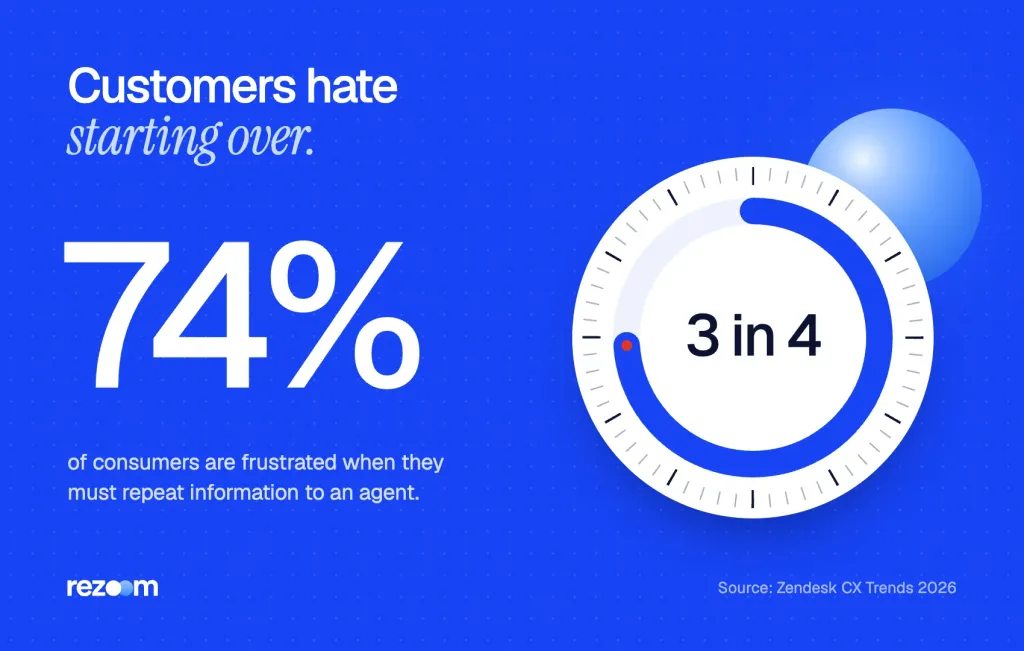
Customers hate starting over. In Zendesk's CX Trends 2026 survey of 6,182 consumers, 74% said they are frustrated when they have to repeat information3. And 81% want agents to continue the conversation without backtracking.
That means a rep who untangles the whole request the first time saves the customer from three separate calls. If your story shows that, it answers the real worry behind the question.
Customer service interview questions with sample answers: angry customers, saying no, chat and AI tools, STAR stories, plus BLS pay data for your salary ask.
How do you structure a STAR answer for a multi-issue request?
Use STAR, but give the Action part the most room. State the situation in one or two lines and name your task. Then walk through how you clarified, listed and solved each issue in order. Close with a result for the customer and one thing you changed, such as a note template or a checklist.
The University of Washington's career center suggests a split for the STAR method of interviewing2: about 20% situation, 10% task, 60% action and 10% result. That balance fits this question well, because the action is where you show the untangling.
- SituationName the customer, the channel and the mix of issues in one or two sentences.
- TaskSay what you owned, such as solving it in one contact or routing it correctly.
- ClarifyShow the questions you asked and the recap you gave the customer.
- Split and solveList each issue, the order you handled it in and who fixed what.
- Result and follow-upGive the outcome, how you confirmed it and what you changed after.
The "list out loud" move
The strongest answers include one line where you read the issues back to the customer. For example: "So we have three things: the double charge, the wrong size and the gift card." That single sentence proves you listened and organized the request.
Want a refresher on the format? Our guide to the STAR method interview answer covers each letter with more examples. Also see our list of behavioral interview questions for related prompts you may hear next.
Count the issues and say the count out loud, such as "two products and one billing error." Then use a result you can measure, like one call instead of three, or a refund in two days. Numbers make your answer easy to score.
Sample answers to the confusing customer request question by job
Choose the sample answer that matches the job you want, then swap in your own details. Each one names the mixed issues, shows a clarifying question, splits the request into parts. Then it ends with a clear result and follow-up. Keep your version near two minutes when you say it out loud.
Call center or support rep
"A caller said her order was 'all wrong.' I asked her to walk me through it, then repeated back three issues: a double charge, a late package and an old shipping address." "I refunded the duplicate charge first, because it was the most stressful for her. Next I fixed the address, then I opened a trace on the package with our carrier." "I emailed her a recap of all three items. She got the refund in two days, and the package arrived that week."
Retail associate
"A customer came to the register with two bags and a receipt. She wanted to return a lamp, swap a rug for a new size and get a price match on a chair." "I asked her which one mattered most, then handled them in order: the return, the exchange, then the price match with my manager's approval." "She left with everything sorted in one visit. I also suggested we post the price-match rules at the register, and my manager did."
Applying for store roles? Browse our retail resume examples to see how strong candidates turn stories like this into bullets. Our retail interview questions guide covers the other prompts you will likely face.
Bank or telecom rep
"A customer called about a 'crazy bill.' After a few questions, I found three issues: a late fee, a plan that no longer fit and a phone still on a payment plan." "I waived the fee within my limit, then compared two plans with him. For the device balance, I explained the payoff and noted his account." "His next bill dropped, and he did not call back about it. I added a short note so the next rep could see the full story."
Bank teller screens use the same logic, with accounts, cards and fees. Our bank teller interview questions page has more examples for branch roles.
SaaS support
"A client wrote one long email about a login error, a missing invoice and a feature request. I replied with a numbered list and asked her to confirm the order." "I fixed the invoice the same day. Then I logged the login error as a bug ticket and sent the feature request to the product team, with her name on both." "I updated her when engineering shipped the fix. She later renewed her plan and mentioned the clear updates."
Entry level with no job experience
"At my school's food bank, a donor called with three questions at once: drop-off hours, a tax receipt and whether we took baby formula." "I wrote each question down, answered the hours right away and checked the formula rule with our coordinator. Then I asked her for an email so I could send the receipt." "She got all three answers that afternoon. After that, I made a one-page FAQ for the front desk."
How do you build your own answer? A fill-in-the-blank template
Fill in the template with one real customer and the issues they mixed together. Then add the question you asked, the order you solved them in and the result. Practice it out loud until it takes about two minutes. Then trim any line that does not show listening, splitting, ownership or follow-up.
Start with the template below, then cut it down. Your goal is a calm, clear answer, not a perfect script.
"At [company or place], a customer contacted me about [what they said first]. After I asked [your clarifying question], I found [number] separate issues: [issue 1], [issue 2] and [issue 3]."
"I handled [issue 1] first because [reason]. Then I [action for issue 2], and I [solved or routed issue 3] to [person or team]."
"The result was [outcome for the customer]. I followed up by [email, call or note], and afterward I [one thing you changed]."
Pick the right story
- Real and recent: Choose a case from the last two years if you can.
- Two or more parts: The request must truly mix products, issues or departments.
- Your actions: Pick a story where you did the work, not a teammate.
- Clean ending: The customer's problem got solved, or you can explain the handoff.
Before your interview
Mock interviews, out loud, with an AI voice coach.
What should you say if they push back?
Expect follow-up questions. They may ask what you would do differently, how you knew the issues were separate, or what happened if you could not fix one part. Answer each with one honest sentence, then a short example. Stay specific, own any misstep and show what you learned.
In live interviews, the first answer is only the start. So prepare for two or three follow-up questions.
Interviewer: "How did you know those were separate issues and not one problem?"
"I asked when each problem started. The charge came from billing last week, but the address was wrong from the first order, so they had different causes."
Interviewer: "What if you could not fix one of them yourself?"
"I would tell the customer who owns it and when they will hear back. Then I would check that the handoff happened."
Interviewer: "What would you do differently?"
"I would send the written recap sooner, so she had the list before we hung up."
Common follow-up questions
- "What did you learn?": Name one habit, such as always reading the issue list back.
- "What if the customer got upset?": Say you stayed calm, slowed down and kept to the list.
- "Who else was involved?": Name the team or role, and say what you handed off.
Does the follow-up turn to an angry customer? Our guide on how to describe a difficult customer shows how to answer that version.
Describe a difficult customer: 8 sample answers for retail, call center, bank and more, a 4-step formula, and what to say with no customer service job.
One-way video tools often give you a short timer and no second try. So record yourself twice and keep the version that names every issue in the first 20 seconds. Our one-way video interview tips cover setup and timing.
What mistakes ruin a confusing customer request answer?
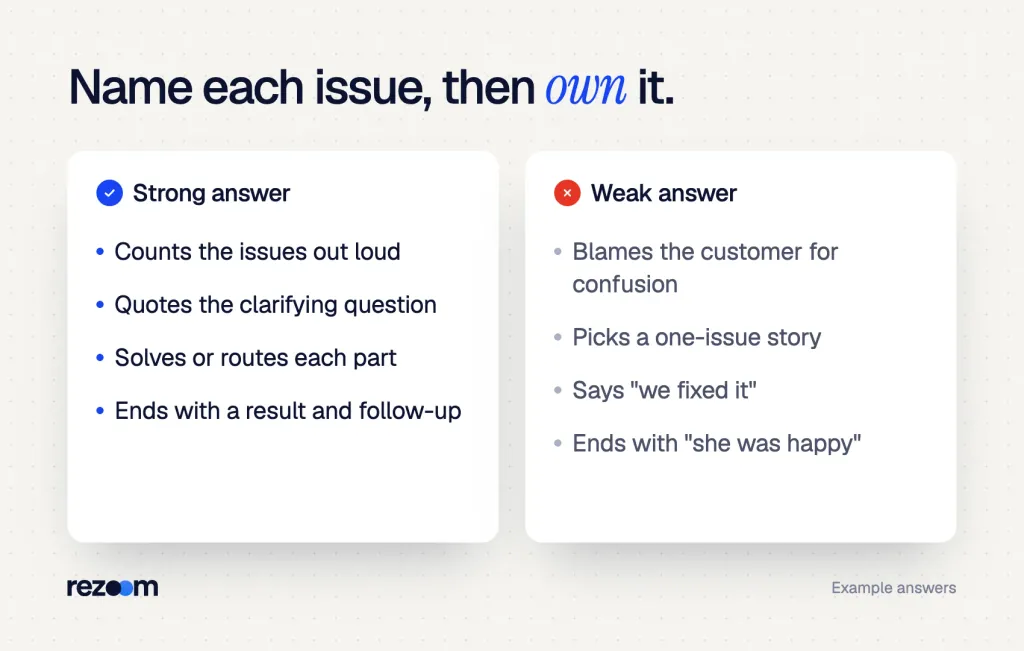
The biggest mistakes are telling a story with only one issue or blaming the customer. Other mistakes are skipping the clarifying step, saying "we" for everything and ending with no result. Keep the customer as the hero of the problem and yourself as the one who sorted it out.
Do
- Name each issue clearly and count them.
- Quote the clarifying question you asked.
- Say "I" for the work you did yourself.
- End with a result and a follow-up step.
Don’t
- Call the customer dumb or "all over the place."
- Pick a story with only one simple problem.
- Jump straight to the fix without questions.
- Leave an issue unsolved with no handoff.
Weak vs strong answers at a glance
| Part of the answer | Weak version | Strong version |
|---|---|---|
| Opening | "Customers are confusing all the time." | "One caller mixed a refund, a plan change and a login issue." |
| Clarifying | "I figured out what she meant." | "I asked which issue to tackle first and read the list back." |
| Action | "We fixed it." | "I refunded the charge, then routed the login bug to IT." |
| Result | "She was happy." | "She got the refund in two days and did not call back." |
How do you show these skills on your resume and in your letter?
Turn your interview story into one resume bullet and one cover letter line. Name the mix of issues, the action and the result, such as resolving multi-product requests in a single contact. That way the hiring manager sees the same skill on paper before they ask the question.
The story you prepare for the interview also makes a strong resume bullet. For example: "Resolved multi-issue billing and delivery requests in one contact, with written recaps."
Our customer service representative resume example shows how to phrase contact volume, first-call fixes and tools.
Customer service representative resume example
See how a support rep lists first-contact fixes, call volume and the tools they used.
Customer service jobs at a glance
BLS counts about 2,666,000 customer service representative jobs in 20251, with about 289,500 openings a year. Most reps learn the role through on-the-job training that lasts 2 to 4 weeks. So your interview story matters more than a degree.
For store roles, our retail cover letter examples show how to open with one short customer story. Then practice saying your answer with an AI mock interview that asks follow-up questions and scores your STAR structure.
Practice out loud with an AI voice coach.
Frequently asked questions
How long should my answer be?
Aim for about two minutes when you say it out loud. Give most of that time to your actions, and keep the setup to one or two sentences.
What if I have never worked in customer service?
Use a school, volunteer, club or family example where someone brought you several questions at once. The skills of asking, sorting and following up are the same.
Is this question the same as "describe a difficult customer"?
Not quite. A difficult customer story is about emotion, while a confusing customer request story is about sorting mixed issues. Some stories cover both, so pick the angle the question asks for.
Should I use STAR for an online assessment?
Yes. Written and one-way video assessments score structure, so a clear situation, task, action and result helps the reviewer find each skill quickly.
What if I could not solve every issue?
That is fine if you owned the handoff. Say who took the issue, how you told the customer and how you checked that it got done.
Can I use the same story for different questions?
Yes, as long as you change the focus. The same call can show listening for one question and problem solving for another.
Sources
We opened and read each page below. The small numbers in the text point here. Pages that carry no publication date show n.d.
- U.S. Bureau of Labor Statistics2025
Customer service representatives held about 2,666,000 jobs in 2025, with about 289,500 openings a year and 2 to 4 weeks of on-the-job training
- University of Washington Career and Internship Centern.d.
A STAR answer should give about 20% to the situation, 10% to the task, 60% to the action and 10% to the result
- Zendesk2025
74% of consumers are frustrated when they have to repeat information, and 81% want agents to continue without backtracking
- Hello Interviewn.d.
Interviewers look for candidates who find the customer's underlying need and turn the case into lasting fixes
Mohammad has spent more than ten years designing consumer products and leads product at Rezoom, deciding what gets built and what gets left out. His guides cover the whole job search, from resume sections and cover letters to interview answers and career moves.
Goodi, M. (2026, November 5). Describe a Time You Untangled a Confusing Customer Request: Answers. Rezoom. https://rezoom.io/confusing-customer-request-interview-question/