

Summary
Advice about when it is "polite" to raise pay mostly predates pay transparency, and it treats one question as though it were three. Is the band right, where in the band would I sit, and what is the actual number are separate questions with separate timing — and when the posting publishes a range, the first one is already answered.
Most guidance on how to ask about salary in an interview treats it as one delicate topic with one correct moment. Wait until they like you. Never go first. Read the room. Before you name any figure, it helps to know what counts as a good salary increase when you change jobs.
That framing is out of date, and it obscures something more useful: three different questions hide inside "asking about salary," and each has its own answer and its own timing.
Separating them removes most of the awkwardness, because you stop trying to time a conversation and start asking a specific thing at the point where someone can actually answer it.
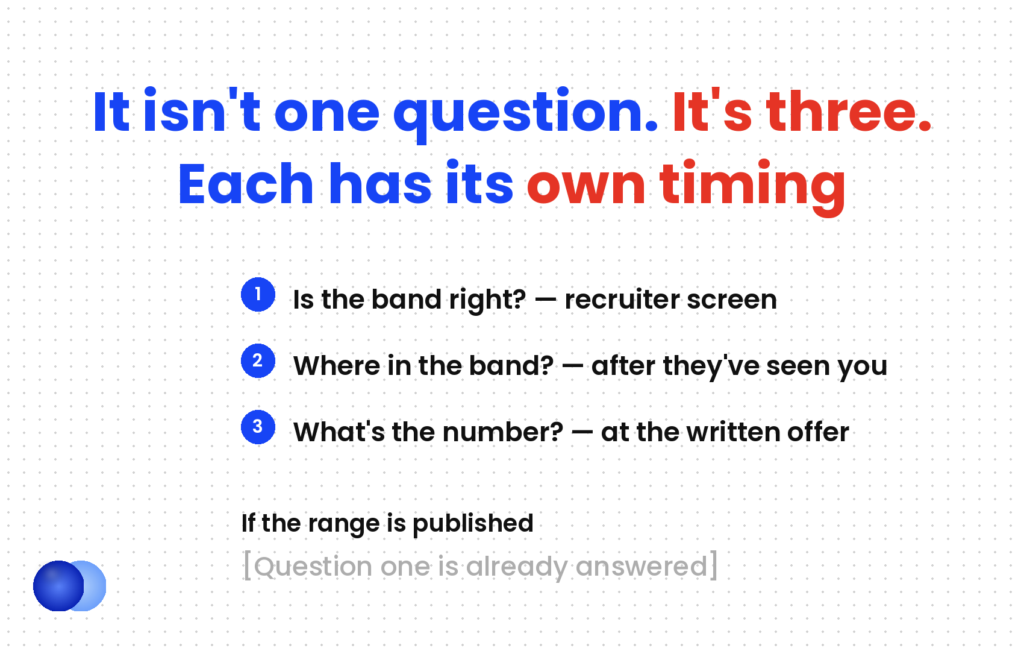
What are the three questions?
Is the band right for this role, where in the band would I sit, and what is the actual number. The first is a screening question you are entitled to ask early. The second belongs mid-process. The third belongs at offer stage, and it is the only one that is a negotiation.
| The question | When to ask | What you are really doing |
|---|---|---|
| Is the band right? | Recruiter screen, or before it | Protecting both sides' time |
| Where in the band would I sit? | After they have seen your work | Calibrating expectations |
| What is the number? | At the written offer | Negotiating |
In practice, almost all the anxiety about "is this rude" attaches to the first one, and the first one is the least sensitive of the three. Asking whether a role pays within a range you can work with is a compatibility question, not a demand.
The second and third are where the real stakes sit, and nobody thinks those are impolite because by then the employer has raised them.
Has pay transparency changed the answer?
Substantially. Around 60% of postings now publish a salary range, and where one exists, question one is already answered — which turns "asking about salary" into confirming a number you both have rather than raising a subject. Most advice on this topic predates that shift.
The old advice made sense when you were negotiating blind.
"Never name a number first" and "wait until they want you" were protections against an information gap. Transparency laws in more than a dozen US states, plus voluntary disclosure, have narrowed that gap considerably — the salary expectations answer covers what that means when the employer asks you.
Which produces a simple branch:
When a posting publishes a range, nothing delicate remains to raise. Reference it: "I saw the range posted at 80 to 110 — is that still current for this level?" That is a factual confirmation, and it opens the conversation about where you would sit rather than whether you fit.
When no posting publishes one, question one is legitimate and you should ask it early rather than spend three rounds finding out. In some transparency jurisdictions, the law obliges employers to provide a range on request.
Ask two other questions first
When you reach "do you have any questions for me", ask one or two about the role or the team before you ask about pay. Not because salary is shameful, but because it changes what the question tells them. A candidate whose only question was about money has revealed their ranking; a candidate who asked about the team's roadmap, the biggest current problem, and then the range has revealed a normal set of priorities. Same question, same answer, different impression — and it costs ninety seconds.
How do you word it?
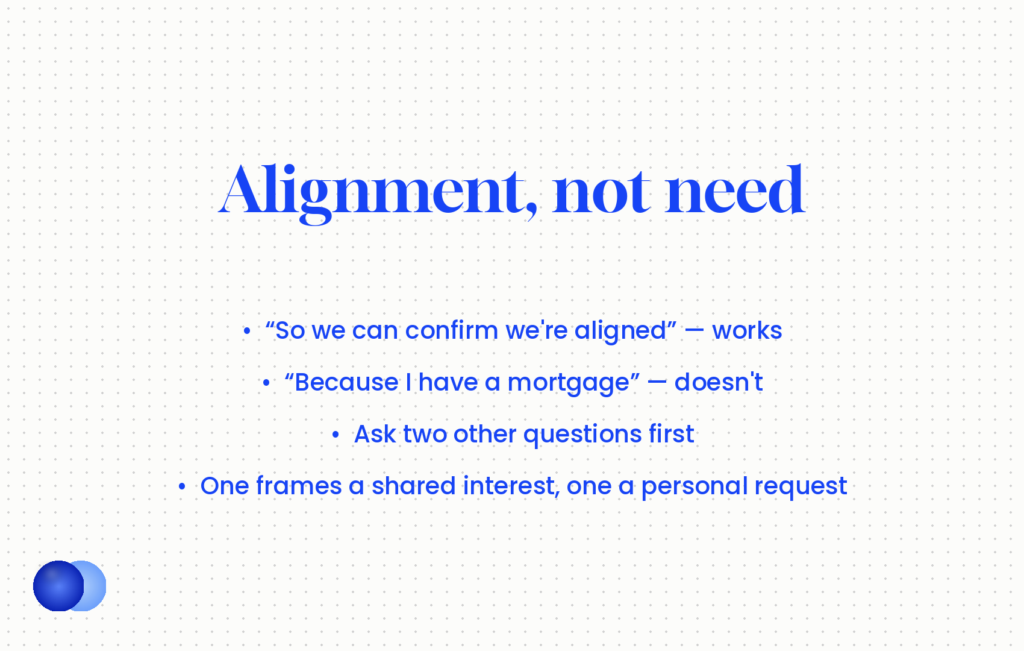
Frame it as alignment rather than need. "Could you share the range budgeted for this role, so we can confirm we're aligned before going further" works at any stage. Avoid anything built on your expenses, and avoid treating it as a favour you are asking for.
Four ways to ask about salary in an interview, by situation:
Early, no published range:
"Before we go further, could you share the range budgeted for this role? I'd rather confirm we're aligned now than use up your time."
Early, range published:
"I saw the range posted at 80 to 110 — is that still current for this level, and where in it would someone with my background typically land?"
Mid-process, after a strong round:
"Now that we've talked through the scope, could you tell me where in the range this would sit? It'll help me think about the whole picture."
When they deflect:
"Understood. Is there a figure you can share once we're further along? I'd just like to avoid us both investing more time if the band doesn't work."
Each of those does the same thing: it frames the question as protecting a shared interest rather than as a personal request. That is the difference between a question a recruiter answers easily and one that makes the conversation heavier.
Need-framed: "I need to know the salary because I have a mortgage and I can't take a pay cut."
Alignment-framed: "Could you share the range budgeted for this role? I'd rather confirm we're aligned before either of us invests more time."
The first invites the employer to assess whether your circumstances are their problem. The second describes a process both of you benefit from. Same information requested; only one of them is easy to say yes to.
What do their answers mean?
"We haven't set a range" from a hiring manager is rarely true, since the requisition had a budget. "It depends on the candidate" usually is true — the band is wide and the offer genuinely varies. A refusal to say anything at all, at any stage, is itself information.
Broadly, three responses and what each signals:
"The range is X to Y." Straightforward. Now ask where in it your profile would land, which is question two.
"It depends on the candidate." Generally honest. Most bands are wide and the offer does vary with what you bring. A reasonable follow-up: "What would put someone at the top of that band?"
"We haven't set a range for this position." Unlikely at the hiring-manager level, because a requisition needs a budget to exist. From a recruiter it may simply mean they have not been told. Worth one polite follow-up rather than a challenge.
Refusal at every stage. An employer who will not indicate a band after several rounds is telling you something about how they will handle the offer conversation and probably the annual review after it.
Treat a recruiter raising pay as an open door. When they ask what you are looking for, the topic is on the table and you can ask for their range in the same breath.
Ask in the first two minutes of a first interview. Not because it is forbidden, but because you have not yet given them any reason to want to answer generously.
What if you are the one asked first?
Answer with a range anchored near the top of what you would happily accept, justified by scope rather than by need. Employers hear the bottom of your range as your real number, so set it where you would sign without hesitation.
The reverse happens in most processes, usually at the recruiter screen, and it is a different skill from asking.
The short version: give a range, tie it to the role's scope, and set the bottom at your target rather than below it. The salary expectations answer covers the full method, including why naming the midpoint of a posted range is the most expensive mistake in the topic.
One point specific to being asked early: this is a filtering conversation rather than a negotiation. The goal is to stay in the process at a sensible anchor, not to maximise. Maximising happens later, at the written offer — which is what the salary negotiation email is for.
Does asking hurt your chances?
Rarely, and the exceptions are informative. Some interviewers react coolly to the topic, which tells you something about the culture. The material risk is asking too early, too bluntly, or as your only question — not asking at all.
Finally, worth being honest rather than reassuring.
A minority of interviewers do find the subject uncomfortable, and a candidate who leads with it in a first conversation can read as transactional. That is a real cost, and it is entirely avoidable by ordering your questions.
What is not a real cost: asking a normal, well-framed question about the band at a sensible point. Employers expect it, most postings now disclose it anyway, and a company that penalises a candidate for asking what the job pays has revealed a dynamic you would meet again at every review.
Job seekers have a right to protect their time and find out whether a position can pay enough. Ask tactfully, and show that salary is one of several factors you're weighing.
What should you do before the interview?
Research the band, set your three numbers, and decide which of the three questions you need answered in this particular conversation. Walking in without a figure means either accepting theirs or improvising one.
Three steps before you work out how to ask about salary in an interview at all:
1. Research the band. Posted ranges for the same title in the same city, plus a published salary guide for the industry. Fifteen minutes.
2. Set three numbers. Your floor, your target, and the anchor you would say out loud — the same preparation that makes an offer conversation survivable later.
3. Decide what you need from this conversation. At a recruiter screen you need the band. At a final round you need where in it you would sit. Knowing which one you are after stops you asking a vague question and getting a vague answer.
And keep the sequence in mind. None of this matters until you reach an interview at all, which is a resume problem rather than a salary one — an AI resume checker against the specific posting covers that gate.
Frequently asked questions
How do you ask about salary in an interview politely?
Frame it as alignment rather than need: "Could you share the range budgeted for this role, so we can confirm we're aligned before going further?" Ask one or two other questions first.
When should you bring up salary in an interview?
It depends which question you are asking. Whether the band works is legitimate at the recruiter screen. Where in the band you would sit belongs mid-process. The actual number belongs at the written offer.
Is it rude to ask about salary in a first interview?
No, though leading with it can read as transactional. Ask about the role or the team first, then the range — same question, better impression.
What if the salary range is already published?
Then reference it rather than raising the subject: "I saw the range posted at 80 to 110 — is that still current for this level?" Around 60% of postings now include a range.
What does "we haven't set a range" mean?
From a hiring manager, rarely the truth — a requisition needs a budget to exist. From a recruiter it may mean they have not been told. Worth one polite follow-up rather than a challenge.
What if they ask me first?
Give a range anchored near the top of what you would happily accept, justified by the role's scope rather than your expenses. Employers hear the bottom of your range as your real number.
Can asking about salary cost me the job?
Rarely. A minority of interviewers find the topic uncomfortable, and a company that penalises a normal question about pay has shown you how it will handle every future review.
What should I do if the range is too low?
Say so plainly and early. Sometimes the band has room above it for the right candidate, and when it does not, you have saved weeks on a role you would have declined.



Comments