Salary History on Job Application: What to Put (2026 Guide)
Salary history on job application forms: when you can skip it, what to enter if it is required, which states ban the question and what to say in interviews.

On this pageDo you have to put salary history on job application forms?
- Do you have to put salary history on job application forms?
- Which states ban salary history questions?
- What do you put when the salary history field is required?
- How do you answer salary history questions in a screen or interview?
- When does sharing your salary history help you?
- What should you check before you submit?
- FAQ
- Sources
You rarely have to give your salary history on a job application. Many states and cities bar employers from asking, and in those places you can leave the field blank. If the field is required, enter your target range, "N/A" or "Negotiable" where the form allows it. In a screen, steer the talk to the pay you want for this job.
Salary history on job application forms asks what you earned before. You usually don't have to share it. Many states ban the question, so leave it blank, enter "N/A" or give your target range instead.
The field shows up as "previous salary," "current salary" or "what was your last salary." It feels like a test. But it is really an anchor, and a low number can follow you into the offer.
Quick answers by situation
| Your situation | What to say/do | Example line |
|---|---|---|
| The field is optional | Leave it blank | (no entry) |
| The field is required and takes text | Enter "N/A" or "Negotiable" | "Negotiable based on the role" |
| The field is required and takes only numbers | Enter your target range or a placeholder the form allows, then explain in notes | "62,000-68,000 (target range)" |
| You live in a state with a ban | Skip it; the employer should not ask | "I'd rather focus on the range for this role." |
| A recruiter asks on a phone screen | Name the pay you want instead | "I'm targeting $62,000 to $68,000 for this role." |
| Your past pay was higher than this job pays | Share it only if it helps you, with context | "I earned more before, but this range works for me." |
Do you have to put salary history on job application forms?
No, in most cases you do not have to put salary history on a job application. In states and cities with salary history bans, employers can't ask at all. Elsewhere they can ask, but you can still decline politely or give the pay you want for this job instead of your old number.
A salary history question asks for your past pay. A desired salary question asks what you want next.
Those are two different fields, and the second one is the one to answer with care. Our guide to desired salary on job application forms covers that field in detail.
So when you see "current salary," you have three honest choices. You can skip it, enter a placeholder the form allows, or give your target range. You don't need to make up a number.
Why employers ask for your past pay
Employers ask because past pay is a quick shortcut. If you earned $50,000, they may offer $53,000, even if the job is worth $65,000. That is why so many places now limit the question.
- Screening: some firms use past pay to guess if you fit their budget.
- Anchoring: your old number can set the ceiling for the offer.
- Habit: many old forms still carry the field, even in states that ban it.
Desired salary on a job application: type a researched range, what to enter when the box takes only numbers, pay transparency laws and how to back it.
Which states ban salary history questions?
More than a dozen states, plus cities like New York City and San Francisco, bar employers from asking about pay history. The list keeps growing, and Virginia's ban took effect July 1, 2026. Rules vary by place and by employer type, so check your state's labor department page before you decide.
Paycor's state tracker2 lists bans that reach private employers in states such as California, Colorado, Connecticut, Illinois, Maryland, Massachusetts, New Jersey, New York, Oregon and Washington. In several other states, the ban covers only state agencies.
New laws keep coming. Law firm Foley & Lardner1 reported in May 2026 that Virginia's ban took effect July 1, 2026.
The law prohibits employers from asking about or seeking out the wage or salary history of an applicant.
Foley & Lardner, 2026
What the bans usually cover
Most bans share a core. But the details differ, so read your own state's page.
| Rule | What it means for you | Example state |
|---|---|---|
| No asking | The form and the interviewer should not ask | New York |
| No digging | They can't call your old boss to find out | New York |
| No using it to set pay | Your old number should not shape the offer | Virginia |
| You may volunteer it | You can share it if it helps you | California |
| Pay range on request | You can ask for the job's pay scale | California |
New York's labor department says its ban took effect January 6, 20203. It also bars employers from seeking the same facts from other sources. California's Labor Commissioner says an employer cannot seek salary history4, "orally or in writing." And it must give you the pay scale if you ask.
This is general information, not legal advice. Laws change, and some apply only to employers of a certain size.
Do the bans help?
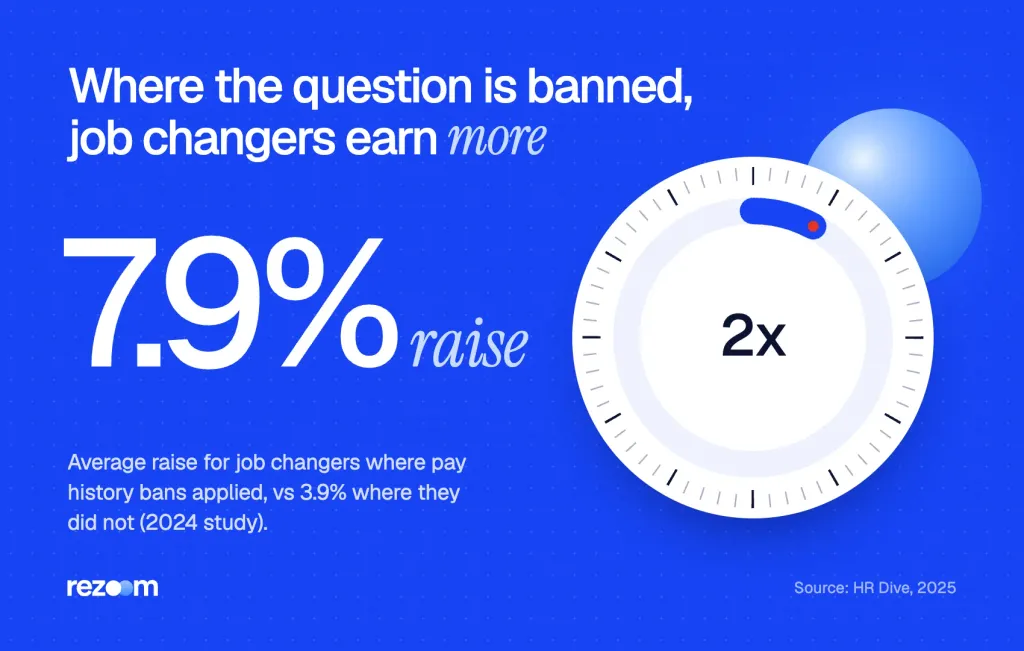
Early research says yes. A 2024 study cited by HR Dive5 found job changers in places with bans got raises of 7.9% on average. Job changers in places without them got 3.9%.
What do you put when the salary history field is required?
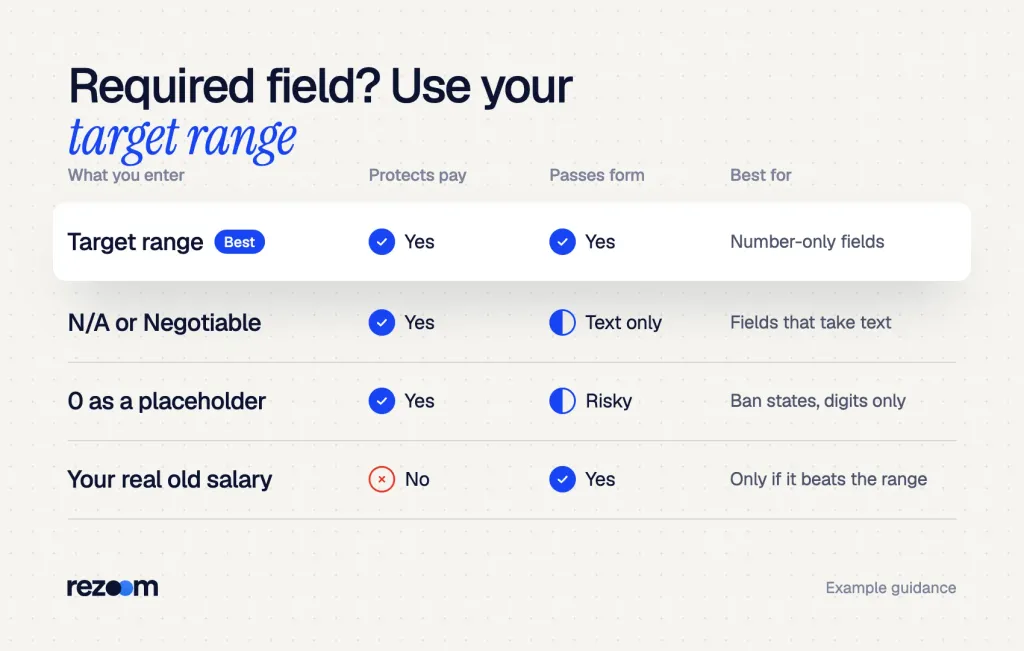
If the form won't let you move on, enter your target range for this job, or "N/A" or "Negotiable" if the field takes text. If it only takes numbers and you're in a ban state, a 0 may be the honest choice, but add a note. Never enter a fake past salary.
Online forms can be rigid. So when you see salary history on job application pages, read the field label first. "Expected salary" and "salary history" need different answers.
- Read the labelCheck if it asks for past pay or desired pay. Many forms mix them up.
- Try text firstType "N/A" or "Negotiable." Many text fields accept it.
- Use your target rangeIf it wants a number, give the range you want for this job, not your old pay.
- Add a noteUse the comments or cover letter field to say you'd like to discuss pay once you learn more.
- Save proofTake a screenshot if you live in a ban state and the form still demands past pay.
Placeholder numbers: when 0 is fine
Some forms accept only digits. In that case, a 0 or a 1 tells a human you chose not to answer.
If you live in a ban state, that is your right. But if the system filters out low numbers, a 0 can sink your application, so a target range is often the safer entry.
Salary history field: "N/A - I'd prefer to discuss pay for this role."
Notes field: "I'm targeting [low number] to [high number] based on the duties of this [job title] role and the market in [city]. I'm open to talking about the full package."
Many states now require a pay range in the job post. If you see one, anchor your target to the top half of it. Then you never need to mention your old salary at all.
How do you answer salary history questions in a screen or interview?
Thank them, decline to share past pay and pivot to the range you want for this job. Keep it short and friendly. If you live in a ban state, you can mention that the law lets you skip it. If they insist, offer your target range again rather than your old number.
Most of these questions come up on a phone screen. The recruiter wants to know if you fit the budget. So answer the real question: what will it take to hire you?
"I'd rather not share my past pay, since this role has different duties. Based on my research, I'm targeting $62,000 to $68,000. Does that fit your range?"
"I believe the law here lets me keep my pay history private, so I'll pass on that one. But I'm happy to share my target range for this job."
Our guide on how to answer salary expectations has more lines you can use once the talk turns to numbers. If you want to raise pay yourself, see how to ask about salary in an interview.
What to say if they push back
- "We need it for our records." Stay calm: "I understand. I'd rather focus on what this role pays. What range do you have budgeted?"
- "Everyone shares it." Hold your line: "I get that. My target is $62,000 to $68,000, which I think fits the job."
- "We can't move forward without it." In a ban state, say: "I believe the law here doesn't require it. Could we talk about the range instead?"
- "Just ballpark it." Give the future, not the past: "My ballpark for this job is mid-60s."
Interviewer: "What are you making now?"
"I'd rather keep that private. I'm targeting $62,000 to $68,000 for this role."
Interviewer: "I still need a number for the hiring manager."
"Then please share my target range. If that's outside your budget, I'd like to know now so we don't waste your time."
The words matter less than the tone. If you sound calm, most recruiters move on in seconds. So rehearse the line three or four times before the call.
When you want to rehearse, use our AI tool to practice salary questions out loud and hear how you come across.
Free ATS score, the text the software extracts and your missing keywords. No sign-up.
When does sharing your salary history help you?
Sharing past pay can help when it is higher than the new job's range or when it shows strong growth. In some states, you may volunteer it even where employers can't ask. But share it on purpose, with context, and only when it moves the offer up, not down.
If you earned more before, a quick mention can lift the offer. And if you took a pay cut for a reason, like a move or a career change, a short line of context helps.
Do
- Give your target range for the new job.
- Share past pay only if it raises your offer.
- Ask for the job's pay range early.
Don’t
- Make up or inflate a past salary.
- Enter a low old number on a form you could skip.
- Argue about the law with a recruiter.
Let your resume carry the weight
A strong resume makes your past pay matter less. Results, scope and skills tell the hiring manager what you're worth now.
Browse our administrative resume examples to see how admins show impact without listing pay. For a close match, these administrative assistant resume examples put numbers like calendars managed and costs saved up top.
Administrative assistant resume example
A resume that shows results instead of past pay.
Your letter can do the same. This administrative assistant cover letter example keeps the focus on the work you'd do, not what you earned.
Administrative assistant cover letter example
A short letter that keeps the focus on the job, not your old salary.
If a post asks you to "include salary history in your cover letter," give a range instead. Our admin cover letter samples show how to close with one calm line on pay. Later, if an offer comes in low, a salary negotiation email can help you ask for more.
Around 60% of postings now publish a range, which makes deflecting obsolete. The salary expectations answer that anchors high without pricing you out.
What should you check before you submit?
Before you hit submit, confirm what the field really asks, check your state's rules and pick your target range. Then make sure your notes field and cover letter say the same thing. A consistent answer across the form, the letter and the phone screen reads as confident.
Before you submit the form
Once the form is done, get ready for the call. If you want to rehearse, try the mock interview below.
Practice out loud with an AI voice coach.
Frequently asked questions
Is it legal to ask for salary history on a job application?
It depends on where you live. Many states and cities ban the question for private employers, while others allow it. Check your state labor department's page.
Can I leave the salary history field blank?
Yes, if the form allows it. If it is required, enter "N/A," "Negotiable" or your target range instead.
Should I put 0 for previous salary?
Only if the field takes numbers only and you choose not to share. A target range is often safer, since some systems filter out a 0.
Can an employer verify my past salary?
In ban states like New York, employers can't seek it from other sources. Elsewhere, some may ask past employers or use a verification service, so never inflate it.
What if I made more at my last job?
Sharing it can help lift the offer. Add a short line on why this role still fits you.
Is salary history the same as desired salary?
No. Salary history is what you earned before. Desired salary is what you want in the new job, and it is the better number to share.
Sources
We opened and read each page below. The small numbers in the text point here. Pages that carry no publication date show n.d.
- Foley & Lardner2026
Virginia's salary history ban took effect July 1, 2026, and bars employers from asking about or seeking out applicant pay history.
- Paycorn.d.
Paycor's tracker lists the states and cities with salary history bans and shows which apply only to state agencies.
- New York State Department of Laborn.d.
New York's salary history ban took effect January 6, 2020, and bars employers from seeking pay history from other sources.
- California Department of Industrial Relationsn.d.
California employers cannot seek salary history and must give applicants the pay scale on reasonable request.
- HR Dive2025
A 2024 study found job changers got 7.9% raises where pay history bans applied, versus 3.9% where they did not.
Mohammad has spent more than ten years designing consumer products and leads product at Rezoom, deciding what gets built and what gets left out. His guides cover the whole job search, from resume sections and cover letters to interview answers and career moves.
Goodi, M. (2026, November 15). Salary History on Job Application: What to Put (2026 Guide). Rezoom. https://rezoom.io/salary-history-on-job-application/