

Summary
The best ChatGPT interview prep prompts give the model three things: the job description, your resume, and a clear role, such as "act as the hiring manager." Use them in order: research the company, predict likely questions, get STAR feedback, run a mock interview, then plan salary answers and your own questions. Verify every company fact yourself, keep confidential details out of the chat, and never use AI live during the interview.
ChatGPT interview prep prompts work best when you paste in the job description and your resume, then give the model one job at a time. Generic prompts get generic coaching. A prompt with context, a role and a clear output gets you practice that sounds like the real interview.
This guide gives you 15 prompts in the order you would actually prepare: research, likely questions, answer feedback, a mock interview, salary, and the questions you ask at the end. Each one is ready to copy. Replace the text in [brackets] with your details.
There is also one firm rule. Use AI to prepare, not to perform. Hiring managers draw a clear line between the two, and the data below shows where.
Why use ChatGPT interview prep prompts at all?
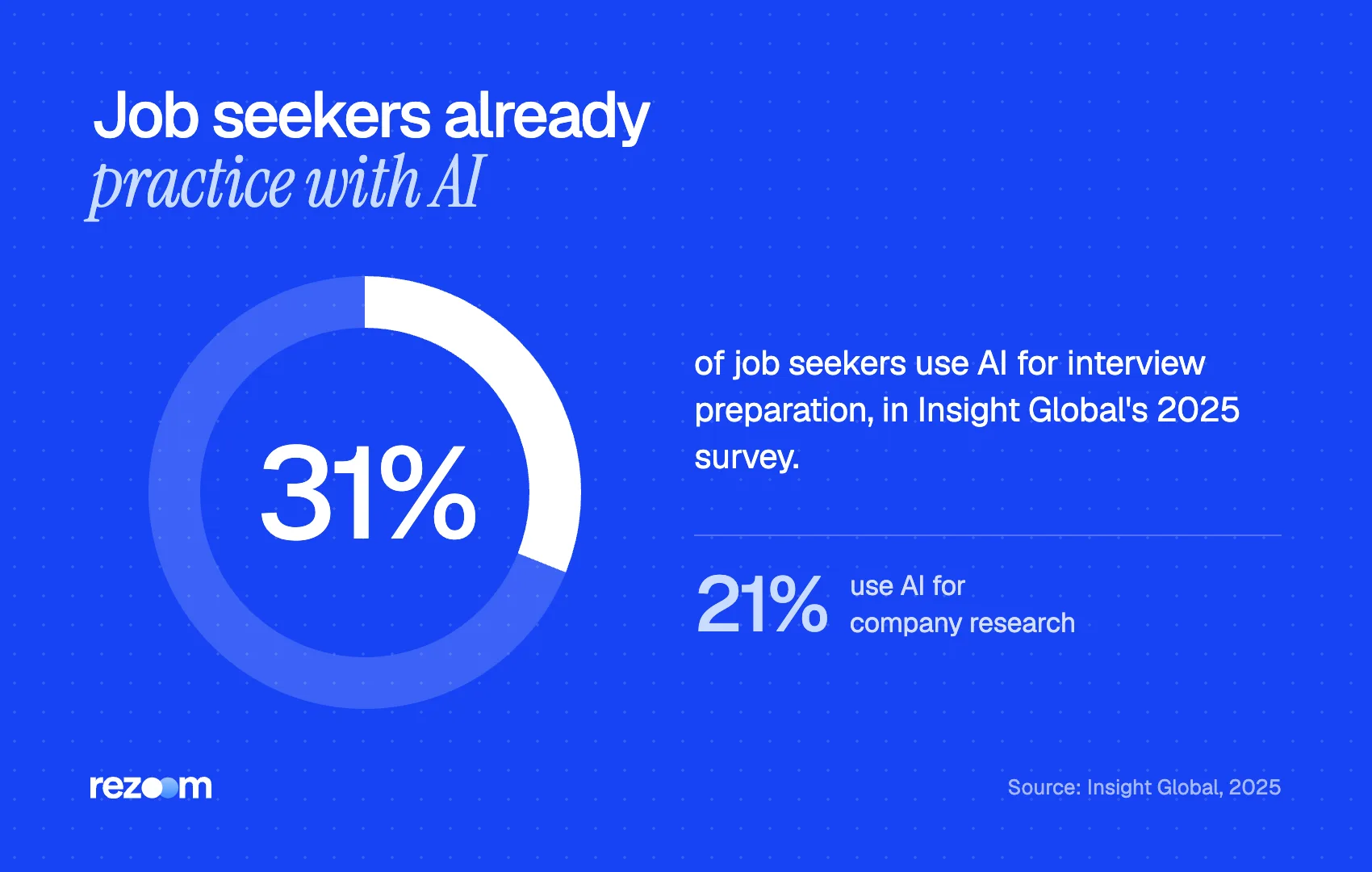
ChatGPT interview prep prompts give you unlimited, on-demand practice: predicted questions, feedback on your stories and a realistic mock interview. Insight Global found 31% of job seekers already use AI for interview prep. The limit is live use: 57% of hiring managers in a TopResume survey said real-time AI tools should never be used during an interview.
In Insight Global's 2025 survey, 31% of job seekers said they use AI for interview preparation, and 21% use it for company research.
Employers are watching how candidates use it, though. Resume Genius's 2026 survey found that 46% of hiring managers had caught candidates using AI for interview responses. And in TopResume's 2025 survey of 600 hiring managers, 57% said real-time tools like whispering bots should never be used when speaking with an employer.
So the decision rule is simple. Everything before the interview is fair game. Nothing runs during it.
| Stage | What the prompt does | What you must check yourself |
|---|---|---|
| Setup | Loads the job, your resume and a coach role | No confidential employer details pasted |
| Company research | Builds a briefing and talking points | Every fact against the company site or news |
| Likely questions | Predicts questions from the job description | That they match the actual requirements |
| STAR feedback | Scores and tightens your stories | Every number and claim is true |
| Mock interview | Asks one question at a time, with follow-ups | Your answers sound like you, not a script |
| Salary and your questions | Drafts answers and questions to ask | Pay ranges against government or posted data |
How do you set up ChatGPT before you prompt it?
Start one chat per job. Paste the job description and your resume, tell ChatGPT to act as an interview coach for that role, and ask it to wait for instructions. Turn off model training or use Temporary Chat, and never paste confidential material an employer shared with you.
Context separates useful coaching from filler. Give the model the job description, your resume and the interview format.
Mind your privacy. OpenAI's Data Controls FAQ says that when Improve the model for everyone is off, new conversations are not used to train its models. Temporary Chats are also excluded from training, though they may be kept for up to 30 days for safety. Remove phone numbers and addresses from your resume before you paste it.
You are an experienced interview coach and a hiring manager for [job title] roles in [industry]. I have an interview with [company] for the role below on [date]. The format is [phone screen / video / panel / final round].
Job description: [paste the full job description]
My resume: [paste your resume with contact details removed]
Do not answer anything yet. Confirm you have read both, then list the 5 requirements this employer cares about most.
Which prompts help you research the company?
Ask ChatGPT to turn the company's own materials into a briefing: what it sells, who it serves, recent priorities and how the role supports them. Paste in the About page, a recent press release or an earnings summary. Then verify every fact, because language models can state false information with confidence.
Research is where ChatGPT is weakest. OpenAI describes hallucinations as cases where a model confidently generates an answer that isn't true. Company details, revenue figures and recent news are exactly where that happens.
The fix is to feed it sources rather than ask it to recall them. Copy text from the company's site or a recent announcement into the chat.
Using only the text I paste below, write a one-page briefing on [company]: what it sells, who its customers are, its stated priorities this year, and 3 challenges the [job title] role likely helps with. Mark anything you are inferring as "inference." Do not add facts that are not in the text.
[paste About page, press release or annual report excerpt]
Based on the briefing, write 3 short talking points that connect my experience to this company's priorities. Each one should name one real achievement from my resume and one specific company priority. Keep each under 40 words.
Your answer to "Why do you want to work here?" comes straight from Prompt 3.
How do you get ChatGPT to predict questions from a job description?
Paste the job description and ask for the questions a hiring manager would ask to test each requirement, grouped into behavioral, technical and situational. Ask it to explain which line of the posting each question tests. That link shows you which stories you need ready.
Every requirement in a posting becomes a question. Our guide on how to find keywords in a job description shows how to spot those requirements first.
Act as the hiring manager for this role. Write the 12 questions you are most likely to ask, grouped as behavioral, technical and situational. After each question, quote the line from the job description it tests.
Compare my resume with the job description. List the 3 requirements where my resume looks weakest, the question an interviewer would ask about each, and an honest way to answer using experience I actually have.
Draft a 60-second answer to "Tell me about yourself" for this role. Use present, past, future order. Use only facts from my resume. Then list 2 follow-up questions it might trigger.
For the opener, compare the draft against our tell me about yourself examples. For the full bank, see our lists of common interview questions and behavioral interview questions.
What prompts give useful STAR answer feedback?
Write your answer first, then ask ChatGPT to grade it against the STAR structure, flag vague parts and suggest one measurable result. The University of Washington's career center suggests about 60% of a STAR answer should describe your actions. Ask the model to check that balance.
ChatGPT is better at feedback than first drafts. If it writes your story, you get a smooth answer you cannot defend.
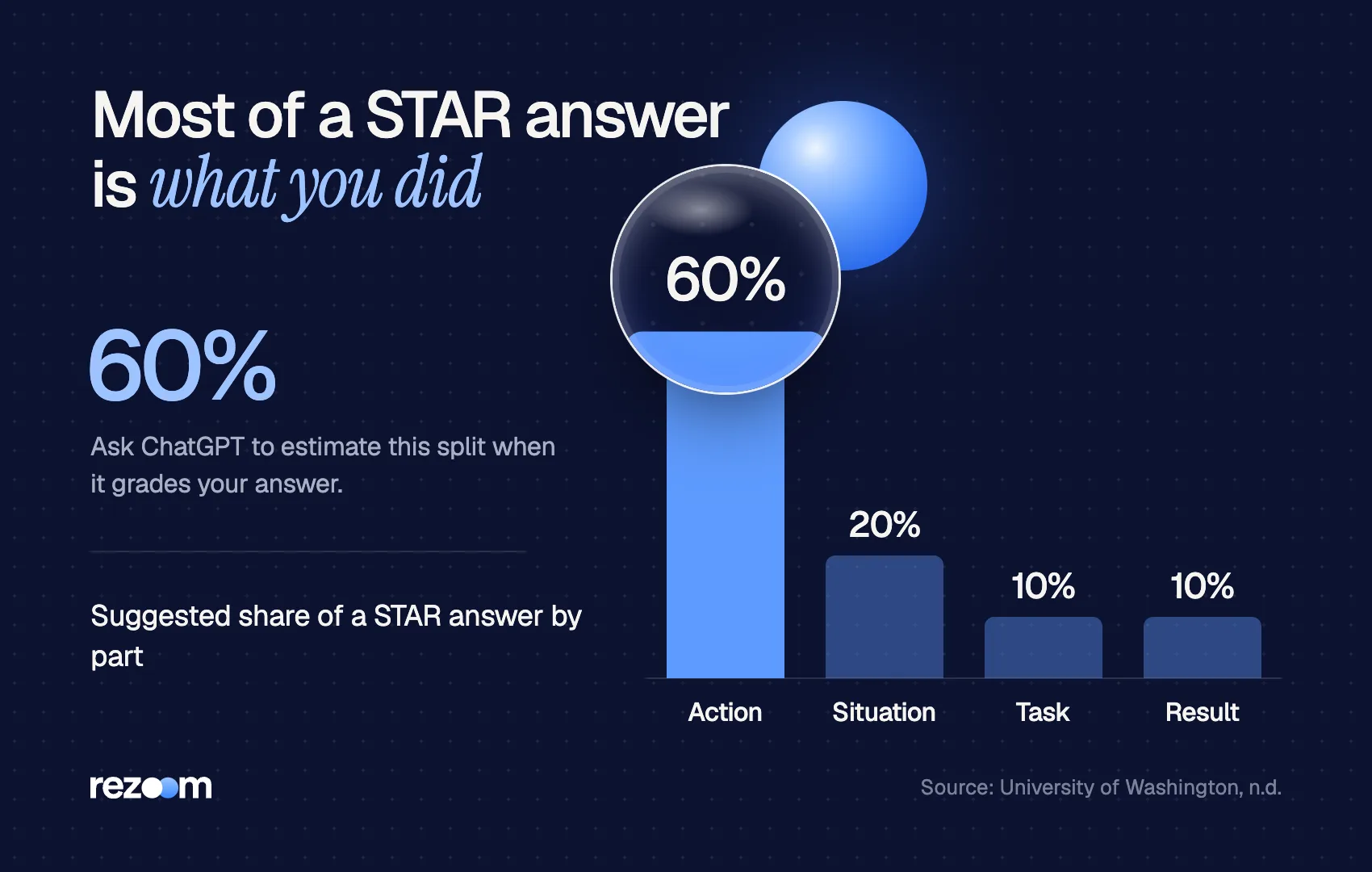
The University of Washington Career & Internship Center suggests a split of roughly 20% situation, 10% task, 60% action and 10% result. Most weak answers invert that and spend half the time on background. Our STAR method interview guide covers the structure in full.
Here is my answer to "[question]": [paste your answer]
Grade it 1 to 10 on clarity, specificity and relevance to this job. Estimate what share of the answer covers Situation, Task, Action and Result. Flag any sentence that is vague or that I could not back up with detail. Do not rewrite it yet.
Now shorten my answer to under 2 minutes spoken, about 250 words. Keep my wording where possible. Do not add any facts, numbers or results I did not give you. Where a number would help, write [ADD NUMBER] instead.
Ask me the 3 hardest follow-up questions a skeptical interviewer would ask about this story, one at a time. Wait for my reply before asking the next.
Make the model admit gaps
Add "Do not add facts I did not give you" to every feedback prompt. Without it, ChatGPT tends to fill gaps with plausible numbers. Interviewers ask follow-ups, and a number you cannot explain does more damage than no number at all.
How do you run a mock interview with ChatGPT?
Tell ChatGPT to play the interviewer, ask one question at a time, wait for your answer, and give feedback only at the end. Set the interview type, the length and a difficulty level. Answer out loud or in voice mode, then review the scorecard and repeat the weakest question.
The phrases "one question at a time" and "wait for my answer" keep the model in role instead of dumping a list.
Run a 30-minute mock [phone screen / panel / final round] interview for this role. You are [interviewer's title]. Ask one question at a time and wait for my answer. Ask a follow-up when my answer is vague. After 8 questions, give me a scorecard: strongest answer, weakest answer, and one fix for each.
Act as a direct, slightly skeptical interviewer. Ask me 5 uncomfortable questions for my situation, such as [an employment gap / a short job / a career change / a layoff]. After each answer, tell me whether I sounded defensive and how to say it in fewer words.
I have a one-way video interview with 3-minute answer limits. Ask me 5 likely questions one at a time. After each answer I type, tell me if it would fit in 3 minutes when spoken and what to cut.
Recorded formats have their own rules. Read our guides on the AI video interview and HireVue interview tips before you practice for one. Rezoom's AI mock interview gives the same practice in a timed, spoken format.
Paste the real job description and your resume into every new chat do: Write your own STAR stories first, then ask for feedback do: Answer mock questions out loud and time yourself do: Check every company fact and salary number against a source you can open
Memorize ChatGPT's wording word for word dont: Paste confidential details an employer shared with you dont: Let the model add results or numbers you did not achieve dont: Use any AI tool live during the interview
Which prompts prepare salary questions and the questions you ask?
Ask ChatGPT to draft a salary answer built on a range you researched, not a number it guesses. Check pay against the BLS Occupational Outlook Handbook and the posted range. Then have it generate questions to ask the interviewer, based on the job description and your company research.
ChatGPT has no reliable view of current pay at a specific company. Give it the range yourself. The BLS Occupational Outlook Handbook lists median pay for hundreds of occupations, and many US postings now include a pay range.
My research shows a range of [$X to $Y] for this role in [city], based on [source]. The posting lists [range or "no range"]. Draft a short, polite answer to "What are your salary expectations?" for a [first-round / final-round] interview. Give one version that names a range and one that asks about their budget first.
Our guide to the salary expectations answer covers timing and wording.
Based on the job description and my company briefing, write 8 questions I could ask at the end of the interview. Group them for the recruiter, the hiring manager and a future teammate. Avoid anything answered on the company website.
Here are the questions I was asked and short notes on my answers: [paste notes]. Tell me which answer was weakest, what I should mention in my thank-you email, and which stories to prepare for the next round.
Our full list of questions to ask in an interview helps you choose. Before the interview, make sure your resume tells the same stories you plan to tell. The Rezoom AI resume builder tailors it to the job description in minutes.

Frequently asked questions
What is the best ChatGPT prompt for interview prep?
The most useful one is a setup prompt that pastes the job description and your resume and asks ChatGPT to act as the hiring manager. Every later prompt, from predicted questions to mock interviews, builds on that context.
Can ChatGPT do a mock interview?
Yes. Tell it to ask one question at a time, wait for your answer and give feedback at the end. Answering out loud or in voice mode makes the practice closer to the real thing.
Is it cheating to use ChatGPT for interview prep?
No. Preparing with AI is like practicing with a coach. The line most hiring managers draw is live use: in TopResume's survey, 57% said real-time AI tools should never be used during an interview.
Should I memorize ChatGPT's answers?
No. Memorized AI wording sounds scripted and breaks down under follow-up questions. Use the model to structure and tighten your own stories, then practice them in your words.
Is it safe to paste my resume into ChatGPT?
Remove your phone number and address first. Turn off "Improve the model for everyone" or use Temporary Chat, and never paste confidential details an employer shared with you.
How many ChatGPT interview prep prompts should I use?
One per stage is enough: setup, research, likely questions, STAR feedback, a mock interview, and salary or closing questions.



Comments