Jonah Lindqvist Prompt Engineer, Evaluation Portland, 97214, United States [email protected] · (503) 555-1608
11 September 2026
Ms. Renata Sandoval Clinical Documentation Willamette Clinical Systems Portland, United States
Application for Prompt Engineer, Clinical Documentation, Willamette Clinical Systems
Dear Ms. Sandoval,
I am applying for the Prompt Engineer post on the clinical documentation team. I have spent four years on production language model systems, and what I would bring is not a set of prompts but the evaluation that decides whether a change ships.
At Rosehill Legal Technologies I own the extraction and summarization prompts behind a document review product used by 63 firms, about 210,000 documents a month. The first thing I built there was the eval set: 2,100 cases sampled from 14 months of production documents, stratified by type and jurisdiction, frozen in January 2025 before any tuning began. Against that frozen baseline of rubric 3.1 of 5, the version I shipped scored 3.8, and hallucinated citations fell from 6.2% to 0.9% of outputs after I required quoted source spans and rejected unsupported claims at validation.
What I would want to bring to clinical documentation is the discipline rather than the numbers. Every prompt change runs a 640-case regression suite before merge, every production response carries the version that produced it, and the rubric is scored automatically with human adjudication on a 15% subsample, at a Cohen's kappa of 0.74. That is what makes a complaint six weeks later answerable instead of a guess. Your posting mentions clinician review of generated summaries, which is where an adjudicated rubric earns its cost.
I have not worked with clinical data before and would expect the first months to be spent learning what a correct summary means there, since the eval set is only as good as the definition underneath it. I would be glad to walk through the sampling procedure or the one change we rolled back. Thank you for your time.
Sincerely, Jonah Lindqvist
Summary
A prompt engineer cover letter names one evaluation you built and what it settled: the held-out set and when it was frozen, the baseline your change had to beat, who or what judged, and the version that shipped. This guide gives you a full adaptable letter, the openings that get read, and how to write one when your language model work was never anyone's job title.
Prompt Engineer cover letter examples by experience level
A prompt engineer cover letter is a one-page letter naming one evaluation you built, what it measured against, and what it settled.
That is narrower than most applicants make it, and it is what separates a file. In practice, everybody applying can describe prompts they have written. The letter that gets a second read describes the held-out set that proved one of them was better, when you froze it, and who decided.
Guide to a prompt engineer cover letter
This guide and the corresponding prompt engineer cover letter example will cover:
- First, how to structure the letter, paragraph by paragraph
- Why the evaluation, not the prompt, is the story worth telling
- Then, how to write the letter when the work was never anyone's job title
- The openings readers read and the ones they skim
How to write a prompt engineer cover letter
| Paragraph | Its job | Length |
|---|---|---|
| Opening | The post, your years on production model systems, what you bring | 2 to 3 sentences |
| Evidence | One eval set: size, sampling, freeze date, baseline, result | 4 to 5 sentences |
| Discipline | The regression suite, version control, the judge and its agreement | 3 to 4 sentences |
| Close | What you do not yet know, and an offer to walk through the method | 2 sentences |
Lead with the eval set, not the prompt you are proudest of
The instinct is to open with a clever prompt. Resist it: prompts are short, copyable and dated, and a reader who wanted one could write it in ten minutes.
Open instead with the artifact that does not transfer. "The first thing I built there was the eval set: 2,100 cases sampled from 14 months of production documents, stratified by type and jurisdiction, frozen in January 2025 before any tuning began" is a sentence almost nobody in the pile can write, and it answers the reader's real question: whether your numbers mean anything.
The freeze date does the work: it says you did not tune against your own test, which is the commonest way these numbers turn out to be worthless.
A prompt engineer cover letter example you can adapt
Dear Ms. Sandoval,
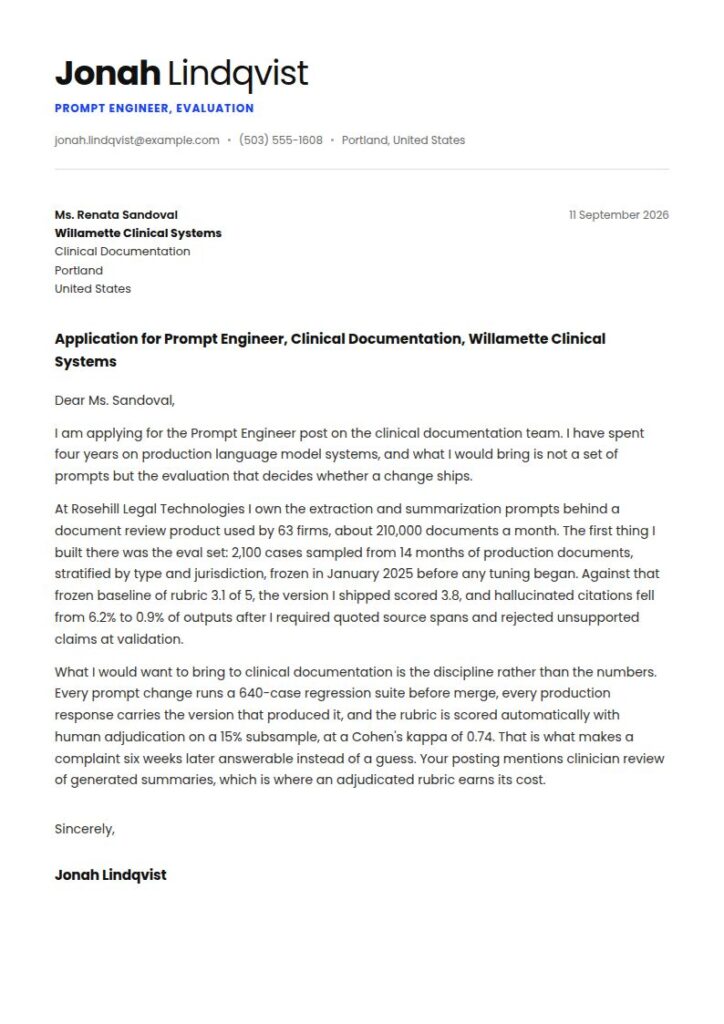
I am applying for the Prompt Engineer post on the clinical documentation team. I have spent four years on production language model systems, and what I would bring is not a set of prompts but the evaluation that decides whether a change ships.
At Rosehill Legal Technologies I own the extraction and summarization prompts behind a document review product used by 63 firms, about 210,000 documents a month. The first thing I built there was the eval set: 2,100 cases sampled from 14 months of production documents, stratified by type and jurisdiction, frozen in January 2025 before any tuning began. Against that frozen baseline of rubric 3.1 of 5, the version I shipped scored 3.8, and hallucinated citations fell from 6.2% to 0.9% of outputs after I required quoted source spans and rejected unsupported claims at validation.
What I would want to bring to clinical documentation is the discipline rather than the numbers. Every prompt change runs a 640-case regression suite before merge, every production response carries the version that produced it, and the rubric is scored automatically with human adjudication on a 15% subsample, at a Cohen's kappa of 0.74. That is what makes a complaint six weeks later answerable instead of a guess. Your posting mentions clinician review of generated summaries, which is where an adjudicated rubric earns its cost.
I have not worked with clinical data before and would expect the first months to be spent learning what a correct summary means there, since the eval set is only as good as the definition underneath it. I would be glad to walk through the sampling procedure or the one change we rolled back. Thank you for your time.
Sincerely, Jonah Lindqvist
Openings that work
| Instead of | Use |
|---|---|
| I am passionate about the possibilities of generative AI | I have spent four years on production language model systems, and what I bring is the evaluation that decides whether a change ships |
| I have extensive experience crafting effective prompts | The first thing I built there was the eval set: 2,100 cases, stratified by document type, frozen before tuning |
| I significantly improved the quality of model outputs | Against a frozen baseline of rubric 3.1 of 5, the version I shipped scored 3.8 |
| I am excited by your innovative use of AI in healthcare | Your posting mentions clinician review of summaries, which is where an adjudicated rubric earns its cost |
In short, each right-hand opening contains something a reader could question, and a question starts an interview.
The one story worth telling
Instead, pick one system and tell it in four moves. One told properly beats three listed.
| Move | What goes in it |
|---|---|
| The set | How many cases, where from, how stratified, when frozen |
| The baseline | What the change had to beat, in the metric's own terms |
| The judge | Automatic scorer, human raters or both, with the agreement statistic |
| The record | The version that shipped, when, and whether anything was rolled back |
The rollback is the move nobody makes, and it is worth more than the headline number. An applicant who volunteers that the team pulled one of nine versions within four hours is describing a process with a safety net.
Give the eval set a size, a sampling method and a freeze date. Name the baseline in the same sentence as the result. Say who or what judged. Mention the regression suite and what a failure blocks. Say in one clause what you do not yet know about their domain.
Do not paste a prompt into the letter. Do not quote a score without the baseline it beat. Do not describe iterating until the output looked better as evaluation. Do not claim an eval set your team built as your own. Do not list every model family you have called; the reader will ask about the one you know least well.
When the work was never anyone's job title
Most people writing this letter did the work under another name. For example, a support operations analyst who hand-coded 1,200 conversations into an intent taxonomy built a sampling frame. A quality lead who ran calibration sessions has been doing inter-rater agreement for years.
Therefore, write that history as what it was. The letter's job is one sentence of translation, placed early: "the evaluation work below was done as a support operations analyst, before anyone here had the title." Then carry on with the evidence, which is identical either way.
The title is unpublished; the occupations around it are not
The Bureau of Labor Statistics publishes no Occupational Outlook Handbook profile for prompt engineers, so there is no federal employment count, growth rate or median wage for the title. The occupations that bracket the work had medians of $120,230 for data scientists, $135,980 for software developers and $140,300 for computer and information research scientists as of May 2025 (BLS, May 2025).
All three are growing: data scientists 35% between 2025 and 2035 with about 24,800 openings a year, computer and information research scientists 22% with about 2,900, and software developers, quality assurance analysts and testers 10% with about 106,100 (BLS, 2025-35 projections).
For the letter that means vocabulary matters. The same evaluation story reads as research, engineering or measurement depending on which posting it answers.
Length, format and sending it
One page, four paragraphs, 250 to 400 words. PDF unless the portal says otherwise, named for yourself and the post: jonah-lindqvist-prompt-engineer-cover-letter.pdf. Address a named person where you can find one, and keep every number identical to the resume, because readers notice a discrepancy.
Our prompt engineer resume example uses the numbers here, and the free ATS checker will tell you whether the pair parses.
Key takeaways
- First, lead with the eval set and its freeze date, not with a prompt.
- Also, give the baseline in the same sentence as the result.
- Name the judge, and the agreement statistic if more than one judged.
- Mention the regression suite and what a failure blocks.
- Volunteer the rollback; it is worth more than the headline number.
- Translate work done under another job title in one early sentence.
- Say what you do not yet know about their domain.
Write your prompt engineer cover letter in 10 minutes with our AI cover letter builder.
Prompt engineer cover letter questions, answered
How long should a prompt engineer cover letter be?
One page, four paragraphs, 250 to 400 words. One evaluation told properly fills it. A letter listing four systems in a sentence each says less than one describing a single set, baseline and shipped version.
Should I attach prompts or a portfolio?
Attach the evaluation instead: the sampling procedure, the rubric, the regression suite, and a write-up of a change that did not work. Prompts go stale when the model underneath changes, so a portfolio of them ages badly.
What if I have never held the title?
Say so in one early sentence and carry on. The evidence is identical whether you produced it as a support analyst, a quality lead or a data analyst, and readers know the title is new.
Do I put salary expectations in the letter?
No. There is no published federal wage for the title to anchor against, and quoting a jobs-board average invites a conversation about the source rather than the work. The bracketing occupation figures are the defensible reference: $120,230, $135,980 and $140,300 as of May 2025 (BLS, May 2025).
How do I write to an employer in a domain I do not know?
Read what they publish, name one specific thing from it, and say plainly what you do not yet know. The honest version is unusually persuasive here, because an eval set is only as good as the definition of correctness underneath it, and that comes from the domain rather than from you.