
Summary
"Tell me about a time you failed" tests self-awareness, ownership and growth, not your track record. Choose a real, recent failure with moderate stakes that you caused at least in part. Tell it with STAR, then add a fifth step: the lesson and the specific habit you changed. Proof that you applied the lesson later is what turns a failure story into a hiring signal. Avoid fake failures, blame, and anything ethical or catastrophic.
When an interviewer says "tell me about a time you failed," they are not hunting for your worst moment. They want to see whether you own mistakes, learn from them, and change how you work. The winning answer is a real, moderate failure told in STAR order, followed by the lesson and proof you applied it.
As the University of Warwick careers team puts it, "the interviewer is really assessing how you respond to failure, not the failure itself." That changes how you should choose and tell the story.
Why do interviewers ask about a time you failed?
Interviewers ask about a time you failed to gauge self-awareness, accountability and growth. Behavioral questions assume past behavior predicts future behavior, so they want evidence that you notice your own mistakes, take ownership without blaming others, and change your habits so the same failure does not happen twice.
Behavioral interviews rest on one idea. Wayne State University Career Services states it plainly: "past performance in a similar setting is the best predictor of future performance."
A 2022 meta-analysis by Sackett and colleagues, summarized by SIOP, found structured interviews had the highest mean validity of the selection methods studied, at .42.
The interviewer is checking three things:
- Self-awareness. Do you see your own part, or only bad luck and other people? Warwick notes employers also want to know whether you reflect on mistakes or repeat them.
- Problem-solving under pressure. What did you do once things went wrong? In NACE's Job Outlook 2025, nearly 90% of employers said they look for problem-solving skills, the top attribute on the list.
- Growth. Did the failure change a habit you can name?
How do you choose the right failure to talk about?
Choose a real failure you caused at least in part, with moderate stakes, from the last two or three years, and with a lesson you have since applied. Avoid trivial slips, disguised strengths, ethical lapses, and anything that touches a core skill of the job you want. The best failure sits close to the role but not at its center.
| Test | Good failure | Risky failure |
|---|---|---|
| Ownership | You made the call or missed the step | A teammate or vendor caused it |
| Stakes | A missed deadline, lost deal or rework | A typo, or a lawsuit, injury or firing |
| Ethics | An honest misjudgment | Cutting corners, hiding a mistake, breaking rules |
| Relevance | Touches the job, not its core skill | A failure at the main thing you are hired to do |
| Proof of growth | You applied the lesson later, with a result | The lesson is still theoretical |
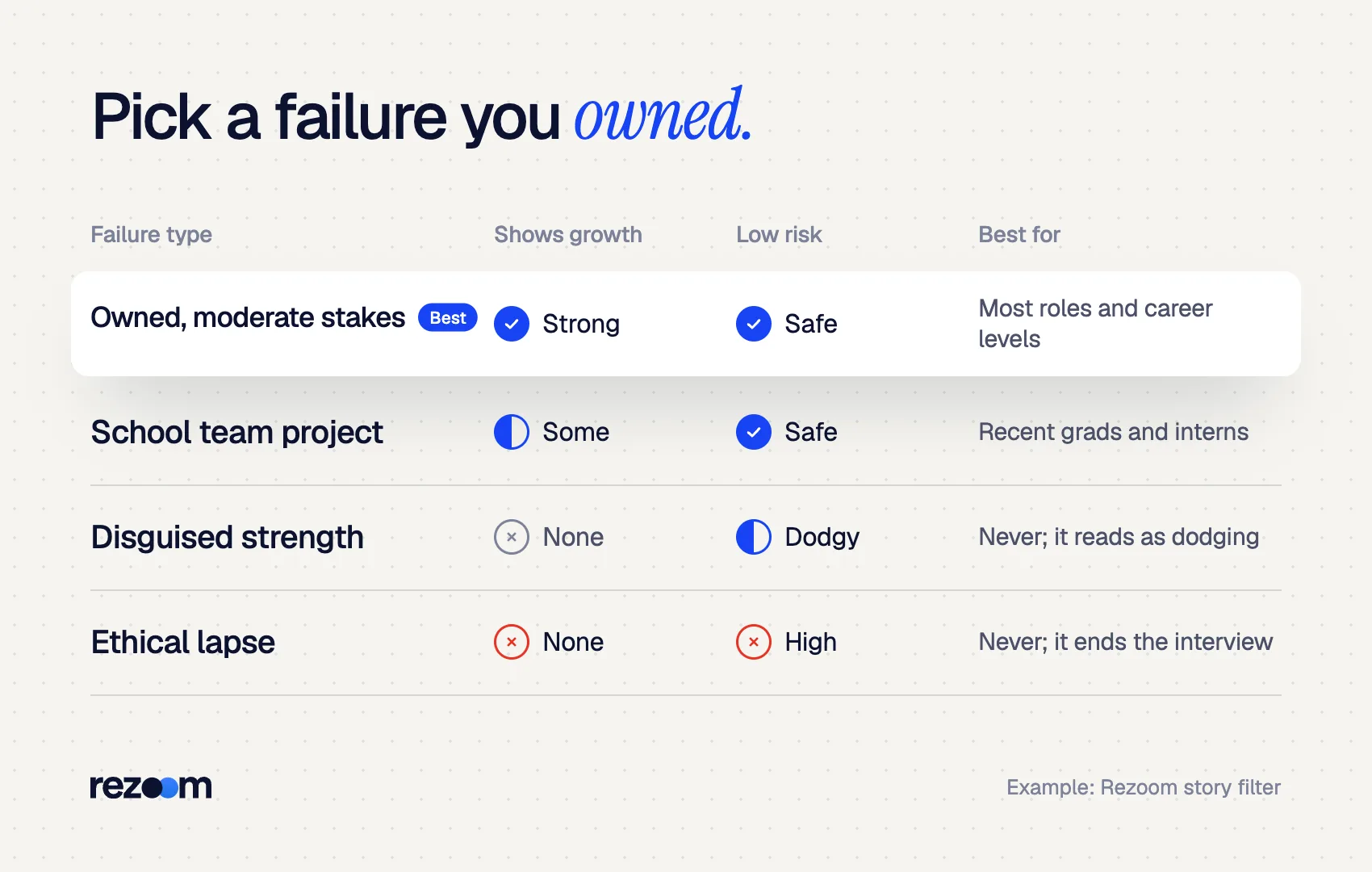
The relevance line is the one most guides skip. An accountant should not choose a failure about getting numbers wrong. That same accountant can safely talk about a failed presentation to leadership. Warwick makes a similar point: a creative role may reward a risk that did not pay off, while a methodical role may not.
Also skip the disguised strength, such as "I failed because I cared too much." Interviewers hear it as dodging. That move belongs, carefully, in a greatest weakness answer, and even there it rarely works.
What is the best structure for a "time you failed" answer?
The MIT Career Advising office recommends a rough split of 20% Situation, 10% Task, 60% Action and 10% Result. For a failure story, add one line at the end. The structure looks like this:
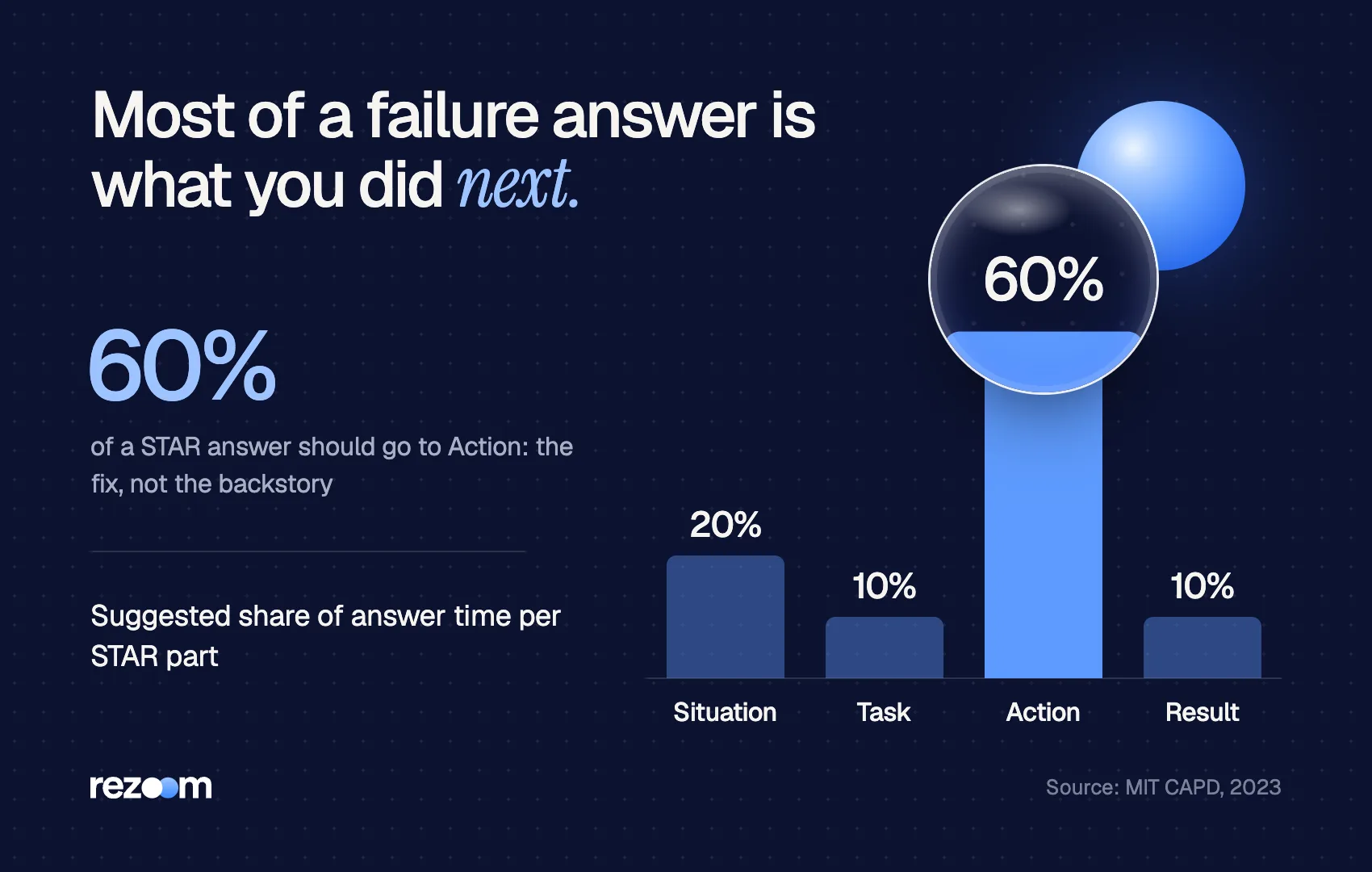
- Situation (1–2 sentences). Where you were and what the goal was.
- Task (1 sentence). What you owned.
- Action (3–4 sentences). Your mistake in one clear sentence, then what you did to contain and fix it.
- Result (1–2 sentences). The honest outcome. Do not spin a failure into a win.
- Lesson (1–2 sentences). The habit you changed and one later moment it paid off.
Say "I" when you describe the mistake. Sliding into "we" sounds like spreading the blame. For more on the method, see our STAR method interview guide.
Name the mistake in one sentence
Write your failure as a single sentence that starts with "I": "I didn't confirm the client's sign-off before launch." If you can't, the story isn't owned yet. Say that sentence early in your Action section, then move straight to what you did about it. Interviewers relax once they hear clear ownership.
Example answers to "tell me about a time you failed"
"In my senior capstone, I volunteered to lead a four-person team building a budgeting app. I assigned tasks in our first meeting and then assumed everyone was on track.
Two weeks before the deadline, I found out our backend was half built. That was on me. I called a meeting, re-split the remaining work by each person's strengths, and we met every other day until the demo.
We delivered, but with two features cut, and we got a B-plus instead of the A we were aiming for. Since then, I set a short weekly check-in on any shared project. In my internship last summer, that habit caught a missed data handoff a full week early."
"Last year, I scheduled a promotional email and selected the wrong segment. It went to about 3,000 past customers instead of a small test group of 200.
I caught it within the hour, told my manager immediately, and drafted a short correction email that went out that afternoon.
The damage was small but avoidable. I built a three-step send checklist and started asking a teammate to verify the segment before any send over 500 people. We have not had a wrong-list send since, and the checklist is now used by the whole team."
"At my last company, I pushed a small configuration change on a Friday afternoon without running the full test suite. I assumed it couldn't touch anything important. It broke password resets for about two hours.
I rolled it back, posted a clear incident note in our team channel, and wrote the post-mortem myself over the weekend.
The team adopted my proposal to run config changes through the code pipeline. Personally, I no longer deploy late on Fridays, and I treat 'small' changes with the same tests as big ones. Six months later, that pipeline caught a config error of mine before it shipped."
"Early in my sales career, I closed a mid-size deal partly by promising a reporting feature that was only on our roadmap. It slipped by a full quarter.
When I found out, I called the client before they discovered it themselves. I worked with our solutions team on a manual weekly report as a stopgap and offered a short contract extension at no cost.
We kept the account, but the renewal was tougher than it should have been. Now I confirm any roadmap item with product in writing before I mention it to a customer, and I put the date in the proposal."
"As a newer nurse, I noticed a patient's blood pressure trending down over two checks. I decided to wait for the next reading before calling the physician because I didn't want to overreact.
My charge nurse saw the trend and escalated it right away. The patient was fine, but my hesitation could have delayed care.
Since then, I escalate on the trend, not just the threshold, and I use our SBAR format to make the call quick. I now walk new graduates through that same lesson when I precept."
"I managed a website relaunch for a client and built the timeline without checking the client's legal review process. Their legal team needed three weeks, not three days.
I told the client and my director as soon as I knew, re-sequenced the work so design and development kept moving, and negotiated a two-week launch delay instead of five.
We launched late, and the client was frustrated. I now map every external approval in the kickoff meeting and add a buffer for each one. On my next three projects, all external reviews landed inside the plan."
"When I was promoted to team lead, I kept doing the hardest analysis myself because it felt faster. Within two months, I was the bottleneck, and two analysts told me in one-on-ones they weren't growing.
They were right. I set up a simple plan: each analyst owned one complex report, with a short review from me instead of a rewrite.
By the next quarter, turnaround time was back to normal and I had time for planning work. Now I ask, 'Who on my team should own this?' before I start anything."
What should you not say when asked about a time you failed?
Do not claim you have never failed, offer a disguised strength, blame others, pick an ethical lapse or a catastrophe, or end without a lesson. Also avoid failing at the core skill of the target job, and do not let the story run past two minutes. Each of these signals low self-awareness or a real hiring risk.
Name your mistake in one sentence that starts with "I."
Say "I've never really failed at anything." do: Pick a real failure with moderate stakes. dont: Offer a humblebrag like "I worked too hard." do: Show what you did to contain the damage. dont: Blame a teammate, client or manager. do: End with a lesson and one later moment you applied it. dont: Choose a story about cutting corners or hiding a mistake. do: Keep it to 60 to 90 seconds. dont: Turn the result into a win it wasn't.
If your best failure story involves friction with a colleague, consider saving it for tell me about a conflict with a coworker. A strong success story is a better fit for what is your greatest accomplishment. Keep your stories distinct across one interview.
How do you practice your answer before the interview?
Outline two failure stories as bullets, one recent and one with stronger proof of growth. Say each aloud and time it at 60 to 90 seconds. Then practice follow-ups like "What would you do differently?" and "Has it happened again?" with a mock interviewer who pushes back.
MIT recommends preparing 3 to 5 stories as bullet outlines rather than memorized scripts. One failure story can then cover variations like "Tell me about a mistake you made." Our list of common interview questions shows how often these variations come up.
A Rezoom AI mock interview can ask you this question, follow up the way a real interviewer would, and flag answers that run long or never name the lesson. For more practice sets, see our behavioral interview questions guide.
Frequently asked questions
How long should my answer about a time you failed be?
Aim for 60 to 90 seconds spoken. That covers the story, the fix and the lesson, and leaves time for follow-up questions.
Can I use a failure from school or a personal project?
Yes, if you are early in your career. Choose a team or academic project with real stakes, and show how the lesson carried into work or an internship.
Should the failure be recent?
Ideally within the last two or three years. An older story is fine if it changed how you work and you can show a recent example of the new habit.
What if my failure cost the company money?
You can use it if the stakes were moderate and you led the recovery. Be honest about the impact, focus on what you did next, and show the habit you changed.
Is "tell me about a time you failed" the same as "what is your greatest weakness"?
No. The failure question asks for one past event told as a story. The weakness question asks about an ongoing trait and what you are doing to improve it.
What if I can't think of a failure?
Look for a missed deadline, a lost deal, or a decision you would make differently. Saying you have none is the only wrong answer.



Comments