

Summary
When an interviewer says "tell me about a conflict with a coworker," they want proof that you can disagree without damaging the work or the relationship. Pick a real, resolved, work-related disagreement where you acted first. Tell it in STAR order, spend most of your time on what you did, and end with a result plus what you now do differently. Never blame the coworker, claim you never have conflicts, or pick a story about personality.
When an interviewer asks you to describe a conflict with a coworker, they are testing one thing: can you disagree and still get the work done? The best answer is a short STAR story about a real, resolved, work-related disagreement in which you made the first move.
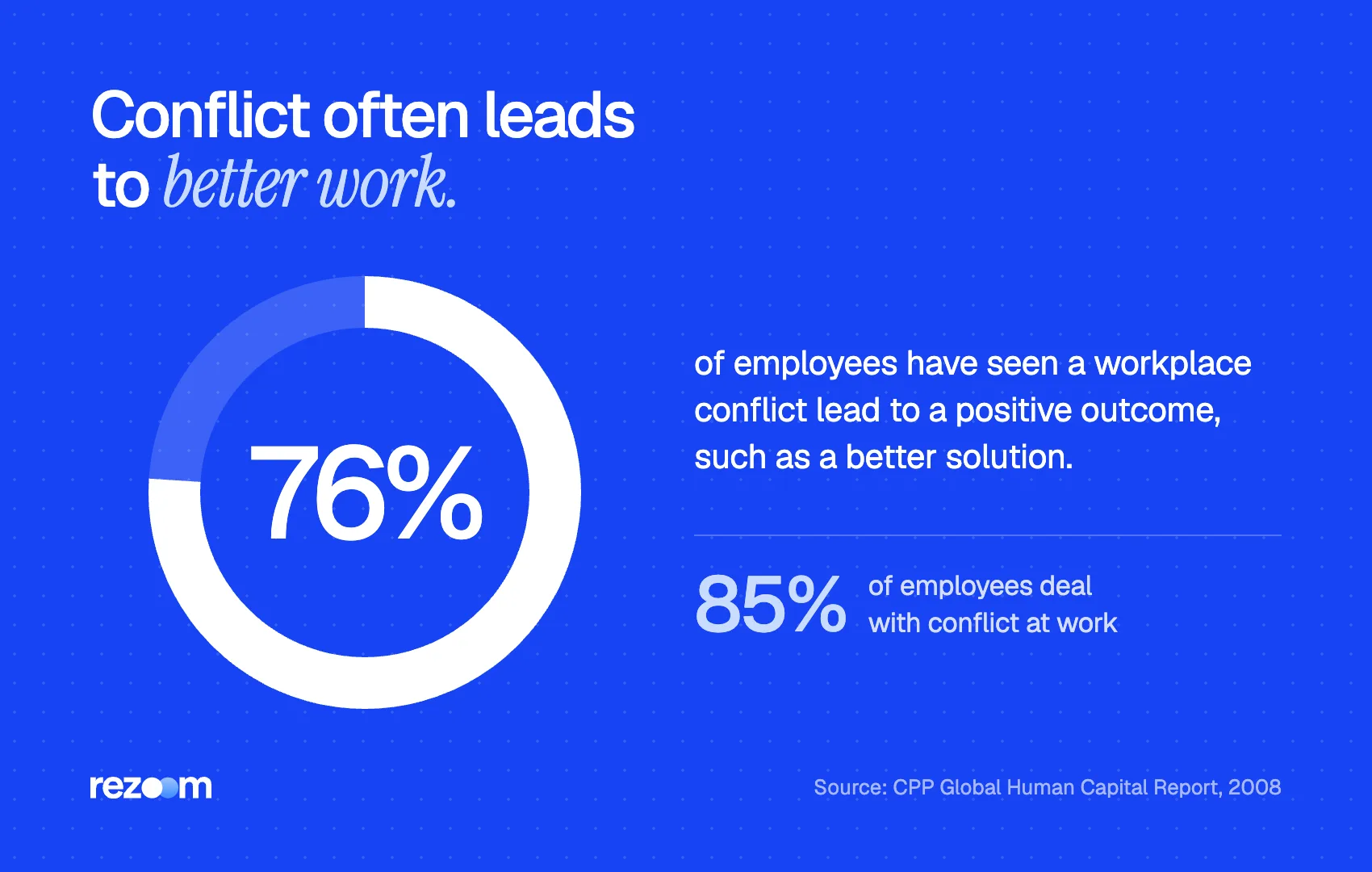
Conflict is normal at work, so pretending you have never had any is the weakest possible reply. A CPP study of 5,000 full-time employees found that 85% deal with conflict to some degree. Interviewers know that.
Why do interviewers ask about a conflict with a coworker?
Interviewers ask about a conflict with a coworker to predict how you will behave on their team. Behavioral questions assume past behavior predicts future behavior. They listen for emotional control, direct communication, focus on the shared goal, and a resolution that kept the relationship intact. The disagreement itself matters less than your role in fixing it.
Behavioral questions rest on a simple premise. As Wayne State University Career Services puts it, interviewers assume "past performance in a similar setting is the best predictor of future performance."
Research backs it. A 2022 meta-analysis by Sackett and colleagues, summarized by SIOP, found structured interviews had the highest mean validity of any selection method studied (.42).
Teamwork is also near the top of what employers screen for. In NACE's Job Outlook 2025, nearly 80% of employers said they look for evidence of teamwork. A conflict story is the most direct proof you can offer in the room.
The interviewer is listening for four signals:
- Composure. You stayed calm and professional.
- Initiative. You raised the issue directly instead of waiting or complaining.
- Shared goal. You framed the disagreement around the work, not the person.
- Repair. The outcome was good for the project and the relationship.
How do you pick the right conflict story?
Pick a conflict that was about work, not personality, that you helped resolve, and that ended well. Prefer a recent story from a role similar to the one you want. The stakes should be real but moderate: a missed handoff or competing priorities, not harassment, a firing, or a legal dispute.
Run every candidate story through this filter. If it fails any line, choose another.
| Test | Use the story if… | Skip it if… |
|---|---|---|
| Cause | It was about process, priorities, quality or deadlines | It was about personality, values or gossip |
| Your role | You made the first move toward a fix | Your manager stepped in and solved it for you |
| Outcome | It was resolved, with a result you can name | It is still ongoing or ended with someone leaving |
| Stakes | Real but moderate | Trivial (desk temperature) or severe (misconduct) |
| Relevance | It uses a skill the new job needs | It happened in an unrelated setting a decade ago |
The cause line matters most. The CPP report found personality clashes and warring egos were the top cause of workplace conflict (49%), ahead of stress (34%) and heavy workloads (33%). That is exactly why a personality story is risky. It invites the question, "Were you the ego?"
Recast the conflict around something observable. "We disagreed about the launch date" lands far better than "She was difficult to work with."
What is the best STAR structure for a coworker conflict answer?
Use STAR with the weight on Action. MIT's career office suggests roughly 20% Situation, 10% Task, 60% Action and 10% Result. For conflict, split Action into three moves: you sought to understand, you proposed a fix, and you followed through. Close with one line on what you do differently now.
The MIT Career Advising office recommends a rough split of 20% Situation, 10% Task, 60% Action and 10% Result. In a 90-second answer, that is about 55 seconds on what you did.
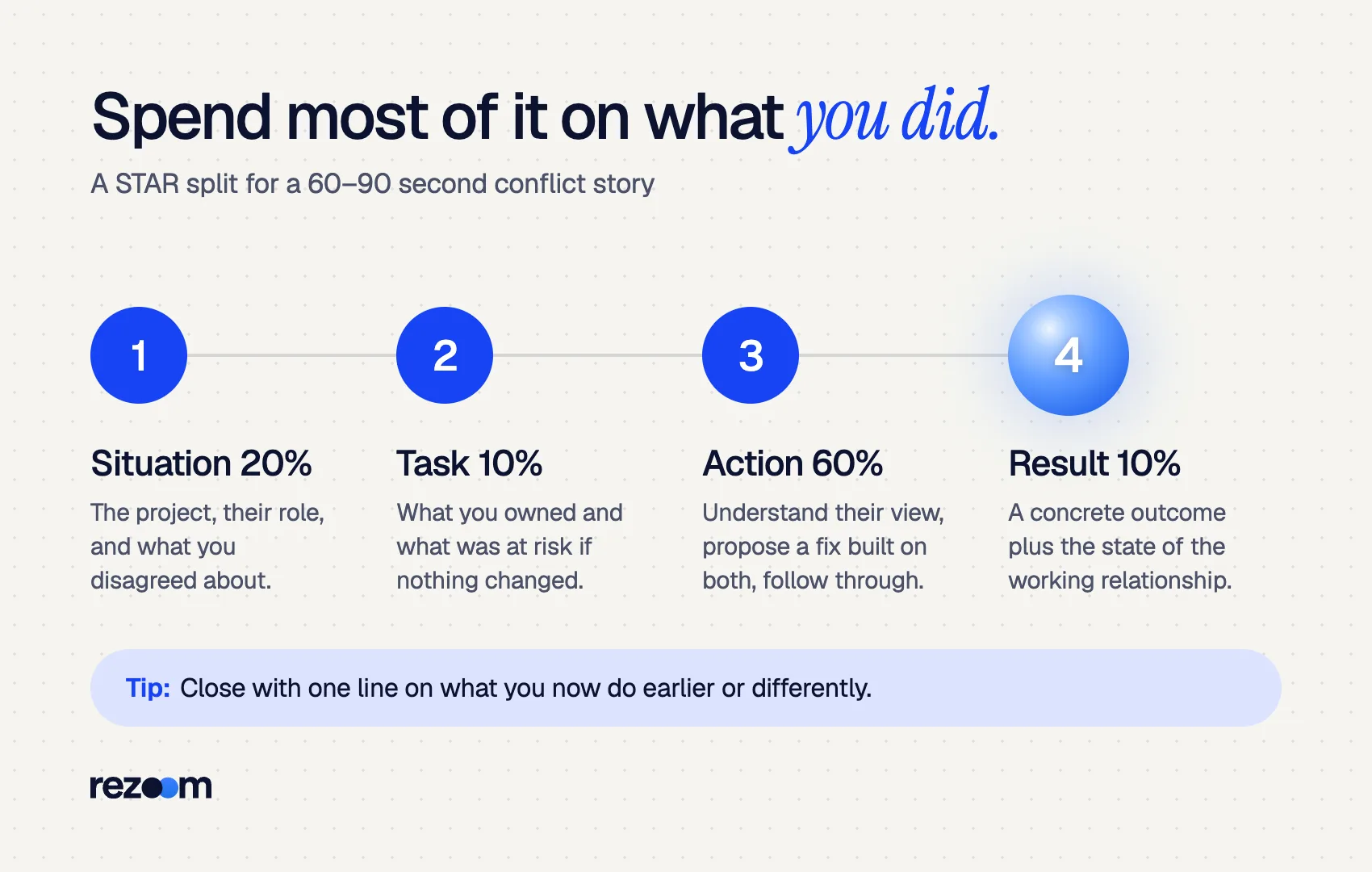
Here is the conflict-specific version:
- Situation (1–2 sentences). The project, the coworker's role, and what you disagreed about.
- Task (1 sentence). What you were responsible for and what was at risk.
- Action (3–5 sentences). Understand: you asked to talk privately and listened. Propose: you suggested a fix built on both views. Follow through: you checked in or set a process.
- Result (1–2 sentences). A concrete outcome, ideally a number, plus the state of the working relationship.
- Lesson (1 sentence). What you now do earlier or differently.
Use "I" for your actions and "we" for the shared outcome. For a deeper walkthrough of the method itself, see our STAR method interview guide.
Prepare the follow-up, not just the answer
Strong interviewers dig in after your story. Expect "What would you do differently?", "How is your relationship with them now?" and "What if they had refused to compromise?" Have one honest sentence ready for each.
Example answers for a conflict with a coworker, by role
Each answer below runs 60 to 90 seconds when spoken. Each names a work-based disagreement, shows the candidate acting first, and ends with a measurable or concrete result. Swap in your own details, keep the structure, and say the numbers only if they are true for you.
"On my last team, a senior engineer and I disagreed about a pull request. I wanted to ship a quick fix for a checkout bug, and he wanted a full refactor first. The bug was costing us failed orders, so I owned getting a fix out that week.
I asked him for fifteen minutes instead of arguing in comments. His real concern was that quick fixes in that module kept breaking things. So I proposed shipping the small fix behind a feature flag and pairing with him on the refactor the next sprint.
We shipped in two days, the error rate dropped, and the refactor landed two weeks later. Now I move tense code review threads to a short call much earlier."
"A night-shift nurse and I kept clashing over handoffs. She felt my reports were too long, and I felt hers left out pending labs. Patient safety was on the line, so I wanted to fix it rather than vent about it.
I asked her to grab coffee before a shift. We agreed we both cared about the same thing, catching what was pending. I suggested we try our unit's SBAR format with a short 'pending items' line at the end.
We trialed it for two weeks, and our charge nurse later rolled it out to the whole unit. I learned to raise a pattern after the second time, not the tenth."
"A sales colleague kept sending last-minute requests for custom one-pagers, which pushed my campaign deadlines. I was responsible for a product launch email that was at risk of slipping.
Instead of quietly saying no, I asked him what was driving the rush. Most requests came from the same three deal types. So I built three editable templates he could adapt himself, and we agreed on a 48-hour window for anything truly custom.
Rush requests dropped to about one a week, and the launch went out on schedule. Now I look for the repeat request behind a conflict before I push back on it."
"A teammate and I disagreed about a customer who wanted a refund outside policy. She wanted to deny it flat out. I thought we would lose a long-time account.
I asked her to step off the floor so we were not debating in front of the queue. I suggested we offer store credit and escalate the refund request to our supervisor with the account history attached.
The customer accepted the credit and renewed. Our supervisor turned that into a written exception path for similar cases."
"An engineering lead and I clashed over status updates. I needed weekly dates for the client, and he felt my check-ins were micromanagement.
I asked him what kind of update would cost him the least time. He suggested a shared board he already used. I agreed to stop the meetings if he flagged any risk there within a day.
The next two milestones landed on time, and the client stopped escalating to my director. I learned to ask how people prefer to report before I set the process."
"Two part-time associates both wanted every Saturday off. As the new shift lead, I owned the schedule, and morale was slipping.
I met with each of them separately first, then together. I proposed a rotating weekend calendar posted a month ahead, with swaps allowed if they found cover.
Complaints stopped within a month, and our Saturday call-outs dropped. The lesson for me was to set a clear, visible rule early, so people argue with the rule instead of with each other."
What are red-flag answers to a conflict question?
The red flags are claiming you never have conflicts, blaming or mocking the coworker, telling an unresolved story, letting a manager fix it for you, choosing a serious misconduct case, and ending with no lesson. Each one tells the interviewer you either lack self-awareness or will bring drama to the team.
Describe the disagreement as a difference about the work.
Call the coworker lazy, toxic or difficult. do: Show yourself starting the conversation, privately. dont: Say your manager stepped in and sorted it out. do: End with a concrete result and a working relationship. dont: Tell a story that is still unresolved. do: Admit your own part if you had one. dont: Say "I get along with everyone, so I have never had a conflict." do: Keep it to 60 to 90 seconds. dont: Pick harassment, discrimination or a firing as your example.
One more subtle red flag: a story in which you were simply right and the coworker eventually admitted it. It sounds like winning, not resolving.
If your story touches on a mistake of your own, it may fit better as an answer to tell me about a time you failed. Keep the two stories different so you are not repeating yourself in one interview.
How do you answer if you have never had a conflict with a coworker?
Almost everyone has had a disagreement, even a small one. Reframe "conflict" as a difference of opinion about priorities, process or deadlines. If you are early in your career, use a school, internship or volunteer team project. Never answer that you have had no conflict at all.
Interviewers rarely mean a shouting match. A disagreement about how to split a project or which deadline comes first counts.
Try this opener: "I have not had a serious falling-out, but I did have a real disagreement about…" Then tell a full STAR story.
The research supports this framing. In the same survey where 85% of employees reported dealing with conflict, the CPP study, 76% of employees had seen conflict lead to a positive outcome, such as a better solution to a workplace problem. A disagreement that improved the work is exactly the story interviewers want.
How should you practice this answer before the interview?
Outline two or three conflict stories as bullets, not scripts. Say each one aloud and time it, aiming for 60 to 90 seconds. Practice the likely follow-up questions. Then rehearse with a mock interviewer who can push back, ideally under realistic time pressure.
MIT recommends preparing 3 to 5 stories as bullet outlines, so you can adapt them on the spot. You will find more of those in our list of behavioral interview questions.
A Rezoom AI mock interview can ask you this question with follow-ups and give feedback on your structure and length. If you face several interviewers at once, review our panel interview guide too, since each panelist may probe a different part of your story.

Frequently asked questions
How long should my answer about a conflict with a coworker be?
Aim for 60 to 90 seconds when spoken. That is long enough for a full STAR story and short enough to leave room for follow-up questions.
Is it okay to admit I was partly at fault?
Yes. Owning your part shows self-awareness. Keep it brief, then focus on what you did to fix the situation.
Can I describe a conflict with my manager instead?
Only if the question allows it. If they ask about a coworker, use a peer.
Should I name the coworker in my answer?
No. Use their role, such as "a senior analyst." Naming people sounds like gossip and can reach someone who knows them.
How is "tell me about a conflict" different from "how do you handle conflict"?
The first asks for one past story, so answer with STAR. The second is general, so give your approach in two sentences, then back it with a short example.



Comments