How to Pass an AI Interview: 7 Rules Now That 63% Have Had One
How to pass an AI interview: what live AI interviewers score, 7 rules, practice questions, what to say when the bot mishears you, and how to ask for a human.
On this pageHow to pass an AI interview when the AI talks back?
To pass an AI interview, answer each question with one specific story, give numbers, and treat every follow-up as a chance to add proof. Live AI interviewers from vendors like HireVue, Alex and Ribbon score your words against the employer's rubric, not your charm. If the bot mishears you, say so and restate. You can ask for an accommodation or a human path.
Here is how to pass an AI interview: give the AI clear evidence. Answer the exact question, use one real story with a number, and treat each follow-up as a second chance to prove a skill.
This guide is about live AI interviewers. These are voice or chat agents that talk back, ask follow-ups and score you as you go. They are not the same as a one-way recorded screen, which our AI video interview guide covers.
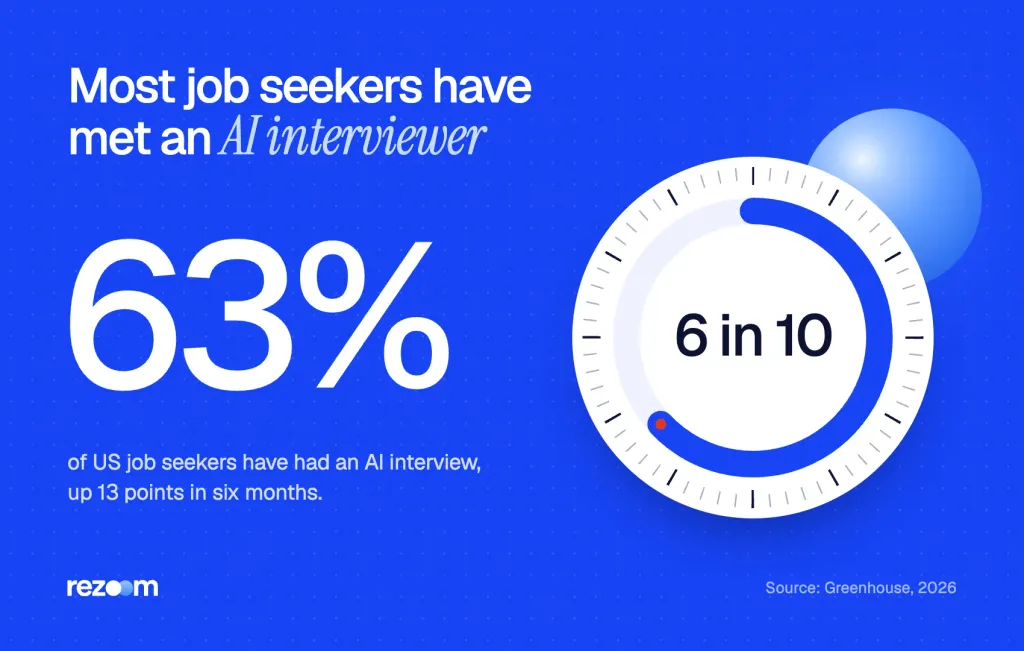
And you will likely meet one soon. Greenhouse found that 63% of US job seekers1 have already had an AI interview, up 13 points in six months.
The 7 rules at a glance
| Rule | What to do | Why it works |
|---|---|---|
| 1. Answer the exact question | Repeat the key word of the question in your first line | AI interviewers notice when an answer misses the point |
| 2. Use one story per answer | Situation, task, action, result, in under 2 minutes | Rubrics look for a clear example of a skill |
| 3. Add a number | Calls per day, time saved, people helped | Specifics count as evidence |
| 4. Welcome the follow-up | Add a new detail, don't repeat yourself | Probing questions dig for depth |
| 5. Think out loud | Say how you decided, not just what you did | Your reasoning is part of the score |
| 6. Correct the bot | "I think I was misheard. Let me restate." | The transcript is what gets scored |
| 7. Ask for what you need | Request an accommodation or a human path early | Many tools have an opt-out route |
How to pass an AI interview when the AI talks back?
A live AI interviewer asks a question, listens, then probes with a follow-up. To pass, give a short, specific answer with one story and one number. Then use the follow-up to add a new detail, such as your reasoning or the result. The AI scores the content of your words against the employer's rubric.
The big change is the follow-up. HireVue says its AI agents ask "probing follow-up questions, in a natural two-way conversation3." Alex, formerly Apriora, says its interviewer "asks intelligent follow-ups5" and reacts to answers like a recruiter.
So if you say "I'm a team player," expect the AI to ask for proof.
Which tools run live AI interviews?
These are real vendors you may meet. Check your invite for details.
| Tool | Format | What the vendor says |
|---|---|---|
| HireVue AI Interviewer | Two-way voice | Asks follow-ups, scores on a 1-5 rubric, recruiters make the final call |
| Alex (formerly Apriora) | Voice or video | Asks follow-ups, sends a summary, does not auto-reject |
| Ribbon | Voice or video | Follows up when an answer needs more detail, 10+ languages |
| micro1 (Zara) | Conversational AI recruiter | Scenario questions on how you think and communicate |
| Workday Paradox | Chat or text | Asks knockout questions, then lets you self-schedule |
Ribbon also says candidates can interview "at any hour7." Its first screen can be short: HR Brew reported a five-minute screening8 that turns into a candidate profile.
Chat agents differ. Workday says Paradox "asks required knockout questions via chat or text10," so read each one carefully.
AI recruiter phone interview calls are usually five-minute knockout screens. See what the voice AI asks, how it scores you, and how to prepare.
What does an AI interviewer score?
Most live AI interviewers score your answers against a rubric the employer sets for the role. HireVue ties each score to behavioral anchors and evidence from the interview. Alex says reputable tools judge the content of your answers, not how you look or sound. So specific examples beat smooth delivery.
The rubric is the key. HireVue offers a "custom 1-5 rubric3" and says every score ties back to evidence from the interview. Its launch release says responses can be scored against "IO-validated rubrics4."
Alex puts it plainly in its candidate guide. "An AI is scoring evidence6," so specifics matter more than charm.
You're not being scored on smoothness.
Alex, How to Ace an AI Interview: A Candidate's Guide
What earns points and what doesn't
- Earns points: a clear example, the action you took, a number and the result.
- Earns points: your reasoning, said out loud.
- Earns points: an answer that matches the question's key word.
- Doesn't help: buzzwords with no story behind them.
- Doesn't help: a long, polished speech that never answers the question.
Also, the AI usually does not decide alone. Our HireVue interview tips cover the older HireVue formats, but for its AI Interviewer, HireVue says "recruiters always make the final call3." Alex says it "does not make final hiring decisions." But a weak rubric score can still push you down the review list, so the content matters.
Employers build the rubric from the role's needs. So pull 3 skill words from the job post, like "de-escalation" or "scheduling." Then use each one inside a real story, not as a buzzword.
How do you prepare for an AI interview in 24 hours?
Read the invite for length, format and any opt-out. Pick 4 to 5 stories that prove the job's main skills, each with a number. Practice out loud with a tool that asks follow-ups. Then test your mic, find a quiet room and keep water nearby. Most AI interviews take 15 to 30 minutes.
Alex says its interviews "usually take 15-30 minutes6" and that you'll usually learn the length upfront. That's short, so every answer counts.
- Read the invite closelyNote the length, voice or chat format, the deadline and any link for accommodations or a human path.
- Build a story bankWrite 4 to 5 short stories with a number each: a hard customer, a busy day, a mistake you fixed, a team win.
- Prepare a follow-up layerFor each story, add one extra detail: why you chose that action or what you'd do next time.
- Practice out loudUse an AI mock interview practice tool so you get used to a voice that asks follow-ups.
- Set up your roomTest your mic, use headphones, silence your phone and keep water close.
Match your stories to your resume
The AI often reads your application too. Alex says it uses "the content of the interview and your application materials5" to write a summary for the hiring team. So your stories should match your resume bullets.
Dana, our example, is applying for a call center role. She compares her stories against strong customer service representative resume bullets, so her numbers line up.
Customer service representative resume example
See how to show call volume, satisfaction scores and problem solving in a few clear bullets.
For more office and support roles, browse our administrative resume examples. If the role also asks for a letter, our administrative cover letter examples show how to echo the same proof.
Before your AI interview starts
What questions does an AI interviewer ask?
Expect common behavioral and situational questions, then a follow-up that asks for more detail. Typical openers cover a hard customer, a busy day, a mistake, teamwork and why you want the job. Practice each one with a second layer, such as your reasoning, the result or what you learned.
micro1 says its AI recruiter uses scenario questions to see "how you think, problem-solve, and communicate9." So practice the main question and the likely probe together.
Sample answers with follow-ups
AI: "Tell me about a time you handled an upset customer."
"A caller was billed twice. I said sorry, found the error and refunded $84 in the same call."
AI: "What did you do to keep it from happening again?"
"I flagged the billing bug to my lead, and we fixed the template that week."
AI: "How do you handle a high call volume?"
"On launch days I took about 70 calls. I used saved replies for common questions so I could spend time on hard ones."
AI: "Describe a mistake you made at work."
"I booked a client on the wrong date. I called them first, rebooked and then added a double-check step to my routine."
AI: "Why do you want this role?"
"I like fixing problems on the first call. Your post says first-call resolution matters, and that's what I track for myself."
Practice questions to rehearse
- Tell me about a time you solved a problem under pressure.
- How do you decide what to do first when everything is urgent?
- What would you do if a customer asked for something against policy?
- What questions do you have about the role?
Alex notes that your own questions at the end may reach the hiring team.
HireVue interview tips: how a HireVue interview works, think time and answer limits, retakes, what the AI scores, game-based tests and how to prepare.
Mock interviews, out loud, with an AI voice coach.
What should you do if the AI misunderstands you?
Say so right away and restate your answer in one clear sentence. Ask the AI to repeat or confirm a question you didn't catch. If the tool glitches or freezes, take a screenshot, finish if you can, then email the recruiter and the vendor's support. Alex says tech problems can lead to a new slot.
Glitches happen. In 2025, Futurism reported that an Apriora AI recruiter repeated "vertical bar pilates11" about 14 times during a real interview.
Most problems are smaller, like a cut-off answer or a misheard word. Because the transcript gets scored, fix it out loud.
What to say when the bot gets it wrong
Do
- Say "I think I was misheard. Let me restate that."
- Confirm unclear questions: "Just to check, you're asking about X?"
- Pause before you answer. Silence to think is fine.
- Screenshot any freeze or error and note the time.
Don’t
- Talk over the AI while it is still asking.
- Guess at a question you didn't hear.
- Restart the session without telling anyone.
- Argue with the bot or vent about AI.
Alex says "pauses are fine6" and that the AI won't judge you for taking a breath. It also suggests you confirm a question if you're unsure.
If the tech fails, ask for a redo. Alex says that if a technical issue makes you miss your slot, "you will be able to take the interview at another time5."
Write to the recruiter the same day. Name the time, what broke and one line on what you meant to say. Then the human who reads your summary has the context the AI missed.
Should you ask for an accommodation or a human interviewer?
Yes, if you need it. Under the ADA, employers must provide reasonable accommodations in hiring unless it causes undue hardship, including when they use AI tools. Ask early and in writing. Some tools, like HireVue's, list AI opt-out paths, and NYC law lets candidates request an alternative process.
You don't need to share a diagnosis. Just say what gets in the way and what would help.
What the rules say
- ADA: Employers must "provide reasonable accommodations12" in hiring, and a request should not hurt your chances.
- Alternative test: If a tool screens you out because of disability, the employer must use an accessible test of your job skills.
- New York City: Employers using automated tools must give notice "no less than ten business days13" before use and let you request an alternative process or accommodation.
- Vendor paths: HireVue lists "accommodation requests & AI opt out paths3" in its AI Interviewer.
Should you just ask for a human?
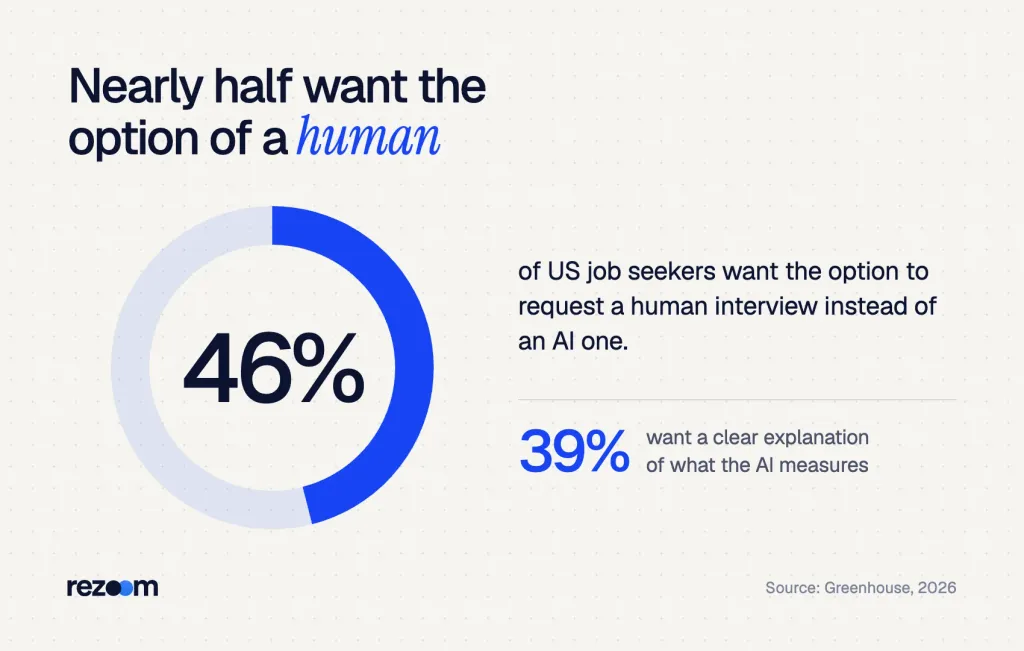
You can ask, and you're not alone. Greenhouse found that 46% of US job seekers2 want the option to request a human interview. Also, 39% want a clear explanation of what the AI measures.
But without a disability need or a local law, the employer can say no. So frame it as a question, not a demand, and be ready to do the AI round if that's the only path.
Subject: [Your name] – AI interview for [job title]
Hi [recruiter name], I've received the AI interview link. Because of a hearing need, I'd do best with live captions or a human interviewer.
Is there an accommodated or human path I can request? I'm glad to schedule this week.
Thanks, [your name]
Ready to rehearse? Try our AI mock interview practice the day before, so a follow-up question feels normal. For recorded screens instead, see our one-way video interview tips.
Practice out loud with an AI voice coach.
Frequently asked questions
Can you fail an AI interview?
Yes. If your answers miss the question or lack specific examples, your rubric score drops and a recruiter may never review you. The AI usually doesn't make the final call, but its score shapes who gets seen first.
How long does an AI interview take?
Alex says most of its interviews take 15 to 30 minutes, and you usually learn the length upfront. Some first screens, like Ribbon's, can be about five minutes.
Does an AI interviewer read my facial expressions?
The HireVue and Alex pages we checked describe scoring the content of your answers, not your face. Alex says reputable tools judge what you say, not how you look or sound.
Can I use notes during an AI interview?
Check the invite, because each employer sets its own rules. Brief notes with your story keywords are usually safer than a script, which sounds read aloud.
Can I ask an AI interviewer to repeat a question?
Yes. Ask it to repeat or confirm the question before you answer. Guessing wastes your time and can earn a low score.
Will I get feedback after an AI interview?
Often not. Alex says it can't give feedback to candidates directly, and Greenhouse found that 51% of US candidates who finished an AI interview never got an outcome.
Sources
We opened and read each page below. The small numbers in the text point here. Pages that carry no publication date show n.d.
- Greenhouse2026
63% of US job seekers have had an AI interview, up 13 points in six months, and 51% of those who finished one never heard an outcome.
- Greenhouse2026
46% of US job seekers want the option to request a human interview, and 39% want a clear explanation of what the AI measures.
- HireVuen.d.
HireVue's AI Interviewer asks probing follow-ups, scores on a 1-5 rubric tied to evidence, leaves the final call to recruiters and lists accommodation and opt-out paths.
- HireVue2026
HireVue's AI Interviewer runs two-way voice interviews and scores responses against IO-validated rubrics.
- Alexn.d.
Alex asks follow-ups, summarizes the interview and application for the hiring team, does not make final decisions and reschedules after tech issues.
- Alex2026
AI interviews usually take 15 to 30 minutes, score evidence against a rubric, and pauses do not lower your score.
- Ribbonn.d.
Ribbon runs voice and video interviews at any hour, follows up when answers need detail and supports 10+ languages.
- HR Brew2025
Ribbon's live AI screening takes about five minutes and becomes a candidate profile.
- micro1n.d.
micro1's AI recruiter Zara uses scenario questions to judge how candidates think, problem-solve and communicate.
- Workdayn.d.
Workday Paradox asks required knockout questions via chat or text and lets candidates self-schedule.
- Futurism2025
An Apriora AI recruiter glitched and repeated "vertical bar pilates" about 14 times in a candidate's interview.
- ADA.gov (US Department of Justice)2022
Employers using hiring technology must provide reasonable accommodations and use an accessible test when a tool screens out a qualified applicant with a disability.
- New York City Administrative Coden.d.
NYC employers must give candidates 10 business days' notice of an automated tool and let them request an alternative process or accommodation.
Mohammad has spent more than ten years designing consumer products and leads product at Rezoom, deciding what gets built and what gets left out. His guides cover the whole job search, from resume sections and cover letters to interview answers and career moves.
Goodi, M. (2026, November 24). How to Pass an AI Interview: 7 Rules Now That 63% Have Had One. Rezoom. https://rezoom.io/how-to-pass-an-ai-interview/