
Summary
In ResumeGo's field experiment of 7,287 applications, a generic cover letter lifted callbacks 17% over no letter, while a tailored one lifted them 53%. A template supplies the first number; the blanks you fill supply the second. Use a plain, single-column template of 250–400 words that opens with evidence rather than enthusiasm, addresses a named person, and forces one specific sentence about this employer. Copy it into Word or Google Docs and export a text-based PDF.
A cover letter template saves you the formatting, and the formatting was never the part that got interviews. The numbers are worth seeing before you copy anything.
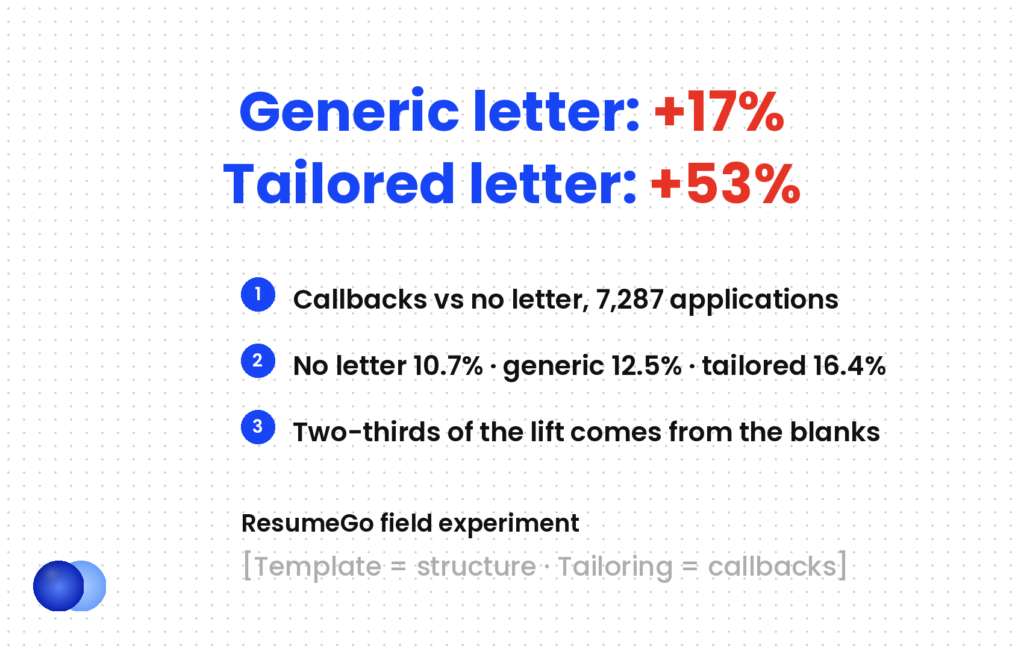
ResumeGo sent 7,287 applications to live job postings and tracked callbacks for 30 days. A generic cover letter beat no letter by 17%. A tailored one beat no letter by 53%. In raw terms, callbacks moved from 10.7% with no letter to 12.5% with a generic one and 16.4% with a tailored one.
So roughly two-thirds of what a letter is worth comes from the parts a template cannot write for you. The template below fixes the structure and makes the blanks hard to fill generically.
What should a cover letter template actually contain?
Five fixed parts in a single column: your contact header, a named greeting, an evidence-first opening, one or two proof paragraphs, and a closing that names the next step. Everything else — colour bars, photos, sidebars, skill meters — is decoration that costs you with portals and adds nothing for a reader.
Most downloadable templates compete on looks, yet in Resume Genius's survey of 625 hiring managers, 36% spend under 30 seconds on a cover letter and 41% say the introduction leaves the biggest impression.
A good template therefore does four jobs:
Keep it to one column. The same rule applies here as on a resume. Many portals ask you to paste the letter into a plain text box, and a two-column layout turns into scrambled fragments there.
Hold the length at 250–400 words. That matches 30 to 60 seconds of reading, and Resume Genius found hiring managers' average preferred length sits around 400 words. How long should a cover letter be covers the full reasoning.
Put evidence before motivation. Readers skim for proof; enthusiasm alone is the sentence every applicant writes.
Make the blanks specific. "[Company]" is a blank anyone can fill in two seconds. "[One thing this team shipped or announced in the last year]" is a blank that forces research, and research is the 53% part.
| Template element | Generic version | Tailored version |
|---|---|---|
| Greeting | Dear Hiring Manager | Dear Priya Shah |
| Opening | I am excited to apply for… | A result from your work that matches their need |
| Body | List of strengths | One or two proven results with numbers |
| Company line | Your company is a leader in the industry | One named project, product or problem |
| Callback lift in ResumeGo's data | +17% vs no letter | +53% vs no letter |
Why does a generic cover letter template underperform?
Because readers spot it instantly. In ResumeGo's recruiter survey, 78% said they can easily tell a generic letter from a customised one and 81% strongly prefer the tailored kind. A template leaves generic fingerprints — interchangeable openers and flattery any company could receive.
Readers do not need to identify where a letter came from to discount it. They only need to notice that nothing in it belongs to one employer. The fingerprints are predictable: an opener that says you are "excited to apply for the position of [Job Title] at [Company]", a paragraph of adjectives, and a closing line about being "a great fit for your team". Most free templates on page one contain all three.
What about AI-written letters?
Novorésumé's 2026 survey of 1,000 US job seekers found 46.8% used AI on their most recent cover letter and 32.4% had at least once submitted a letter written almost entirely by AI with little or no editing. A separate Insight Global survey reports 88% of hiring managers claim they can spot AI use.
Treat that as a claim: blind tests suggest recruiters cannot reliably tell who wrote a document. What they detect is genericness, so a chatbot fill and a hurried fill fail for the same reason. Our guide to cover letter mistakes ranks the credibility failures that matter more than style.
Novorésumé also found that only 10.6% of job seekers send an identical letter to every employer. A fully generic letter now puts you in a small, visible minority rather than hiding you in the crowd.
Where do you get a free cover letter template for Word or Google Docs?
Copy the plain-text cover letter template below straight into a blank Word or Google Docs file. That avoids the multi-column designs in many built-in galleries. Set 11pt body text and 1-inch margins, then export a text-based PDF unless the posting asks for Word.
Word and Google Docs both ship letter templates in their galleries, but many carry sidebars, shaded headers or text boxes that break when a portal strips formatting. Starting blank is faster than dismantling a design.
In Word: open a blank document, paste the template, set the body font to 11pt in a standard face such as Calibri or Georgia, and keep margins between 0.75 and 1 inch. Use File > Save As and choose PDF.
In Google Docs: create a blank document, paste the template, set File > Page setup margins to 1 inch, then use File > Download > PDF document.
PDF or Word? As with resumes, file type is the small variable and layout the large one. Send a text-based PDF, or a .docx when the posting asks for one. Cover letter format covers header layout, dates and spacing in detail.
If you would rather skip the formatting, the cover letter builder on rezoom.io handles layout and export, so your time goes into the blanks.
Write the company sentence first
Before you touch the opening, fill the one blank that requires research: a specific thing this employer has done, launched or struggled with in the past year. Try their newsroom, an engineering blog or the posting's own description of the team's problem. Once that sentence exists, the rest of the letter has something concrete to point at, and it stops reading like a template.
What does the cover letter template look like?
Four short paragraphs between a named greeting and a sign-off. It opens with a result, proves it with a second example, connects your work to one specific thing at the company, and closes with a clear next step. Filled in properly, it lands between 280 and 380 words.
Copy the text below. Every bracket is a blank, and the notes after it explain what each one needs.
The standard template (250–400 words)
` [Your Full Name] [City, Country] · [Phone] · [Email] · [LinkedIn URL]
[Date]
[Hiring Manager's Full Name] [Job Title] [Company Name]
Dear [First Name] [Last Name],
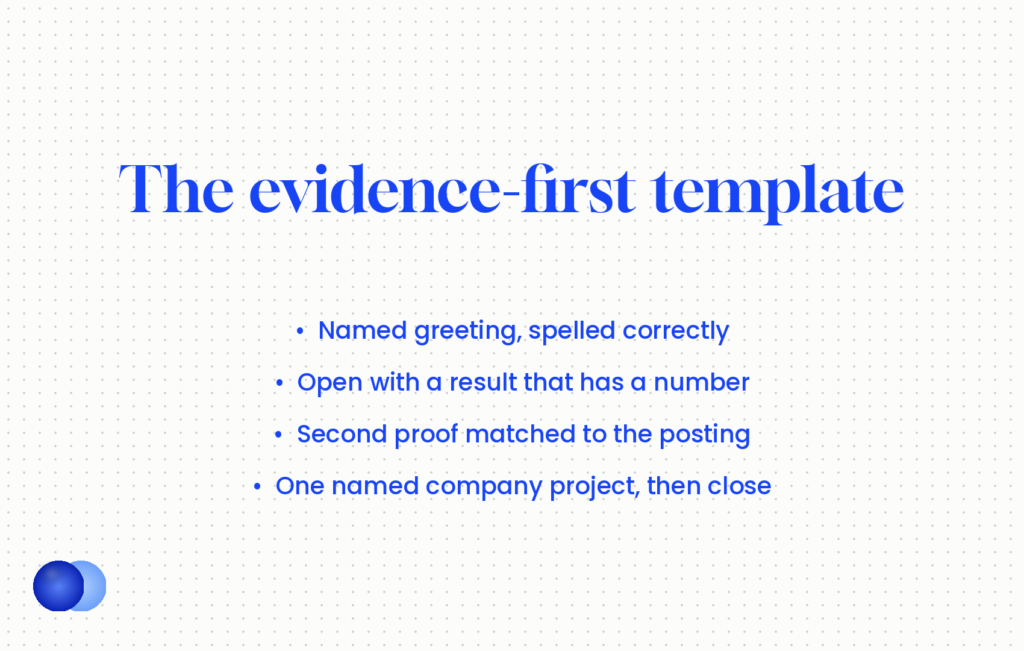
In [role] at [current or last employer], I [specific result with a number: cut, grew, shipped, saved] by [how you did it]. Your posting for [exact job title] asks for [the requirement it stresses most], and that result is the closest thing I have to a preview of how I would handle it.
[Second proof paragraph.] Before that, I [second result with a number, chosen to match the posting's second-most-stressed requirement]. The work involved [one or two tools, methods or stakeholders named in the posting], which I used [how often, at what scale].
I am applying to [Company] specifically because of [one named project, product, launch, market or problem from the past year]. [One sentence that links your evidence to that specific thing: what you would bring to it or what you have already done that resembles it.]
I would welcome the chance to talk about how [the result from paragraph one] could translate to [the team's goal or problem]. I am available for a call [timeframe], and my resume with further detail is attached.
Kind regards, [Your Full Name] `
What each blank needs
The greeting. A real name, spelled correctly. A wrong name costs more than a generic greeting, so check the name on LinkedIn or the company site. Who to address a cover letter to covers what to do when you cannot find one.
The first result. Choose the achievement that answers the requirement the posting repeats most, not your proudest one. A number — percentage, time saved, revenue, team size — turns a claim into evidence.
The company paragraph. This is the only place motivation appears, and it sits third on purpose. One named thing beats three compliments.
The close. A concrete next step and availability. Skip "references available upon request"; nobody needs to hear it.
How do you adapt the template for email or a paste box?
Cut it to 150–200 words and keep the order: result, fit, one company-specific line, next step. Short is right in an email body, a LinkedIn message or a character-limited portal field. In a standard attached letter, short simply reads as low effort.
Length is a channel decision, not a quality decision. A letter under 200 words in a standard attached-document slot tends to underperform, because the reader expects the full argument there. In an email body, most recruiters read on a phone first, and 150–200 words is the right size. Email cover letter covers subject lines and mobile reading in detail.
The short template (150–200 words)
` Subject: [Exact Job Title] application — [Your Name], [one-phrase proof]
Dear [First Name] [Last Name],
In [role] at [employer], I [specific result with a number]. Your [job title] posting stresses [top requirement], and that result is the closest match I can offer.
I have also [second result or credential matching the second requirement]. [Company]'s [named project or problem] is the reason I am applying rather than sending a general enquiry.
My resume is attached. I am free for a short call [timeframe].
Kind regards, [Your Name] · [Phone] · [LinkedIn URL] `
For anything with an "attach cover letter" button, go back to the full version.
What does a filled-in template look like?
The difference between a generic fill and a tailored fill usually sits in the first two sentences. The same template produces both; only the blanks change. The version that opens with a number and names a real company project is the one that earns the larger callback lift.
Generic fill: "Dear Hiring Manager, I am excited to apply for the Operations Analyst position at Northwind Logistics. I am a detail-oriented, hard-working professional with a passion for data, and I believe I would be a great fit for your dynamic team."
Tailored fill: "Dear Priya Shah, In my role as operations analyst at Carrow Freight, I cut average dock-to-stock time from 31 hours to 19 by rebuilding the receiving schedule around carrier arrival data. Your posting for an Operations Analyst stresses warehouse throughput, and that project is the closest preview I have of how I would approach it."
The first could go to any of 500 companies. The second could only go to one.
Rewrite the opening sentence for every application, even when the proof paragraphs stay broadly the same across similar roles.
Open with "I am excited to apply" or "My name is" — the reader already knows both, and the introduction is the part 41% of hiring managers say leaves the biggest impression.
The opening deserves the most time of any line in the letter. If yours still sounds like a template, how to start a cover letter walks through opener types that lead with evidence. Only a small minority of recruiters say they want to read about your motivation at all, which is why this template holds it back until the third paragraph.
Applications that included cover letters tailored specifically to the job at hand had a 53% higher callback rate than applications with no cover letter at all.
What can a cover letter template not do for you?
It cannot supply the evidence, the research or the fit. A template handles structure, which accounts for the smaller share of a letter's value. If your resume does not show the results the posting asks for, no letter layout will close that gap.
A cover letter template removes the blank-page problem and keeps you inside a structure that works. It cannot decide which of your results matters to this employer, or invent one you do not have.
The ResumeGo figures also predate generative AI, which made fluent generic letters free. That likely widens the gap: a polished generic letter is now the default, so the specific sentence counts for more.
Treat the template as a checklist rather than a script. If a sentence in your finished letter would still make sense sent to a competitor, rewrite it. If every sentence would not, send it.
Frequently asked questions
Is there a free cover letter template for Word and Google Docs?
Yes. Copy the plain-text template in this article into a blank Word or Google Docs file, set 11pt text and 1-inch margins, and export a PDF. Starting from blank avoids the sidebars and text boxes in many gallery designs.
Do cover letter templates still work in 2026?
The structure works; the generic wording does not. In ResumeGo's field experiment, generic letters lifted callbacks 17% over no letter while tailored ones lifted them 53%, so the blanks you fill matter more than the template itself.
How long should a cover letter template be?
Between 250 and 400 words for a standard attached letter, which matches 30 to 60 seconds of reading. Use a 150–200 word version only for email bodies, LinkedIn messages and paste boxes.
Should I use "Dear Hiring Manager"?
Only when you genuinely cannot find a name. A named greeting performs better, but a wrong or misspelled name does more damage than a generic greeting, so verify it before you send.
Should a cover letter template start with why I want the job?
No. Open with a specific result that matches the posting's main requirement. Motivation belongs later in the letter, tied to one named thing about the company.
Should I send the cover letter as a PDF or Word file?
A text-based PDF by default, because it holds its layout on every screen. Send a Word file when the posting asks for one. Layout matters far more than file type.
Can recruiters tell if I used a template?
They can tell when a letter is generic, which is the real problem. In ResumeGo's survey, 78% of recruiters said they could easily distinguish generic letters from customised ones.
Is it fine to use AI to fill in a cover letter template?
It can help with drafting, but an unedited AI fill fails for the same reason a lazy manual fill does: nothing in it belongs to one employer. Add the real numbers and the company-specific sentence yourself.

Comments