

Summary
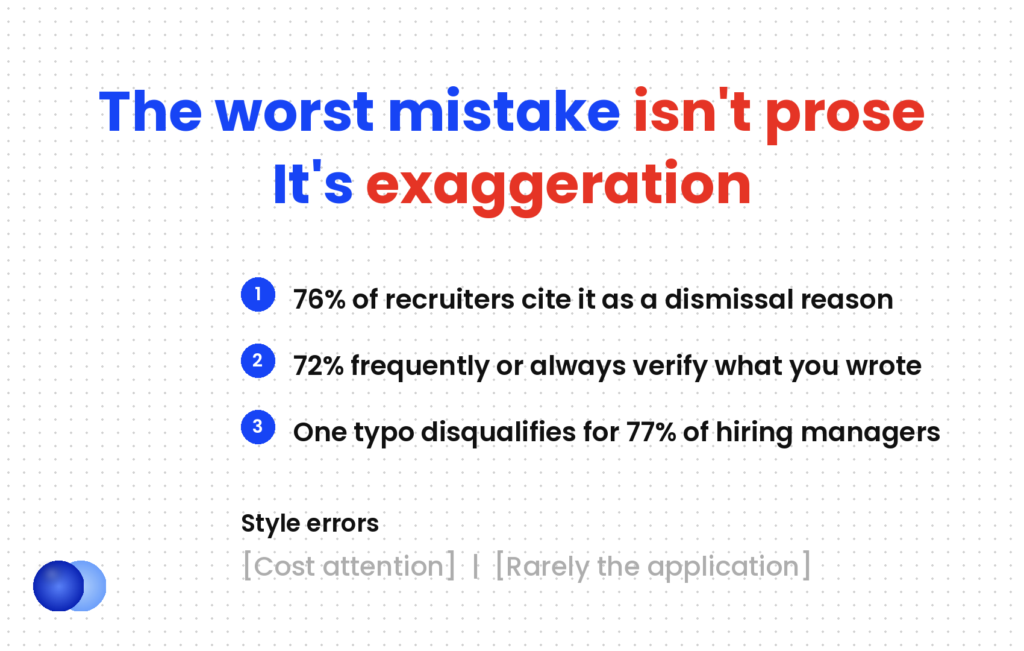
Most lists of cover letter mistakes are about style — the stock opening, the passive close. The rejection data ranks them differently. Zety's recruiter survey found 76% dismiss candidates for lies or exaggeration, and 72% verify what they read. A single typo disqualifies for 77% of hiring managers. Style errors are real, but they sit well below credibility failures.
Every list of cover letter mistakes opens with the same entries. Don't start with "I am writing to apply." Don't be generic. Don't forget the company name.
All real. But the rejection data ranks them differently, and the top of the list is not about prose at all.
Zety's recruiter survey found 81% of recruiters have rejected a candidate based on something in their cover letter — and the most common reason cited, by 76%, was lies or exaggeration. Not a weak opening. Not a missing call to action. A credibility failure.
Which cover letter mistakes actually get you rejected?
Ranked by the rejection data: exaggeration (cited by 76% of recruiters), a single typo (disqualifying for 77% of hiring managers), no customisation (72%), and poor formatting (72%). Style problems like a stock opening matter, but they cost attention rather than the application.
| Mistake | How often it disqualifies |
|---|---|
| Lies or exaggeration | 76% of recruiters cite it |
| A single typo or grammatical error | 77% of hiring managers would disqualify |
| Not customised to the role | 72% (Zety) · 63% (CareerBuilder) |
| Poorly formatted | 72% |
| Obviously AI-written without editing | 39% would reject if suspected |
| Generic opening and close | Costs attention, rarely the application |
That table reorders the usual advice on cover letter mistakes. The four entries at the top are about trust and care. The ones people write whole articles about sit lower, because they reduce the attention a letter gets rather than removing it from consideration.
Why is exaggeration the biggest risk?
Because cover letters invite it and recruiters check. Prose tempts inflation in a way a bullet list does not, and 72% of recruiters frequently or always verify what candidates write. One claim that falls apart under a reference call can end an application the resume would have carried.
Of all cover letter mistakes, inflation is the easiest to make. A resume's format limits it. A bullet saying "Managed a team of 8" is checkable and plain.
A cover letter is prose, and prose drifts. "I was instrumental in transforming the department's approach" feels true while you write it and falls apart when someone asks a reference what you actually did.
Recruiters check. In the same survey, 46% said they frequently verify what candidates write and a further 26% always do. That is nearly three in four.
The fix is specificity, not modesty. "I rebuilt the weekly report three teams now plan against" is both more impressive and more defensible than "I transformed our reporting." Claims with numbers and names survive a reference call. Claims made of adjectives do not.
Write every claim as if the reference will be asked about it
Before sending, read each sentence and imagine someone asking your former manager about it on the phone. Would they confirm it in roughly the same words? If a sentence would make them pause — "well, she was part of that team" — rewrite it to the version they would confirm without hesitation. That version is almost always more specific, and specific reads as more capable than inflated.
What are the fifteen mistakes, in order?
Credibility first — exaggeration, typos, the wrong company name. Then relevance — no customisation, restating the resume, no evidence. Then execution — length, formatting, generic phrasing. The order matters because fixing the lower tiers cannot rescue a letter that fails the upper ones.
Tier 1 — these end the application
1. Exaggeration. The most-cited dismissal reason. Replace adjectives with checkable facts.
2. A single typo. 77% of hiring managers would disqualify for one. Read it aloud — the ear catches what the eye skips.
3. The wrong company name. A reused letter with the previous employer's name in it. The fastest possible rejection, and it happens constantly.
4. Not customised at all. 72% reject an uncustomised letter. If it could be sent to another company unchanged, it is not customised.
Tier 2 — these make it forgettable
5. Restating the resume. The reader has the resume. A letter that summarises it has wasted its only advantage.
6. Claims without evidence. "Detail-oriented team player" is four assertions and no proof.
7. All about what you want. Only 9% of recruiters want to read about a candidate's motivation, so a letter built on it misses the other 91%.
8. No link to the posting's requirements. The employer wrote your outline; ignoring it produces a letter about you rather than about their need.
9. Explaining things nobody asked about. Why you left, a gap, a grievance. Anything negative belongs in an interview, if anywhere.
Tier 3 — these cost attention
10. The stock opening. "I am writing to express my interest" spends your best sentence on information they already have.
11. The passive close. "I look forward to hearing from you" proposes nothing.
12. Too long. Past 400 words, reading drops. How long a cover letter should be covers why.
13. Poor formatting. Inconsistent fonts, tight margins, a different design from the resume. 72% cite it.
14. Unedited AI output. The problem is not the tool — it is the genericness the tool produces by default.
15. The wrong salutation. "To Whom It May Concern", or worse, a wrong name. Who to address a cover letter to covers the search.
Tier 1 failure: "I single-handedly transformed the company's entire data strategy."
Tier 2 failure: "I have extensive experience with data strategy and am passionate about analytics."
Fixed: "I rebuilt the forecasting model three regional teams plan against, cutting the monthly close from twelve days to five."
The first is a claim a reference will not confirm. The second is safe and says nothing. The third is both defensible and impressive — which is the combination the whole list is trying to reach.
Change the file name, the greeting and the company name every time, and then search the document for the previous company's name before sending. The reused-letter error is the one that most reliably ends an application instantly.
Fix the Tier 3 items while ignoring Tier 1. A beautifully opened letter with one inflated claim still loses to a plain letter that holds up under a reference call.
Does it matter who reads it?
Substantially. Novoresume's survey found 51.7% of recruiters skip cover letters, but only 22.9% of HR managers do. The person most likely to read yours is the one closest to the hiring decision — and the least forgiving of generic writing.
This changes how much cover letter mistakes actually cost.
Nobody can reject a letter for something they never read. But the readers who do open cover letters skew toward hiring managers — people who read closely because they will manage whoever gets the job.
So the audience that notices your mistakes is disproportionately the one that decides. That is the argument for getting it right even though many letters are never opened: the ones that are opened are read by the people who matter most.
76% of recruiters cite lies or exaggerations as a reason for dismissal — and 46% frequently verify the information candidates provide, with a further 26% always doing so.
How do you check a letter before sending?
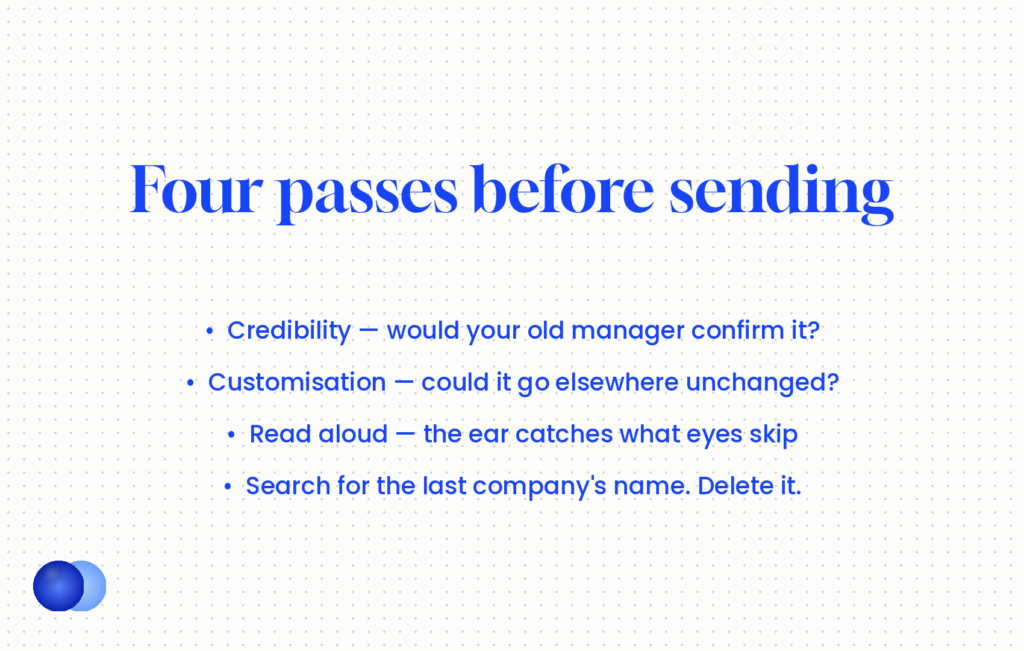
Four passes — credibility, customisation, a read-aloud for errors, and a final search for the previous employer's name. About ten minutes, and it catches every Tier 1 mistake, which are the only ones that end the application outright.
Catching cover letter mistakes takes four passes, each looking for one thing:
1. The credibility pass. Read every claim as your former manager would. Rewrite anything they would not confirm.
2. The customisation pass. Could this letter go to a different company unchanged? If yes, it needs a specific detail about this one.
3. The read-aloud pass. Out loud, slowly. It catches typos, missing words and awkward phrasing that silent reading slides past.
4. The name search. Search the document for the last company you applied to. Delete every instance.
Then the structure: how to write a cover letter covers what should be there, and this list covers what should not. And the resume it accompanies faces its own screen — an AI resume checker catches the equivalent problems there.
Frequently asked questions
What are the most common cover letter mistakes?
Ranked by rejection data: exaggeration, typos, not customising the letter, and poor formatting. Style issues like a stock opening or passive close matter, but they cost attention rather than ending the application.
Can a cover letter get you rejected?
Yes. Zety's survey found 81% of recruiters have rejected a candidate based on something in their cover letter, most often lies or exaggeration.
How bad is one typo in a cover letter?
Serious. A CareerBuilder survey found 77% of hiring managers would disqualify a candidate for a single typo or grammatical mistake.
Do recruiters check what you write in a cover letter?
Most do. 46% frequently verify what candidates write and a further 26% always do — nearly three in four.
Is it a mistake to use AI to write a cover letter?
Using it unedited is. ResumeBuilder found 39% of hiring managers would reject a letter they suspected was AI-written without human editing. The problem is the genericness, not the tool.
Should I repeat my resume in my cover letter?
No. The reader has the resume, so summarising it wastes the one document that can explain what the resume cannot.
What is the worst cover letter opening?
"I am writing to express my interest in the position." It spends your best sentence telling the reader what the application already told them.
How do I check my cover letter before sending?
Four passes: a credibility check on every claim, a customisation check, a read-aloud for errors, and a search for the previous employer's name.

Comments