

Summary
Pronouns on a resume are optional and entirely your choice. If you add them, put them in the header, usually in parentheses after your name, such as Jordan Lee (they/them), or on the contact line. Leaving them off is equally acceptable and does not affect how an ATS reads your resume. Base the decision on your comfort, privacy, the employer and your field, and keep the format consistent with LinkedIn and your email signature.
Pronouns on a resume are optional. You can add them next to your name, for example Jordan Lee (they/them), or leave them off, and both choices are accepted resume practice.
No rule requires them and no rule forbids them. The real question is what you want a recruiter to know before the first call, and how you weigh clarity against privacy.
This guide shows how common pronoun sharing is, what research says about hiring, four placement options, and formats you can copy.
Should you put pronouns on a resume?
It is your choice. Adding pronouns on a resume tells recruiters how to refer to you, which helps if your name is ambiguous. Leaving them off keeps personal details private until you choose to share them. Neither choice is required, and neither changes how an ATS parses your resume.
Career centers frame it as a personal decision rather than a rule. Grinnell College's career office calls the choice one that can be intimidating and offers considerations instead of a verdict. A guide on Cornell's career network lists pros and cons on both sides and tells readers to weigh their own comfort level.
Reasons people add them:
- Clarity. Recruiters know how to refer to you, especially with a name that does not signal gender, such as Taylor or Jordan.
- Fewer corrections. You avoid being misgendered in emails or interviews.
- Fit. Some candidates want to see how an employer responds before they join.
Reasons people leave them off:
- Privacy. Not everyone wants to share gender-related information with strangers.
- Bias concerns. Some hiring research, covered below, found less interest in certain resumes with pronouns.
- Space and focus. Some prefer to keep the header to name and contact details only.
How common is sharing pronouns?
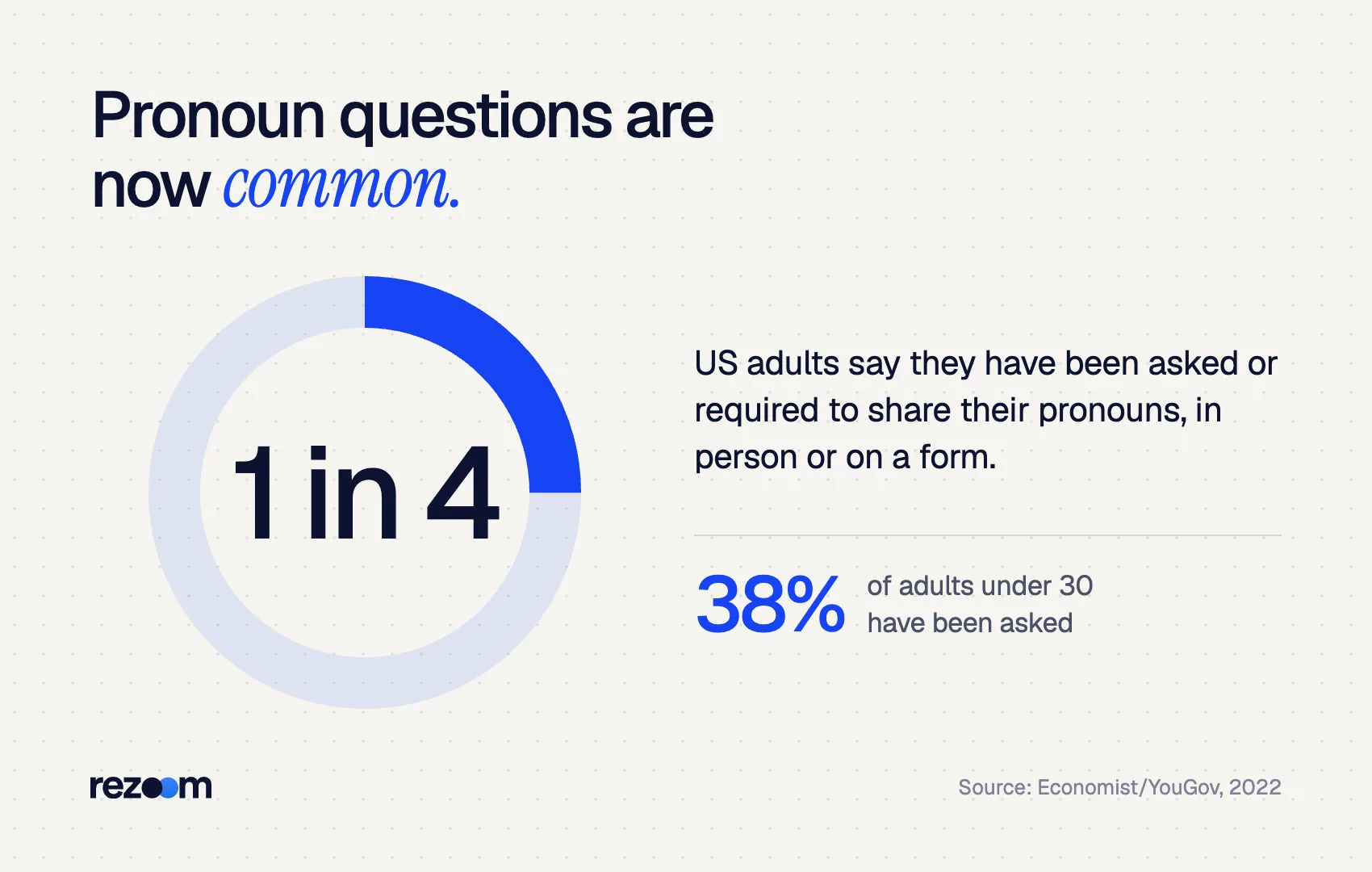
Fairly common and growing. An Economist/YouGov poll in March 2022 found one in four US adults had been asked or required to share their pronouns, in person or on a form. Among adults under 30, the figure was 38%. Pew found 26% of adults knew someone who uses gender-neutral pronouns in 2021.
Pronoun fields now appear on forms and profiles. In March 2022, an Economist/YouGov poll of 1,500 US adults found one in four had been asked or required to share their pronouns at some point, in person or on a form. Among adults under 30, 38% had been asked.
Familiarity is rising too. Pew Research Center reports that 26% of US adults personally knew someone who goes by gender-neutral pronouns in 2021, up from 18% in 2018.
LinkedIn added a dedicated pronoun field to profiles in March 2021. It sits near the top of the profile, so recruiters see it alongside your name.
So about 1 in 4 adults had already been asked for pronouns by 2022. That makes the topic familiar to many hiring teams, but familiarity is not the same as a requirement.
What does research say about pronouns on a resume and hiring?
The evidence is limited and mixed. Business.com experiments in 2023 and 2024 found resumes listing they/them pronouns drew somewhat less interest from hiring managers than otherwise identical resumes. The studies are small and from one publisher, so treat them as one input, not a verdict.
The most cited data comes from Business.com. In its 2023 study, reported by HCA Magazine, 69% of employers said they would interview an applicant whose resume listed they/them pronouns, compared with 72% for one without pronouns.
Its 2024 follow-up asked 985 people with hiring duties to review four identical resumes that differed only in pronouns: none, he/him, she/her and they/them. The resume with they/them was 8% less likely to be judged a good fit, even though reviewers rated it equally qualified. The same study found Gen Z hiring managers were 30% more likely than older managers to see that resume as a good fit.
Business.com also surveyed 379 nonbinary workers. 72% said revealing their gender identity would hurt their job search, down from 83% in 2023.
Read these numbers carefully. They come from a single publisher, use survey-based experiments rather than real applications, and do not measure he/him or she/her effects in detail. They show that reactions vary by reviewer. They do not tell you what any one employer will do.
Where do you put pronouns on a resume?
In the header. The most common spot is in parentheses after your name, such as Jordan Lee (they/them). Other options are a separate small line under your name or the end of the contact line. Do not put pronouns in the summary or in bullet points, where they break the resume's style.
Recruiters scan the top of the page first, so the header is the natural place. Our resume header guide covers the rest of that section.
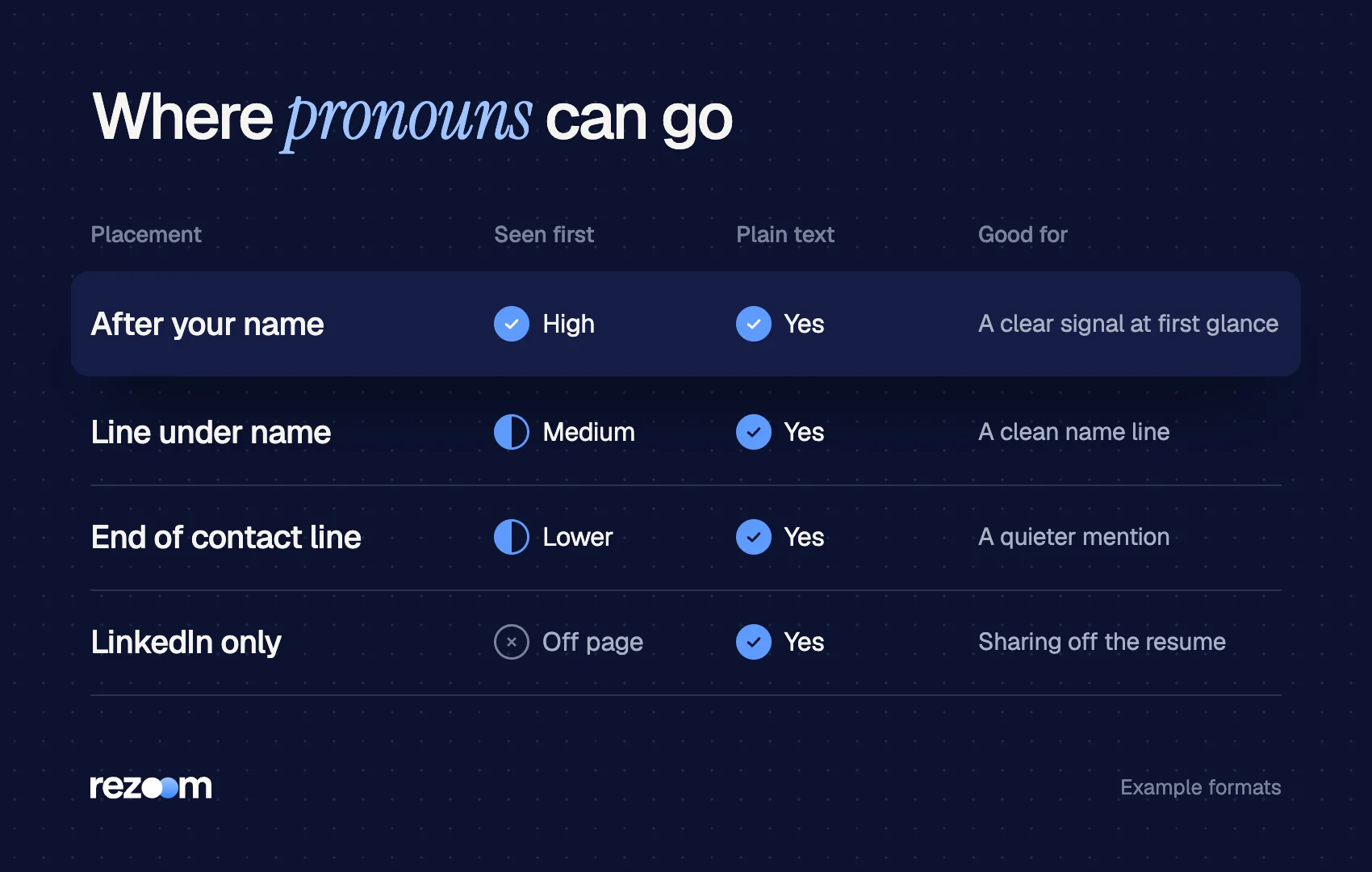
| Placement | Example | Visibility | Good for |
|---|---|---|---|
| After your name | Jordan Lee (they/them) | High | A clear signal at first glance |
| Line under your name | she/her | Medium | Keeping the name line clean |
| End of contact line | email, phone, he/him | Lower | A quieter mention |
| LinkedIn only | Pronoun field on profile | Off the resume | Sharing without adding to the resume |
Pronouns are plain text, so any of these placements parses normally in an applicant tracking system. Keep them out of the resume summary and bullet points. Resumes skip personal pronouns in bullets anyway, as our guide on using "I" on a resume explains.
Jordan Lee (they/them) Chicago, IL | [email protected] | (555) 013-7702 | linkedin.com/in/jordanlee
Maria Santos she/her Phoenix, AZ | [email protected] | (555) 018-2245
David Kim Boston, MA | [email protected] | (555) 016-9031 | he/him
How do you format pronouns on a resume?
Use lowercase with a slash, such as she/her, he/him or they/them. Put them in parentheses after your name or on their own line in a smaller size than the name. For more than one set, write she/they. Use the same format on LinkedIn, your email signature and your cover letter.
Small details keep the header clean:
- Case. Lowercase reads lighter: (they/them), not (They/Them).
- Separator. A forward slash with no spaces.
- Size. Same size as your contact line, smaller than your name.
- Multiple sets. she/they or he/they.
- Name first. Pronouns follow your name; they never replace it.
Write pronouns in lowercase with a slash, such as (she/her) do: Keep them in the header, near your name or contact line do: Match the format on LinkedIn, email signature and cover letter
Add pronouns inside bullet points or the summary dont: Write a sentence explaining them, such as "My pronouns are…" dont: Use a different set on your resume than on your LinkedIn profile
If you go by a name other than your legal one, settle that first, because pronouns sit right next to it. Our guide to a preferred name on a resume covers formats and the legal-name handoff.
Cover letter sign-off: Sincerely, Jordan Lee (they/them)
Email signature: Jordan Lee | they/them Data Analyst | [email protected] | linkedin.com/in/jordanlee
How do you decide what fits your job search?
Weigh four factors: your comfort with sharing, how clear your name is on its own, what you know about the employer, and whether you want to share now or later. You can also add pronouns to some applications and not others. A clear, consistent resume matters more than any single header detail.
Use these questions to decide, one application at a time:
- Comfort. Would you feel at ease answering a question about your pronouns in an interview? If not, waiting is reasonable.
- Name clarity. If your name is often misread by gender, pronouns save a correction later.
- Employer signals. Check the careers page, job post and staff LinkedIn profiles. Some application forms include an optional pronoun field.
- Timing. You can share pronouns later, in an email signature, during an interview or after you start.
Keep a version of each header
Save two header versions in your master resume, one with pronouns and one without. Then pick per application in a few seconds, without retyping or breaking the layout. Keep the rest of the resume identical so your versions never drift apart.
Whatever you decide, the content below the header decides the interview. The Rezoom AI resume builder lets you add or remove pronouns in the header with one edit and tailors the rest of the resume to each job post. Then review the details recruiters notice first with our list of resume red flags.

Frequently asked questions
Is it unprofessional to put pronouns on a resume?
No. Pronouns in the header are an accepted format, and many career centers describe them as a personal choice. Leaving them off is equally professional.
Do pronouns on a resume affect ATS parsing?
No. Pronouns are plain text in the header, so an applicant tracking system reads them like any other contact detail.
Can an employer ask for my pronouns?
Some application forms and onboarding systems include an optional pronoun field. A 2022 Economist/YouGov poll found one in four US adults had been asked or required to share pronouns at some point.
Should I put pronouns on my cover letter too?
If they are on your resume, add them to your cover letter signature for consistency. If they are not, leave them off both.
What if my pronouns are he/him or she/her?
The same choice applies. Some people with any pronouns add them for clarity or to normalize sharing; others leave them off. Both are acceptable.
Can I add pronouns after I am hired?
Yes. Many people share pronouns later, in an email signature, a profile field or a direct conversation with their manager or HR.



Comments