

Summary
A master resume is a private, unlimited-length document that records every job, result, skill, credential and project you have. You never send it to employers. Instead, you copy it and cut it down to a one- or two-page resume for each application. Build it once from old resumes, reviews and records, store every bullet with a number, and update it every quarter so nothing gets lost.
A master resume is a private document that lists everything you have done at work: every job, result, skill, certification and project, with no page limit. You never send it to an employer. You copy it and cut a short, tailored resume from it for each application.
The reason is simple: careers get long. The Bureau of Labor Statistics found people born from 1957 to 1964 held an average of 12.9 jobs between ages 18 and 58. A one-page resume cannot hold that history, and memory is worse at it.
This guide shows what goes into a master resume, how to organize it, how to maintain it, and how to turn it into a tailored resume in about 20 minutes.
What is a master resume?
A master resume is a complete, unlimited-length record of your work history, achievements, skills, education and credentials. It works as a personal career database. You do not send it to employers. You copy it and delete what a specific job does not need, leaving a one- or two-page tailored resume.
Idaho State University's career center describes it as a comprehensive document to track your experiences, achievements, and skills that becomes the source for tailored resumes. Education Week's career column calls it a record of "all you have done in your public life."
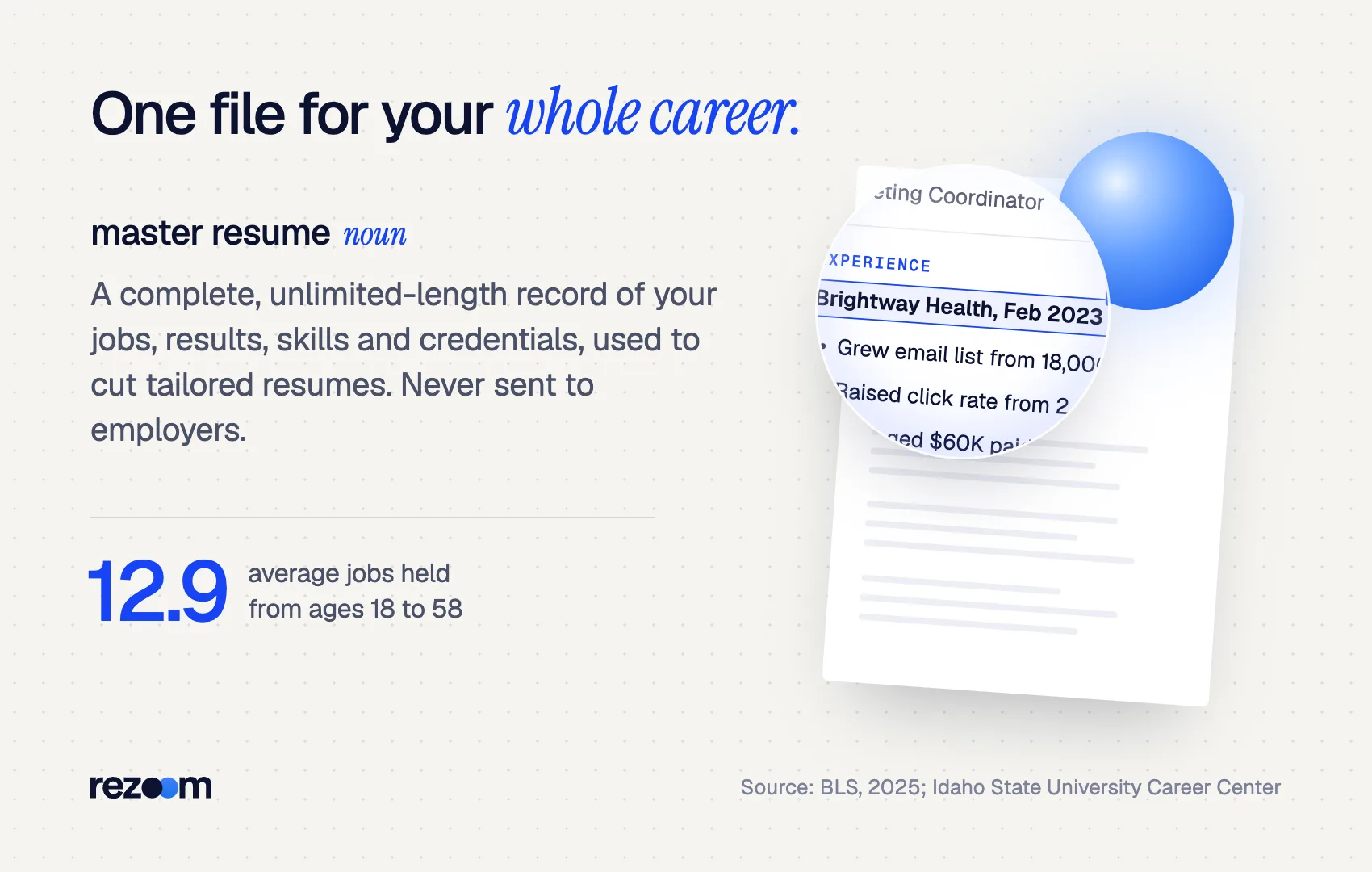
With an average of 12.9 jobs across a working life, that database gets long fast. The key difference is the reader. A normal resume is written for a recruiter. A master resume is written for you, six months from now, when you need a strong bullet fast.
| Master resume | Tailored resume | |
|---|---|---|
| Reader | You | Recruiter and ATS |
| Length | No limit | One page, two at most |
| Bullets per job | All of them, often 8–15 | The best 3–6 for this job |
| Summaries | Several versions | One |
| Sent to employers | Never | Yes |
| Updated | Every quarter | Per application |
What should you include in a master resume?
Include every job with exact dates, every quantified result, all skills grouped by type, education, certifications, licenses, awards, training, volunteer work, projects, publications and speaking. Add raw context too: team size, budgets, tools, and who can confirm each result. More is better, because you can only cut what you saved.
Save everything now and judge it later. Raw material includes:
- Every job, with employer, city, title, and month-and-year dates for each title
- Every result, written as a bullet with a number wherever possible
- Skills, grouped as technical, tools, languages and leadership
- Education, including GPA, honors and relevant coursework
- Credentials, such as licenses, certifications and online courses
- Projects, volunteer work, awards, publications and talks
- Context notes: team size, budget, tools used, and who can verify the result
Also keep three to five summary versions, one for each direction you might apply. For example, a project manager might keep one for operations roles and one for product roles.
Marketing Coordinator | Brightway Health | Denver, CO | Feb 2023 – Present
- Grew email list from 18,000 to 41,000 subscribers in 20 months
- Raised newsletter click rate from 2.4% to 3.9% by testing subject lines weekly
- Managed a $60,000 annual paid social budget across Meta and LinkedIn
- Coordinated 11 community health events, averaging 220 attendees
- Wrote 40+ blog posts; 6 ranked on page one for target terms
- Trained 3 interns on HubSpot workflows and brand guidelines
- Built the monthly KPI dashboard in Looker Studio for the director
- Tools: HubSpot, Canva, Looker Studio, WordPress, Hootsuite
- Verify: Dana R., Marketing Director
That entry has nine lines. A tailored resume would use three or four of them. The rest wait for the next application. For ideas on turning duties into results, see these resume accomplishment examples.
How do you build a master resume from scratch?
Start with your most recent resume, then gather old resumes, LinkedIn, performance reviews, offer letters, project files and emails praising your work. Paste everything into one document by job. Rewrite each item as a result with a number. Finish by adding skills, credentials and context notes.
Plan for two to three hours the first time. After that, updates take minutes.
- Collect sources. Old resumes, your LinkedIn profile, performance reviews, offer letters, award emails and project reports.
- Paste by job. One heading per title, newest first. Do not edit yet.
- Rewrite as results. Turn "handled social media" into "grew Instagram from 2,000 to 9,500 followers in 12 months." Our guide on how to quantify your resume has formulas for this.
- Add the extras. Skills, education, credentials, projects, volunteer work and summary versions.
- Note the proof. Add where each number came from and who can confirm it.
Formatting matters less than in a sent resume. Still, use simple headings and plain bullets. That way you can paste sections straight into a builder or a plain-text resume without cleanup.
Write every bullet as a finished, sendable sentence with a number do: Keep exact month-and-year dates for each title do: Store one copy in the cloud and one offline
Send your master resume to an employer dont: Delete old bullets because they seem weak today dont: Leave vague notes like "did reporting" that you will not remember later
How do you keep a master resume up to date?
Set a recurring calendar reminder every quarter. Add new results, numbers, tools, trainings and titles while they are fresh. Also update it after any review, promotion, project launch or award. Mark outdated figures with a date rather than deleting them, so you can still use them later.
Most results are easy to record the week they happen and hard to rebuild a year later. A quarterly 15-minute review keeps your numbers accurate.
Update immediately after these events:
- A performance review or promotion
- A project launch or a finished deadline
- A new certification, license or course
- Praise in writing from a manager or client
This matters even if you stay put. BLS reports median tenure with a current employer was 4.1 years in January 2026. That is four years of results to remember for your next internal move. If you apply internally, a current master resume is the fastest start for a resume for an internal position. For a broader refresh, see our guide to updating your resume.
Keep a brag log feeding your master resume
Keep a running note on your phone called "wins." Add one line whenever something goes well, with the date and the number. During your quarterly review, move each line into your master resume as a finished bullet. This takes two minutes a week and saves hours later.
How do you cut a tailored resume from a master resume?
Duplicate the master resume, never edit the original. Highlight the posting's top skills and title. Keep the summary version that fits, then keep three to six bullets per relevant job that match those skills. Delete everything else, match the posting's wording, and check that it fits one or two pages.
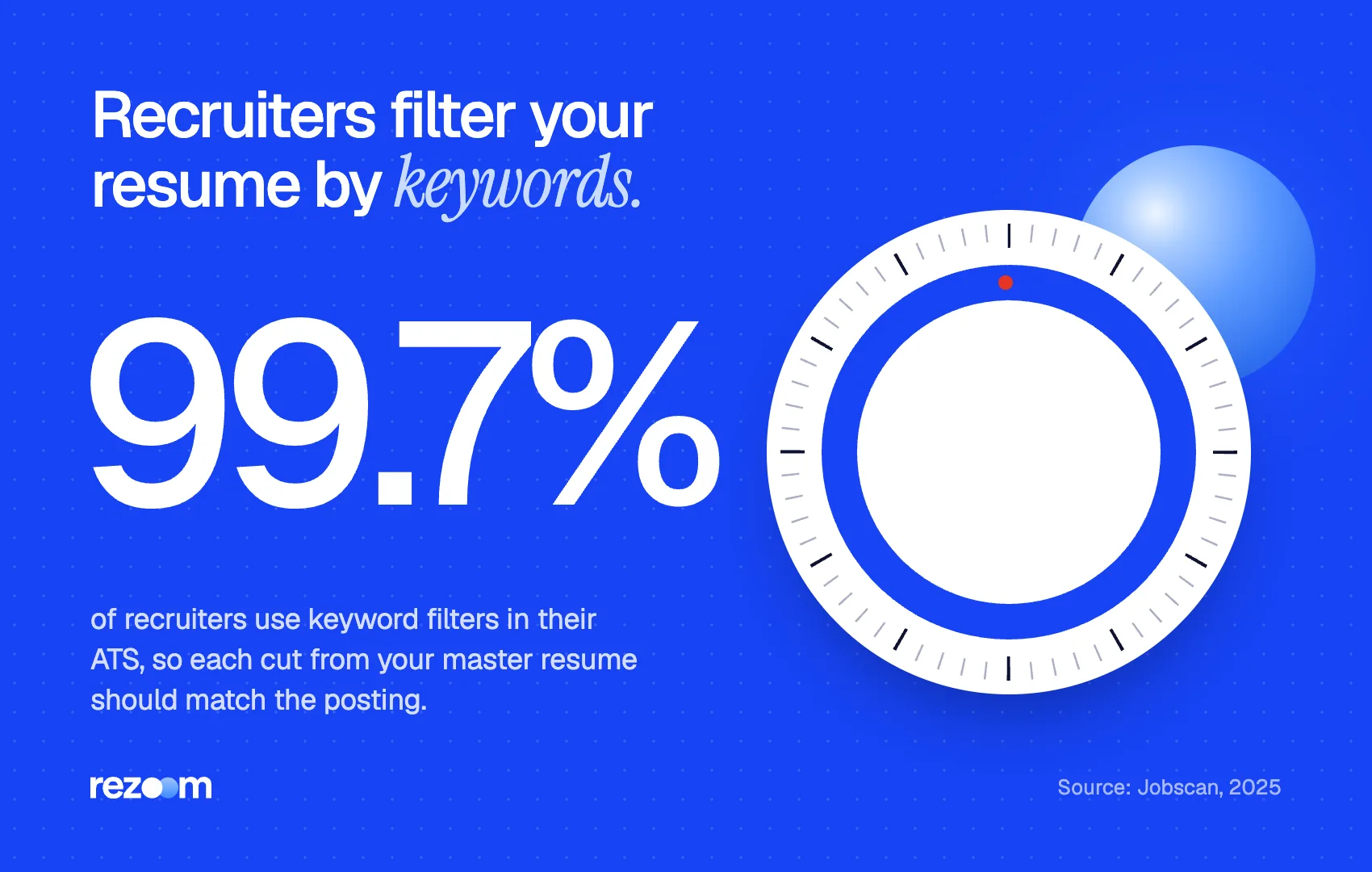
The cut is mostly deletion, which is why it goes fast. Recruiters search by keywords and skills. Jobscan's 2025 report found 99.7% of recruiters use keyword filters in their ATS, and resumes containing the job title got 10.6 times more interview invitations. Your master resume gives you enough bullets to match almost any posting.
The steps:
- Duplicate the master file and rename it with the company and role.
- Mark the posting. Highlight the job title and the five to eight skills it repeats most. Our resume keywords guide shows how.
- Choose a summary and put the target job title in it.
- Keep three to six matching bullets per relevant job, best first.
- Delete the rest, including old jobs that add nothing. Our guide on how many jobs to list on a resume helps decide.
- Echo the posting's language where it is honest to do so, then check length.
Marketing Coordinator | Brightway Health | Denver, CO | Feb 2023 – Present
- Wrote 40+ SEO blog posts; 6 ranked on page one for target terms
- Grew email list from 18,000 to 41,000 subscribers in 20 months
- Raised newsletter click rate from 2.4% to 3.9% through weekly subject-line tests
- Built the monthly content KPI dashboard in Looker Studio
The paid social and events bullets stayed in the master file. For a full method on matching one posting, read our guide to the targeted resume. If you want the cutting done faster, the Rezoom AI resume builder can turn your full history into a tailored draft for a pasted job description.

Should you ever send a master resume to employers?
No. A master resume is too long and too broad for a recruiter, and it hides your best match under unrelated detail. Send a tailored one- or two-page version instead. The only exceptions are requests for a full work history, such as some federal or security forms, which still need their own format.
Recruiters spend little time per resume. A long list of everything you have done forces them to search for the fit. That is your job, not theirs.
Keep the master file private, and track which tailored version went where. A simple job application tracker with a column for the file name avoids sending the wrong version to an interviewer later.
Frequently asked questions
What is the difference between a master resume and a CV?
A CV is a full academic record that you do send, mainly for academic, research and medical roles. A master resume is private and is never sent. You use it only as a source for tailored resumes.
How long should a master resume be?
As long as it needs to be. Many people end up with five to ten pages. Length does not matter because only you read it.
Is a master resume the same as a federal resume?
No. A federal resume is a specific, detailed format you submit for US government jobs. A master resume can feed it, though, since it already holds exact dates and full details.
How often should I update my master resume?
Every quarter, plus right after a review, promotion, project launch or new credential. Recording results while they are fresh keeps your numbers accurate.
What format should a master resume use?
Use a simple word processor or Google Doc with plain headings and bullets. Avoid tables and columns so you can paste sections into any template or online form.
Should I include jobs from more than 15 years ago?
Yes, in the master file. You will rarely use them on a tailored resume, but exact titles and dates help with background checks and long applications.



Comments