

Summary
A resume for an internal position should be rebuilt, not reused. Lead with your current employer, show each title and promotion as its own dated entry, and quantify results the hiring manager can verify. Use the company's own names for teams, tools and metrics, and match the new posting's keywords because internal applications often run through the same ATS. Tell your manager before you apply, then follow HR's transfer process.
A resume for an internal position is a rebuilt version of your resume that leads with your record at your current employer. It shows every role and promotion you have held there, results the hiring team can check, and the company's own vocabulary. You should still tailor it to the new posting, because internal candidates are compared against the job description too.
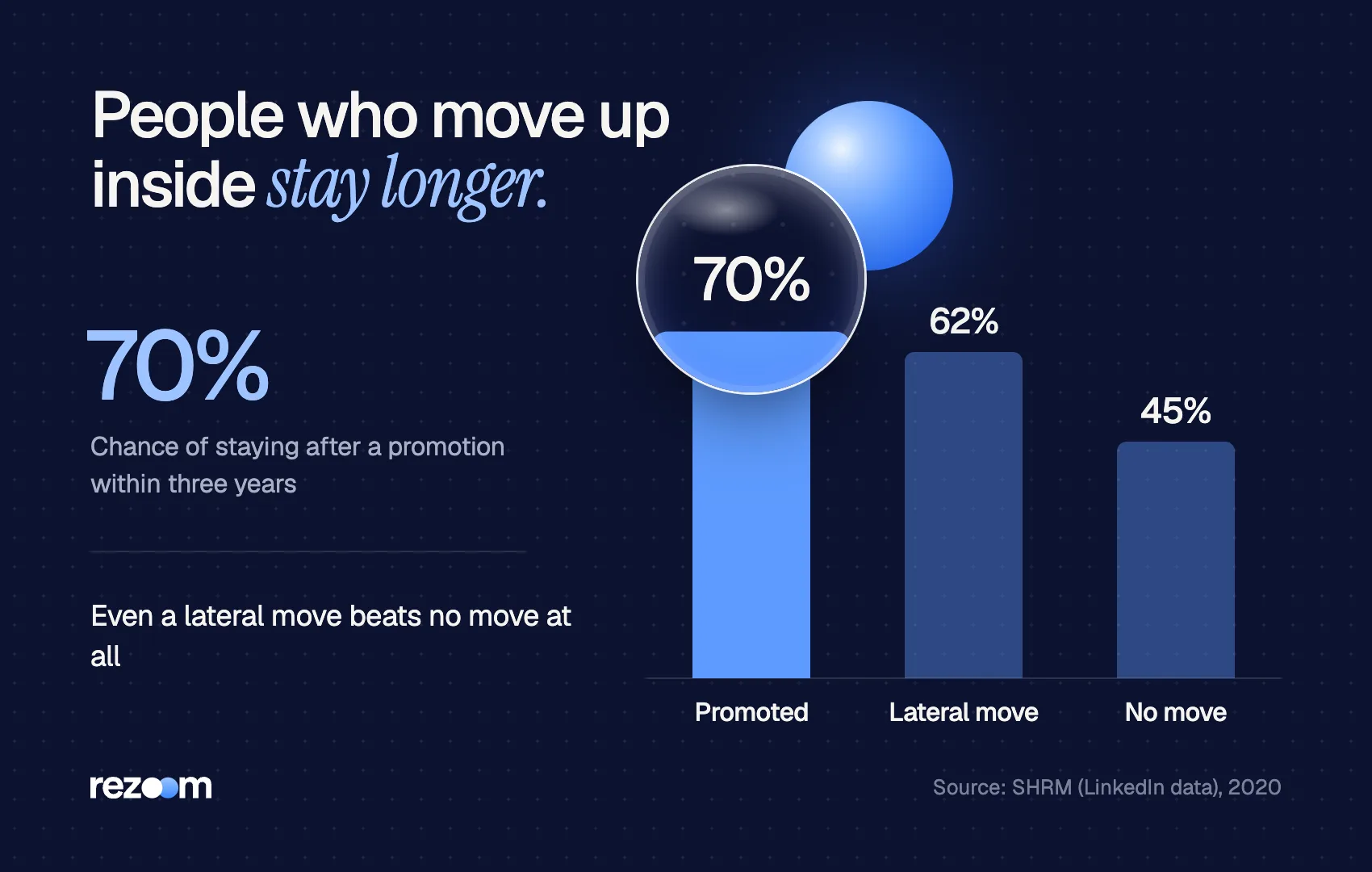
The stakes are real on both sides. LinkedIn data reported by SHRM found employees promoted within three years had a 70% chance of staying, versus 45% for people who made no move. Yet a Gartner survey found only 33% of job seekers looked internally first.
This guide covers what changes, how to format progression at one company, which keywords to use, and when to talk to your manager.
What changes on a resume for an internal position?
A resume for an internal position keeps the standard format but changes the emphasis. Your current employer moves to the top and gets the most space. Each internal title becomes its own dated entry. Bullets use company names for teams, tools and metrics, and older outside jobs shrink to one or two lines.
Your reader already knows the company. They may even know you. That changes what earns space on the page.
An external resume explains context: what the company does, how big the team was, which tools you used. An internal resume can skip most of that. Spend the words on outcomes the hiring manager can verify with a quick message to your current boss.
| Element | External resume | Internal resume |
|---|---|---|
| Summary | Who you are and your strongest selling point | The role you want and why your record here fits it |
| Current employer | One entry, one title | Separate dated entries for each title held |
| Company context | Explain size, industry, products | Skip it; the reader knows |
| Bullets | Results in general terms | Results tied to named internal projects, teams and KPIs |
| Older jobs | Full bullets for relevant roles | One or two lines each, or cut |
| Proof | Metrics and employer names | Metrics, review language, internal awards |
| Keywords | From the posting | From the posting plus the company's own job framework |
Do not reuse the resume you were hired with. It describes a person who has not done any of the work you have done since. If you need a full refresh first, our guide to updating your resume walks through it section by section.
How do you show progression at one employer?
List the company name once, then stack each title beneath it with its own start and end dates, newest first. Give your current role the most bullets. Under each earlier title, keep two or three results that explain why you were promoted. This makes growth visible in a six-second scan.
Internal hiring managers want evidence that you have already grown inside the company. The stacked format shows that in one glance.
Northline Logistics | Columbus, OH Operations Supervisor | Mar 2025 – Present - Lead a 14-person inbound team across two shifts; cut dock-to-stock time from 31 to 22 hours - Rolled out the new slotting process in Q3 2025, adopted by both regional sites
Inventory Specialist | Jun 2023 – Mar 2025 - Reduced cycle-count variance from 2.1% to 0.6% in 12 months - Trained 9 new hires on the WMS; chosen as site super-user for the 2024 upgrade
Notice that the earlier role carries the bullets that justify the promotion. Training others and owning a system upgrade are leadership signals. For more layouts, including lateral moves and title changes without a raise, see how to show a promotion on a resume.
Promotions matter to retention: in LinkedIn's analysis, people promoted within three years had a 70% chance of staying. If you made a lateral move, list it the same way. The same analysis found employees who moved laterally had a 62% chance of staying, well above the 45% for those who stayed put. Lateral moves read as range, not stalling.
What should you cut or shrink?
Shrink outside jobs that are more than ten years old or unrelated to the target role to a single line with title, employer and dates. Cut generic duties the hiring manager already knows you perform. Keep only education and certifications the posting asks for, plus any you earned while at the company.
Space is the main constraint. A two-page internal resume rarely helps, because the reader can ask your colleagues for detail.
Cut these first:
- Company descriptions for your current employer
- Duties shared by everyone in your current role
- Old outside jobs that do not support the target role
- Objective statements that say you want to "grow with the company"
Keep older roles only when they fill a gap the new posting asks for. A sales job from before you joined matters if you are applying to account management. If you are unsure how far back to go, our guide on how many jobs to list on a resume has a simple cutoff rule.
Name internal projects and systems the hiring manager will recognize do: Quote a specific metric from a review or dashboard you can back up do: Add certifications or training you completed on company time
Explain what the company does or how big it is dont: Mention internal politics, conflicts or why you want to leave your team dont: Include confidential revenue figures you would not share in an all-hands
Which keywords belong on a resume for an internal position?
Use two keyword sources. First, copy the exact skills and title wording from the new posting, since many employers route internal applicants through the same applicant tracking system. Second, use the company's own terms for teams, products, systems and competencies, as written in its career framework or job architecture.
Internal applications often go through the same ATS as external ones. Recruiters search that system by skills and titles. Jobscan's 2025 report found 99.7% of recruiters use keyword filters in their ATS, and 76.4% start their search with skills.
So match the posting first. If it asks for "stakeholder management" and "SQL," those exact words should appear in your summary or bullets. Our guide to resume keywords shows how to pull them from a posting.
Then layer in internal language. Use the official names for:
- Your team and the target team
- Internal tools and systems ("Salesforce CPQ," not "our quoting tool")
- Company competencies from your review form ("Customer Obsession," "Delivers Results")
- Programs you joined, such as a leadership track or mentoring cohort
Inventory and operations supervisor with 3+ years at Northline Logistics, promoted from specialist in 2025. Led the Columbus dock-to-stock redesign that cut processing time 29%. Applying to Regional Operations Manager to scale the same slotting process across all four Midwest sites.
The summary names the target role, shows the promotion and points to one verifiable result. That is enough. For more ways to put numbers on your work, see how to quantify your resume.
Should you tell your manager before applying internally?
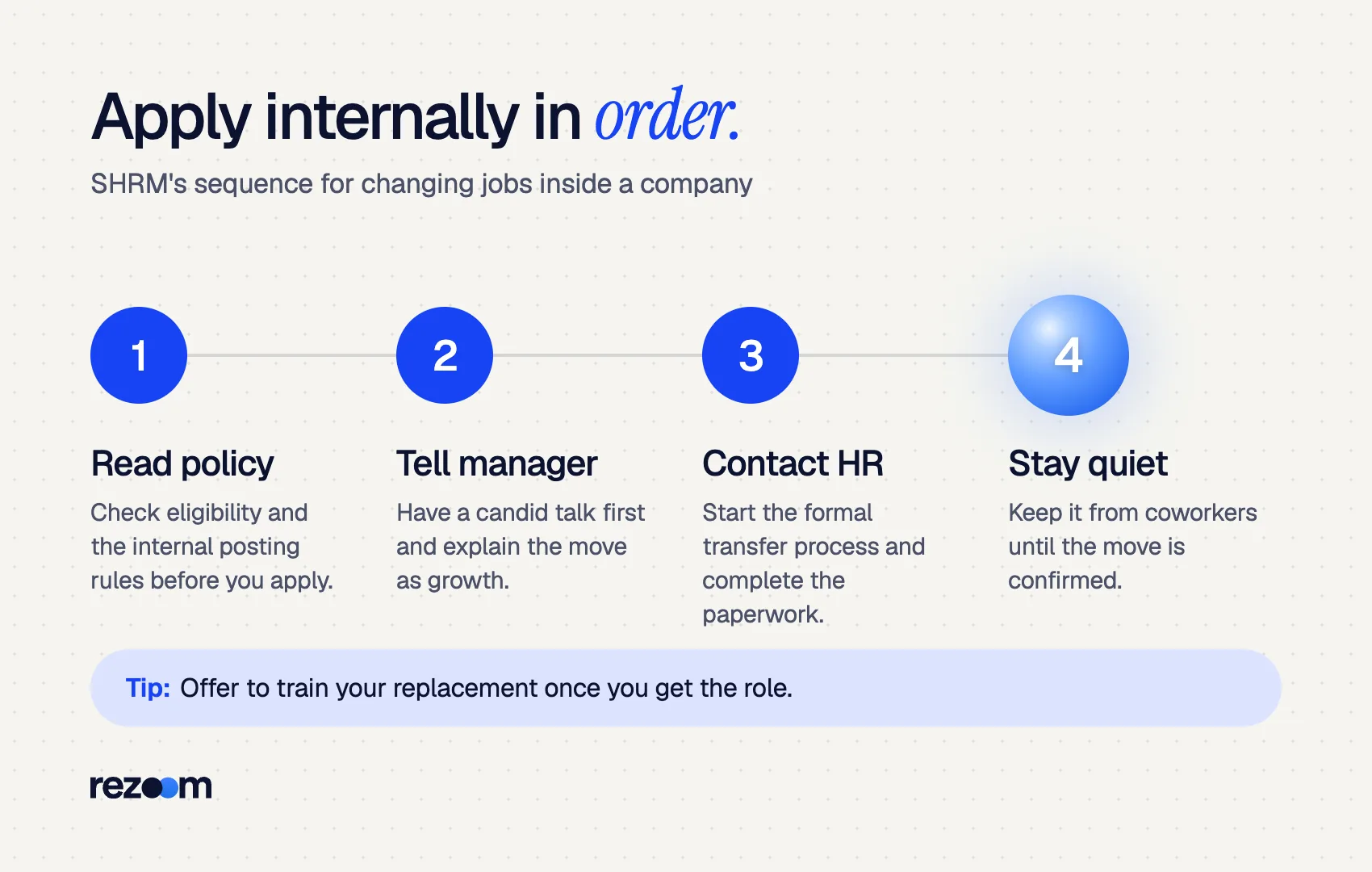
Yes, in most cases. SHRM advises a candid talk with your manager before you apply, then contacting HR to start the transfer process. Check your company's internal posting policy first, since some require manager notification or a minimum time in role. Keep the move confidential from coworkers until it is final.
The order matters. SHRM's Ask HR column lays out four steps: review the transfer policy, talk with your manager, contact HR, and keep it quiet until the move is confirmed. As the column puts it, transparency is "preferable to blindsiding your manager."
Managers do not always help, so plan the conversation. Gartner data reported by SHRM found only 17% of candidates said their manager facilitates internal applications. Frame the move as growth for the company, not an escape from your team. Offer a transition plan, including training your replacement.
Silence has a cost too. Gallup found 42% of employees who voluntarily left said their manager or organization could have done something to keep them. An internal application is often that conversation, started by you.
Ask for a reference inside the building
After you tell your manager, ask whether they will speak to the hiring manager for you. A short note from a current supervisor carries more weight than any line on the page. Then add one line of review language to your resume, such as "Rated Exceeds Expectations, 2024 and 2025."
What else should go with your internal application?
Send a short cover letter that names the role, explains why the move helps the company and mentions who you have spoken with. Update your internal profile in the HR system to match your resume. Track the posting, deadlines and conversations, since internal processes often move faster than external ones.
A cover letter for an internal role can be three short paragraphs. Name the role, link your record to its biggest need, and mention that you have spoken with your manager. If you are early in your career, our internship cover letter guide shows a similarly short, direct structure.
Many companies also keep an internal talent profile. Make it match your resume so recruiters searching the system find the same titles and skills. Log every step in a job application tracker, including who you spoke to and when.
Finally, keep a full record of everything you have done at the company. A master resume makes the next internal move faster, and a targeted resume shows how to cut it down for one posting. When you are ready to draft, the Rezoom AI resume builder can stack your internal titles and match the posting's keywords for you.

Frequently asked questions
Do I need a resume to apply for an internal position?
Usually yes. Most employers ask internal candidates to apply through the same system as external ones. Even when they do not, a resume for an internal position gives the hiring manager a clean summary to share with their own boss.
Should I list my current company once or for each role?
List the company once, then stack each title under it with its own dates. This shows progression clearly and saves space.
How long should an internal resume be?
One page is enough for most people with under ten years of experience. Two pages make sense only when you have held several senior roles at the company.
Can I mention my performance reviews on my resume?
Yes, briefly. A line such as "Rated Exceeds Expectations, 2024 and 2025" is useful because the hiring manager can verify it. Do not paste long review quotes.
What if my manager does not support my internal application?
Follow your company's posting policy and speak with HR. Many policies let you apply after giving notice to your manager, even without their approval. Keep the conversation focused on your growth, not your frustrations.
Is a lateral move worth putting on a resume?
Yes. List it as its own dated entry under the company. A lateral move shows range and new skills, and it often sets up the next promotion.



Comments