

Summary
A targeted resume is a version of your resume rewritten for one specific job posting. It uses the employer's job title, skills, and wording, and it puts your most relevant results first. You can build one in about 25 minutes by scanning the ad, matching 8 to 12 keywords, rewriting your headline, summary, and top bullets, and checking the file. Jobscan's 2025 data found a 10.6x higher interview rate when the resume title matched the job title.
A targeted resume is a resume rewritten for one specific job posting, using the employer's job title, skills, and language. It is not a new resume from scratch: you start from a full source document and cut, reorder, and reword it for a single role.
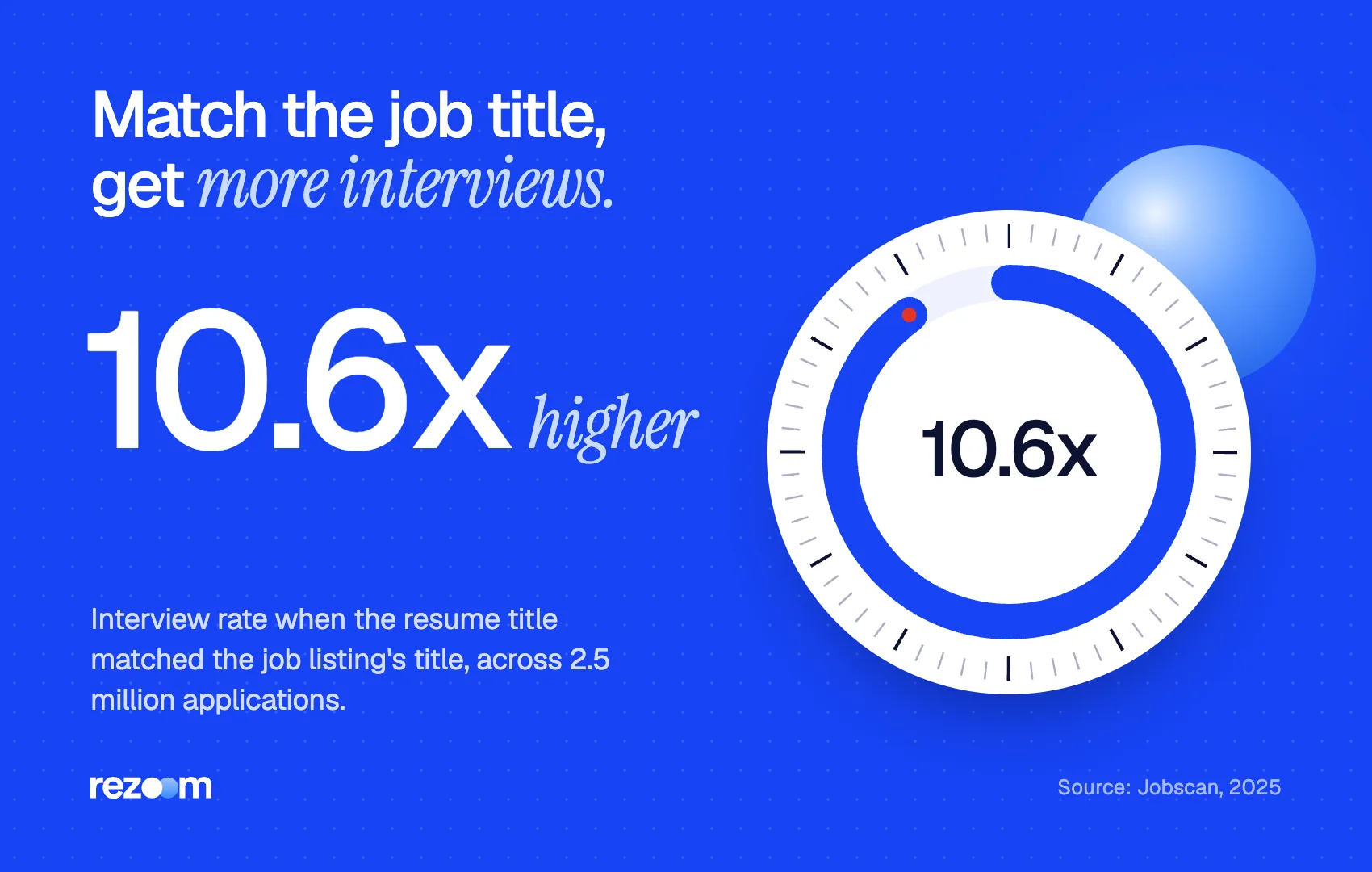
That focus pays off. In its 2025 study of 2.5 million applications, Jobscan found that resumes whose title matched the job listing's title had an interview rate 10.6 times higher than those that did not.
Below is a timed process you can repeat for every application, a keyword-matching method for applicant tracking systems (ATS), and copy-ready examples.
What is a targeted resume?
A targeted resume is a one-to-two page resume customized for a single job posting. It mirrors the posting's job title, required skills, and terminology, and it orders your experience so the most relevant achievements appear first. It differs from a general resume, which tries to cover every possible role at once.
The University of Central Missouri's career center puts it simply: a targeted resume "conveys your experiences that are relevant to a specific role you are applying for." Everything else gets trimmed or moved down.
Most people keep a long source file with every job, project, and metric. If you don't have one yet, start with our guide to building a master resume. Each targeted resume is a copy of that file, edited down for one employer.
| General resume | Targeted resume | |
|---|---|---|
| Written for | Any role in your field | One job posting |
| Title line | Your current title | The posting's exact job title (if truthful) |
| Skills section | Everything you know | 8 to 12 skills the ad asks for, in its wording |
| Bullet order | Chronological importance | Most relevant result first |
| Time per application | 0 minutes | About 20 to 30 minutes |
| Best for | Networking, job fairs | Online applications screened by an ATS |
Why does a targeted resume get more interviews?
A targeted resume gets more interviews because both the software and the recruiter are searching for specific terms. Recruiters filter ATS results by keywords and titles, and humans skim for a fast match. Jobscan's 2025 data showed a 10.6x higher interview rate when the resume title matched the posting's title.
There are two readers, and both reward a close match.
First, the software. Jobscan's 2025 recruiter survey found that over 99.7% of 384 recruiters use filters in their ATS. A filter on "Project Coordinator" or "Salesforce" only surfaces resumes that contain those words. For a deeper look at how that search works, read how ATS works.
Second, the human. Eastern Iowa Community Colleges' 2026 resume tips note that resumes get 10 to 20 seconds of initial review. In that window, a reader looks for the job title and two or three must-have skills. A targeted resume puts them where the eye lands.
The biggest single lever is the title. Candidates whose resume title matched the target title saw that 10.6x higher interview rate, so a headline that echoes the posting is the first edit to make.
Match the title, not the fiction
Use the posting's exact title in your headline only if it honestly describes your work. If your official title was "Ops Associate II" but you ran logistics projects, write "Logistics Project Coordinator | Ops Associate II at Brightline." The ATS sees the target title, and the recruiter still sees your real one.
How do you tailor a targeted resume in 25 minutes?
Split the work into four timed passes: scan the job ad (5 minutes), pick 8 to 12 keywords (8 minutes), rewrite your headline, summary, and top bullets (8 minutes), then check and save (4 minutes). Work from a copy of your master resume, and edit only what the posting actually changes.
A time box keeps tailoring sustainable. If each application takes two hours, you will stop doing it by week two.
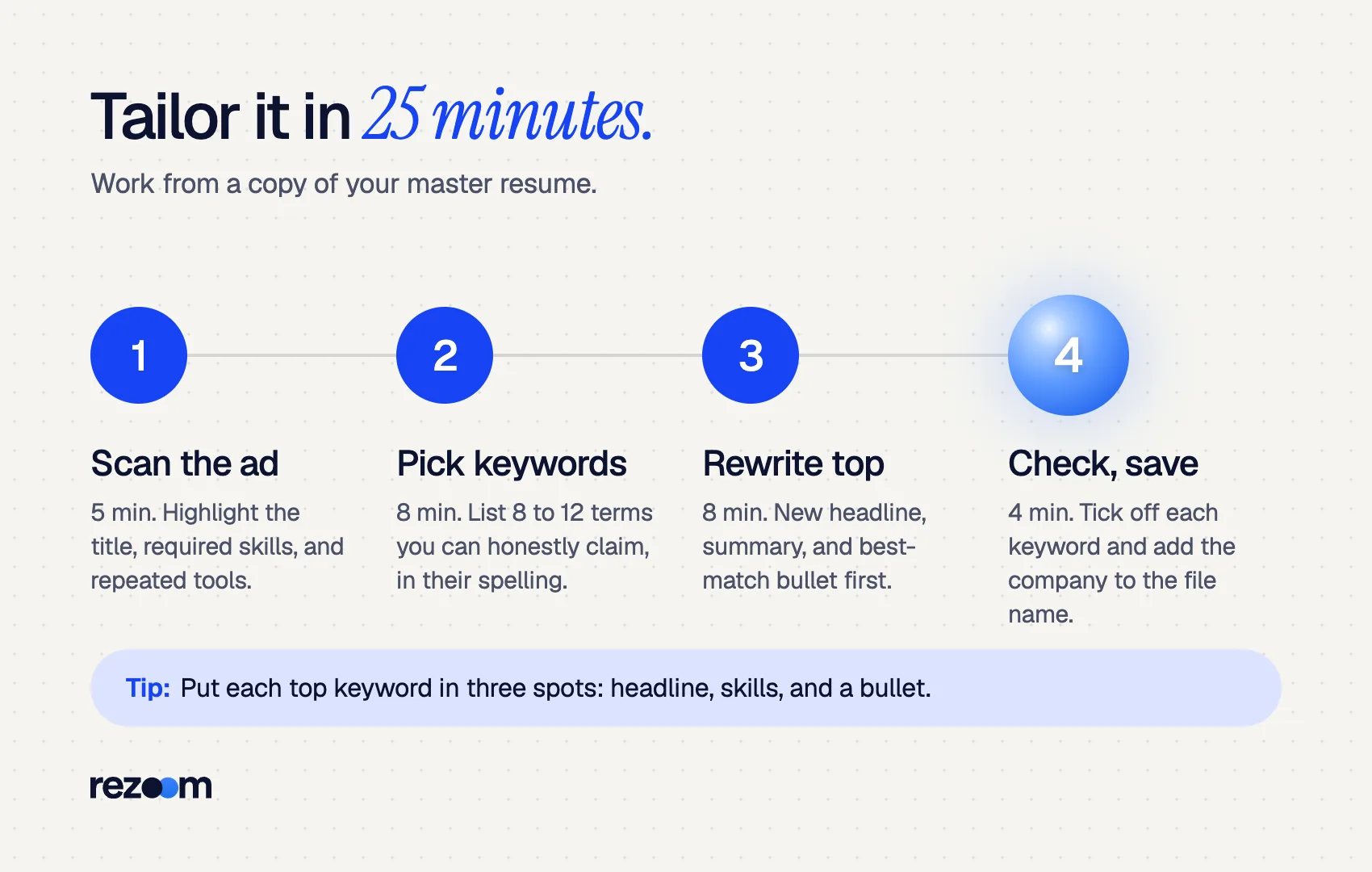
Minutes 0 to 5: scan the ad. Read the posting once from top to bottom. Highlight the job title, required qualifications, and any tool or certification named more than once. Ignore boilerplate about culture and benefits.
Minutes 5 to 13: pick your keywords. List 8 to 12 terms you can honestly claim. Rank them: required items first, then "preferred," then repeated phrases. Note the exact spelling the employer uses, such as "Microsoft Excel" vs. "Excel."
Minutes 13 to 21: rewrite the top third. Change the headline to the target title. Rewrite your summary in two or three sentences using the top four keywords. Then reorder bullets in your most recent role so the best match sits first.
Minutes 21 to 25: check and save. Read the resume against your keyword list and tick off each term. Save it with the company name in the file name so you can find it later; our guide to resume file names shows the format.
The UCM guide adds one useful point: even when your experience isn't identical to the ask, showing similar previous experience still counts. Translate, don't invent.

How do you match ATS keywords on a targeted resume?
Pull keywords from the job ad itself, then place each one where it proves something: the headline, the skills section, and at least one bullet with a result. Use the employer's exact phrasing, include both the acronym and the full term once, and never paste lists of words you cannot back up in an interview.
Keyword matching is a placement problem more than a vocabulary problem. A term in your skills list says you know it. The same term in a bullet with a number shows you used it.
Use this three-spot rule for your top five keywords:
- Headline or summary: name the role and two core skills.
- Skills section: list the term in the posting's spelling.
- One bullet: use it in context, with an outcome.
Oklahoma State University's ATS guide suggests finding keywords in job postings, company websites, and resources like O\NET. When an ad is thin, O\NET OnLine lists the tasks and software tools for each occupation. Its profile for market research analysts, for example, names Tableau, Salesforce, and Google Analytics.
For a full list of keyword types and where they go, see our resume keywords guide. And if you worry that a single missing word gets you auto-rejected, read the ATS rejection myth first. Most systems rank and filter; humans still decide.
Copy the posting's exact spelling, such as "Microsoft Power BI" do: Write the acronym and full term once, such as "Search Engine Optimization (SEO)" do: Put each top keyword inside a bullet that shows a result do: Keep a simple one-column layout so the ATS reads every line
Hide keywords in white text or tiny fonts dont: Paste the job description into your resume dont: List a tool you have never used because the ad mentions it dont: Swap in a fancier synonym when the ad uses a plain term
What does a targeted resume look like? Examples
A targeted resume looks like a normal resume with sharper choices: a headline that matches the posting's title, a summary built from its top requirements, and bullets reordered so the most relevant result comes first. The examples below show the same candidate's lines before and after tailoring for two different jobs.
Here is one candidate, Alex Rivera, with three years in marketing operations. The general version reads fine but matches nothing in particular.
Headline: Marketing Analyst | Google Analytics, Tableau, A/B Testing
Summary: Marketing analyst with 3 years of campaign reporting experience. Built Tableau dashboards used by a 12-person team and ran A/B tests that lifted email click-through rate by 18%.
Experience bullet (moved to first position): - Analyzed Google Analytics data for 40+ campaigns and presented weekly Tableau reports to the VP of Marketing, cutting reporting time by 6 hours per week
The posting for the second job stressed CRM work and stakeholder coordination. Same person, same facts, different emphasis.
Headline: Marketing Operations Coordinator | Salesforce, HubSpot, Campaign Management
Summary: Marketing operations specialist with 3 years of experience managing Salesforce and HubSpot workflows. Coordinated launches across sales, design, and product for 40+ campaigns.
Experience bullet (moved to first position): - Managed HubSpot-to-Salesforce lead routing for 40+ campaigns, reducing lead handoff time from 2 days to 4 hours
Notice what did not change: the employer, the dates, and the results. Only the selection, order, and wording moved. If you are applying inside your current company, the same logic applies; see our guide to a resume for an internal position.
When is a targeted resume not worth the effort?
Skip deep tailoring when you are handing a resume out at a job fair, sending it to a recruiter who covers many roles, or applying to near-identical postings. In those cases, reuse your last targeted version and change only the headline. Save the full 25-minute pass for roles you genuinely want.
Not every application deserves the same effort. Use this decision rule:
- Full tailoring (25 minutes): a role you want, a posting with a clear title and skill list, or any application through a company's own ATS.
- Light tailoring (5 minutes): a near-duplicate posting for the same title. Change the headline and top bullet.
- No tailoring: networking events, general recruiter outreach, and referrals where someone will hand your resume over personally.
One caution: a targeted resume can't fix a real mismatch. If the posting requires a license you don't hold, rewording won't help. Put that time into roles where your background fits at least most of the must-haves.
Tailoring also changes content, not format. Keep the same clean, ATS-safe layout in every version; our resume format types guide covers which structure fits your history. Some online forms also ask you to paste text instead of uploading a file; for that case, keep a plain text resume ready.
When your draft is done, run it against the posting in the Rezoom ATS resume checker to see which keywords you still miss.
Frequently asked questions
Is a targeted resume the same as a tailored resume?
Yes. "Targeted" and "tailored" describe the same thing: a resume customized for one job posting. Some career centers also call it a customized resume.
How many keywords should a targeted resume include?
Aim for the 8 to 12 terms you can honestly claim from the posting. Place your top five in three spots each: headline or summary, skills section, and a bullet.
Do I need a different targeted resume for every job?
For distinct roles, yes. For near-identical postings with the same title, reuse your last version and adjust the headline and top bullet.
Should I use the exact job title from the posting?
Use it in your headline when it truthfully describes your work. Keep your real official titles in the experience section so background checks match.
Can AI write a targeted resume for me?
AI can draft a tailored version quickly, but you still need to check every claim and keyword against your real experience. Never let a tool add skills, titles, or numbers you can't defend in an interview.
Does a targeted resume need a cover letter too?
Not always, but it helps. Jobscan's [2025 data](https://www.jobscan.co/blog/interview-rates-study) linked including a cover letter with a 3.4 times higher interview rate.



Comments