

Summary
Most resumes should list three to five jobs, and rarely more than six. Entry-level candidates may list one to three, while senior professionals list four to six within the last 10 to 15 years. The count comes from a test, not a quota: keep a job if it falls inside your time window, proves a requirement in the posting, or prevents an unexplained gap. Condense everything else into one line or cut it.
Most people should list three to five jobs on a resume, and rarely more than six. So how many jobs should you list on a resume in your case? Keep every job that proves you fit the posting or fills your recent timeline, and condense or cut the rest.
A fixed number is the wrong goal. Two candidates with 12 years of experience can end up with two jobs and six jobs, and both resumes can be right.
This guide gives you a three-question test to decide job by job. If your question is about dates rather than count, read our companion guide on how far back a resume should go. This article covers the selection rule: which jobs make the cut.
How many jobs should you list on a resume at each career stage?
Entry-level candidates usually list one to three jobs, including internships and part-time work. Mid-career professionals list three to five. Senior professionals list four to six, focused on the last 10 to 15 years. Career changers list only the jobs that support the new field, plus enough recent history to avoid gaps.
These ranges reflect how long people actually stay in jobs. The Bureau of Labor Statistics reports that median employee tenure was 4.1 years in January 2026, and 3.0 years for workers aged 25 to 34. At that pace, a 10- to 15-year window naturally holds about three or four employers.
| Career stage | Typical jobs listed | Resume length | What to add or cut |
|---|---|---|---|
| Student or entry level | 1 to 3 | One page | Add internships, part-time, and campus jobs |
| Early career (2–5 years) | 2 to 4 | One page | Drop high school and unrelated jobs |
| Mid-career (5–15 years) | 3 to 5 | One or two pages | Condense early roles into one line |
| Senior (15+ years) | 4 to 6 | Two pages | Focus on the last 10–15 years |
| Career changer | 2 to 4 relevant | One or two pages | Group unrelated roles briefly |
| Federal applicant | All relevant roles | Two pages maximum | Prioritize recent, relevant experience |
Page length sets a hard ceiling. A one-page resume comfortably holds two to four detailed jobs. A two-page resume holds five or six before bullets get too thin to prove anything.
Why don't you need to list every job you've had?
Most careers include far more jobs than any resume could hold. BLS data on younger baby boomers shows people held an average of 12.9 jobs from ages 18 to 58. More than 40% of those jobs came before age 25.
Listing all of them would bury the ones that matter. Recruiters skim fast. In The Ladders' eye-tracking study, recruiters spent an average of 7.4 seconds on an initial screen and looked at job titles more than any other element. Every extra title competes for those few seconds.
Career offices agree. UC Davis advises you to organize information by relevance and "be selective about what you include." Even the federal government now tells applicants to "remove outdated or unrelated experience."
One distinction matters here. A formal job application or background check form may ask for your complete history. Answer those fully and honestly. The resume itself is where you select.
How do you decide which jobs to keep? Use the keep-or-cut test
Run each job through three questions. Is it inside your time window, usually the last 10 to 15 years? Does it prove a skill, tool, or result the posting asks for? Would cutting it leave an unexplained gap of six months or more? Keep a job that passes any question, and condense or cut the rest.
Top-ranking guides give you a range, then stop. The range tells you how many jobs is normal, not which ones to keep. The real answer to how many jobs should you list on a resume is "as many as pass this test." Use it on every role, starting with the most recent.
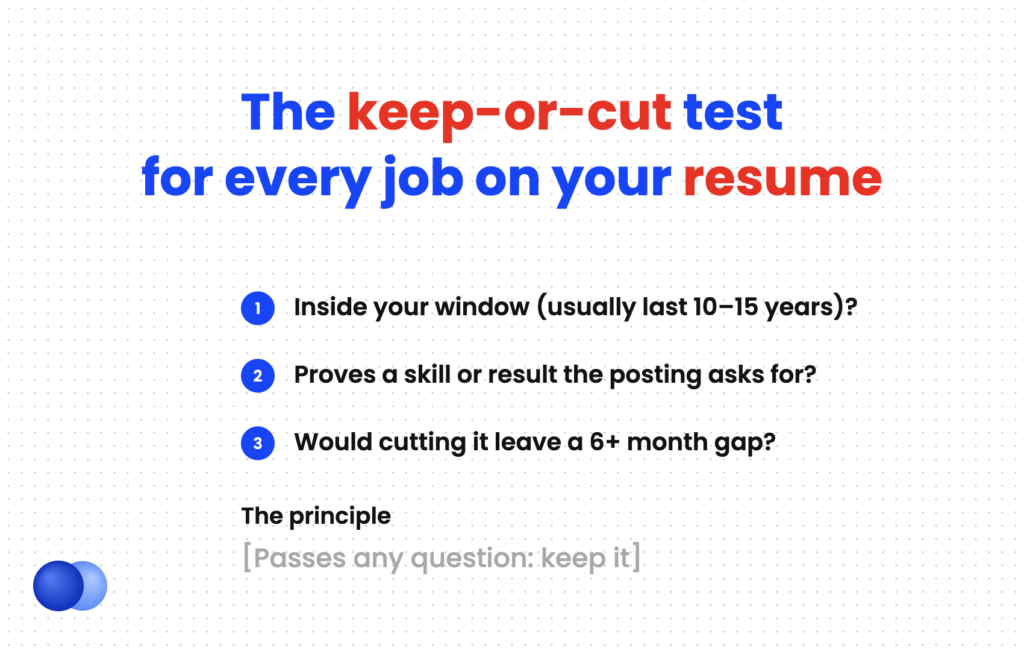
1. Is it inside your window? Set your window to the posting's required years plus about five, capped near 15 years. A role asking for five years of experience means roughly the last decade matters most.
2. Does it prove a requirement? Put the job description next to the role. If the job shows a required tool, skill, credential, or result, it earns a full entry even if it is older.
3. Would cutting it create a gap? A missing recent year raises more questions than a weak job. If removing a role opens a gap of six months or more inside your window, keep it with one or two bullets. Our guide on how to explain an employment gap covers the gaps you can't close.
Then sort the survivors:
- Passes question 2: full entry with three to five bullets.
- Passes only 1 or 3: short entry with one or two bullets.
- Passes none: cut it, or add it to a single "Earlier Experience" line.
Count bullets, not just jobs
If your resume feels long, cut bullets before cutting jobs. Give your two most relevant roles four or five bullets each, and give older or less relevant roles one or two. This keeps your timeline intact while pushing your best evidence to the top of the page.
How do you shorten older or less relevant jobs?
Condense older or unrelated jobs instead of deleting them outright. Give them one or two bullets, drop the bullets entirely, or group several roles under an "Earlier Experience" or "Additional Experience" heading with titles and employers only. This keeps your career story visible without spending space on it.
MIT's career office suggests exactly this structure. Put the most important roles under "relevant experience" at the top, and move the rest to an "additional experience" category below.
Here is how a condensed entry looks in practice.
EARLIER EXPERIENCE
Sales Associate, Target | Retail Cashier, Kroger | Server, Olive Garden
Built customer service and cash-handling skills across three retail and hospitality roles
Dates are optional on this line. Leave them off if the roles fall well outside your window. Many experienced candidates do this to keep attention on recent work, and our resume tips for workers over 50 explain the approach in more detail.
Short-term and contract jobs can also collapse into one entry. List the agency or your freelance title once, then summarize the assignments underneath. See how to list temp agency work on a resume for that layout.
What if your recent jobs are short, unrelated, or ended badly?
Keep recent jobs that fill your timeline even if they are short or unrelated, but give them only one or two bullets. You can usually leave off a job of a few weeks. A job you were fired from or left early follows the same keep-or-cut test as any other role.
Recent history carries the most weight, so be careful cutting from it. A short, unrelated job from last year often helps more than it hurts because it closes a gap.
Two situations come up often:
- Very short jobs. A role of a few weeks rarely needs to appear. Our sibling article on whether to list a job you quit after a month walks through that decision.
- Jobs that ended badly. Termination alone is not a reason to cut a job. Read should I put a job I was fired from on my resume for how to handle it honestly.
Career changers face the reverse problem. Your most relevant work may be old, and your recent jobs may be unrelated. Lead with the relevant roles under a "Relevant Experience" heading, then list recent jobs briefly. Our career change resume guide covers this in full.
RELEVANT EXPERIENCE Marketing Coordinator (Freelance) | Self-employed | Jan 2025 – Present - Plan and publish weekly email campaigns for 3 local clients, growing combined list to 4,200 subscribers
ADDITIONAL EXPERIENCE Operations Supervisor | FedEx | Jun 2019 – Present - Lead a 12-person overnight sorting team
Do the rules change for federal jobs?
Yes. Since September 27, 2025, federal resumes on USAJOBS are limited to two pages, and resumes over the limit are removed from consideration. The Office of Personnel Management tells applicants to prioritize the most relevant and recent experience and remove outdated or unrelated roles.
The federal two-page rule is strict. OPM's agency guidance states that applicants with resumes exceeding two pages will be removed from consideration.
That makes job selection more important for federal applicants, not less. Federal postings still check that you meet specialized experience requirements, so keep every role that proves them. Cut or condense the rest before trimming the detail in your qualifying jobs.
What mistakes do people make when choosing jobs to list?
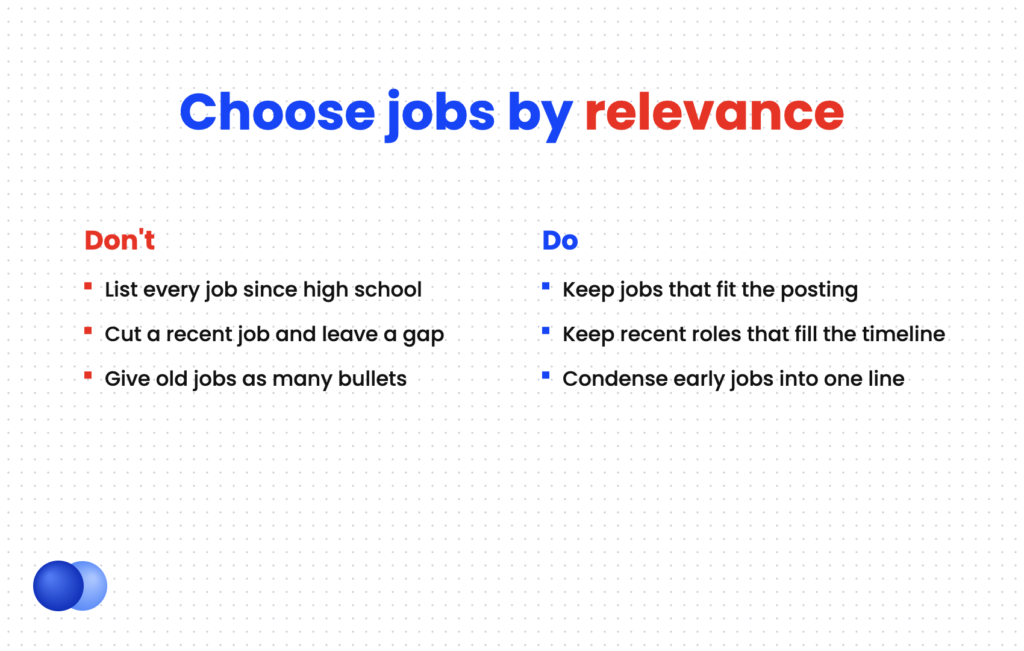
The most common mistakes are listing every job out of habit, cutting recent jobs and creating gaps, giving old jobs as many bullets as current ones, and choosing jobs by prestige instead of relevance. The fix is the same each time: tailor your job list to the specific posting.
Choose jobs by relevance to the posting do: Keep recent roles that fill your timeline do: Give older roles one or two bullets do: Group early jobs under "Earlier Experience"
List every job since high school dont: Delete a recent job and leave a year-long gap dont: Give a 2012 job as many bullets as your current one dont: Keep a job only because the employer is famous
Your job list can change for each application. A project manager applying to a healthcare company might promote a hospital role and demote a retail one. Rezoom's AI resume builder can reorder and trim your roles against each job description.

Frequently asked questions
Is it OK to leave jobs off your resume?
Yes. A resume is a selective summary, not a legal record. Leave off jobs that are old, unrelated, or very short, but answer fully if a formal application asks for complete history.
How many jobs is too many on a resume?
More than six detailed jobs is usually too many. If you have more relevant roles, condense the oldest into a single "Earlier Experience" line.
Is it bad to have only one job on your resume?
No. One long job with a promotion or growing responsibilities can be stronger than several short ones. Break it into titles if your role changed.
Should I list jobs from more than 15 years ago?
Usually not in detail. List older jobs only if they prove a key requirement, and consider dropping their dates.
Should part-time jobs go on a resume?
Yes, if they fill your timeline or show relevant skills. For students and early-career candidates, part-time jobs are often the core of the experience section.
How many jobs should I list for a federal resume?
List every role that proves the specialized experience the posting requires, within the two-page limit. Remove outdated or unrelated roles first.



Comments