Resume Tips Over 50: Subtraction Only Gets You Past the Screen
Most resume tips over 50 are subtraction — cut dates, cut old roles. That clears the screen. What gets you hired is the recent evidence you add back.

On this pageHow real is age bias in hiring?
Age discrimination in hiring is measurable — meta-analytic evidence puts the callback penalty for older applicants around 29%, and AARP reports people over 50 spend nearly twice as long unemployed. The standard advice is all subtraction: cut graduation years, trim old roles. That gets you past the screen. What changes the outcome is the recent, specific evidence you add back in its place.
Almost every set of resume tips over 50 is a list of things to remove. Cut the graduation year. Trim roles older than fifteen years. Drop the AOL address.
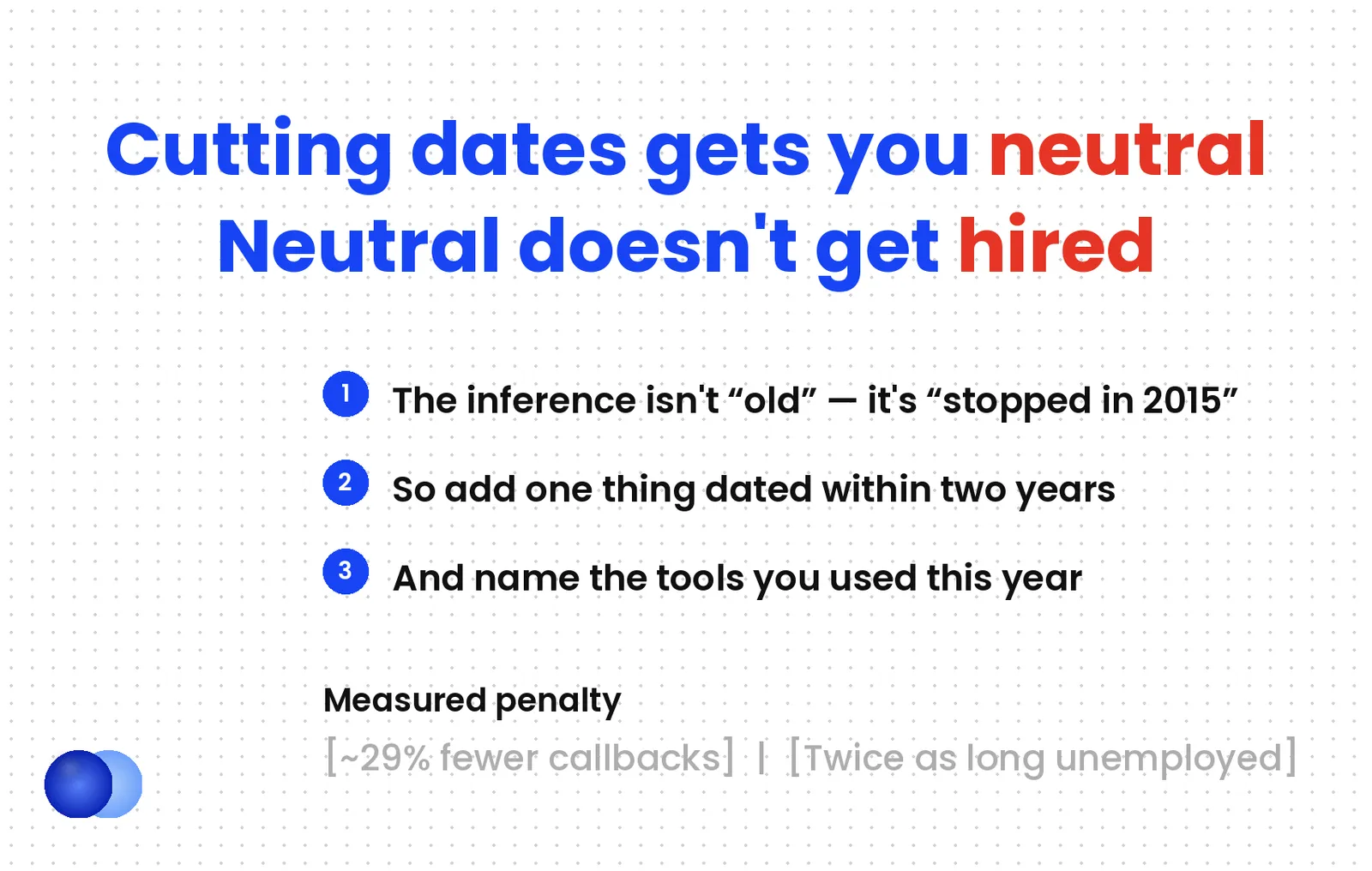
That advice is correct and incomplete. Subtraction removes the signals that trigger a fast assumption — but it leaves a merely neutral resume, and neutral does not get hired.
For finished layouts by job title, see our resume examples.
The inference an employer actually makes is rarely "this person is old." It is "this person's evidence stops in 2015." Subtraction cannot fix that. Only what you add back can.
How real is age bias in hiring?
Measurable and well documented. A systematic review of correspondence studies found consistent callback penalties for older applicants, with meta-analytic estimates around 29% fewer callbacks. AARP reports people over 50 experience unemployment nearly twice as long as younger peers.
In fairness, worth establishing before the tactics, because the tactics are a response to something real rather than to anxiety.
The strongest evidence is experimental. A systematic review and meta-analysis published in Collabra: Psychology1 pooled correspondence studies from 2010 to 2019, sending otherwise identical applications differing only in age, and separated results by band — 40-49, 50-59, 60-65 and 66+ — against a 29-35 control group. That penalty appears consistently and grows with age.
The aggregate figure most often cited from that literature is roughly 29% fewer callbacks2 for older applicants.
The downstream cost is duration. AARP reports4 that people over 50 spend nearly twice as long unemployed as younger peers, which is the same discrimination expressed as time rather than as a rejection.
One honest complication. WHO data for Europe — the only region with figures across all age groups — finds younger people report more age discrimination than other groups, and a Stanford Digital Economy Lab paper found workers aged 22-25 in AI-exposed occupations saw employment declines of roughly 6 to 13% relative to older workers in less exposed roles. Age bias is not a one-directional story, even though the hiring penalty for older candidates is the well-established part.
What should you remove?
Graduation years for degrees older than about 15 years, detailed work history beyond 10 to 15 years, dated email domains, and technology nobody lists any more. This is curation rather than concealment — every candidate chooses what to highlight.
The subtraction half of resume tips over 50 comes down to five cuts, plus one point about whether they are legitimate:
1. Graduation years. For any degree more than roughly fifteen years old. Keep the degree and the institution; drop the year.
2. Work history beyond 10 to 15 years. Detail the recent roles fully. Everything before that goes to a single line: "Earlier roles at Acme, Wexford and Northgate, 1998–2010."
3. Dated email domains. An AOL or Hotmail address is a free signal you can remove in two minutes.
4. Obsolete technology. Nobody lists Lotus Notes. If a tool has not been current for a decade, it dates you without demonstrating anything.
5. Every role you ever held. Thirty years of full detail is a document nobody finishes reading.
| What you remove | What replaces it |
|---|---|
| Graduation year on a 1994 degree | The degree and institution, undated |
| Four bullets under a 2004 role | One line: "Earlier roles at Acme, Wexford and Northgate, 1998–2010" |
| An AOL or Hotmail address | A plain firstname.lastname address |
| Lotus Notes, WordPerfect, Flash | The tools you used this year, by name |
| "Over 25 years of experience" | A quantified outcome from the last five |
On legitimacy: this is standard curation, and every candidate does a version of it. A graduate omits their supermarket job; a director omits their first analyst role. Choosing what to highlight is what writing a resume is. You are not concealing your age — it will be evident in an interview, and that is fine.
Two pages is right for most candidates with twenty years of history — one page forces cuts that lose real evidence. Three pages is too many outside academia, research, and executive roles that genuinely require board and publication history. If your document is running to three, the problem is usually that roles from 2004 still have four bullets each rather than one line.
Which resume tips over 50 actually add something?
Recent, dated, specific evidence. A certification from the last two years, a tool you used this year, an outcome with a number from the last five. The concern behind age bias is currency, and currency is a thing you can demonstrate directly rather than argue against.
Meanwhile, this is the half of the advice that usually goes missing, and it does more work than the cuts.
Something dated within two years. A certification, a course, a project. It does not need to be large — it needs a date.
Current tools by name. Not "proficient in analytics software" but the actual names of what you used this year. Vocabulary is what a recruiter searches, and it is also what signals currency.
Quantified outcomes from the last five years. Your best achievement may be from 2009. Lead with a recent one anyway, and keep 2009 as a line further down.
Evidence of adaptation. A migration you ran, a system you learned, a process you changed. The unstated worry is not that you are old — it is that you stopped adjusting.
Subtraction only: "Experienced Operations Manager with a proven track record of leadership and process improvement across multiple industries."
Subtraction plus addition: "Operations Manager, manufacturing and logistics. Cut supply chain latency across 14 sites in 2025 by rebuilding the scheduling process in NetSuite. Lean Six Sigma Black Belt; completed the Supply Chain Analytics certificate in 2025."
Version one removed the dates and added nothing. The second names this year, a current system, and a number — and it never mentions age because it does not need to.
What format should you use?
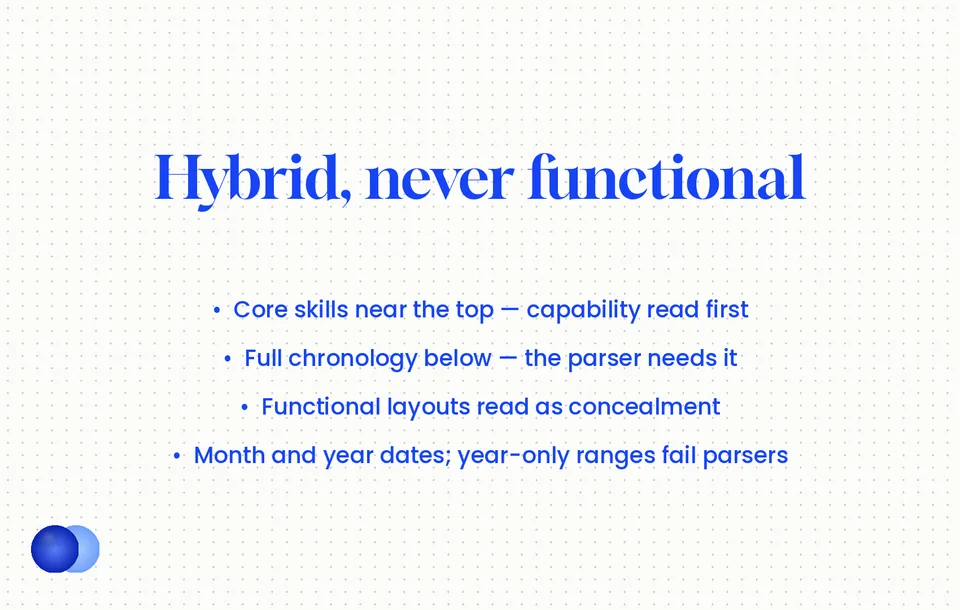
Hybrid — a skills section near the top followed by a full chronological history. Do not use a functional resume. Skills-only layouts are a red flag to recruiters and parse poorly, and they are associated with candidates hiding something, which is the opposite of what you need.
Understandably, the temptation to hide the timeline is strong and the format that does it is the wrong one.
A functional resume removes the chronology, which feels like it removes the age signal. What it actually does is trigger both a parsing failure and a recruiter's suspicion — the three resume formats covers the parse-rate gap, and the recruiter-side distrust is well documented. Our guide to the resume format for experienced hires over 50 shows the reverse-chronological alternative.
Hybrid gives you what you actually wanted: a Core Skills block near the top, so the first thing read is capability rather than a date, followed by an intact history that satisfies both the parser and the reader.
Two supporting details. Keep dates in Mar 2021 – Jun 2024 format, since year-only ranges fail on several parsers. And keep the layout single-column, which matters more than any other formatting decision. Our guide on how to write dates on a resume covers every edge case.
Do
- Lead the top third of page one with something from this year. That space carries most of the initial scan, and a current date there answers the currency question before anyone asks it.
Don’t
- Write "over 25 years of experience" in your summary. It converts a fact the reader would have inferred into a headline, and it is the one phrase that makes seniority sound like a liability rather than a qualification.
Free ATS score, the text the software extracts and your missing keywords. No sign-up.
Does trimming dates hurt you with an ATS?
No, and this is a common worry with a clear answer. Applicant tracking systems parse fields and match vocabulary; they do not compute your age or penalise a shorter history. Keep month-and-year dates on the roles you do include, since year-only ranges parse unreliably.
People conflate two separate concerns here.
The parser reads employers, titles, dates and skills into fields, then ranks on vocabulary overlap with the posting. Nothing in that pipeline calculates age. How an ATS works covers what actually filters candidates, and it is knockout questions and search terms rather than tenure.
The human forms the impression. So the tactics on this page point at the right target — the second reader, not the first.
One caveat worth knowing: some older applicant tracking deployments did score long employment histories differently, and a small number may still. That is an argument for trimming to 10-15 years anyway, which you were doing for the human reader regardless. The same cut-off answers how far back a resume should go for every age group.
Correspondence studies sending otherwise identical applications differing only in age show consistent callback penalties for older applicants, increasing across age bands.
Collabra: Psychology, meta-analysis of age discrimination in recruitment
What actually moves the outcome?
Referrals and direct contact, more than any resume edit. The callback penalty applies to cold applications where a stranger infers from a document. A named introduction bypasses the inference entirely, which is why it matters more here than for most candidates.
Finally, worth saying plainly, because it is the honest ceiling on everything above. If you left the workforce entirely before applying again, the steps for a resume after retirement apply instead.
Every one of these resume tips over 50 improves a cold application. None of them changes the underlying bias, and pretending otherwise would be dishonest — a 29% callback penalty is a fact about employers, not a failure of your document.
What genuinely changes the equation is arriving through a person rather than a pile. A referral replaces inference with testimony, which is why it is worth more to a candidate over 50 than to almost anyone else.
Three practical routes: former colleagues who moved on and now hire, industry groups where your experience is the asset rather than the question, and a LinkedIn profile built around searchable current skills so recruiters find you rather than screening you.
And once the resume is done, confirm it against a real posting rather than assuming — an free ATS resume checker shows what parsed and where the vocabulary missed, which is a faster answer than another round of edits.
Frequently asked questions
How many years of work history should I include over 50?
Ten to fifteen years in detail. Condense everything earlier into a single line naming the employers and a date range, rather than dropping it entirely.
Should I remove my graduation year from my resume?
Yes, for degrees more than roughly fifteen years old. Keep the degree and institution and drop the year — this is curation, not concealment.
Is age discrimination in hiring real?
Yes, and measurable. Correspondence studies sending identical applications differing only in age show consistent callback penalties, with meta-analytic estimates around 29% fewer callbacks for older applicants.
Does an ATS penalise older candidates?
Modern systems parse fields and match vocabulary rather than computing age. Some older deployments scored long employment histories differently, which is another reason to trim to 10-15 years.
Should I use a functional resume to hide my age?
No. Skills-only layouts parse worst and recruiters associate them with concealment. Use a hybrid — skills near the top, full chronological history below.
How long should a resume be after 50?
Two pages for most candidates with twenty years of history. Three is too many outside academia, research and executive roles requiring board or publication history.
Should I say "over 25 years of experience" in my summary?
No. It converts something the reader would infer into a headline, and it frames seniority as a liability rather than a qualification.
What matters more than editing my resume?
Referrals. The callback penalty applies to cold applications where a stranger infers from a document, and a named introduction replaces that inference with testimony.
Sources
We opened and read each page below. The small numbers in the text point here. Pages that carry no publication date show n.d.
- Collabra: Psychology, University of California Press2023
Systematic review and meta-analysis of correspondence studies and scenario experiments from 2010-2019,…
- Cogn-IQ2026
Meta-analytic literature indicates roughly 29% fewer callbacks for older applicants; the resume…
- StylingCV2026
Remove graduation years for degrees older than 15 years, limit detailed history…
- Forbes2026
AARP reports people over 50 experience unemployment nearly twice as long as…
- Resume.io / Innovative Human Capital2026
Survey of 600 US job seekers aged 50+ conducted May 2026: 46.5%…
Mohammad has spent more than ten years designing consumer products and leads product at Rezoom, deciding what gets built and what gets left out. His guides cover the whole job search, from resume sections and cover letters to interview answers and career moves.
Goodi, M. (2026, October 23). Resume Tips Over 50: Subtraction Only Gets You Past the Screen. Rezoom. https://rezoom.io/resume-tips-over-50/