

Summary
Retirement is the one career gap that explains itself, so hiding it is wasted effort. What hurts a returning retiree is duration: a last job that ended years ago and nothing dated since. Name the retirement in one honest line with month-and-year dates, fill the period with recent dated activity, trim the history to 10–15 years, and use a hybrid format. RAND research found 82% of people who unretire had planned to, so say what you want now.
Most advice on a resume after retirement treats the word "retired" as something to hide. That solves the wrong problem, because retirement is the one gap a recruiter never needs you to explain.
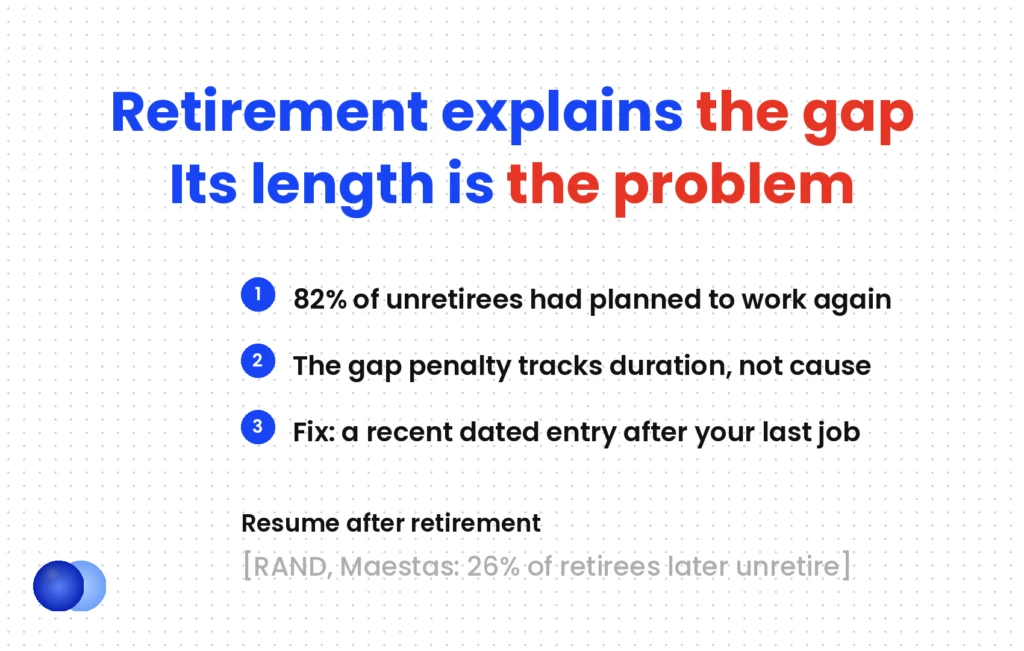
Think about what a reader wonders when they hit an unexplained gap: illness, dismissal, trouble holding a job? "Retired" answers all of that in one word. The question it leaves open is different: how long ago did this person last do the work, and can they still do it now? The gap penalty tracks duration, not cause, and retirement typically produces the longest gap on any resume.
So the task has two parts. Take away whatever makes the page read as old, and add something recent and dated that shows the retirement has ended. The first clears the screen; the second changes the decision.
If you draw a pension or Social Security, earnings from new work can affect your benefits depending on your age and country; check the current rules before you agree hours. General information rather than financial or legal advice.
What does a resume after retirement actually need to fix?
Not the reason for the gap, which "retired" already supplies. It needs to fix staleness: a most recent job that ended years ago and nothing dated after it. A recruiter reads the last date on the page as the last date you did the work, so the page needs a newer one.
A hiring manager finds the top end date and subtracts it from today. Three years reads as three years out of practice, whatever caused them. That is why retirees hear two contradictory pieces of advice — cut old material, or add new material — and why both are right: they fix different halves of the problem.
| What the reader sees | What they conclude | The fix |
|---|---|---|
| "Retired" with honest dates | Voluntary, explained break | Leave it — it is doing its job |
| Last job ended 2–4 years ago | Skills may have lapsed | A dated entry covering the retirement period |
| 35 years of roles on the page | Expensive, possibly inflexible | Trim to the last 10–15 years |
| Senior title, junior posting | Will leave when bored | A summary stating what you want now |
| Graduation year from 1985 | Age, before anything else | Remove the year, keep the degree |
The first row is the one people get backwards. Recruiters rarely penalise the word. One vendor survey cited by the National Council on Aging (MyPerfectResume, 2025) found only 30% of employers view gaps negatively at all, and a retirement gap gives even that 30% the answer before they ask.
Should you write "retired" on your resume?
The one-line version, for when you did little that relates to the job:
` Planned retirement | Jun 2022 – Aug 2026 `
The activity version, which is almost always stronger:
` Consulting & Volunteer Work (post-retirement) | Jun 2022 – Present · Treasurer, Riverside Food Bank: rebuilt budget tracking in Excel for 40 volunteers · Two freelance audits for local small businesses, 2025 · Completed Google Project Management Certificate, Mar 2026 `
Either way, write month and year on every date. Year-only ranges fail to parse on at least three of eight major applicant tracking systems, so you risk losing your dates entirely to hide a gap the word "retired" had already explained. Worse, anyone who checks LinkedIn sees the real dates, and concealment reads worse than retirement ever could.
The word "planned" tells the reader you chose to stop and are choosing to return.
Most returns are planned
RAND research by Nicole Maestas found 26% of retirees later unretire, and 82% of those who returned had expected to work during retirement before they stopped. Unretirement is mostly a plan, not a crisis. Write the resume like someone carrying out a plan: calm, specific, no apology.
What should go in the retirement period?
Anything recent, real and dated: consulting, freelance projects, board or treasurer roles, volunteering with measurable scope, and certificates with a completion month. This is the "add recent dated evidence" half of the fix, and it matters more than any amount of trimming.
Trimming only stops the page from signalling age. A recent dated entry proves you work in the present tense. Three rules make it credible.
Date every item. "Completed a certificate" is weak. "Completed Google Data Analytics Certificate, Apr 2026" places you in 2026, which is the point of the whole entry.
Quantify volunteer work like paid work. A food bank treasurer who managed a $60,000 budget, or a school board member who chaired a hiring panel, did real work. Write the bullet as you would for a salaried role.
Keep it honest in scope. One course and one small project is fine. A modest entry survives interview; an inflated one does not.
If you did nothing work-related, start something before you apply. A short course or one pro bono project takes weeks and gives the page a date from this year.
Before: "Operations Director, Halden Logistics, 1994–2022. Retired 2022." Then 28 years of roles, a 1983 graduation year, and a skills list with Lotus Notes on it.
After: "Operations Director, Halden Logistics · Mar 2009 – Jun 2022", with three bullets of results, then "Consulting (post-retirement) · Jun 2022 – Present · Redesigned warehouse scheduling for two regional distributors, cutting overtime 18%." Earlier roles collapse to one line. Graduation year gone. Skills list matches the posting.
Nothing is hidden in the second version. The only difference is that the latest date on the page now reads 2026.
How far back should a resume after retirement go?
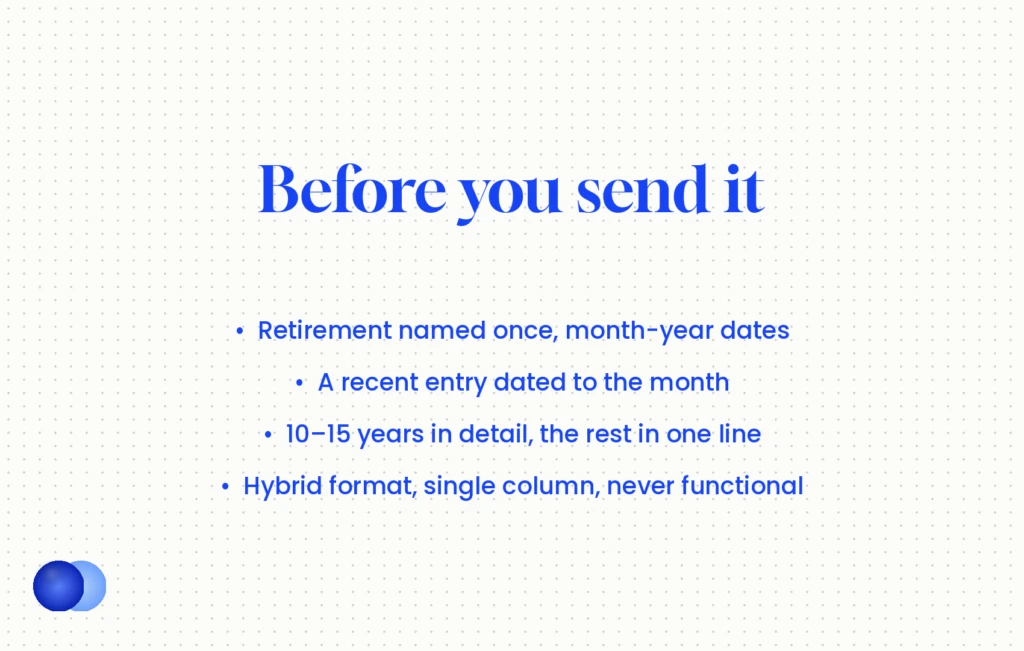
Detailed entries for the last 10–15 years, then one summary line for everything earlier. Drop graduation years and outdated tools. This is the "subtraction" half: it keeps the page from announcing your age before the reader has seen your results.
For candidates over 50, the site's position is simple: subtraction clears the screen; adding recent dated evidence changes the outcome. A resume after retirement needs both.
Keep 10–15 years in detail, counting the retirement period itself.
Compress the rest to one line. "Earlier experience includes 15 years in regional logistics management, including two national freight carriers."
Remove graduation years. Keep the degree and institution.
Update the tools. A platform that vanished in 2010 says more about your age than any date.
Why bother? A meta-analysis published in Collabra: Psychology found older applicants receive roughly 29% fewer callbacks than equally qualified younger ones. You cannot remove that bias, but you can stop the page triggering it in the first six seconds. The full over-50 playbook sits in resume tips over 50.
Match the page to the hours you want
Most returning retirees want less than they had: fewer hours, a narrower remit, no direct reports. Say so in the first line of the summary — "Former operations director seeking a part-time planning role, three days a week." Without it, a recruiter sees a director applying for a coordinator post and assumes you will leave within months. With it, seniority becomes a bargain. The resume for a part-time job guide covers how to frame availability.
Which resume format works after retirement?
Hybrid: a short skills-led summary at the top, then reverse chronological history with month-and-year dates. Never functional. It is the format recruiters most associate with concealment, and it parses worst, which is the opposite of what a long gap needs.
The functional resume looks designed for this situation: skills first, dates out of sight. That is exactly why it fails.
It parses badly. Functional layouts parse at roughly 70–85%, against 92–97% for chronological and hybrid, and legacy Taleo and Workday setups can reject them outright.
It reads as hiding something. Recruiters assume a functional resume conceals a timeline problem. Retirement is not one, so hiding it creates suspicion you never earned.
A hybrid gives you the skills-first opening you wanted without either cost. Keep it single column with standard headings, and make page one stand alone. The resume format types comparison explains the parse-rate gap in detail.
Use a hybrid layout with one honest, dated retirement line and a recent activity entry directly above your last paid role.
Switch to a functional resume or year-only dates to blur the retirement, because both parse worse and both read as concealment.
How do you explain retirement in an interview?
In one sentence, then move forward. "I retired in 2022 as planned, and I've found I want to keep working, part-time, on the kind of problem this role solves." Then point to the recent entry on your resume. Never apologise for retiring.
The question you will actually face is rarely "why did you retire?" It is the unspoken one behind it: will this person stay, and are they current? Answer that.
Context. One line: you retired, and you chose to.
Evidence. The consulting project, the course, the volunteer role — the dated entry from your resume.
Direction. Why this role, at these hours, now.
That structure mirrors the approach for any gap, covered fully in how to explain an employment gap. If your break ran long for reasons besides retirement, such as caregiving, the returning to work resume guide covers that path.
If benefit rules cap what you can earn, ask for a specific number of hours rather than explaining your pension.
Hiring managers are much more interested in a candidate's aligned strengths, achievements, and business results.
What can a resume after retirement not fix?
The market. Unretirement rates fall when hiring slows, and 2025 sat well below pre-pandemic levels. Age bias also survives a well-built page. A strong resume after retirement improves your odds; it cannot promise a job, so plan for a longer search.
Boston College's Center for Retirement Research measured the unretirement rate among workers 55 and over at 1.9% in 2025, against nearly 3% in 2019. The centre's reading: people unretire when it is easiest, so a low rate signals a harder market, not less interest.
AARP's summer 2026 survey of 2,065 adults over 50 found 67% expect finding new work to be difficult, and 35% name age discrimination as the main barrier. Among those who had recently unretired, 48% cited economic need.
None of that changes what to do, only how long it takes. Use your old network before job boards, and tailor every application.
Build the page in the Rezoom resume builder, then check the result against this article: single column, hybrid order, month-and-year dates, one recent dated entry.
Frequently asked questions
Should I put "retired" on my resume?
Yes, once, as a dated line or as the heading of an activity entry covering the retirement period. It explains the gap in one word.
How do I list retirement on a resume?
As an entry in your work history with month-and-year dates, such as "Consulting & Volunteer Work (post-retirement), Jun 2022 – Present", with two or three dated bullets.
How far back should my resume go after retirement?
The last 10–15 years in detail, then one summary line for earlier experience. Drop graduation years and outdated software from the page.
Should I use a functional resume to hide the gap?
No. Functional resumes parse worst and recruiters read them as concealment. Use a hybrid instead.
Can I use year-only dates to shorten the gap?
No. Year-only ranges fail on several major applicant tracking systems, and retirement already explains the gap. Use month and year on every date.
How do I avoid looking overqualified?
State what you want in the first line of your summary, including hours and scope. Stated intent turns seniority into a bargain rather than a flight risk.
Does working after retirement affect my pension or Social Security?
It can, depending on your age, your country and the scheme. Check the current earnings rules before you agree hours.
How long does it take to get hired after retirement?
Often longer than people expect. Unretirement rates fall in slower markets, and 67% of over-50s in AARP's 2026 survey expected the search to be difficult.



Comments