

Summary
To list overlapping jobs on a resume, keep every role in its own entry with accurate month-and-year dates. Put current jobs first, ordered by most recent start date, then past jobs in reverse chronological order by end date. Label a secondary role as part-time, freelance or contract so the overlap reads as deliberate. Cut or merge side jobs that do not support the role you want.
To list overlapping jobs on a resume, give each role its own entry with honest month-and-year dates, and put the job you still hold at the top. Overlapping jobs are normal and do not need an apology on the page. The only real risks are a confusing order and dates that look like errors.
Holding two jobs at once is common. The U.S. Bureau of Labor Statistics counted 8.5 million multiple jobholders in August 2026, or 5.2% of everyone employed. Recruiters see concurrent roles all the time.
This guide gives you one ordering rule, a decision table for the five most common overlap situations, and copy-ready formats for each.
Is it OK to have overlapping jobs on a resume?
Yes. Overlapping jobs are acceptable on a resume as long as the dates are accurate and each role is clearly labeled. About 5.2% of employed Americans hold more than one job, so recruiters expect to see concurrent roles. Include a second job when it adds relevant skills; leave it off when it adds only noise.
Concurrent roles usually signal work ethic, not a problem. Several certified resume writers surveyed by the National Résumé Writers' Association said concurrent roles "are not frowned upon" and that employers understand why people hold more than one job.
The most common pattern is a full-time job plus a part-time one. In 2024, 4.8 million of the 8.4 million U.S. multiple jobholders had a full-time primary job and a part-time secondary job. Another 2.1 million worked two part-time jobs.
What a recruiter wants from overlapping jobs is simple: they want to understand the timeline in a few seconds. If they have to stop and decode your dates, you lose the benefit of showing the extra work.
What order should overlapping jobs go in on a resume?
List current jobs first, starting with the one you began most recently. Then list past jobs in reverse chronological order by end date. If two past jobs ended in the same month, put the more relevant or more senior one first. Apply the same rule to every entry so the timeline stays readable.
Most advice stops at "reverse chronological order," which breaks down the moment two jobs overlap. Use this two-step rule instead.
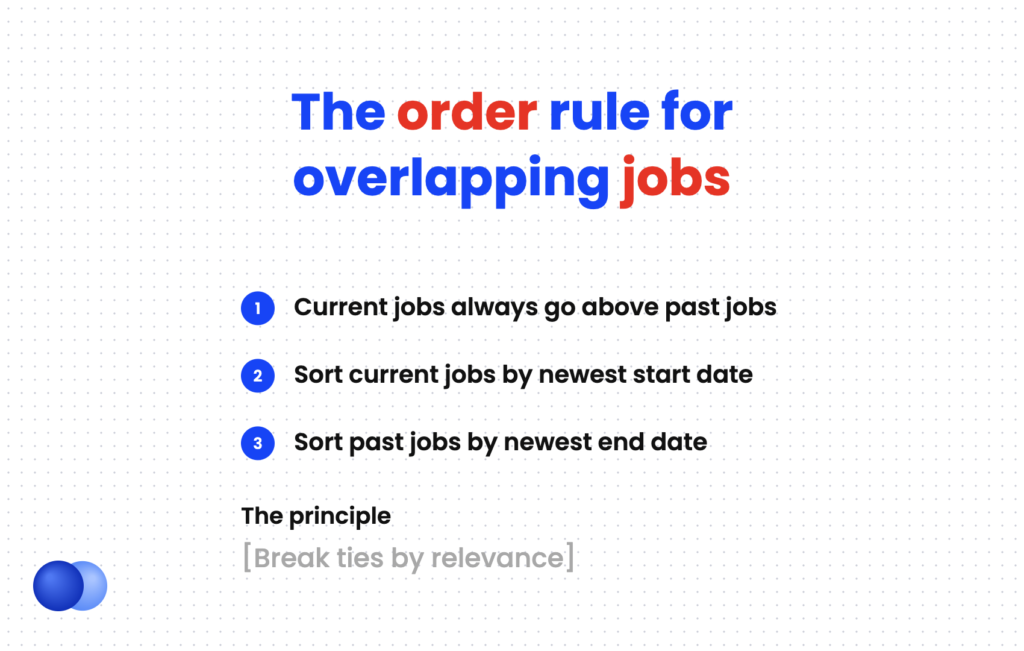
- Current roles go on top. A job you still hold always comes before a job you left, no matter which one started first. Career sources such as Chron give the same rule.
- Sort each group consistently. Among current jobs, sort by start date (newest first). Among past jobs, sort by end date (newest first).
When two entries tie, relevance breaks the tie. Put the role closest to your target job higher. Harvard's career office advises listing entries in reverse chronological order and staying consistent in format, and a tie-breaker keeps you consistent.
The one-second test
Cover everything below your dates with your hand and read only the date column top to bottom. If the sequence looks random, a recruiter will think so too. Fix the order before you fix the wording.
How do you write the dates for overlapping jobs?
Use the same month-and-year format for every job, such as "Mar 2023 – Present" or "03/2023 – 08/2025." Write "Present" for any role you still hold. Never shorten one job's dates to hide an overlap; background checks confirm dates, and a mismatch looks worse than the overlap itself.
Month and year is the safe default. The NRWA writers recommended MM/YYYY dates and said most applicant tracking systems read overlapping dates correctly. Teal's formatting guide also lists month and year as the most common format, with consistency as the main rule.
Pick one style and keep it:
| Format | Example | Best for |
|---|---|---|
| Abbreviated month | Mar 2023 – Present | Most resumes; easy to scan |
| Numeric | 03/2023 – Present | Tight layouts; ATS-safe |
| Year only | 2019 – 2021 | Roles older than about 10 years |
| Full date | 03/06/2023 – 08/29/2025 | Only when an application form asks |
Avoid year-only dates for recent overlapping jobs. "2023 – 2024" next to "2024 – Present" hides whether you overlapped for one month or eleven. That vagueness invites questions you could have answered on the page.
Also, do not trim dates to make overlap disappear. An employment verification confirms dates of employment and job titles with the employer. A resume that disagrees with that record is a bigger problem than two jobs at once.
How do you list overlapping jobs in common situations?
Match the format to the situation. A side job next to a full-time role gets its own labeled entry. Two roles at one employer go under one company heading. A short handoff overlap between employers needs no comment. Many small freelance gigs can merge into one entry with a single date range.
Most overlapping jobs fall into one of five patterns. Use this table to decide where each role goes.
| Situation | How to list it | Label to add |
|---|---|---|
| Full-time job plus part-time side job | Two separate entries; main job first if both are current | "Part-time" after the side job title |
| Full-time job plus freelance or consulting | Separate entry, or one grouped freelance entry | "Freelance" or "Consultant" |
| Two part-time jobs at once | Two entries, sorted by the ordering rule | "Part-time" on both |
| New job started before old one ended | Two entries with real dates; no explanation needed | None |
| Two roles at the same company | One company heading, titles stacked beneath | None |
The last row is not really an overlap. It is a promotion or internal move, so follow the format in our guide on how to show a promotion on a resume.
If your side work is independent client work, our freelance resume guide shows how to present it as one strong entry. If you were placed at a client by a firm, see how to list contract work on a resume.
Operations Coordinator | Brightline Logistics, Columbus, OH | Jun 2022 – Present - Cut average carrier invoice processing time from 6 days to 2 by building a shared tracking sheet - Coordinated 140+ weekly shipments across 3 regional warehouses
Bookkeeper (Part-time) | Harbor Street Dental, Columbus, OH | Jan 2024 – Present - Reconcile monthly accounts payable and payroll for a 12-person practice in QuickBooks
In that example, the full-time job stays on top even though the part-time job started later. That is the one sensible exception to "newest start date first": when both are current, lead with your primary role. The "Part-time" label explains the overlap before anyone asks.
Should you include every overlapping job on your resume?
No. Include an overlapping job only if it shows skills, results or responsibility the target employer values. A weekend retail shift next to a senior engineering role usually adds nothing. Keep side jobs that fill a skills gap, show leadership, or relate to the new field. Remove the rest or merge them.
Your resume is an argument for one job, not a full record of your life. The NRWA experts tied the decision to career goals, relevance and background check accuracy. Use three questions.
- Does it support the target role? A part-time tutoring job helps a teaching application. It does little for a data engineering one.
- Is it recent? Old concurrent jobs can drop off entirely. Our guide on how far back a resume should go covers the cut-off.
- Does it cover a gap? If your main job ended and the side job continued, keep it. It shows continuous work. If you still have a gap, handle it with the approach in how to explain an employment gap.
One more check before you include a side job: make sure it did not break a moonlighting or conflict-of-interest policy at your main employer. Chron flags this directly and adds that your references should know about any job you held while they supervised you.
Give each overlapping job its own entry with month-and-year dates do: Put roles you still hold above roles you have left do: Add "Part-time," "Freelance" or "Contract" to the secondary job title do: Count calendar years, not stacked jobs, when you state total experience
Shorten or blur dates to hide that two jobs overlapped dont: Use year-only dates for recent roles that overlapped dont: List a side job that has no link to the job you want dont: Mix ordering rules, such as start date for some entries and end date for others
How do you avoid overstating experience with overlapping jobs?
Count calendar time, not the sum of your jobs. If you worked two jobs from 2021 to 2024, that is three years of experience, not six. State years of experience by field in your summary, and let the dates in each entry do the rest. Inflated totals get caught when a recruiter compares your summary to your timeline.
This is the mistake most guides skip. Overlapping jobs make it easy to double count.
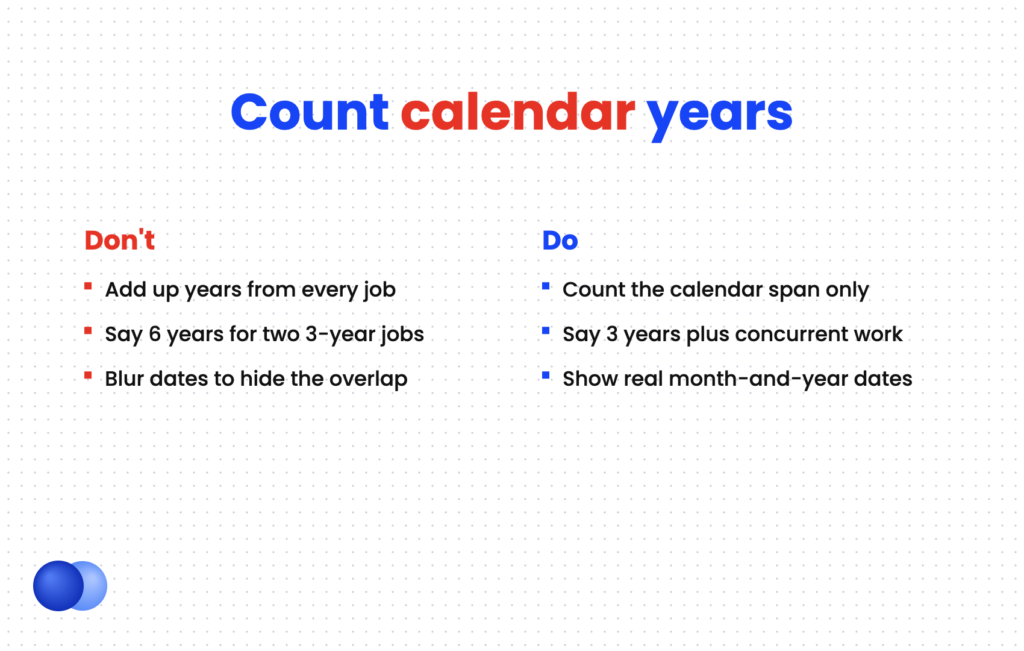
Suppose you held a full-time marketing job and a part-time freelance design role for the same three years. Your summary should not say "six years of marketing and design experience." It should say "three years in marketing, including concurrent freelance design work."
Recruiters do simple subtraction on your dates. When the total in your summary is larger than the span of your timeline, it reads as padding. A precise claim builds trust faster than a large one.
Marketing coordinator with 3 years of B2B campaign experience, plus concurrent freelance design work for 9 small-business clients since 2022.
The same logic applies when a job posting asks for a minimum number of years. Match the requirement with the span of relevant work, and point to both roles as evidence of depth.
Can ATS software read overlapping dates?
Generally, yes. Resume writers surveyed by the NRWA reported that most applicant tracking systems interpret overlapping dates correctly. Parsing problems come from layout, not overlap: dates inside tables or text boxes, mixed date formats, and dates placed far from the job title. Keep dates on the same line as each job.
The overlap itself is rarely the issue. Formatting is. To help the parser, keep each entry in a simple structure: job title, employer, location and dates on one or two lines, then bullets.
Avoid putting two concurrent jobs side by side in columns. It may look tidy, but it can scramble the reading order. Stack them vertically instead, using the ordering rule above.
If you want to see how your file reads to a parser, run it through the Rezoom ATS resume checker. For more on entry structure, read our guide to writing work experience on a resume.

Frequently asked questions
Do overlapping jobs look bad on a resume?
No. Overlapping jobs look bad only when the dates are unclear or the side job has no relevance. With clear labels and a consistent order, they show capacity and work ethic.
Which job goes first if both are current?
Put your primary or most relevant current job first. If both carry equal weight, put the one you started most recently first.
Should I explain overlapping jobs in my cover letter?
Only if the overlap is unusual, such as three simultaneous roles or two full-time jobs. A short line in the cover letter can give context. A normal side job needs no explanation.
How do I list a new job that started before my old job ended?
List both with their real dates. A few weeks of overlap during a handoff is common and needs no comment.
Can I combine several short overlapping gigs into one entry?
Yes. Group similar freelance, contract or gig work under one heading, such as "Freelance Graphic Designer, Various Clients," with a single date range. Then name key clients or projects in the bullets.
Does working two jobs at once count as double experience?
No. Experience is measured in calendar time. Two jobs held over the same two years equal two years of experience, though you can highlight the extra skills each role added.



Comments