How to List Contract Work on a Resume: Formats for Every Setup
How to list contract work on a resume: 4 formats for 1099, agency, contract-to-hire and NDA roles, which company to name, and copy-ready examples by setup.

On this pageWhat counts as contract work on a resume?
- What counts as contract work on a resume?
- How do you list contract work on a resume?
- Should you list the contract firm or the client company?
- How do you keep contract work from looking like job hopping?
- How do you list contract work under an NDA?
- How do you list a contract-to-hire job on a resume?
- How should you write bullets for contract roles?
- FAQ
- Sources
List contract work in your regular experience section, in reverse chronological order, with "Contract" in the job title and month-and-year dates. If a contract firm paid you, name the firm as employer and the client beside it. If you worked independently, use one entry such as "Independent Consultant" and list clients under it. Group short, similar contracts so the resume does not look like job hopping.
To list contract work on a resume, put it in your main experience section like any other job. Add "Contract" to the job title and name whoever paid you: the contract firm, or your own business.
The right format depends on one question: were you paid by a firm, or did you invoice clients yourself? Get that right and contract work reads as specialized experience, not instability.
Contract work is a large part of the U.S. workforce. The Bureau of Labor Statistics counted 11.9 million independent contractors, 7.4% of total employment, plus 862,000 workers provided by contract firms1 in its most recent survey. Recruiters see these entries every day.
This guide covers the four common contract setups, a decision rule for each, and copy-ready formats. If you were placed in short fill-in roles through a staffing agency, see our separate guide on how to list temp agency work on a resume.
What counts as contract work on a resume?
Contract work is paid work for a fixed term or project, rather than open-ended employment. It includes independent 1099 contracting, W-2 roles through a contract or consulting firm, and contract-to-hire positions. It differs from temp agency work, which usually fills short-term staffing gaps, and from freelancing, which usually means many small clients.
The line between these categories matters because each one gets a slightly different format. BLS tracks them separately: contract firm workers (862,000) and temporary help agency workers (945,000)1 are distinct groups, and independent contractors are far larger than both. App-based delivery falls under the same 1099 heading; the guide to listing DoorDash work on a resume shows how to turn platform stats into bullets.
| Arrangement | Who pays you | Typical length | How to list it |
|---|---|---|---|
| Independent contractor (1099) | The client, directly | Project or fixed term | Your own entry, such as "Independent Consultant" |
| Contract firm placement (W-2) | The contract or consulting firm | Months to years, often one client | Firm as employer, client named on the same line |
| Contract-to-hire | Firm first, then client | Trial period, then permanent | One entry with two date ranges or a title change |
| Temp agency assignment | The staffing agency | Days to weeks, many sites | See the temp agency guide |
| Freelance gigs | Many small clients | Short, repeat projects | See the freelance resume guide |
If you are unsure whether you were a contractor or an employee, check your tax form. The IRS draws the line based on behavioral control, financial control and the type of relationship2, and employers withhold taxes only for employees. A 1099 usually means you were independent; a W-2 means someone employed you.
How do you list contract work on a resume?
Put contract work in your main experience section in reverse chronological order. Use this pattern: Job Title (Contract), Employer or Client, Location, Month Year to Month Year. Add three to five results-focused bullets. Group several short, similar contracts under one heading with one date range, then name clients in the bullets.
Should contract jobs go in a separate section?
Usually not. Put contract roles in your main experience section in date order, with "Contract" in the title. A separate "Contract Work" section only helps when you have many short gigs that would crowd out your main jobs.
Contract work belongs in the same section as your permanent jobs. A separate "Contract Experience" section can push strong work below the fold and make your timeline look broken. Harvard's career office recommends reverse chronological order and fact-based bullets that quantify results4. Contract roles follow the same rules.
Use this decision rule:
- One or two long contracts? List each as its own entry, like a normal job.
- Several contracts through the same firm? One firm heading, with each client and its dates listed beneath.
- Many short independent projects in one field? One entry, such as "Independent Data Analyst," with one date range and the best projects as bullets.
Resume writers polled by the National Résumé Writers' Association5 also recommend combining similar contractor or freelance positions into one entry. It saves space and shows a continuous thread of work. If some contracts ran at the same time as other jobs, follow our rules for how to list overlapping jobs on a resume.
UX Researcher (Contract) | Northgate Health Systems, Remote | Feb 2024 – Jan 2025
Ran 38 moderated usability sessions that shaped the redesign of a patient scheduling app
Cut appointment booking steps from 7 to 4, lifting completed online bookings by 22%
Delivered a research repository the in-house team still uses for quarterly studies
Does your resume follow these 4 rules?
Should you list the contract firm or the client company?
Name the organization that paid you as the employer, then name the client on the same line. If a contract firm issued your W-2, write "Firm Name, contracted to Client Name." Background checks verify dates with the employer of record, so listing only the client can create a mismatch that looks like a false claim.
This is the question most guides skip, and it causes real problems at the offer stage. Employment verification services confirm dates of employment and job titles by contacting the employer you name3. If you name the client, but the client never employed you, the check can come back with no record.
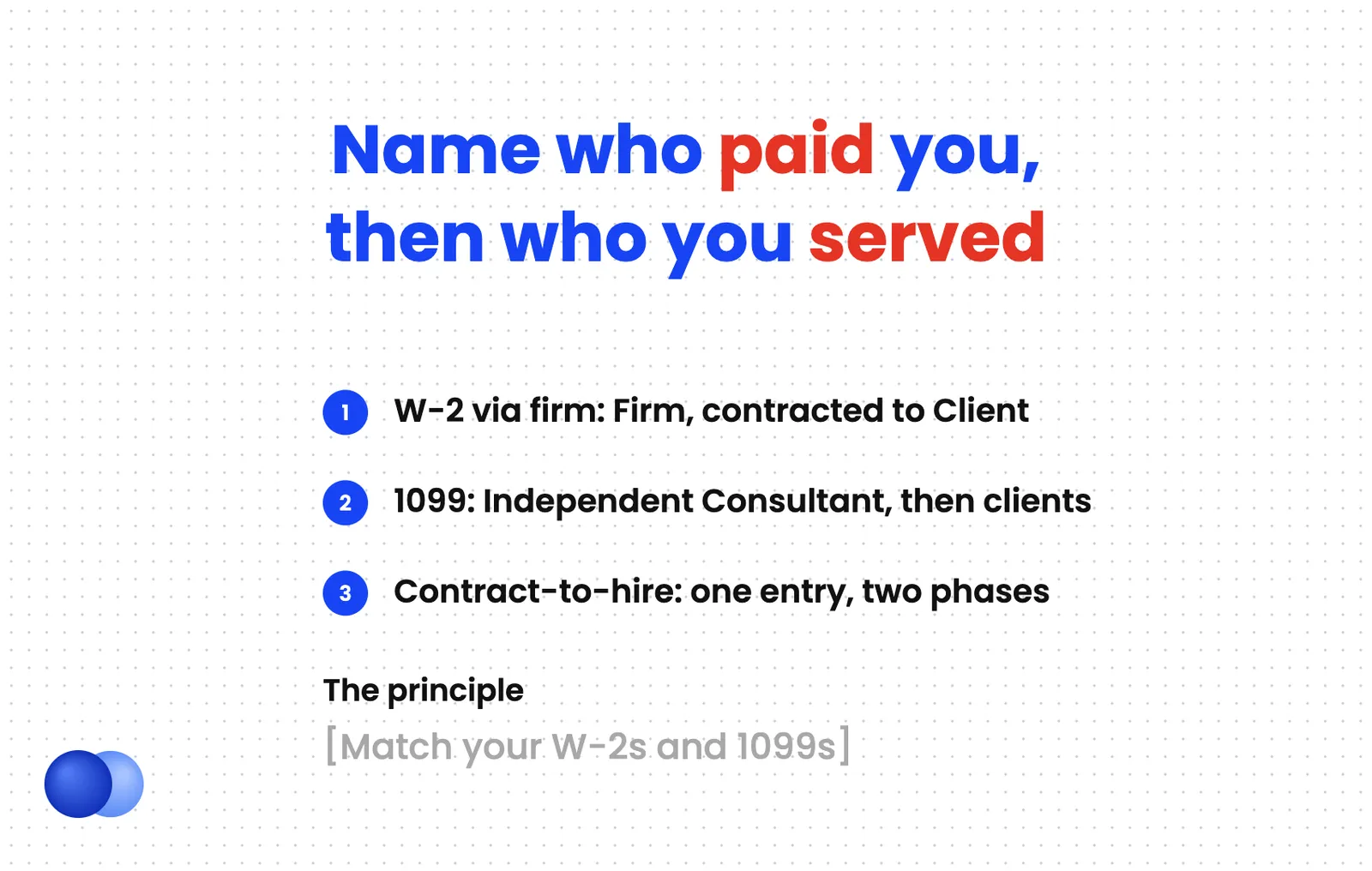
The fix is to show both names. The firm is your employer; the client is where the work and the recognizable brand live. Recruiters get the context, and verification goes to the right place. On cleared programs where you cannot name the client, describe the scope instead and list your clearance level and its current status.
Software Engineer (Contract) | Apex Technical Consulting, Chicago, IL | Mar 2021 – Present
Placed with enterprise clients on 6–14 month engagements
Client: Midwest Regional Bank | Aug 2023 – Present
Migrated 11 legacy batch jobs to AWS Lambda, cutting nightly processing time by 40%
Client: Lakeshore Insurance Group | Mar 2021 – Jul 2023
Built a claims-intake API handling 15,000 requests per day with 99.9% uptime
If you contracted on your own
For independent contracting, you are the business. Use a clear title such as "Independent Consultant" or your registered business name, then list clients in the bullets or as sub-entries. A client who agrees to take a reference call is worth noting in your reference list. If you walk dogs or pet sit on your own, our dog walker resume example shows this format with walk volume and insurance lines.
Before you finalize dates, pull your W-2s, 1099s or contract start and end dates. Your resume should match what a verifier will find. If a firm employed you across several clients, the firm's dates are the ones that will be confirmed.
How do you list short-term contract work?
Give each contract its own entry if it lasted about three months or more. Group shorter gigs under one line, such as "Independent Contractor, 2024 to 2026," and name the clients and results in the bullets below it.
How do you keep contract work from looking like job hopping?
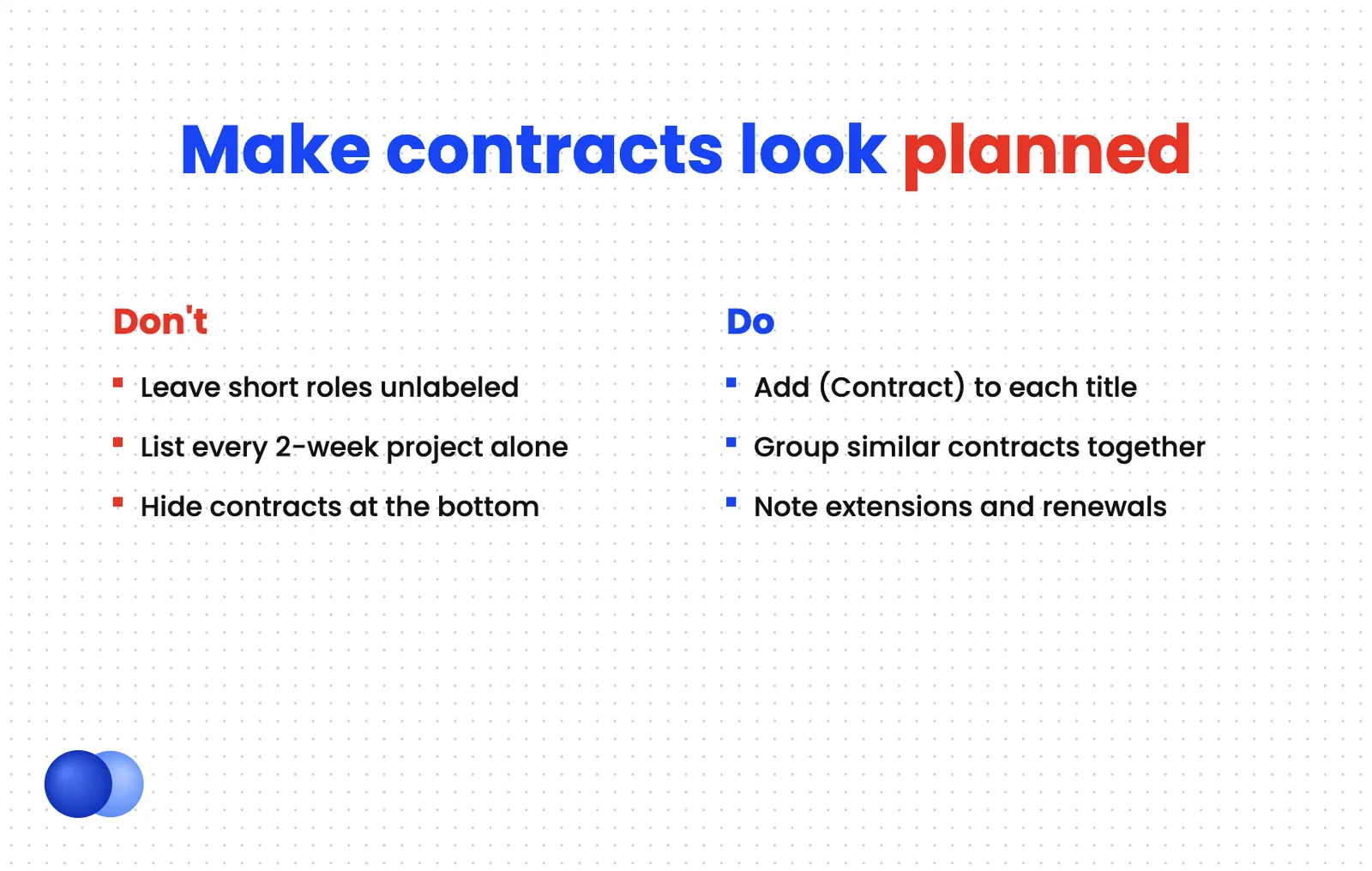
Label every contract clearly and group related contracts. Add "Contract" to the title so a recruiter knows each role had a planned end date. Group back-to-back contracts under one firm or one independent heading. Mention extensions and renewals in a bullet, because renewal is proof that the client valued your work.
Three short jobs in two years looks like instability. Three contracts that each ended on schedule looks like a specialist in demand. The only difference is labeling.
Use these signals:
- The word "Contract." Put it in parentheses after the title, or as a line under the entry.
- The planned term. "12-month contract, extended to 18" shows the client wanted more.
- The reason it ended, if useful. "Project delivered" or "Contract completed" answers the question before it is asked.
Do
- Add "(Contract)" to every contract job title
- Name the firm that paid you and the client you served
- Note extensions, renewals and early completions in a bullet
- Group short, similar contracts under one heading
Don’t
- Bury contract work in a separate section at the bottom
- List only the client when a firm was your employer of record
- Call a 1099 role "full-time employee" or invent a permanent title
- List every two-week project as its own entry
Free ATS score, the text the software extracts and your missing keywords. No sign-up.
How do you list contract work under an NDA?
Replace the client name with an accurate description, such as "Fortune 500 retail company" or "Series B fintech startup." Keep the results, scale and tools, but remove anything confidential, such as unreleased products or internal figures. If a contract firm employed you, the firm name stays on the resume and anchors verification.
Confidentiality agreements are common in consulting and technology contracts. They rarely prevent you from describing your role. They usually restrict naming the client or sharing internal data.
A descriptive label still tells a recruiter the size and industry of the client. Pair it with metrics that show scale without exposing secrets. For example, "a top-10 U.S. health insurer" plus "processed 2 million claims per month" gives plenty of context.
If you are unsure what your agreement allows, read it or ask the firm. Do not guess.
How do you list a contract-to-hire job on a resume?
Use one entry for the employer that hired you, and show the change in the title line or dates. For example: "Data Analyst, Contract (Jan 2023 – Jun 2023); Data Analyst (Jul 2023 – Present)." This shows continuous work, proves the company chose to hire you, and keeps the timeline easy to read.
A conversion from contract to permanent is a strong signal. The client tested your work and decided to keep you. Do not split it into two unrelated entries. When you apply for a permanent role next, these IT cover letter examples show how to frame a contract win.
List the permanent employer as the company heading, then stack the two phases. It works the same way as a promotion, which our guide on how to show a promotion on a resume covers in detail.
Riverbend Foods, Omaha, NE
Supply Chain Analyst | Jul 2023 – Present
Supply Chain Analyst (Contract via Keystone Staffing) | Jan 2023 – Jun 2023
Converted to permanent role after 6-month contract
Built a demand forecast model that reduced stockouts by 18% across 42 stores
How should you write bullets for contract roles?
Write contract work bullets around deliverables and results, since contracts are hired to finish something specific. Start with an action verb, name what you delivered, and add a number: time saved, cost cut, users served or deadlines met. Include the tools and methods the client used, because they double as resume keywords.
Contracts exist to produce an outcome. Your bullets should show that you produced it. Lead with the deliverable, then the result.
Weak: "Responsible for data migration." Strong: "Migrated 4 TB of customer records to Snowflake two weeks ahead of the contract deadline." See how a full software engineer resume example turns project work into results.
Software engineer resume example
Project and contract work written as shipped results.
Tools and platforms matter more on contract entries than on most jobs. Clients hire contractors for specific skills, and recruiters search for those skills. Our guide to resume keywords explains how to match them to a posting. For structure and verb choice, see writing work experience on a resume. Tech roles lean on contracts most, as our IT resume examples show.
When your entries are ready, the Rezoom AI resume builder can format contract, client and date lines consistently across your whole history.
Freelance resume entries with no company name fail to parse 40% of the time. One umbrella entry with clients as sub-bullets parses at 95%. The full fix.
Frequently asked questions
Does contract work count as real experience?
Yes. Contract work is paid professional experience and counts toward the years of experience a posting requires. List it with the same detail as permanent roles.
Should I put "contract" in the job title?
Yes. Adding "(Contract)" after the title tells recruiters the role had a planned end date. It prevents short tenures from being read as job hopping.
How do I list contract work that is still ongoing?
Use "Present" as the end date, just like a permanent job. If the contract has a known end date, you can mention the term in a bullet.
What is the difference between contract work and temp work on a resume?
Contract work is usually a skilled, fixed-term or project role, often with one client. Temp work usually covers short staffing gaps through an agency. Both need clear labels, but temp roles are more often grouped under the agency name.
Can I list contract work if I was paid on a 1099?
Yes. List yourself as "Independent Contractor" or "Independent Consultant," or use your business name, and name clients in the entry. Keep your 1099s in case an employer asks for proof.
How do I explain a gap between contracts?
Short gaps between contracts are normal and rarely need comment. For longer breaks, a brief note in the cover letter or interview works best. Our guide on how to explain an employment gap has sample wording.
Should I list a short contract job on my resume?
Yes, if it fits the job you want. Label it "Contract" so the short dates make sense, or group several short contracts under one entry to keep the page tidy.
How do you put contract jobs on a resume?
List each one like a job: a title with "(Contract)," the firm that paid you, the client if you can name it, dates and two to four result bullets. Group short contracts under one firm heading.
Sources
We opened and read each page below. The small numbers in the text point here. Pages that carry no publication date show n.d.
- U.S. Bureau of Labor Statistics2024
July 2023 survey (released Nov 2024): 11.9 million independent contractors (7.4% of…
- Internal Revenue Service2026
Contractor vs employee depends on behavioral control, financial control and relationship type;…
- GoodHiren.d.
Employment verification confirms dates and job titles by contacting the employer specified
- Harvard FAS Mignone Center for Career Successn.d.
Reverse chronological order; fact-based bullets that quantify results
- National Résumé Writers' Association2022
Resume writers recommend combining similar freelance, contractor or temporary positions into one…
Mohammad has spent more than ten years designing consumer products and leads product at Rezoom, deciding what gets built and what gets left out. His guides cover the whole job search, from resume sections and cover letters to interview answers and career moves.
Goodi, M. (2026, November 17). How to List Contract Work on a Resume: Formats for Every Setup. Rezoom. https://rezoom.io/how-to-list-contract-work-on-resume/