

Summary
List temp agency work under the staffing agency, because the agency is usually your legal employer and the one that verifies your employment. Put the client company in the same entry so recruiters see where you actually worked. With one or two long assignments, give each its own entry; with three or more, group them under one agency heading with dated sub-entries. Add one or two results per assignment, not a list of duties.
To list temp agency work on a resume, name the staffing agency as the employer and the client company as the place you worked, in the same entry. Then pick a layout based on how many assignments you had: separate entries for one or two, a grouped entry for three or more.
That one rule solves most of the confusion. It keeps your dates continuous, it matches what a background check will find, and it still gives credit to the recognizable brand you worked for.
Temp work is also far from unusual. Temporary help services employed about 2.52 million people in August 2026, according to BLS data. Recruiters see these entries every day, so the goal is clarity, not concealment.
Who do you list as the employer for temp agency work?
List the staffing agency as the employer, because it usually hires you, pays you and withholds your taxes. Add the client company on the same line or the line below, marked "Assigned to" or "Client." This matches employment verification records and still shows the brand name recruiters recognize.
The agency is your employer of record in most cases. EEOC guidance says a staffing firm typically qualifies as the employer because it hires the worker, pays the wages and withholds taxes. The client usually shares that role during the assignment because it supervises your day-to-day work.
That matters when a new employer runs a background check. If you list only the client, the check may come back with "no record," which looks like a false claim. Staffing firm Staffmark gives the same advice: include both the agency and the client so future verification goes smoothly.
The simplest pattern looks like this:
Administrative Assistant (Temporary) Apex Staffing, assigned to Harborview Medical Associates | Boston, MA | Mar 2025 – Aug 2025
Should temp agency work get separate entries or one grouped entry?
Use separate entries when you had one or two assignments that lasted three months or longer. Group them under one agency heading when you had three or more assignments, short stints, or several clients through the same agency. Grouping turns a choppy timeline into one continuous job and saves space.
Most guides stop at "list separately or group." The real question is which one makes your timeline read cleanly at a glance. Use this decision table.
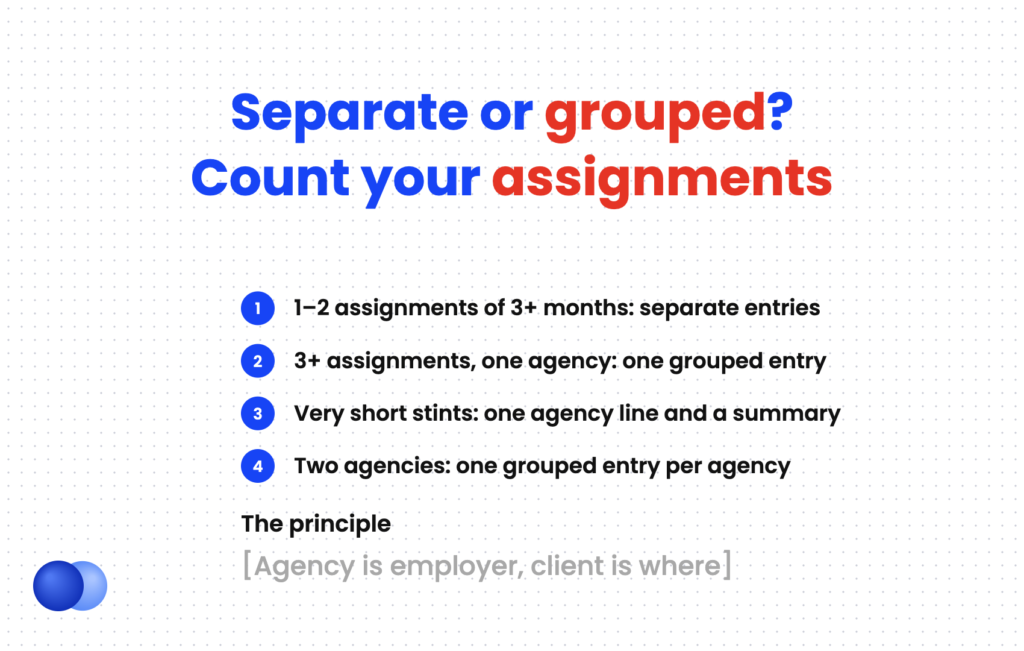
| Your situation | Best format | Why it works |
|---|---|---|
| 1–2 assignments, each 3+ months | Separate entries, "(Temporary)" in the title | Each role has enough substance to stand alone |
| 3+ assignments through one agency | One agency entry, clients as sub-entries | Shows one continuous employer, no apparent job-hopping |
| Many very short assignments (days or weeks) | One agency entry with a summary line, no sub-entries | Too many sub-entries eat space without adding proof |
| Assignments through 2+ agencies | One grouped entry per agency | Keeps employers accurate for verification |
| Temp role converted to permanent hire | Agency entry, then a new client entry | Shows the conversion as a win, like a promotion |
| Temp work unrelated to your target job | Grouped entry, 1 bullet on transferable skills | Covers the dates without crowding relevant roles |
If most of your recent history is temp work, grouping is almost always the stronger choice. It turns six short dates into one multi-year employer.
Temporary Office Support Associate Summit Staffing Group | Chicago, IL | Jan 2024 – Present Placed on short- and long-term assignments with healthcare and financial clients.
Front Desk Coordinator, assigned to Lakeshore Medical Group (Jun 2025 – Present) - Check in 70+ patients per day and cut average wait-time complaints by handling insurance pre-checks at scheduling - Trained 3 new receptionists on the scheduling system within their first week
Accounts Payable Clerk, assigned to Midwest Credit Union (Jan 2024 – May 2025) - Processed 300+ vendor invoices per month with zero late-payment penalties during month-end close
How do you write bullets for short temp assignments?
Write one or two bullets per assignment that show a result, a volume or a fast ramp-up. Short assignments rarely produce big metrics, so use counts, speed and feedback instead: calls per day, invoices per month, days to learn a system, or an extension offer from the client.
Hiring managers already know temp roles are short. What they want to see is that you became useful quickly. Three kinds of evidence work well in short stints.
- Volume: calls, orders, invoices, patients or shipments you handled per day or month.
- Speed to productivity: how fast you learned a new system, process or team.
- Client signals: an extended assignment, a request to return, or a permanent offer.
An extension is especially strong proof. A client does not extend a temp who underperforms. If your agency recruiter passed along praise, that is a fair source for a bullet too.
For more bullet structure, see our guide to writing work experience on a resume. And if some of your work was direct 1099 contracting rather than agency placement, the rules differ slightly; our sibling guide on how to list contract work on a resume covers that case.
Warehouse Associate (Temporary) Staffline Solutions, assigned to Front Range Distribution Center | Denver, CO | Oct 2025 – Feb 2026 - Picked and packed 180+ orders per shift at 99.8% accuracy during peak season - Assignment extended twice at the client's request
Data Entry Specialist (Contract via Staffline Solutions) Client: Mile High Utilities Co. | Denver, CO | Apr 2025 – Sep 2025 - Digitized 12,000 paper service records in 5 months, 3 weeks ahead of schedule
How do you show a temp-to-hire conversion?
Show a temp-to-hire conversion as two linked entries: the agency assignment first, then the permanent role at the client with its own start date. Or put both under the client as stacked titles. Either way, the conversion itself signals that the employer tested your work and chose to hire you.
A conversion is one of the best things temp agency work can produce. Do not hide it inside a single blended entry that makes it look like you were always permanent.
The cleanest layout treats it like an internal move. List the client company as the heading, then stack the permanent title on top and the agency title below it. Mark the lower one "(via Apex Staffing)." Our guide to showing a promotion on a resume uses the same stacked-title structure.
You can also say it outright in a bullet, for example: "Converted from temporary to permanent staff after 4 months." Recruiters read that as a performance review in one line.
Does temp agency work look bad to employers?
No. Temp agency work is common and many workers use it on purpose. Recruiters worry more about unexplained gaps and a scattered timeline than about temp roles themselves. A clean grouped entry with dated clients and a few results reads as steady employment, not instability.
Temp work is a normal part of the labor market. In the most recent BLS contingent worker survey, 945,000 workers were paid by a temporary help agency on their main job in July 2023. The American Staffing Association reports that nearly 2.2 million temporary and contract employees worked for staffing companies in an average week in 2024. The same page says 64% of staffing employees use it to bridge a gap between jobs or land a job.
It also spans skill levels. ASA's breakdown puts 21% of staffing employees in professional and managerial work and 11% in engineering, IT and science roles. So "temp" on a resume does not signal low skill by itself.
What does raise flags is a timeline that looks unexplained. Leaving temp agency work off to "look cleaner" usually creates a gap instead. If you do have time between assignments, our guide on how to explain an employment gap shows how to handle it briefly. If you ended an assignment yourself after only a few weeks, our guide on whether to list a job you quit after a month covers that case.
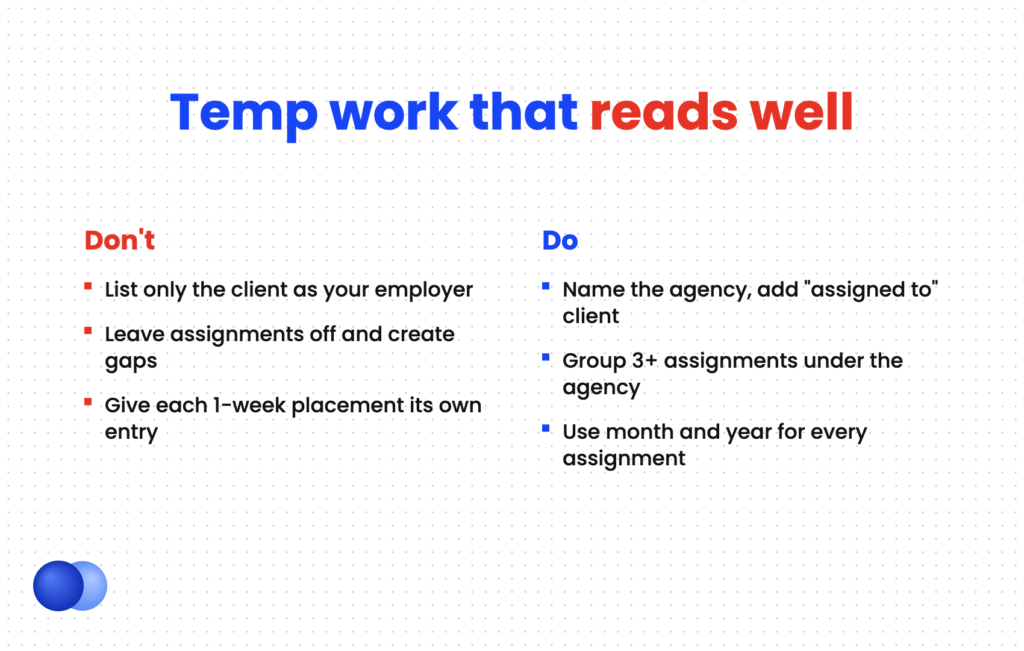
Name the staffing agency as the employer so verification matches do: Add the client company with "assigned to" or "Client:" do: Group three or more assignments under one agency heading do: Use month and year for every assignment date
List only the client and imply you were its direct hire dont: Leave assignments off and create a gap in your timeline dont: Give every one-week placement its own full entry dont: Fill bullets with duties the recruiter can already guess
How much detail should older temp assignments get?
Give recent, relevant temp agency work full detail with client sub-entries and bullets. Compress older or unrelated assignments into one grouped line with dates. Most resumes cover the last 10 to 15 years, so assignments older than that can usually go, unless they prove a skill the job requires.
Relevance decides the space. A temp placement at a hospital deserves real bullets if you are applying for a medical office role. A seasonal retail placement from years ago may only need the agency name and dates.
Use the same cutoff you would use for any job. Our guide on how far back a resume should go explains the 10-to-15-year norm and its exceptions.
If you worked assignments at the same time as another job, the dates will overlap. That is fine; see how to list overlapping jobs on a resume for the layout.
Match the title to the job you want
Agency paperwork often uses generic titles like "General Laborer" or "Clerical Associate." You can use a clearer title that honestly describes the work you did, such as "Accounts Payable Clerk," as long as the agency and dates stay accurate. Then check that the title and bullets carry keywords from the job posting.
How do applicant tracking systems read agency entries?
Applicant tracking systems read a temp entry like any other job if the company name, title and dates sit in standard positions. Keep the agency name on the company line, use plain month-year dates, and avoid tables or columns. Put client names in text, not in headers or graphics.
ATS parsers look for a predictable pattern: title, employer, location, dates. The grouped format works fine as long as each client sub-entry has its own dates in plain text.
Two small choices help. Write "Temporary" or "Contract" in parentheses after the title instead of replacing the title. And use the job posting's own wording for the skills you used on assignment; mirror the exact phrases the posting uses.
If you want to test the layout, build it in the Rezoom AI resume builder, which formats grouped employers and sub-entries in an ATS-readable structure.

Frequently asked questions
Do I put the temp agency or the company on my resume?
Put both. List the staffing agency as the employer and the client company on the same entry. The agency usually handles employment verification, so leaving it off can cause a background check mismatch.
Should I write "temp" in the job title?
Yes, add "(Temporary)" or "(Contract)" after the title. It is honest, it explains short dates at a glance, and it keeps your real title intact for keyword matching.
What if I only worked a temp job for a few weeks?
Include it inside a grouped agency entry if it covers a gap or shows relevant skills. On its own, a few weeks rarely needs a full entry with bullets.
Can I list temp agency work as one job?
Yes. If you worked several assignments for the same agency, list it as one job with the agency's total dates. Then add clients as dated sub-entries or a one-line summary.
How do I list a temp job that became permanent?
List the client as the employer for the permanent period and show the earlier agency period as a stacked title marked "via" the agency. A bullet such as "Converted to permanent staff after 4 months" makes the win explicit.
Should I list temp work if it is unrelated to the job I want?
Usually yes, in compressed form. One grouped line with dates and one transferable-skill bullet keeps your timeline continuous without taking space from relevant roles.



Comments