

Summary
In most cases, leave a job you quit after a month off your resume. One month rarely produces results worth listing, and a resume is a selective document. Include it only if it was short by design, directly relevant, fills a gap of several months, or is your only recent work. If a job application asks for your complete work history, list it there truthfully and keep a short, neutral explanation ready.
Should I put a job I quit after a month on my resume? Usually not. A job you quit after a month rarely adds skills or results, and a resume only needs the experience that proves you fit the role.
There are exceptions, though. Contract work, a directly relevant role, or a job that covers a long gap can earn a place. And a job application form is a different document with different rules.
This guide gives you a decision table, copy-ready entries for the cases where you keep it, and a short script for when someone asks.
Should I put a job I quit after a month on my resume?
Usually no. Leave off a job you quit after a month when it is unrelated, produced no real results, and removing it leaves no noticeable gap. Keep it when the role was short by design, directly relevant to your target job, fills a gap of several months, or is your only recent experience.
Your resume is a marketing document. Boston University's resume guide advises candidates to "include only the positions and experience that will prove your qualifications" and to omit positions unrelated to the application. One month in a role that did not fit rarely proves much.
Leaving the job off also avoids an awkward first impression. A one-month entry makes a recruiter wonder what went wrong before they read your stronger roles.
Quitting early is also common. The Bureau of Labor Statistics counted 3.1 million quits in July 2026. You are not the first person to realize quickly that a job was the wrong fit.
When does a one-month job belong on your resume?
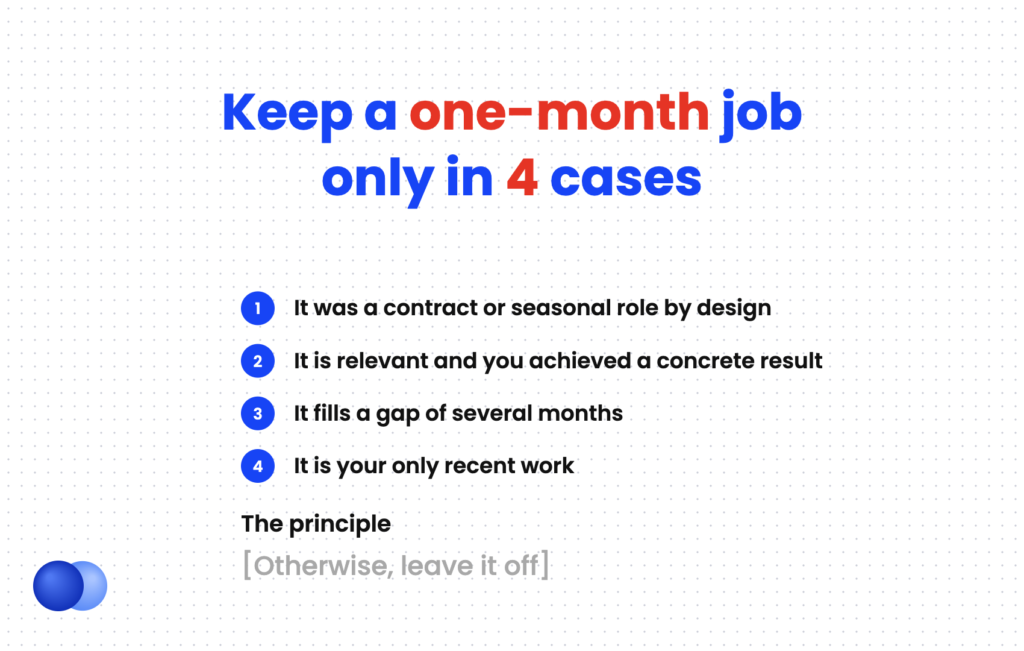
Keep the job when at least one of four conditions applies. It was temporary by design, such as a contract or seasonal role. It is directly relevant and you achieved something concrete. It fills an employment gap of several months. Or it is your only recent work, and leaving it off would suggest you have been idle.
Use this table to decide. Find the row closest to your situation.
| Your situation | List it? | How |
|---|---|---|
| Unrelated job, you already have a new one | No | Leave it off entirely |
| Unrelated job, no gap either way | No | Leave it off; mention only if asked |
| Contract, temp, or seasonal role that ended | Yes | Label it "(Contract)" or "(Seasonal)" |
| Relevant role with a concrete result | Yes | One or two result-focused bullets |
| Only work in the last 6+ months | Yes | Short entry to show recent activity |
| Third or fourth short stint in two years | Case by case | Keep the most relevant; group temp work |
Temporary work is the clearest case. Short by design is not the same as short by choice. Our guides on how to list contract work on a resume and how to list temp agency work on a resume show how to label it.
If you were let go rather than quitting, the rules shift a little. See our companion guide on whether to put a job you were fired from on your resume.
Does one short job make you look like a job hopper?
One short job rarely does. Recruiters look for patterns, not single data points. The concern starts when several short stints appear close together. Median tenure for workers ages 20 to 24 was 1.5 years in January 2026, so early-career moves are normal. What matters is that your longer roles show stability.
Recruiters read a timeline as a whole. One brief job between two solid ones looks like a bad fit that you corrected quickly.
Context helps. BLS reports that median tenure with a current employer was 4.1 years in January 2026. For workers ages 20 to 24, it was 1.5 years, and 3.0 years for ages 25 to 34. Shorter tenures are expected early in a career.
A pattern is different. If you quit after a month more than once in a short period, trim to the roles that best support your application. Our sibling guide on how many jobs to list on a resume helps you decide what to cut.
How do you list a short job if you keep it?
Format it like every other job, with the same date style, and keep it brief. Add a label such as "(Contract)" when the role was temporary by design. Use one or two bullets focused on a concrete task or result. Never stretch the dates to make the tenure look longer.
A kept short job should look deliberate, not apologetic. Keep it to one or two lines.
Junior Data Analyst | Northwind Logistics, Chicago, IL | Feb 2026 – Mar 2026
- Built a weekly Power BI dashboard tracking on-time delivery for 12 regional depots
Event Operations Assistant (Seasonal Contract) | Lakeshore Events, Milwaukee, WI | Nov 2025 – Dec 2025
- Coordinated check-in for 3 holiday events with 1,500+ attendees each
Match the date format you use elsewhere. If every other job shows month and year, this one should too. Showing years only for a single job looks like you are hiding the length.
If you started a new job right away, the dates may overlap or sit side by side. Our guide on listing overlapping jobs on a resume covers that layout.
Check your LinkedIn and your application match
Recruiters often compare your resume with your LinkedIn profile. You can leave a one-month job off both. But if it appears on one, make the dates match on the other. Inconsistent dates raise more questions than the short job itself.
What if a job application asks for your full work history?
A resume can be selective, but a job application form that asks for all employers or a complete history needs a complete answer. List the job there, with a short, neutral reason for leaving. Background checks can verify employment history, and a signed application with gaps in the truth can cost you the offer.
Many online applications ask you to list every employer in a set period and then certify that the information is accurate. That is where omission becomes a problem.
The Federal Trade Commission notes that employers must get your written permission before running a background check, and those checks can cover employment history. Assume a short job can surface.
Federal applications are stricter still. The OPM's Declaration for Federal Employment asks whether, in the last 5 years, you were fired, quit after being told you would be fired, or left by mutual agreement because of specific problems. A plain resignation does not fall under that question. If yours involved any of those situations, answer yes.
For the "reason for leaving" box, keep it short and factual:
- "Role was not as described; left to pursue a better fit."
- "Accepted a position closer to my field."
- "Resigned during onboarding; happy to discuss."
Our guide to reasons for leaving a job has more options by situation.
How do you explain it if an interviewer asks?
Give a two-sentence answer: why the role was not the right fit, then what you are looking for now and why this job matches it. Stay neutral about the former employer. Avoid complaints and long stories. The goal is to show good judgment in leaving quickly, not regret for taking the job.
If the job is on your application, an interviewer may ask about it. Even if it is not, a gap question can lead there.
A strong answer sounds like this:
"The role turned out to be mostly cold outreach, while the posting described account management. I left within a month to find a role that matched, and this position is exactly that."
Keep it factual. If you left for health, family, or safety reasons, you can say "personal circumstances that are now resolved" without further detail. Our guide on how to explain an employment gap covers similar wording.
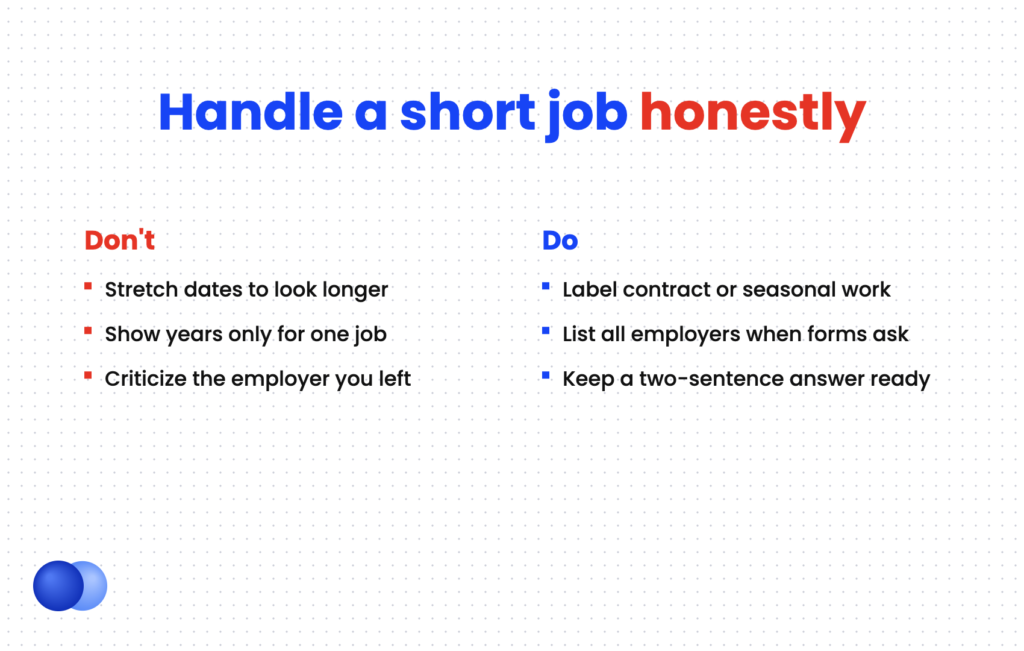
Leave off an unrelated job you quit after a month do: Label short contract or seasonal work clearly do: List every employer when an application asks for all of them do: Keep a two-sentence explanation ready
Stretch dates to make a short job look longer dont: Show years only for one job to hide its length dont: Criticize the employer you left dont: Let your resume, LinkedIn, and application disagree
How do you keep your resume strong after leaving early?
Put the focus on your longer, relevant roles. Tighten the bullets for your best job, lead with a summary that states your target role, and tailor keywords to each posting. A strong experience section makes a missing month irrelevant, because the recruiter's attention stays on what you have achieved.
Your stronger roles do the persuading. A short, confident summary at the top frames your target role before the reader reaches your timeline.
Spend your effort there. Rewrite your top two jobs with results, not duties. Match the skills in each posting. Rezoom's AI resume builder can help you tailor bullets and summaries for each application.

Frequently asked questions
Is it bad to leave a job after one month?
Not on its own. One short job is common and easy to explain. It becomes a concern only when several short stints appear close together.
Do I have to list a job I quit after a month on my resume?
No. A resume is selective, so you can leave it off. List it on a job application if the form asks for all employers.
Will a background check show a job I left off my resume?
It can. Background checks may include employment history, so be ready to explain the job and list it on any form that asks for complete history.
Should I put a two-week job on my resume?
Almost never. A job of a week or two adds no skills. Leave it off unless the application asks for every employer.
How do I explain a one-month job in an interview?
State briefly why the role was not the right fit, then explain why this job matches what you want. Stay neutral about the former employer.
Should I include a short job to avoid a gap?
Only if the gap would be several months. A one- or two-month gap is rarely noticed, especially if you show month and year consistently.



Comments