Is It Bad to Quit a Job After 3 Months? How to Decide and Explain It
Is it bad to quit a job after 3 months? See when it's fine, when it costs you, what to put on your resume, what to say in interviews and which money to check.

On this pageIs it bad to quit a job after 3 months?
- Is it bad to quit a job after 3 months?
- When is leaving at 3 months fine, and when is it costly?
- Should you list a 3-month job on your resume?
- What should you say in your next interview?
- How much notice should you give at 3 months?
- What money should you check before you quit a job after 3 months?
- How do you restart your job search after a short stint?
- FAQ
- Sources
One short job rarely hurts you. It hurts when you quit a job after 3 months with no plan, a pattern of short stays or money you must pay back. Leaving is usually fine for a misrepresented role, a clearly better offer, an unsafe workplace or a move. Check bonus repayment, PTO and benefits first, give two weeks if you can, and explain the exit in one calm sentence.
It is not bad to quit a job after 3 months if you have a clear reason and a plan. One short stay rarely ends a career. But a string of short stays, a messy exit or a bonus you must repay can cost you.
This guide gives you a decision table, resume rules, interview lines and the money items most guides skip.
Quick answers by situation
| Your situation | What to do | Example line |
|---|---|---|
| The job is not what they described | Leave, keep it short and factual | "The role turned out to be 80% cold calls, not account work." |
| You got a clearly better offer | Take it, give two weeks if you can | "I got an offer that fits my long-term goal in B2B sales." |
| The workplace is unsafe or abusive | Leave now, document what happened | "The environment was not safe, so I left." |
| You feel burned out but the job is fair | Fix hours or workload first | "Can we adjust my schedule for the next month?" |
| You have to move | Ask about remote work, then resign | "My family is relocating to Denver in March." |
Is it bad to quit a job after 3 months?
Usually not, if it happens once and you have a good reason. In January 2026, 20.6% of US wage and salary workers had been with their employer 12 months or less, so short tenure is common. Hiring managers worry about patterns, not one early exit. The risk grows when you leave with no reason, no notice or no next step.
Short stays are more common than they feel. The Bureau of Labor Statistics found that median tenure with a current employer was 4.1 years in January 20261. For workers aged 25 to 34, the median was just 3.0 years.
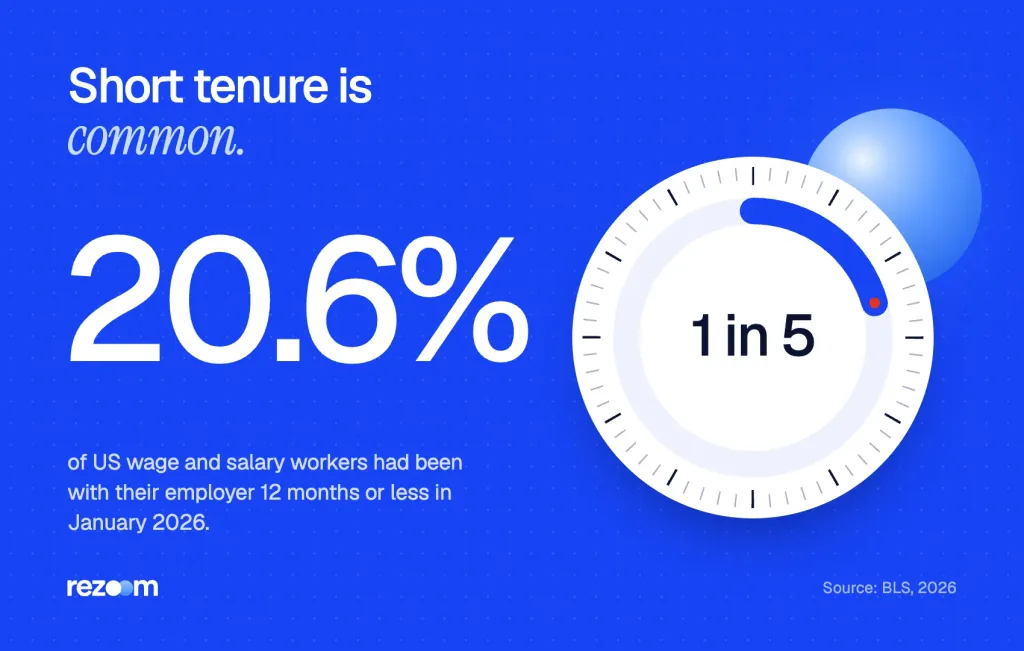
The same survey found that 20.6% of workers had 12 months or less with their employer, about one in five. People also quit all the time: the BLS counted 3.1 million quits in August 20262, a quits rate of 1.9%.
What employers actually worry about
A recruiter who sees a 3-month job asks one thing: will this person leave us too? If your other jobs lasted a year or more, one short stay looks like a bad match. But three short stays in a row look like a pattern.
Our guide to job hopping on a resume shows where that line usually sits and how to frame several short roles.
Before you decide, list your last four jobs and how long each one lasted. If this would be your first stay under a year, the risk is low. If it would be your third, try to fix the job first or line up a role you can stay in.
When is leaving at 3 months fine, and when is it costly?
Leaving at 3 months is usually fine when the role differs from the offer, the workplace is unsafe, you got a clearly better offer, or you must relocate. It costs more when the cause is burnout you could fix, a vague feeling of boredom, or a sign-on bonus you would have to repay.
The reason matters more than the date.
| Reason | Usually fine? | Main cost | Do this first |
|---|---|---|---|
| Bad fit or misrepresented role | Yes | A short gap if you leave without an offer | Compare duties to the job post in writing |
| Better offer | Yes, if it is clearly better | Bridges with your new manager | Get the offer in writing before you resign |
| Toxic or unsafe workplace | Yes, leave now | Lost income if you have no next job | Keep notes, emails and dates |
| Burnout | Depends | You may carry it into the next job | Ask for a schedule or workload change |
| Relocation | Yes | Moving costs and a job search | Ask about remote work or a transfer |
Three questions before you decide
- Can you fix it? Talk to your manager about duties, hours or training first. If nothing changes in two to four weeks, you tried.
- Is this the job or the job type? If you would hate the same role anywhere, plan a career change, not just a new employer.
- What will it cost? Check the money items below before you hand in notice.
If you feel unsafe, skip the wait. "The environment was not safe" is a complete interview answer.
Should you list a 3-month job on your resume?
List it if it fills a gap, if you would leave a gap of more than a few months, or if the employer runs a background check that may show it. Leave it off if you quickly moved to another job and the short role adds nothing. Never lie on an application that asks for every employer.
A resume is a marketing document, not a full work history, so you can often skip a short job. But application forms may ask for every employer, and there you must be accurate.
List it or leave it off, by situation
- Leave it off: You left after 3 months and started a new job right away. The short role adds no skills the reader needs.
- List it: Leaving it off would create a gap of four months or more. A dated entry reads better than a blank.
- List it: The job built a skill the next role wants, such as a CRM tool or a sales quota you hit.
- Always disclose: The application form asks for "all employers," or a background check covers that period.
We cover the edge cases in our guide on whether to put a job you quit after a month on your resume. The same logic applies at three months.
Should you put a job you quit after a month on your resume? Usually not. See the 4 exceptions, how to list it if you keep it, and what to say on applications.
How to show a short job well
Keep the entry short: title, company, months and one or two results. Our sales resume examples show how to put one number in every bullet, even for a short role.
SALES ASSOCIATE, Brightline Outdoor, Austin, TX | Jun 2026 to Sep 2026
Hit 112% of monthly sales goal in my second and third month
Opened 41 store credit accounts, top 3 of 14 associates
If your short stint was on a sales floor, start from our sales associate resume example. It shows how to lead with results so the dates matter less.
Sales associate resume example
A one-page retail sales resume that leads with sales numbers, so a short stay reads as results, not risk.
Do
- Use months and years for every job, not just years.
- Lead each entry with one measurable result.
Don’t
- Stretch the dates to hide a short stay.
- Leave it off if a form asks for every employer.
What should you say in your next interview?
Give one honest, neutral sentence about why you left, then pivot to why the new role fits. Do not blame your old boss. Name a fact, such as a change in duties or a relocation, and show what you learned about the kind of job you want. Keep the whole answer under 30 seconds.
Interviewers ask "Why did you leave after three months?" for two reasons. First, they want to know if the cause will repeat. Second, they want to hear how you talk about a past employer.
Our guide on how to explain quitting without another job covers the gap side of this. For general wording, see our list of reasons for leaving a job.
How to explain quitting without another job in an interview: a 3-part formula, sample answers for burnout, caregiving, relocation and more, and the gap.
Scripts by situation
"The job posting described account management, but the role turned out to be almost all cold calling. I raised it with my manager, and when nothing changed, I left. This role is the account work I want, which is why I applied."
"Three months in, a former manager offered me a role with a clear path into B2B sales. It was the move I had wanted for two years, so I took it. I am looking for a team where I can stay and grow, like this one."
"I left [company] after [number] months because [one neutral fact]. I learned that I do my best work when [what you need]. That is why this role, with [specific detail from the job post], fits."
What to say if they push back
- "Won't you leave us too?" Point to a longer job in your history and say what is different here.
- "Why didn't you stay a year?" Say you tried to fix the issue first, then name one step you took.
- "Did you have problems with your manager?" Stay neutral: "We had different expectations for the role."
Interviewer: "You left your last job after three months. How do I know you won't do that here?"
"Fair question. Before that job, I spent two years at Harbor Home. I left the last one because the duties changed, and I asked about this role's duties in detail before I applied."
Interviewer: "And if the job changes here?"
"Then I would raise it early with my manager, as I did last time. I want a role I can stay in for years."
Free ATS score, the text the software extracts and your missing keywords. No sign-up.
How much notice should you give at 3 months?
Most US jobs are at-will, so you can usually resign at any time, but two weeks is the standard courtesy. Check your offer letter and handbook first, because a contract or a policy may set a different period. If you are still in a probation period, your notice terms may be shorter.
Most US jobs are at-will. Georgia's State Accounting Office explains the employee side of that in its own at-will policy.
It also means an employee is free to resign at any time for no reason or for any reason.
Georgia State Accounting Office, At-Will Employment
The same policy calls notice preferable but not required, and it names two weeks as the professional standard. But that is one employer's policy, so read your own offer letter and handbook. This is general information, not legal advice.
Probation periods and contracts
Some employers set a probation or introductory period for new hires, and the handbook may allow shorter notice during it. If you signed a contract with a notice clause, follow it.
Our guide to the notice period explains the common setups.
How to resign cleanly
For the written part, our 2 week notice letter guide has short templates you can copy.
- Get the new offer in writingWait for a signed offer and a start date before you say anything at work.
- Tell your manager firstAsk for 15 minutes and tell them in person or on video. Thank them and keep the reason short.
- Send a short letterConfirm your last day in writing the same day, and keep it to a few lines.
- Hand over your workList open tasks, clients and logins so your team is not left guessing.
Before you hand in notice
What money should you check before you quit a job after 3 months?
Check five items: any sign-on bonus clawback, relocation repayment, PTO payout rules, the date your health coverage ends, and your 401(k) vesting. At 3 months, you may owe money back and lose any unvested employer match. Ask HR for these terms in writing before you resign.
An early exit often hurts most in money. Read your offer letter and plan documents, then use this table.
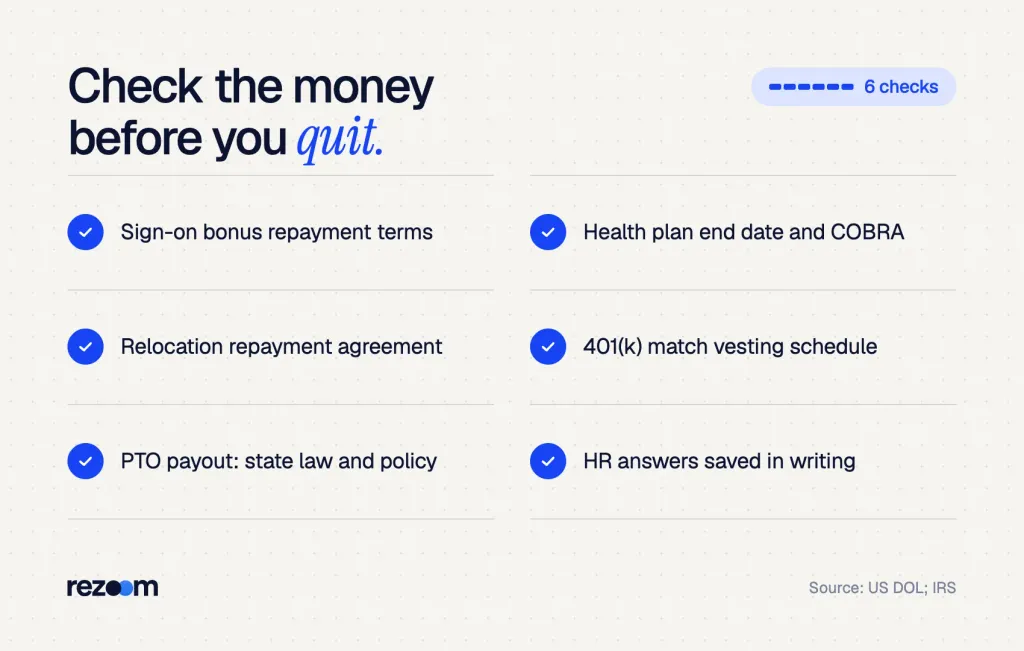
| Item | What to check | Why it matters at 3 months |
|---|---|---|
| Sign-on bonus | Repayment terms in the offer letter | Many offers ask you to pay it back if you leave within a set period |
| Relocation money | Repayment agreement you signed | Moving help often comes with a stay-or-repay term |
| Unused PTO | State law and company policy | Federal law does not require payout |
| Health coverage | The exact end date of your plan | You may face a gap before the next plan starts |
| 401(k) match | The plan's vesting schedule | Unvested match can stay with the employer |
PTO and health benefits
The US Department of Labor says the Fair Labor Standards Act does not require pay for time not worked4, such as vacation. So a payout depends on your state's rules and your employer's policy. Ask HR before your last day.
If your employer has 20 or more employees, COBRA5 generally lets you keep the group health plan after a voluntary job loss. But you may pay up to 102% of the plan's cost. So line up your new plan's start date before you pick a last day.
401(k) vesting
The IRS lets employers use a 3-year cliff or a 6-year graded schedule6 for matching money. Under a cliff, you own 0% of the match until three years of service. Some plans vest right away, so check your plan summary before you pick a date.
Before you resign, email HR and ask about your bonus terms, PTO payout, benefit end date and vesting. A written answer protects you if the numbers change later. Ask in neutral words, such as "I am reviewing my benefits."
How do you restart your job search after a short stint?
Decide whether the short job stays on your resume, update the resume, and write a cover letter that explains your next move in one line. Then apply to roles that fix the problem you left. A clear story matters more than the three months.
Screen every new role for the problem you left. If the duties changed, ask about daily tasks in each interview.
Your cover letter can also handle the short stay before anyone asks. Our sales cover letter examples show how to open with your results and name your next step in one sentence.
Sales associate cover letter example
A short retail sales letter that opens with a sales result and states the career move in one line.
When your story is clear, rebuild the resume around it. Our AI resume builder drafts results-first bullets from your job history, so a short role reads as proof, not a warning. Then edit each line to match what you really did.
Free plan, no card.
Frequently asked questions
Is 3 months too short to quit a job?
Not if you have a clear reason, such as a misrepresented role, an unsafe workplace or a better offer. One short stay is common, but several in a row can worry employers.
Do I have to put a 3-month job on my resume?
No, a resume does not have to list every job. But list it if leaving it off creates a long gap, and always include it on an application that asks for every employer.
Should I give two weeks' notice after 3 months?
Yes, if you can. Most US jobs are at-will, but two weeks is the common courtesy, and your contract or handbook may set different terms.
Will I have to pay back my sign-on bonus?
It depends on your offer letter. Many sign-on and relocation agreements ask you to repay the money if you leave within a set period, so read the terms before you resign.
Will quitting after 3 months hurt my references?
It can, if you leave with no notice or on bad terms. A calm talk with your manager and a full handover usually keep the reference neutral or better.
How do I explain a 3-month job in an interview?
Give one neutral fact about why you left, then say why the new role fits. Keep it under 30 seconds and do not blame your old employer.
Sources
We opened and read each page below. The small numbers in the text point here. Pages that carry no publication date show n.d.
- US Bureau of Labor Statistics2026
Median tenure with the current employer was 4.1 years in January 2026, and 20.6% of workers had 12 months or less
- US Bureau of Labor Statistics2026
Workers quit 3.1 million jobs in August 2026, a quits rate of 1.9%
- Georgia State Accounting Officen.d.
An at-will employee is free to resign at any time, and two weeks' notice is the accepted professional standard
- US Department of Laborn.d.
The Fair Labor Standards Act does not require employers to pay for time not worked, such as vacation
- US Department of Laborn.d.
COBRA generally covers employers with 20 or more employees and may cost up to 102% of the plan's cost
- Internal Revenue Servicen.d.
Employer matching contributions may vest on a 3-year cliff or a 6-year graded schedule
Mohammad has spent more than ten years designing consumer products and leads product at Rezoom, deciding what gets built and what gets left out. His guides cover the whole job search, from resume sections and cover letters to interview answers and career moves.
Goodi, M. (2026, November 3). Is It Bad to Quit a Job After 3 Months? How to Decide and Explain It. Rezoom. https://rezoom.io/is-it-bad-to-quit-a-job-after-3-months/