

Summary
Job hopping usually means several jobs of under a year in a short span. It is common: BLS puts median tenure for workers aged 25 to 34 at 3.0 years, and a fifth of workers have been in their job a year or less. Still, 37% of hiring managers in a LinkedIn survey called it a red flag. Fix it with structure: group contract and agency work, stack promotions, add a short reason line and lead with results.
Job hopping on a resume is not an automatic rejection, but it is a question every recruiter will ask. Your job is to answer it on the page before they ask it out loud.
The good news: short tenures are normal for early-career workers, and the fix is mostly formatting. Group work that belongs together, label contracts as contracts, and give each short stint one honest reason.
Below you will find what counts as job hopping, how your tenure compares with BLS data, what recruiters actually think, and copy-ready resume lines for each fix.
What counts as job hopping on a resume?
Job hopping on a resume usually means a pattern of jobs that each lasted under a year, often three or more in the last five years. One short job is not a pattern. Contract, seasonal, temp and internship roles that were designed to end are not job hopping if you label them clearly.
There is no official cutoff. Recruiters judge a pattern, not a single date range. A useful rule of thumb is to count the permanent roles you left in under 12 months during the last five years.
- One short stint: normal. Many people have one bad fit.
- Two: a light pattern. Add reason lines and lead with results.
- Three or more: a clear pattern. Use every formatting fix in this guide and address it in your summary.
Also count only roles that were meant to last. A six-month contract that ended on schedule shows you finished the work. A permanent job you left after five months raises the question.
How long do people actually stay in one job?
Less time than most people think. BLS data for January 2026 puts median tenure at 4.1 years for all wage and salary workers, 3.0 years for ages 25 to 34 and 1.5 years for ages 20 to 24. About 20.6% of workers had been with their employer for 12 months or less.
Compare your history with your age group, not with an abstract ideal of five years per job. The BLS employee tenure release for January 2026 shows how steeply tenure rises with age.
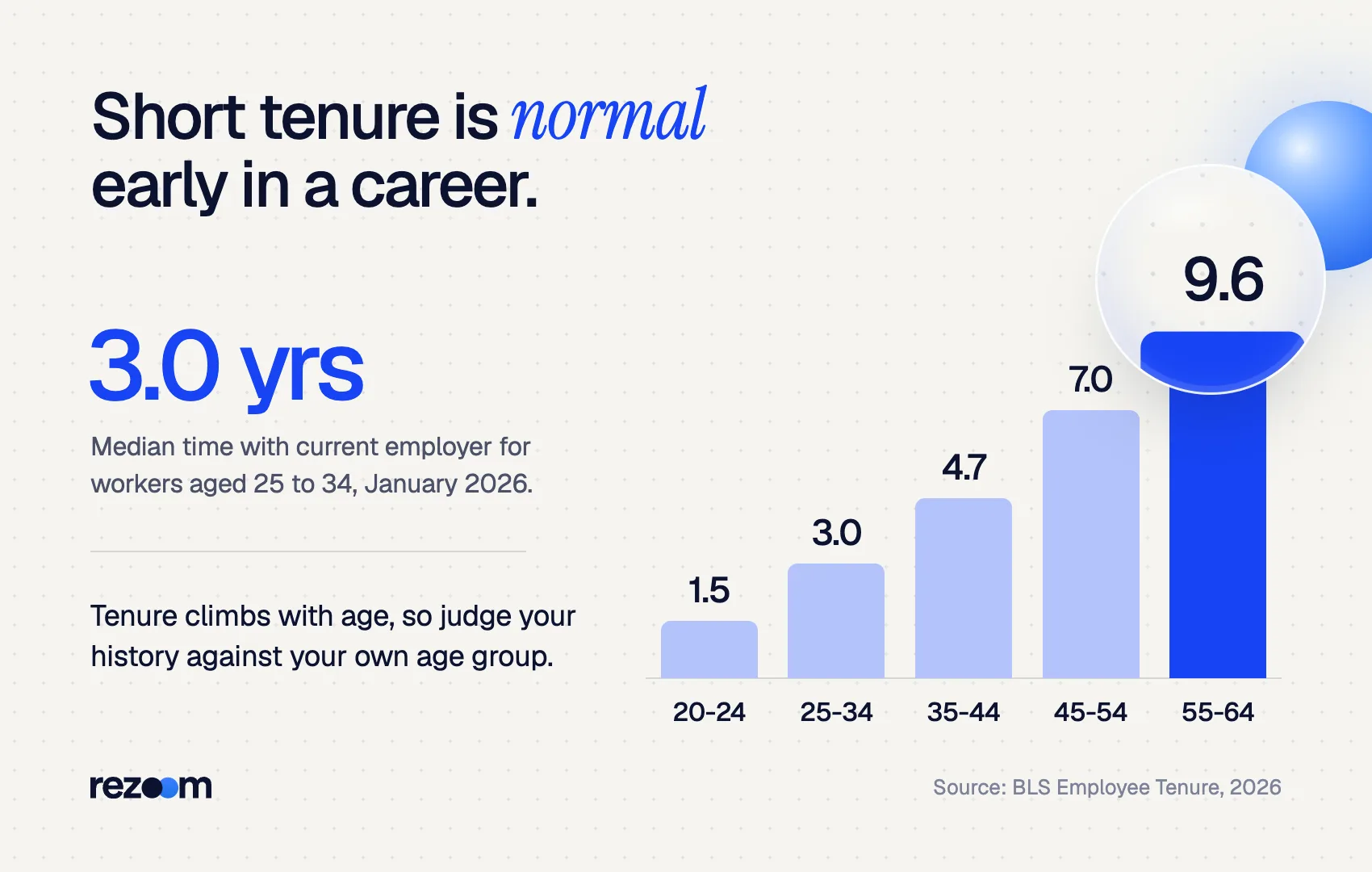
| Age group | Median years with current employer (Jan 2026) |
|---|---|
| 20 to 24 | 1.5 |
| 25 to 34 | 3.0 |
| 35 to 44 | 4.7 |
| 45 to 54 | 7.0 |
| 55 to 64 | 9.6 |
Source: BLS Table 1, employee tenure.
So a 27-year-old with two-year stints sits close to the norm. A 45-year-old with the same pattern stands out more, because the median for that age group is 7.0 years.
Sector matters too. Median tenure was 3.9 years in the private sector and 5.6 years in the public sector. Early-career moves are also normal over a lifetime: the BLS longitudinal survey found people born from 1957 to 1964 held an average of 12.9 jobs from ages 18 to 58, including 5.6 jobs between ages 18 and 24.
Do recruiters still see job hopping as a red flag?
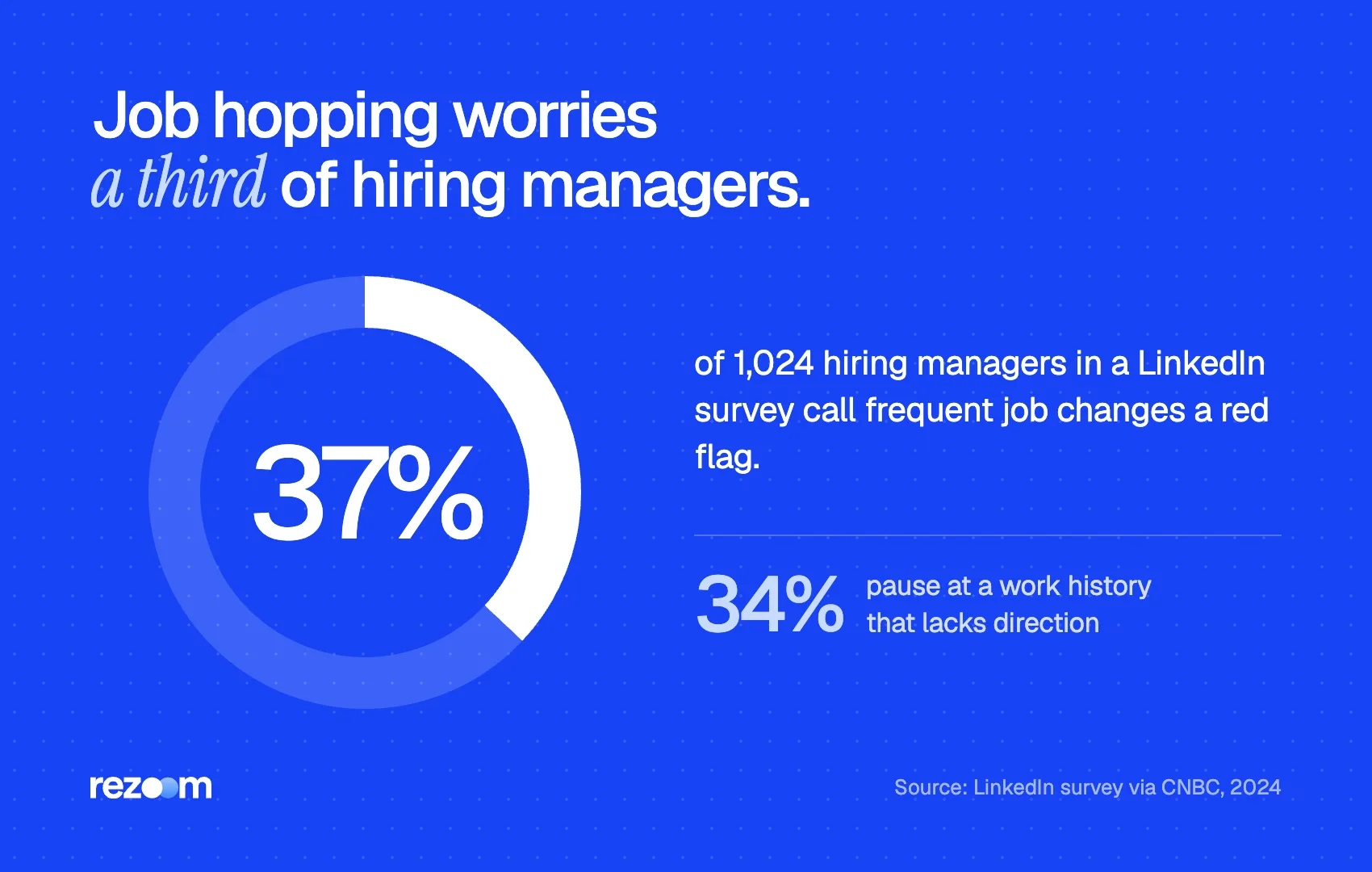
Some do, most will listen. In a LinkedIn survey of 1,024 hiring managers, 37% said frequent job changes are a red flag. A 2025 HR survey found 85.2% see them as a red flag at some level, yet over half would not disqualify an otherwise relevant candidate. Context changes the outcome.
The numbers depend on how the question is asked. A LinkedIn survey reported by CNBC found 37% of hiring managers call job hopping a red flag, and 34% pause at a work history that lacks direction. That second figure is the real lesson: an unclear story hurts more than the number of employers.
A 2025 survey of HR professionals found 85.2% consider frequent job changes a red flag, but only 34.7% see it as a major concern. Over half said they would not automatically disqualify a relevant candidate.
Abroad, the pattern is similar. In a Hays survey of 8,247 UK respondents, 42% of employers said they were less likely to hire a job hopper. The same release notes employers frown on it most "when there's no explanation." So give one.
How do you format job hopping on a resume?
Use structure, not concealment. Group contract, agency and freelance work under one heading. Stack promotions or internal moves under one employer. Add a short reason line under any permanent role you left in under a year. Keep month-and-year dates and put your strongest results first in each entry.
Five fixes cover most cases.
1. Group contract and agency work. If a staffing agency placed you at three clients, list the agency as the employer and the clients underneath. Our guides on contract work and temp agency work show the full layouts.
Contract Software Engineer | Self-employed | Mar 2023 – Aug 2025
Clients: Brightline Health (6-month build), Northpoint Logistics (9-month build), Carver & Hale (4-month audit)
- Shipped 3 client platforms on fixed timelines; all contracts completed or extended
- Cut Northpoint's order-sync errors 41% with a rebuilt API layer
2. Stack internal moves. Three titles at one company is growth, not hopping. Put the employer once and list each title with its dates underneath.
3. Add a short reason line. One italic line, under ten words, answers the question before the recruiter asks it. Use it only for reasons outside your control or clearly positive ones, such as a layoff, an acquisition, a relocation or a recruited move.
Marketing Coordinator | Halcyon Apps | Feb 2024 – Oct 2024 Role eliminated after company acquisition.
Customer Success Lead | Riverstone SaaS | Nov 2024 – Jun 2025 Recruited by former manager to launch onboarding team.
For more wording, see our list of reasons for leaving a job.
4. Keep dates honest and consistent. Some guides suggest years only to blur short stays. Recruiters know that trick, and "2024 – 2025" can hide anything from one month to two years. Use month and year everywhere, and let the reason lines do the work.
5. Lead with results. Put a measurable win in the first bullet of every short role. A five-month job that ends with "cut onboarding time 30%" reads as impact, not flight.
Label contract, seasonal and temp roles in the job title line. do: Group agency placements under the agency name. do: Add one neutral reason line for permanent roles under a year. do: Use your summary to connect the moves into one direction.
Switch to years-only dates for just the short jobs. dont: Blame former managers or coworkers in reason lines. dont: Stretch dates to make a stint look longer. dont: Bury your work history in a skills-only layout.
Should you use a functional or hybrid resume to hide job hopping?
Avoid a pure functional resume. It removes dates and employers, which many recruiters read as hiding something, and some applicant tracking systems parse it poorly. A hybrid resume works better: a strong skills summary on top, then a normal reverse-chronological work history with the fixes above.
A functional resume groups skills by theme and pushes jobs to a short list at the bottom, or drops dates. That layout was built to hide gaps and short stints, and recruiters know it. It often creates the very question you want to avoid.
A hybrid layout gives you the benefits without the suspicion. Open with a three-line summary that names your direction, add a short core skills block, then show your full history in order. The summary is where you connect the dots. LinkedIn career expert Drew McCaskill, quoted in the CNBC report, advises candidates to frame each move as "an asset" and "don't make apologies for it."
Write the summary as a through-line
Name the thread that links your jobs, then prove it. For example: "Customer success manager who has launched onboarding programs at three high-growth SaaS companies, cutting time-to-value by 25% or more each time." Three employers now read as one repeated skill.
Which short jobs can you leave off?
You can leave off a short job that is not relevant to the target role, especially if it lasted under three months and creates no visible gap. Your resume is a marketing document, not a full work history. Keep every job on formal applications that ask for complete employment history.
Leaving off a two-month mismatch is fine if the surrounding dates still flow. If removing it opens a gap, decide which is easier to explain. Our guides on quitting a job after a month and how to explain an employment gap cover both paths.
Background checks and government or security applications usually ask for every employer. Answer those fully, even if your resume is shorter. A master resume that keeps every role, date and result makes those forms easier, and you trim it into a targeted resume for each application.
How do you explain job hopping in an interview?
Prepare a 20-second answer that names the pattern, gives a brief honest reason and pivots to why this role is a long-term fit. Focus on what each move taught you. Never criticize past employers, and show evidence of commitment, such as a contract completed or a promotion earned.
Use a three-part answer: context, learning, fit.
- Context: "Two of my last three roles ended through an acquisition and a layoff."
- Learning: "Each move added a piece, from campaign execution to analytics to team lead."
- Fit: "This role uses all three, and I am looking for a place to build for several years."
Keep the same story across your resume, LinkedIn profile, cover letter and interview. If your explanation of job hopping on a resume matches what you say in the room, the pattern stops being a concern. Consistency builds trust faster than any single explanation.
Once the structure is in place, Rezoom's AI resume builder can help you write results-first bullets for each short role. Then scan your draft against our list of resume red flags before you send it.

Frequently asked questions
How many jobs is considered job hopping?
There is no official number. Three or more permanent jobs of under a year within about five years usually reads as a pattern. One or two short stints do not.
Is two years at a job considered job hopping?
Not for most workers. BLS puts median tenure for ages 25 to 34 at 3.0 years, so a series of two-year roles is close to normal for early-career workers.
Does job hopping hurt your chances of getting hired?
It can. In a LinkedIn survey, 37% of hiring managers called it a red flag. Clear labels, reason lines and strong results reduce the risk.
Should I put a job I only had for three months on my resume?
Include it if it is relevant or leaving it out creates a gap. Leave it off if it is unrelated and the surrounding dates still connect.
Do contract jobs count as job hopping?
Not when you label them. Mark each role as contract or temporary and group them under one heading, so recruiters see planned end dates.
Is job hopping more accepted in tech?
Short tenures are common in fast-moving fields, but the same rule applies everywhere: show a clear direction and results in every role.



Comments