

Summary
Huntr's Q1 2026 data found job seekers under three months out from a layoff interviewed at 5.74%, slightly above the 4.97% rate for people currently employed. The penalty is not the layoff — it is duration, and it appears around the six-month mark. That changes the task from defending the gap to moving before it lengthens.
Almost every guide to the resume after being laid off assumes you are recovering from a mark against you. The data says otherwise, and the number is worth seeing before anything else.
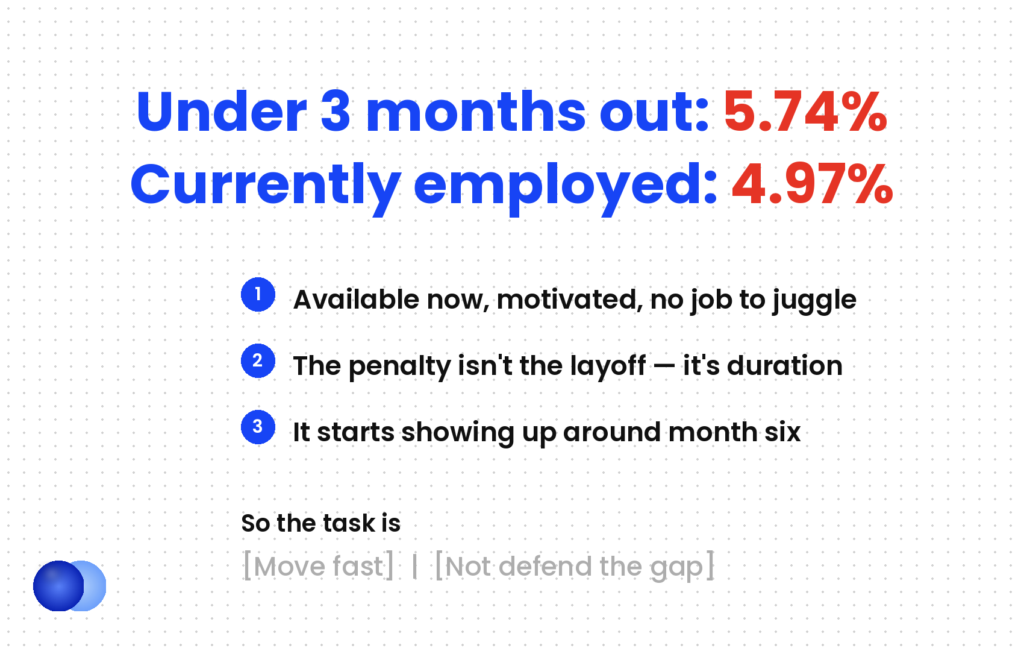
Huntr's Q1 2026 report found job seekers under three months out from a layoff interviewed at 5.74% — slightly higher than the 4.97% rate for candidates who were currently employed.
That is not a rounding error with a comforting story attached. There is a mechanism behind it: you are available now, you are motivated, and you are not juggling a current job. For a hiring team with an open requisition, that is a feature.
Does a layoff hurt your resume?
Not at the point of the layoff. Recent layoff candidates interview at roughly the same rate as employed ones, or slightly better. The penalty is a duration penalty — interview rates hold steady through about six months and then decline as the gap lengthens.
In practice, this distinction changes the entire strategy.
| Time since layoff | What the data shows |
|---|---|
| Under 3 months | 5.74% interview rate — above the employed baseline |
| 3–6 months | Holds roughly steady |
| 6–12 months | Begins to decline |
| 12 months+ | The penalty is real and compounding |
So your job is not to hide a gap or to over-explain one. It is to stop a six-month gap becoming a two-year one. Everything below follows from that.
The context helps too. Around 32% of job seekers with a gap cite a layoff as the cause, which means a recruiter reading your dates assumes a layoff long before they assume a performance problem. And 91% of hiring managers now describe themselves as open to candidates with career breaks.
Should you write "laid off" on your resume?
Notably, both positions have a real argument, and the resolution depends on one variable.
The case for writing it. A recruiter seeing an unexplained end date has to wonder. One neutral line — Senior Product Manager, Acme Corp · Jun 2021 – Oct 2025 (position eliminated in company-wide restructuring) — removes the question and reads as composed.
Against it. The gap is already visible from honest dates. The line costs you space, draws the eye to the thing you least want emphasised, and pre-empts a conversation that goes better in person.
What decides it: whether the layoff was a well-documented public event.
If you were cut in a reduction that made the news at a company anyone recognises, naming it converts an unknown into a known and costs you nothing — "position eliminated in the March 2025 reduction" is a fact a recruiter can verify in one search. If it was a quiet cut at a company nobody has heard of, the line explains nothing and takes up a row.
Default: leave it off the resume. Let the dates be honest and handle the question in the screen, where you can say it in one sentence and move on.
Do not hide it with year-only dates
The temptation to write "2021–2025" next to "2025–2026" and make a four-month gap vanish is strong and the trade is bad. Year-only ranges fail to parse correctly on several major applicant tracking systems, so you may lose your employment dates entirely to hide a gap nobody would have penalised. Use month and year throughout. A visible gap with honest dates reads as transparent; a compressed one reads as concealment the moment anyone checks LinkedIn.
What goes in the gap on your resume?
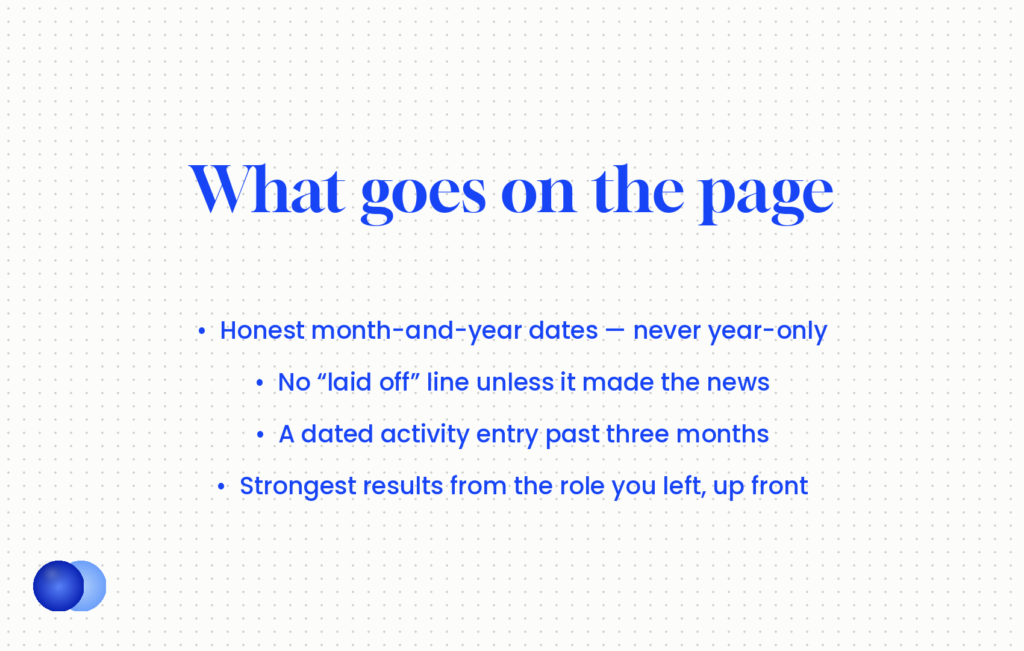
A dated entry with concrete activity, once the gap passes about three months. "Professional Development, Jun 2026 – Present" with a named certificate and a real project beats an unexplained space — and it is the single thing that stops duration becoming the problem.
Under three months, do nothing. A short gap between jobs after a layoff is normal and expected.
Past that, add a line item in your experience section:
` Professional Development & Consulting | Nov 2025 – Present · Completed the Google Data Analytics Professional Certificate · Delivered two freelance reporting projects for a healthtech client · Rebuilt a forecasting model used by a former colleague's team `
Dated, in the work history. Not a footnote. It occupies the period, which is what keeps the timeline continuous.
Three rules for that entry
Specific, not vague. "Kept skills current through independent study" tells a reader nothing. Name the certificate, the client, the project.
Honest about scope. If it was one course and one small project, say that. A modest, real entry reads better than an inflated one that collapses under a follow-up question.
What should the rest of the resume do?
Lead with the strongest results from the role you left. The bullets immediately after your most recent end date carry more weight than usual, because that is where a reader's attention lands when they notice the date.
A resume after being laid off needs two adjustments to the standard construction:
Front-load the last role. Whatever you achieved before the cut should hit hard and immediately. A reader who notices a recent end date reads the bullets under it with more attention, not less — make that work for you.
Keep the format conventional. Reverse chronological or hybrid, single column, standard headings. The instinct to switch to a functional layout to blur the timeline is the same trap covered in resume format types, and it costs you both parsing and credibility.
One thing worth naming: a layoff from a recognisable company carries brand value. The company on your resume is the same company whether you left voluntarily or not, and large-scale reductions at major employers are well-documented public events with no stigma attached.
Defensive: "Senior Analyst, Acme Corp (2021–2025). Unfortunately let go during a difficult restructuring. Responsibilities included reporting, analysis and stakeholder management."
Direct: "Senior Analyst, Acme Corp · Jun 2021 – Oct 2025. Rebuilt the forecasting model three regional teams now plan against, cutting the monthly close from twelve days to five. Owned reporting for a 40-person division through two system migrations."
The second says nothing about the layoff and is far more persuasive about the candidate. The dates carry the information; the bullets carry the argument.
Update LinkedIn in the same week. Recruiters cross-check, and a profile still showing you as employed while your resume shows an end date is a discrepancy that costs more than either document alone.
Use emotional language anywhere. "Unfortunately let go", "devastating restructuring", "through no fault of my own" — each signals that you are still processing it, which is the impression you least want to leave.
How do you explain it in the interview?
One sentence, factual, with the scale if it was public. "My role was eliminated in the March reduction that affected about 400 people" is stronger than "I was laid off", because it makes clear your performance was not the trigger. Then move to what you did next.
Here the structure that works is the same one that works for any gap: context, activity, readiness — in about thirty seconds.
Context. One sentence naming what happened, with the scale if you have it.
Activity. What you did with the time. The certificate, the freelance work, the project.
Readiness. Why you are here now, pointed at this role.
Two things to avoid: over-apologising, which looks worse than the fact itself, and blaming the company, even when the layoff was badly handled. How to explain an employment gap covers the full script and why silence is worse than explanation.
The penalty is real, but it is a duration penalty, not a layoff penalty.
What should you do this week?
Move fast, because the clock is the variable that matters. Update the resume and LinkedIn within days, start a dated activity entry immediately, and apply while the "recently laid off" advantage is still live.
Four things to do with a resume after being laid off, in order of how much they matter:
1. Apply now. The interview-rate advantage sits in the first three months. That window is the most valuable asset you currently have and it is depreciating.
2. Start the activity entry today. Enrol in something, take a small freelance project, offer a former colleague help. It exists from the day you start it, and it is what keeps month seven from looking like month seven.
3. Update LinkedIn. Same week, with the Career Break field if the gap extends. Consistency with the resume matters more than either document.
4. Check the file parses. A resume that does not extract cleanly wastes the window entirely — an AI resume checker against a real posting answers that in two minutes.
Finally, the reframe worth keeping: you are not repairing damage. You are spending a window that is currently open, and the only thing that closes it is time.
Frequently asked questions
Does being laid off hurt your resume?
Not at the point of the layoff. Huntr's Q1 2026 data found candidates under three months out interviewed at 5.74%, slightly above the 4.97% rate for currently employed job seekers.
Should I write "laid off" on my resume?
Usually not. The dates already show the gap, and the explanation goes better in the interview. The exception is a well-documented public reduction at a recognisable company, where naming it converts an unknown into a known.
How long before a layoff gap starts to hurt?
Around six months. Interview rates hold steady through roughly that point and then decline as the gap lengthens, which makes speed the variable that matters most.
What do I put in the gap on my resume?
Once past about three months, a dated entry in your experience section with concrete activity — a named certificate, a freelance project, volunteer work with real scope.
Should I use year-only dates to hide the gap?
No. Year-only ranges fail to parse on several major applicant tracking systems, so you risk losing your employment dates entirely to hide a gap most recruiters would not penalise.
How do I explain a layoff in an interview?
One factual sentence with the scale if it was public, then what you did with the time, then why you are here now. Around thirty seconds total, with no apology and no blame.
Does a layoff from a big company look bad?
The opposite, often. Large-scale reductions at major employers are well-documented public events, and the company name on your resume carries the same weight it always did.
Should I switch to a functional resume to hide the timeline?
No. Functional layouts have the worst parse rates and recruiters associate them with concealment, which is a larger problem than a visible gap.



Comments