How to Respond to a Job Rejection Email: Replies for Every Stage
How to respond to a job rejection email: when to skip a reply, copy-paste scripts for each interview stage, what not to write and what to do next.

On this pageShould you respond to a job rejection email at all?
- Should you respond to a job rejection email at all?
- How do you respond to a job rejection email in 4 steps?
- What should you write in each situation?
- How do you ask for feedback after a job rejection?
- What should you not write in a rejection reply?
- What should you do after you respond to a job rejection email?
- FAQ
- Sources
Reply only when a person sent the rejection or you reached an interview. Send a short note within 24 to 48 hours: thank them, accept the decision, add one specific line and ask to stay in touch. Skip replies to no-reply ATS emails. Ask for feedback in one question, expect silence, and then fix your resume before you reapply.
To respond to a job rejection email, send a short, warm note within 24 to 48 hours. Thank the sender, accept the decision and ask to stay in touch. But skip the reply when an automated no-reply address rejected you before any interview.
This guide gives you a quick rule for when to reply, copy-paste scripts for seven situations and the lines that burn bridges. Then it shows what to fix before you apply again.
Quick answers by situation
| Your situation | What to do | Example line |
|---|---|---|
| Auto-rejection from a no-reply address | Don't reply; fix your resume and move on | (no reply needed) |
| Rejected after a phone screen | Send 2–3 lines of thanks | "Thanks for the call on Tuesday." |
| Rejected after the final round | Thank them, name one moment, keep the door open | "I enjoyed meeting the support team." |
| Internal candidate passed over | Ask your manager for a growth talk | "Could we meet for 20 minutes?" |
| You want feedback | Ask one short, specific question | "Is there one skill I should build?" |
| They picked someone else | Congratulate the team, stay in touch | "I hope the new hire works out well." |
Should you respond to a job rejection email at all?
Reply when a real person sent the rejection or you had at least one interview. A short reply keeps a contact who already knows your work. Don't reply to a no-reply address after an automatic screen-out, because nobody reads it. A reply will not change the decision, so its only job is the next opening.
Many rejections now come straight from the applicant tracking system (ATS). In the 2025 CandE Benchmark Research, 33% of rejected candidates1 got the news from a "do-not-reply" address. So check the sender line before you write a word.
If you want to decode the wording first, read our guide to what an ATS rejection email means. It explains the stock phrases and what each one tells you.
ATS rejection email meaning: an instant reply points to a screening rule, weeks later to a human review. Decode common phrases and know what to do next.
How to tell an auto-rejection from a person
| Signal in the email | Likely sender | Reply? |
|---|---|---|
| "noreply@" or "do-not-reply" address | ATS template | No |
| Arrived minutes or hours after you applied | Screening rule or knockout question | No |
| Signed by a named recruiter with a real address | Person | Optional, 2 lines |
| Came after a phone screen or interview | Person | Yes |
| Mentions your interview or the team by name | Hiring manager or recruiter | Yes, and personalize it |
A rejection that lands within minutes usually comes from a rule, not a reader. Our guide to which ATS sends automatic rejection emails shows how each system times them. If the email arrived that fast, put your energy into the resume instead of a reply.
A reply will not reverse the decision
Career advice columnist Alison Green puts the line at the interview stage. Before that point, you have no relationship to build on.
It doesn’t make sense to do it if you didn’t progress to the interview stage.
Alison Green, Ask a Manager, 2025
But even after an interview, Green says employers are "very unlikely to change their mind." So write your reply for the next role, not this one.
How do you respond to a job rejection email in 4 steps?
Thank the sender for their time, accept the decision in one plain sentence, add one specific detail from your process, and say you would like to hear about future roles. Keep it under 100 words, send it within 24 to 48 hours and reply in the same thread so the recruiter sees the context.
Carnegie Mellon's career center gives a three-part model5: thank them, name the purpose of your note and welcome feedback. We added a timing rule and one personal line, because a generic reply is easy to forget.
- Thank themOpen with thanks for their time and for telling you. Name the role so they know which search you mean.
- Accept the decisionSay you understand in one sentence. Don't argue, explain or ask why they chose someone else.
- Add one specific lineMention one moment, person or project from the process. This is what makes the recruiter remember you.
- Keep the door openAsk them to keep you in mind for future roles, then sign off with your full name.
When to send it
Send the reply within 24 to 48 hours. After that, the recruiter has moved on to the next search and your note reads like an afterthought. If you feel upset, write the draft that day and send it the next morning.
Reply in the same email thread and keep the original subject line. Then the recruiter sees your name, the role and their own message in one place.
Subject: Re: [Job title] at [Company]
Hi [Name], thank you for letting me know about the [Job title] role, and for your time during [the phone screen / the interviews]. I understand the decision. I especially enjoyed [one specific moment, person or project]. If a similar role opens, I would welcome the chance to talk again. Best, [Full name]
Draft the reply the moment the email arrives, while the details are fresh. Then wait a few hours and reread it for tone before you send. A calm, two-line note beats a long one written in the first ten minutes.
What should you write in each situation?
Match the length to how far you got. After an application-stage rejection from a real recruiter, two lines are enough. After a phone screen, add one detail. After a final round, name the people you met. Internal candidates should ask for a growth talk instead of a polite email.
Use these scripts as a base and change the details. Each one is short on purpose, because recruiters skim.
After an application-stage rejection from a real person
If a named recruiter wrote to you before any interview, a reply is optional. Keep it to two lines and don't ask for feedback yet, because they barely saw your file.
Hi Maria, thanks for the quick update on the Customer Service Representative role. I'd like to hear about future openings on your support team. Best, Jordan Lee
After a phone screen
After a screen, you have one conversation to point back to. So mention a detail from it, then close.
Hi Sam, thanks for letting me know, and for the call last Tuesday. I enjoyed hearing how your team handles weekend coverage. If another support role opens, I'd welcome the chance to talk again. Best, Alex Rivera
After the final round
After a final round, you met several people, so name them. Our guide to the final round interview explains why the panel often decides between two close candidates. That makes you a strong "silver medalist" for the next opening.
Hi Dana, thank you for the update on the Office Manager role. I understand the decision. I enjoyed meeting Chris and the operations team, and the vendor-contract project sounded like a great challenge. If anything similar opens in the next few months, I'd be glad to hear from you. Best, Jordan Lee
When they tell you someone else got the job
When the email says they chose another candidate, accept it in one line. Some hires fall through in the first weeks, so a gracious note keeps you first in line.
Hi Priya, thanks for telling me directly. I hope the new hire works out well. If plans change or a second seat opens, I'm still very interested in the team. Best, Sam Carter
When you are an internal candidate
An internal rejection needs a talk, not just an email. You will keep working with these people, so ask for a short meeting about what would make you ready next time.
Hi Kevin, thanks for telling me about the team lead decision, and congratulations to Ana. I still want to grow into a lead role here. Could we meet for 20 minutes this month to talk about the skills I should build first? Thanks, Jordan
How do you ask for feedback after a job rejection?
Ask one short, specific question in your reply, such as which skill would make you a stronger candidate. Make it easy to answer in one line and say you won't argue. Expect no answer: most employers stay silent, often out of legal caution. If they reply, thank them and use it.
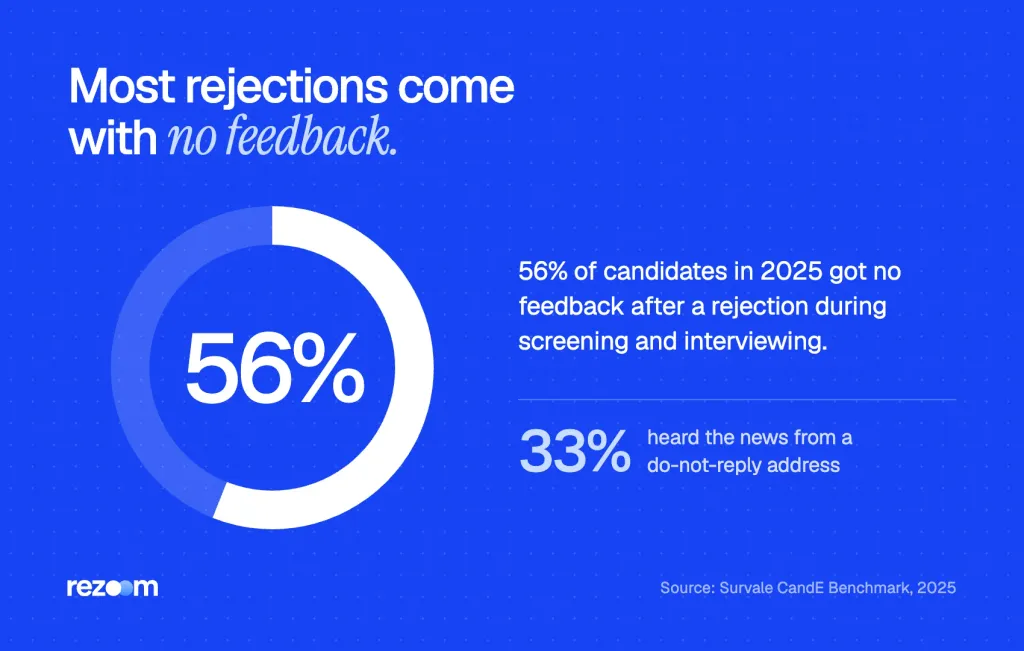
Feedback is rare, so set your hopes low. In the 2025 CandE research1, 56% of candidates got no feedback after a rejection during screening and interviewing. Only 6% got feedback on their test or assessment results.
Many employers hold back on purpose. The Ohio HR group ERC says firms avoid feedback out of fear4 of "legal ramifications," and it advises them to share it only when a candidate asks (2017). So asking politely is the only way to get any.
Hi Dana, thank you again for the update. If you have a moment, is there one skill or example that would have made my application stronger? A one-line answer would help me a lot, and I won't debate it. Best, Jordan Lee
For a longer version with follow-up timing, see how to ask for feedback after an interview.
What to say if they push back
- "We don't share individual feedback." Thank them and ask what the team will look for in the next similar role.
- "We'll keep your resume on file." Ask if you should apply to new postings yourself or wait to hear from them.
- "The role needed more experience." Ask which kind of experience mattered most, then stop there.
Recruiter: "Sorry, our policy is not to share individual feedback."
"I understand. If a similar role opens, which skill will the team look for first?"
Recruiter: "Mostly deeper experience with our CRM and ticket queues."
"That helps. I'll build that up, and I'll reach out when I see the next opening."
Free ATS score, the text the software extracts and your missing keywords. No sign-up.
What should you not write in a rejection reply?
Don't argue with the decision, ask them to reconsider, vent about the process or send a long letter. Don't ask why they chose someone else or ask for the other candidate's details. Also skip replies to no-reply addresses and repeat follow-ups. One gracious note is the whole job.
A bitter reply can follow you, because recruiters talk and many keep notes in the ATS. And the 2025 CandE data shows resentment hit 15% in North America1. Don't let your reply become part of that story.
Do
- Thank them by name and mention the role.
- Keep it under 100 words.
- Ask one feedback question at most.
- Reply in the same thread within 48 hours.
Don’t
- Ask them to reconsider or "give you a chance."
- Explain why their choice was wrong.
- Ask who got the job or why.
- Send a second follow-up if they stay silent.
Phrases to cut
- "I'm shocked by this decision." It reads as a complaint, even if you mean surprise.
- "Can you tell me why I wasn't good enough?" It puts the recruiter on the defensive and invites silence.
- "I think you made a mistake." No one changes a hire after this line.
- "Please let me know if anything changes!!" Desperation shows, and the extra marks look unprofessional.
Some companies send one rejection to many candidates with visible addresses. If you reply, write only to the named recruiter in a new message. A reply-all exposes you, and it exposes the other candidates too.
What should you do after you respond to a job rejection email?
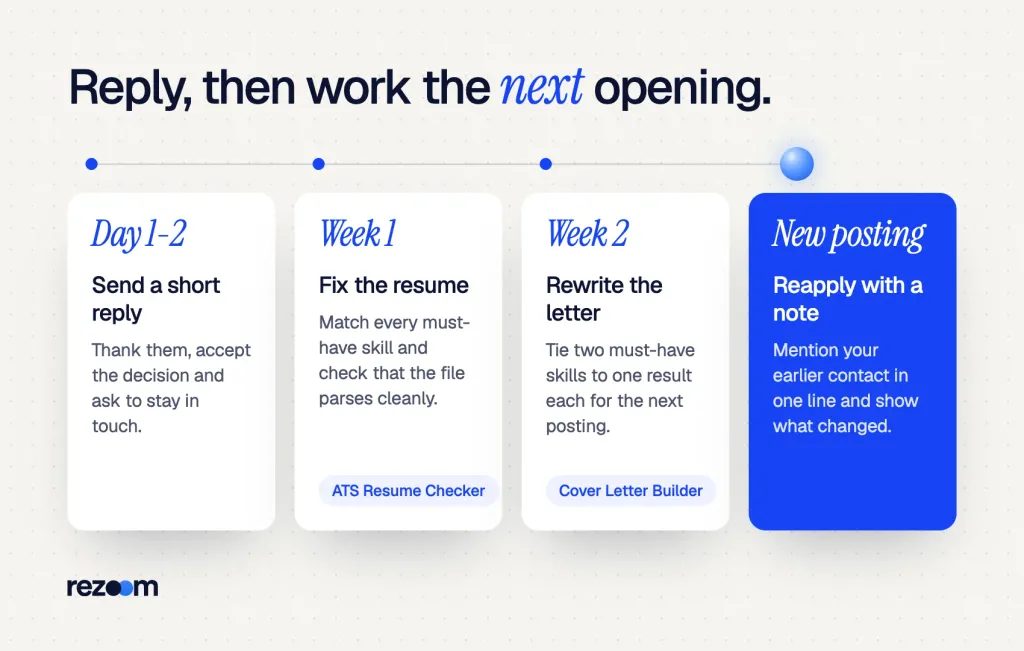
Fix what the rejection points to, then keep applying. If it came within minutes, check your resume and your screening answers. If it came after interviews, polish your examples. Wait for a new posting before you reapply, and mention your earlier contact in a short note when you do.
Most employers will never tell you why. In Q2 2024, only 4% of about 6,500 companies2 using Greenhouse contacted every rejected applicant. So your own review matters more than any reply you get.
Fix the resume first
A fast rejection usually means the resume missed a must-have skill or the parser could not read it. Run your file through an ATS resume checker and compare it with the posting's required skills.
If you applied for front desk, office or support jobs, study strong administrative resume examples before you rewrite. They show how to turn routine tasks into results with numbers.
For support roles in particular, our customer service representative resume example shows how to list call volume, CSAT scores and tools in one clean column.
Customer service representative resume example
A one-column support resume with ticket volume, CSAT scores and CRM tools in measured bullets.
Rewrite the cover letter too
If you reached interviews, the letter got you there, so keep its best lines. If you didn't, it may have read as generic. Our administrative cover letter examples show how to tie two must-have skills to one result each.
Customer service representative cover letter example
A short support letter that opens with a service result and names the posting's top two skills.
Then draft a fresh version for each new posting with our AI cover letter builder. Edit the draft by hand so it sounds like you.
Reapply with a plan
Wait for a new posting or a clear change in your skills before you apply again. Our guide on how to reapply to a company covers timing and what to change. When you do, mention your earlier contact in one line. If you are the one pulling out, use our job application withdrawal email scripts.
Reapply to a company after rejection: how long to wait, including Google's 90-day rule, what the ATS remembers about you and what to change before you apply.
After every new interview, send a thank-you note as well. Our interview follow-up email guide has scripts for each stage.
Before you reapply
Free plan, no card.
Frequently asked questions
Should I respond to a rejection email after an interview?
Yes. A short thank-you after an interview keeps a contact who already knows your work. It will not change the decision, but it can help with the next opening.
How long should I wait to reply to a job rejection?
Reply within 24 to 48 hours. If you feel upset, draft the reply that day and send it the next morning.
Should I reply to an automated rejection email?
No. If the email came from a no-reply address after an automatic screen, nobody reads replies. Spend that time on your resume instead.
Is it OK to ask why I was not chosen?
Ask what would make you a stronger candidate, not why they chose someone else. Keep it to one question and expect no answer, since many employers avoid feedback for legal reasons.
Can responding to a rejection email get me the job?
Rarely for the same role. But if the new hire leaves early or a second seat opens, a recruiter is more likely to call a runner-up who stayed gracious.
Should I connect with the recruiter on LinkedIn after a rejection?
Yes, if you had at least one conversation. Add a one-line note that names the role and thanks them for their time.
Sources
We opened and read each page below. The small numbers in the text point here. Pages that carry no publication date show n.d.
- Survale (CandE Benchmark Research)2026
In 2025, 56% of rejected candidates got no feedback, 33% heard via a do-not-reply email and North American resentment reached 15%
- Axios (Greenhouse data)2024
In Q2 2024, only 4% of about 6,500 companies on Greenhouse contacted all rejected applicants
- Ask a Manager2025
Alison Green says replying makes sense after an interview, and employers are very unlikely to change their minds
- ERC2017
Many employers avoid giving rejected applicants feedback out of fear of legal ramifications
- Carnegie Mellon University Career and Professional Development Centern.d.
A rejection reply should thank the employer, name its purpose and welcome feedback
Mohammad has spent more than ten years designing consumer products and leads product at Rezoom, deciding what gets built and what gets left out. His guides cover the whole job search, from resume sections and cover letters to interview answers and career moves.
Goodi, M. (2026, November 4). How to Respond to a Job Rejection Email: Replies for Every Stage. Rezoom. https://rezoom.io/how-to-respond-to-a-job-rejection-email/