What Can a Former Employer Say About You? The Rules and Your Scripts
What can a former employer say about you? See what HR confirms, when a bad reference is illegal, how to check your record and what to say about a firing.

On this pageWhat can a former employer say about you?
- What can a former employer say about you?
- Is it illegal for an employer to give a bad reference?
- Can employers say why you were fired?
- What shows up in a background check or The Work Number?
- How do you find out what a former employer will say about you?
- What should you say about a past termination in an interview?
- FAQ
- Sources
In most US states, a former employer can say anything true about your work, including why you were fired. Many companies only confirm dates and job titles to limit legal risk. A reference turns illegal when it is knowingly false or breaks a state blacklisting law. Ask HR what they confirm, check your Work Number report, and prepare one calm line about any exit.
What can a former employer say about you? In most states, anything true, including why you left or were fired. But many companies only confirm your dates and job title.
The risk is a false statement, an off-policy manager or an error in a verification database. This guide shows the rules, how to check your record and the exact words to use.
This is general information, not legal advice. Laws differ by state, so talk to an employment lawyer about your own case.
Quick answers by situation
| Your situation | What to say/do | Example line |
|---|---|---|
| You want to know what HR will share | Call or email HR and ask for the policy | "What do you confirm when an employer calls about me?" |
| You were fired and fear the reference | Ask HR if they disclose the reason | "Do you share the reason for separation, or only dates?" |
| You need a real reference | Ask a former manager you trust, by name | "Would you be comfortable giving me a strong reference?" |
| You think a reference cost you a job | Ask the employer if a report was used | "Did a background report play a part in this decision?" |
| An interviewer asks why you left | Give one neutral fact, then pivot | "The role was cut, and I learned what I want next." |
What can a former employer say about you?
Legally, a former employer can usually say anything true about your work, your attendance or the reason you left. In practice, many US companies follow a neutral policy and only confirm dates of employment and job titles. The danger is a statement that is false, or a manager who ignores company policy.
Truth is the main line. The Privacy Rights Clearinghouse puts it plainly.
A former employer can say anything truthful about your performance.
Privacy Rights Clearinghouse
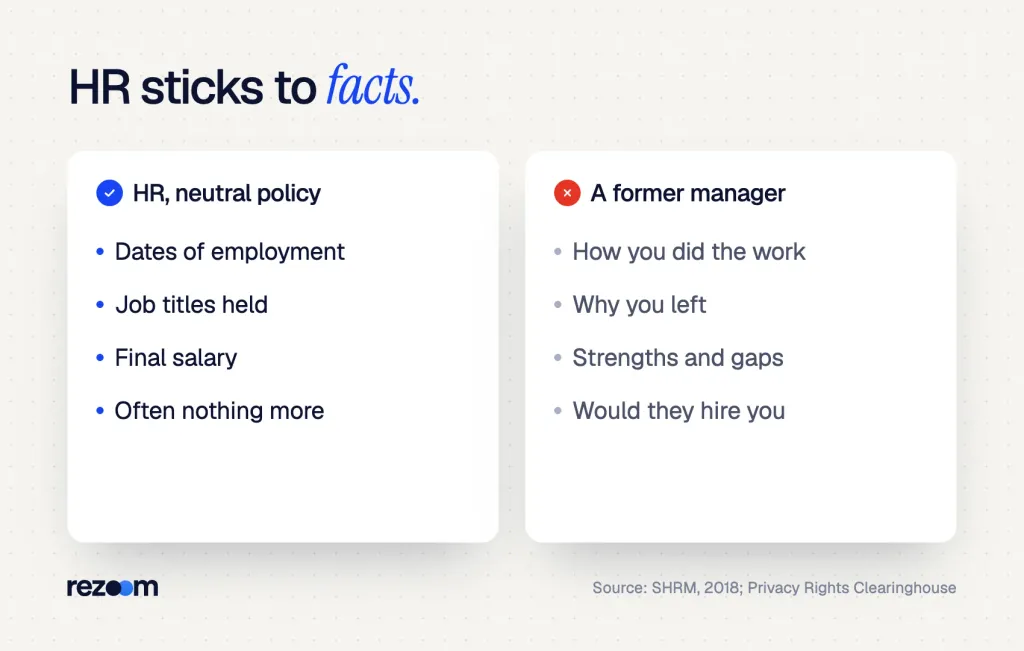
But the same source notes that most employers only confirm dates of employment, final salary and other limited facts1. That is a company choice, not a law, so what does a former employer say about you in practice? Mostly what its policy allows.
Why many companies say so little
SHRM reports that firms often send every reference call to HR, which then confirms only dates of employment and positions held2 (2018). The goal is to limit the risk of a slander or misrepresentation claim. Supervisors are often told to pass calls to HR too.
Still, recruiters know this. The same SHRM article says some reference checkers go around HR and call your old supervisor directly. So a neutral policy does not promise a quiet manager.
What each source usually shares
| Who answers | What they often share | What to do |
|---|---|---|
| HR under a neutral policy | Dates, job title, sometimes final pay | Ask HR for the policy in writing |
| Your former manager | Opinions on your work and why you left | Talk to them before you list them |
| The Work Number | Payroll data your employer sent in | Request your free report |
| A background check company | Records, verified jobs, sometimes more | Know your FCRA rights |
| Drug testing records (DOT jobs) | Failed or refused drug tests | Expect these to be reported |
Jobs under Department of Transportation rules, such as truck driving, are the clear exception. There, employers must report a failed or refused drug test1.
Is it illegal for an employer to give a bad reference?
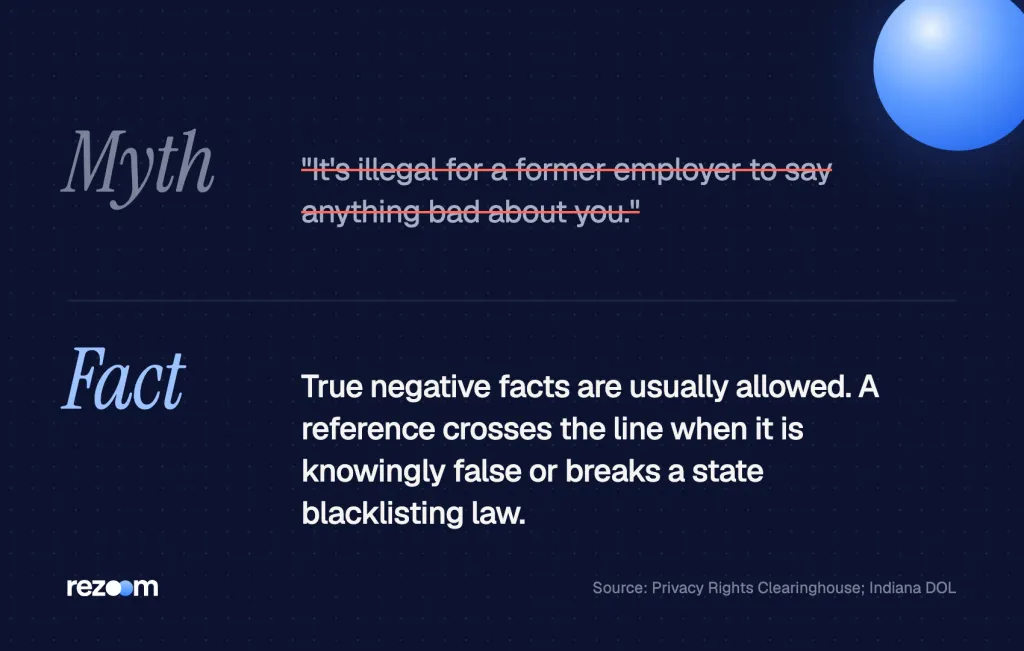
A bad reference is not illegal if it is true. It can be illegal when the employer knowingly says something false, tries to keep you from being hired, or breaks a state blacklisting law. Some states also protect employers who share truthful information in good faith, so honest negative feedback is usually allowed.
The line is truth, not tone. A former manager may say you missed deadlines if you did. But a lie that costs you a job is a different matter.
State laws you may run into
- California blacklisting law: Under Labor Code section 10503, it is a misdemeanor to use a misrepresentation to stop a former employee from getting a job.
- Indiana blacklisting law: Indiana's Department of Labor says blacklisting a discharged worker is a Class C infraction4. But an employer may give a truthful written statement of why you were let go.
- Indiana reference immunity: The same Indiana law shields employers who share information about a worker, unless you prove they knew it was false.
- Indiana copy right: You can also ask a prospective employer, in writing, for copies of written notes from past employers. The request must arrive within 30 days after you apply.
Other states have their own rules, and many protect good-faith references. So check your state's labor department site before you act.
If a recruiter hints that your old employer said something false, note the date, the name and the words used. Then ask a friend or a reference-check service to call and record the answer. A written record matters far more than a feeling if you later talk to a lawyer.
Can employers say why you were fired?
Yes, in most states a former employer can truthfully say why you were fired. Many choose not to, and some only say whether you are eligible for rehire. A few states, such as Missouri, let you request a service letter that must state the true cause of your exit, so you can see the official reason.
Many companies only list the reason as "involuntary separation" or say nothing at all. But some will answer "Is this person eligible for rehire?" A "no" can say a lot without any details.
Missouri's service letter rule
Missouri gives workers a way to see the reason in writing. Under Missouri statute 290.1405, a corporation with seven or more employees must provide a service letter on request. You must have worked there at least 90 days.
The letter must describe your service and truly state the cause, if any, for your exit. You send the request by certified mail within one year, and the employer has 45 days to reply. So a Missouri worker can learn the official story before a new employer hears it.
If you were let go and are filling out forms now, see how to word the reason for leaving on a job application. Short, factual answers work best.
Reason for leaving on job application examples for layoffs, contracts, school, moves and firing: the exact words to type, what HR checks and what to avoid.
What shows up in a background check or The Work Number?
A background check can show verified jobs, dates, records and sometimes salary, and The Work Number holds payroll data that many employers send in. Under federal law, an employer needs your written permission before it orders a report. If the report may cost you the job, you must get a copy first.
Many large employers do not answer reference calls at all. Instead, they send their payroll data to The Work Number, an Equifax database. Then a new employer checks your dates and title there.
The Consumer Financial Protection Bureau says The Work Number will provide a free report upon request6. You can also dispute errors, and the company must investigate.
Your rights under the FCRA
A joint EEOC and FTC guide from 2014 lists your rights when an employer uses a background report:
- Permission first: The employer must ask for your written permission7 before it gets a report from a background company.
- A copy before a "no": If the report may cost you the job, you must get a copy and a notice of your rights.
- A chance to fix it: If you find a mistake, ask the report company to fix it and send a corrected report.
The FTC has fined companies that failed to give these notices8 to rejected applicants (2009). So ask if a report was used when an offer falls through.
Free ATS score, the text the software extracts and your missing keywords. No sign-up.
How do you find out what a former employer will say about you?
Ask HR directly what they confirm, request your Work Number report, and talk to the managers you plan to list. If you live in a service letter state, request the letter. Then fix what you can before a recruiter calls, and line up references who will speak well of you.
Do this before you apply, not after a rejection. Then you can fix problems while they are still small.
- Ask HR for the policyEmail HR and ask what they confirm. Ask if they share the reason for leaving or rehire status.
- Pull your Work Number reportRequest the free report and check your dates, titles and pay.
- Talk to your referencesCall each person you plan to list and ask what they would say.
- Fix what is wrongDispute errors in writing and keep copies of every reply.
Scripts for HR and your former manager
"Hi [HR name], I worked as [title] from [start] to [end]. When a future employer calls, what do you confirm? Do you share my reason for leaving or rehire status? Thank you, [Your name]"
"Hi [Name], I am applying for [role] jobs. You saw my work on [project], so I would value your reference. Would you be comfortable giving me a strong one? If not, I understand."
The last line gives them an easy way out, and that protects you. A lukewarm reference hurts more than none. Our guide on how to ask someone to be a reference covers follow-up and thank-you notes.
Before you list a reference
What should you say about a past termination in an interview?
Give one honest, neutral sentence about what happened, then say what you learned and why the new role fits. Do not blame your old boss, and do not lie, because a reference or rehire question can expose it. Keep the answer under 30 seconds and move on.
Your answer should match what HR and your references will say. If HR says "not eligible for rehire," a story about a friendly exit will fall apart.
First, decide whether to put a job you were fired from on your resume. Then prepare the words.
Include a job I was fired from on my resume? Usually yes. Use this 3-factor rule, see what to write, and learn how to explain it in an interview.
Scripts for the interview
"I was let go from my store manager role after we missed our shrink target two quarters in a row. I took that seriously. I now run weekly loss audits, and that is the habit I would bring here."
"I was let go from [company] in [month, year] because [one neutral fact]. Since then, I have [one step you took]. That is why I am ready for [specific part of this role]."
Interviewer: "Your old employer says you are not eligible for rehire. Why?"
"That is fair to ask. I was let go after a missed target, and their policy marks all terminations that way."
Interviewer: "Would your manager say the same?"
"Yes. I can put you in touch with my assistant manager there, who saw how I fixed the audit process."
What to do and avoid
Keep the story short and consistent with the record. Before the interview, ask: what does a former employer say about you when a recruiter calls? Then plan for the full truth.
Do
- Use the same reason HR is likely to give.
- Name one step you took to fix the problem.
- Offer a reference who saw your best work.
Don’t
- Call a firing a "mutual decision" if it was not.
- Blame a manager or coworker by name.
- Talk for more than 30 seconds about the exit.
If your old company only confirms dates, your listed references carry the whole story. Choose people who saw your results, not your exit. A shift lead who watched you hit goals beats a regional manager who barely knew you.
Rebuild the resume around results
A firing hurts less when your resume shows clear wins. Our retail resume examples put one number in every bullet, so results lead and dates follow.
If you ran a store, the retail manager resume example shows how to frame sales, staffing and shrink results after a rough exit.
Retail manager resume example
A store leadership resume that leads with sales and shrink results, so one hard exit does not define you.
Your cover letter can also set the tone before any reference call. Browse our retail cover letter examples for short openers that name a result first.
Retail manager cover letter example
A retail leadership letter that opens with a store result and keeps the job change to one line.
When your story is set, our AI resume builder drafts results-first bullets from your job history. Then edit each line so it matches what your references will say.
Free plan, no card.
Frequently asked questions
Can a previous employer give a bad reference?
Yes, if it is true. A former employer can share honest negative facts, such as missed deadlines. It becomes a legal problem when the statement is knowingly false or meant to block you from work.
Can employers say why you were fired?
In most states, yes, as long as the reason is true. Many companies choose to share only dates and job titles, and some say only whether you can be rehired.
What can HR say about a former employee?
HR can share true facts about your job, pay and exit. Under a neutral policy, though, most HR teams confirm only dates, titles and sometimes final pay.
Is it illegal for an employer to give a bad reference?
Not if it is true. It can be illegal if the employer knowingly lies or breaks a state blacklisting law, such as those in California and Indiana.
How do I find out what my former employer says about me?
Ask HR what they confirm, request your free Work Number report and talk to the people you list. Some people also hire a reference-check service to call for them.
Can a former employer tell people I was fired?
Usually yes, if it is true. But many employers avoid it to limit legal risk, so ask HR about its policy before you assume the worst.
Sources
We opened and read each page below. The small numbers in the text point here. Pages that carry no publication date show n.d.
- Privacy Rights Clearinghousen.d.
A former employer can say anything truthful, but most only confirm dates, final salary and limited facts
- SHRM2018
Under neutral policies, HR often confirms only dates of employment and positions held
- California Labor Coden.d.
Using a misrepresentation to keep a former employee from a job is a misdemeanor in California
- Indiana Department of Laborn.d.
Indiana treats blacklisting as a Class C infraction and protects truthful employer disclosures
- Missouri Revised Statutes2021
Missouri employers with seven or more workers must issue a service letter within 45 days of a request
- Consumer Financial Protection Bureaun.d.
The Work Number provides a free report on request and must investigate disputes
- EEOC and FTC2014
Employers need written permission for a background report and must share it before a negative decision
- Federal Trade Commission2009
The FTC fined two companies that failed to give required notices to fired workers and rejected applicants
Mohammad has spent more than ten years designing consumer products and leads product at Rezoom, deciding what gets built and what gets left out. His guides cover the whole job search, from resume sections and cover letters to interview answers and career moves.
Goodi, M. (2026, November 4). What Can a Former Employer Say About You? The Rules and Your Scripts. Rezoom. https://rezoom.io/what-can-a-former-employer-say-about-you/