Applying for Multiple Positions at the Same Company: What's Too Many
Applying for multiple positions at the same company? See how many is too many, what recruiters see in the ATS and what to say if two roles call you back.

On this pageIs it bad to apply for multiple positions at the same company?
- Is it bad to apply for multiple positions at the same company?
- How many roles at one company is too many?
- What do recruiters see when you apply to several roles?
- How do you tailor your resume for each role at the same company?
- What should you say in your cover letter and to the recruiter?
- What if two roles at the same company call you back?
- FAQ
- Sources
It is not bad to apply for multiple positions at the same company if the roles fit you and sit close together. Two or three related roles is a safe cap at most employers. Recruiters often see every application on one candidate profile, so a spread of unrelated jobs looks unfocused. Tailor each resume, keep your story consistent and tell the recruiter which role you want most.
Applying for multiple positions at the same company is fine when the roles are close and you qualify for each. Keep it to two or three related jobs, tailor each resume and keep one consistent story.
The risk is not the number itself. It is what the pattern tells a recruiter, because most hiring systems show all of your applications in one place.
This guide gives a cap by company size, shows what recruiters see in Greenhouse and similar tools, and gives scripts for the cover letter, the recruiter call and the day two roles call back.
Quick answers by situation
| Your situation | What to do | Example line |
|---|---|---|
| Two similar roles at one store | Apply to both, tailor each resume | "Cashier and sales floor: I've done both" |
| A small firm with 3 openings | Apply to the one best fit only | "Your office coordinator role fits me best" |
| A large company with many teams | Cap it at 2–3 related roles | "I applied to two analyst roles on your site" |
| Roles at very different levels | Pick one level and stick to it | "I'm targeting team lead roles" |
| Two hiring managers call you back | Be open, then state a preference | "I'm also in process for stock associate" |
| The employer caps applications | Follow the cap and rank your picks | "My top choice is the front end role" |
Is it bad to apply for multiple positions at the same company?
No, as long as the roles are related and you meet the requirements for each. It starts to hurt when you apply to many unrelated jobs or to jobs at very different levels. Then a recruiter sees someone who wants any job there, not this job, and that weakens every application at once.
Many employers say outright that they accept it. Target's careers FAQ says, "you are welcome to apply for more than one job at a time"1, and it adds that you should pick jobs that match your experience and interests.
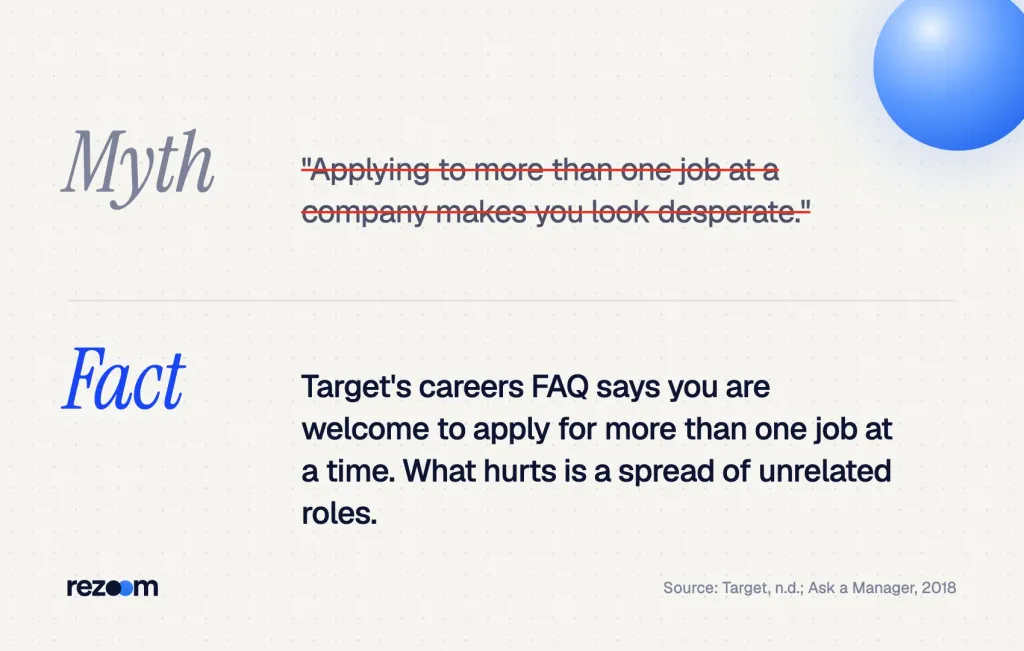
But "allowed" is not the same as "smart." Alison Green of Ask a Manager2 puts the line where most recruiters do: related roles look like real interest, while a scatter of unrelated jobs looks unfocused.
When it helps
- The roles share a core skill. Cashier, customer service desk and sales floor jobs all rest on customer service and cash handling.
- The jobs sit at one level. Two entry-level roles, or two senior roles, tell a clear story about where you fit.
- The company is large. Different teams hire on their own, so a second application rarely stands out.
When it hurts
- The jobs have nothing in common. Applying for accountant, warehouse lead and graphic designer at once suggests you just want in.
- The levels clash. A manager role and an entry-level role at once makes a recruiter ask which one you really are.
- The company is small. One recruiter reads every application, so a pattern shows up fast.
- You stretch your fit. Ask a Manager warns against applying for everything you are only slightly qualified for.
If you are unsure how many applications to send in total across your search, our guide on how many jobs you should apply to breaks it down by week and by field.
How many jobs should I apply to? Estimates run from 32 to 200 per offer — a gap that is really the difference between a 2.5% and an 8% conversion rate.
How many roles at one company is too many?
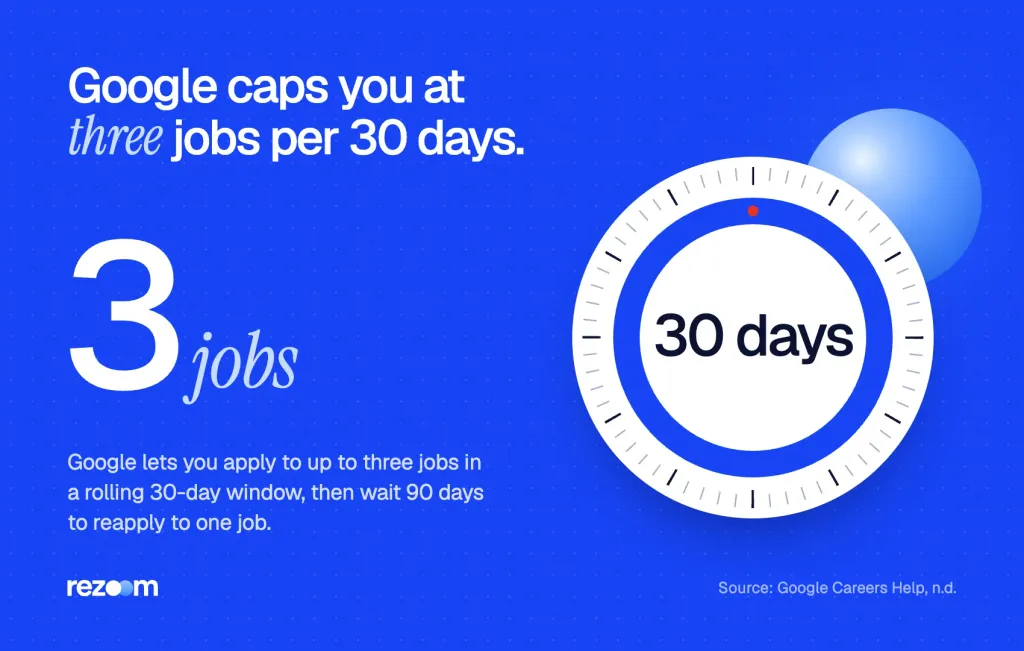
For most people, two or three closely related roles is the safe cap. At a small company, apply to one. At a large employer with many teams, three is still a good ceiling. Google sets a hard limit of three jobs in a rolling 30-day window, so check the careers FAQ before you apply.
There is no single rule, so use company size and how close the roles are. The table below is our working rule, based on the employer pages and advice we opened.
| Company size | Safe number | Why |
|---|---|---|
| Under 50 staff | 1 role | One person reads every application |
| 50 to 1,000 staff | 2 related roles | A small HR team often sees both |
| 1,000+ staff, one location or store | 2–3 related roles | One store manager may review all of them |
| 1,000+ staff, many teams | Up to 3 related roles | Teams hire on their own, but recruiters still search |
Some employers set the cap for you
Some large employers publish a hard limit on multiple positions at the same company. Google's careers help page is the clearest case.
You can apply to up to three jobs within a rolling 30 day window.
Google Careers Help
The same Google page3 says you must wait 90 days before you reapply for the same job. So if you apply to three Google roles this week, you cannot apply to a fourth until the window rolls on.
Amazon recruiters gave similar advice in a 2021 Amazon post4. One suggested picking up to five positions where you fully meet the basic qualifications. That is a ceiling for a huge employer, not a target.
Write your roles in order of preference before you submit anything. If a recruiter asks which one you want, you will answer in one sentence instead of hedging. And if a cap like Google's applies, you spend your three slots on your best fits.
What do recruiters see when you apply to several roles?
In most applicant tracking systems, recruiters see one candidate profile with every job you applied to listed on it. Greenhouse shows an All Jobs tab, and Workable labels you "Also in x other jobs." So assume each recruiter can see your full list, your dates and often the cover letters you sent.
You may think each application lives in its own silo. In most systems, it does not.
What it looks like in common systems
- Greenhouse. The candidate profile has an All Jobs tab5 that lists all jobs linked to you. A recruiter can also add you to another job6, which creates a new application so you can move through both interview plans at once.
- Workable. Its help center7 says each job gets its own profile, linked by your email. Older ones nest under "Also in x other jobs," and recruiters can see them even for jobs they don't hire for.
- iCIMS. Each person gets one Person profile8, with a Workflows tab for the jobs you are linked to and a count of your submissions.
So the recruiter for the cashier role may see your stock associate and sales floor applications too. For more on how one system works end to end, read how Greenhouse ATS works.
Why this cuts both ways
A shared profile helps when your roles fit together. A recruiter who likes you for one job can move you to a better match without a new application.
But it also means a recruiter may search the database later and find all of your past applications at once. Our guide on how recruiters search ATS databases shows the filters they use, including past applicants.
How recruiters search ATS databases: Boolean strings, filters and past-applicant rediscovery in Greenhouse, Workday and iCIMS, plus 6 resume fixes.
How do you tailor your resume for each role at the same company?
Keep your facts the same and change the order and emphasis. Lead each resume with the summary line, skills and bullets that match that posting's top three needs. Never change dates, titles or employers between versions, because the recruiter can compare them side by side on your profile.
Retail chains make this concrete. People often apply for multiple positions at the same company, such as cashier, stock and sales floor, and one store manager may review all three.
Amazon recruiters in the same 2021 post4 suggest using the job's own words and keeping more than one resume for different skill sets.
Same facts, different emphasis
Start from strong retail resume examples to see how each role leads with different skills. Then pick one version per posting and adjust only the top third of the page.
For a cashier posting, model your top section on a retail cashier resume example. It leads with cash accuracy, speed at the register and customer service.
Retail cashier resume example
A one-page cashier resume that leads with cash accuracy, speed and customer service.
Cashier version: Cashier with 2 years at a busy grocery register. Balanced my drawer to the cent on 98% of shifts and handled 300+ customers a day. Stock associate version: Retail team member with 2 years of overnight stocking and register work. Unloaded trucks, rotated stock and kept the aisles shelf-ready by 7 a.m.
Both lines describe the same job history. Only the order and the proof change, so the two resumes never contradict each other.
Four steps to tailor each version
- List each posting's top 3 needsCopy the three skills each job mentions most. Note where two roles overlap.
- Reorder, don't rewriteMove the matching bullets to the top for each version. Keep all dates and titles identical.
- Swap the summary lineWrite one summary sentence per role that names its main skill.
- Check each fileRun every version through a parse check before you upload it.
An ATS resume checker shows which posting terms each version is missing. Then you can fix the gaps by hand before a person reads it.
Do
- Keep employers, titles and dates the same in every version.
- Lead each resume with that posting's top skill.
- Name files by role, such as "Lee-Cashier-Resume.pdf."
- Track which version you sent to which job.
Don’t
- Claim a skill in one resume that you leave out of the other.
- Send the same generic resume to three different roles.
- Apply to roles at two different levels at once.
- Inflate a title to fit a more senior posting.
Free ATS score, the text the software extracts and your missing keywords. No sign-up.
What should you say in your cover letter and to the recruiter?
Mention the other application in one line, then explain the link between the roles and which one you prefer. Keep each cover letter specific to its role. If a recruiter calls, be open about every application, because they can already see it, and give a clear first choice with a reason.
Hiding the second application rarely works, since the recruiter can see it on your profile. So name it once, briefly, and turn it into a sign of real interest in the company.
Our retail cover letter examples show how to open with the store, name one skill and back it with a number. Use that pattern for each role, and add one line about the other application.
Retail cashier cover letter example
A short retail letter that names the store, leads with cash accuracy and backs it with a number.
I have also applied for the stock associate role at this store, because both jobs use the same strengths: accuracy, speed and care for customers. If I had to choose, the cashier role is my first pick, since I spend most of my current shift at the register.
Hi [Name], I applied for the [Role 1] and [Role 2] positions at [Company] on [date]. Both use my [shared skill], which I built over [time] at [current employer]. My first choice is [Role 1] because [one reason]. I'm glad to talk about either. Thank you, [Your name]
What to say if they push back
- "Why did you apply to so many of our jobs?" Name the shared skill, then say which role you want most.
- "Which one do you really want?" Give one answer and one reason. Don't say "whichever you pick."
- "Your resumes look different." Explain that the facts match and you only reordered them for each role.
- "Isn't the other role a step down for you?" Say what draws you to it, such as the schedule or the team.
Recruiter: "I see you also applied for our stock associate opening. Why both?"
"Both jobs use the same strengths, and I'd like to grow with this store. But the cashier role is my first choice, because I've run a register for two years."
Recruiter: "Would you take stock if cashier fills first?"
"Yes, as long as the hours work. I'd still like to move to the front end when a spot opens."
What if two roles at the same company call you back?
Tell each recruiter or hiring manager that you are also in process for the other role. Teams often talk to each other, and some ask you to pick one. Then state your preference, interview well for both, and if both make offers, decide fast and decline the other politely.
Ask a Manager notes that some employers coordinate across teams and may ask you to choose. Others never connect the two. So the honest move is to say it early, before it surprises anyone.
How to handle it step by step
- Disclose early. Mention the other process on the first call, not after an offer.
- Keep your story identical. Use the same reasons, dates and salary range with both teams.
- Decline with care. If you pick one offer, thank the other manager and say you hope to work together later.
Subject: Stock associate role, [Your name]
Hi [Name], thank you for the offer. I have accepted the cashier position at the same store, which fits my experience best. I really enjoyed meeting your team, and I hope we work together soon. Best, [Your name]
If one role turns you down, the other may still move forward, because each job often runs its own process. And if both say no, you can try again later. Our guide on when to reapply to a company covers how long to wait and what to change.
Pre-send check
Before you apply to a second role
Free ATS score and your missing keywords. No sign-up.
Frequently asked questions
Can applying to multiple jobs at the same company hurt you?
It can if the roles are unrelated or at very different levels. Then you look like you want any job rather than this one. Two or three related roles rarely hurts.
Do recruiters see all of my applications?
Usually, yes. Systems such as Greenhouse, Workable and iCIMS link your applications to one candidate profile, so recruiters can see the full list.
Should I use the same resume for every role?
No. Keep the facts the same, but reorder skills and bullets so each version leads with what that posting asks for most.
Is there a limit on how many jobs I can apply for at one company?
Some employers set one. Google allows up to three applications in a rolling 30-day window, so check the careers FAQ first.
Should I mention the other application in my cover letter?
Yes, in one short line. Explain how the roles connect and say which one you prefer.
What if I get offers for two roles at the same company?
Decide quickly, accept the role you want more and decline the other politely. Thank the hiring manager, because you may work near them later.
Sources
We opened and read each page below. The small numbers in the text point here. Pages that carry no publication date show n.d.
- Targetn.d.
Target's careers FAQ says candidates are welcome to apply for more than one job at a time with the same profile
- Ask a Manager2018
Related roles look like real interest, while unrelated roles look unfocused, and larger companies are less likely to notice
- Googlen.d.
Google lets candidates apply to up to three jobs within a rolling 30-day window and requires a 90-day wait to reapply for the same job
- Amazon2021
Amazon recruiters suggest up to five positions where you fully meet the basic qualifications, and more than one resume for different skill sets
- Greenhousen.d.
The Greenhouse candidate profile has an All Jobs tab that lists all jobs associated with a candidate
- Greenhousen.d.
Adding a candidate to another job in Greenhouse creates a new application, and both interview plans can run at once
- Workablen.d.
Workable links a candidate's job profiles by email and nests older ones under "Also in x other jobs"
- iCIMSn.d.
iCIMS keeps one Person profile per candidate, with a Workflows tab listing linked jobs
Mohammad has spent more than ten years designing consumer products and leads product at Rezoom, deciding what gets built and what gets left out. His guides cover the whole job search, from resume sections and cover letters to interview answers and career moves.
Goodi, M. (2026, November 3). Applying for Multiple Positions at the Same Company: What's Too Many. Rezoom. https://rezoom.io/applying-for-multiple-positions-at-the-same-company/