Hana Yoshida Epidemiologist, MPH Evanston, 60201, United States [email protected] · (847) 555-0173
11 September 2026
Ms. Bernadette Ocampo Population Health Analytics Northshore Regional Health System Evanston, United States
Application for Health Data Scientist, Northshore Regional Health System
Dear Ms. Ocampo,
I am applying for the Health Data Scientist post with Northshore Regional Health System. I hold an MPH in Epidemiology from the University of Illinois Chicago with a concentration in infectious disease surveillance, and I currently run the weekly respiratory surveillance pipeline for a county health department covering 1.9 million residents.
The posting asks for someone who can build models that clinicians will act on, and that is the part of this work I came into public health to do. In my current post I rebuilt the case investigation intake and cut the median time from laboratory report to investigation from 72 hours to 31, which mattered only because I spent as long on the workflow the investigators use as on the analysis behind it. My master's thesis analyzed six years of outbreak data across 240 schools using spatial cluster detection, and the department adopted the method as its seasonal reporting template.
I came to epidemiology after six years in commercial market research, and that is the reason the models get used rather than a detour from it. Survey design, sampling and the work of persuading a skeptical stakeholder to change a process are the same skills in either sector, and I had six years of them before I had the degree.
I can start with four weeks' notice and I am happy to walk through code or a sample of the reporting. Thank you for your time.
Sincerely, Hana Yoshida, MPH
Summary
A master's degree cover letter has one job the resume cannot do: it explains why you did the degree and why you want this particular post. This guide gives you a full adaptable letter, the sentence that answers an overqualification worry before it is raised, how to write a thesis or capstone into a letter, and what changes when the degree is a legal entry requirement.
Master’s cover letter examples by experience level
A master's degree cover letter has one job the resume cannot do. The resume lists the qualification; the letter explains why you did it and why you want this particular post.
That matters more than it does for most applications, because a graduate degree raises a question whichever direction it points. For a post that requires it, the question is whether your specialism is the right one. For a post that does not, the question is why you are here at all. Both are answered in one sentence, early, without apology.
Guide to a master's degree cover letter
This guide and the corresponding master's cover letter example will cover:
- The three situations a master's letter can be in, and what each one needs
- A full adaptable letter you can rewrite for your own field
- How to put a thesis or capstone into a letter as work, not as a title
- The sentence that answers an overqualification worry before it is raised
- What changes when the degree is a legal entry requirement
Which of the three letters are you writing
| Your situation | What the first paragraph does | What the second paragraph does |
|---|---|---|
| The degree is required for the post | States the degree, concentration and any license it underpins | Gives the in-field work: practicum, assistantship, project, with numbers |
| The degree is preferred, and you have experience | States the role you do now and its scale | Uses the degree to explain a specific capability the posting asks for |
| The degree is above the level of the post | States the role and availability, not the degree | Gives one plain reason for wanting this job, then the evidence you can do it |
The mistake that runs across all three is treating the degree as the argument. It is not the argument; it is the reason you can make one.
A master's degree cover letter example you can adapt
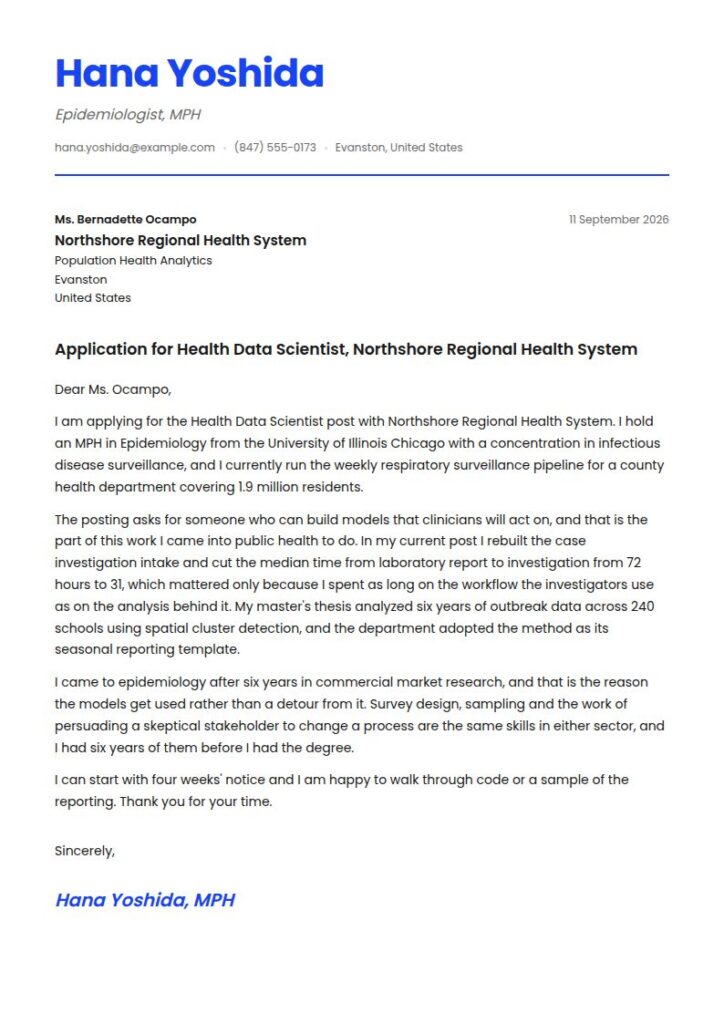
Dear Ms. Ocampo,
I am applying for the Health Data Scientist post with Northshore Regional Health System. I hold an MPH in Epidemiology from the University of Illinois Chicago with a concentration in infectious disease surveillance, and I currently run the weekly respiratory surveillance pipeline for a county health department covering 1.9 million residents.
The posting asks for someone who can build models that clinicians will act on, and that is the part of this work I came into public health to do. In my current post I rebuilt the case investigation intake and cut the median time from laboratory report to investigation from 72 hours to 31, which mattered only because I spent as long on the workflow the investigators use as on the analysis behind it. My master's thesis analyzed six years of outbreak data across 240 schools using spatial cluster detection, and the department adopted the method as its seasonal reporting template.
I came to epidemiology after six years in commercial market research, and that is the reason the models get used rather than a detour from it. Survey design, sampling and the work of persuading a skeptical stakeholder to change a process are the same skills in either sector, and I had six years of them before I had the degree.
I can start with four weeks' notice and I am happy to walk through code or a sample of the reporting. Thank you for your time.
Sincerely, Hana Yoshida, MPH
Openings that work
| Instead of | Use |
|---|---|
| I recently completed my master's degree and am eager to apply my knowledge | I hold an MPH in Epidemiology with a concentration in infectious disease surveillance |
| I am writing to express my interest in this position | I am applying for the Health Data Scientist post with Northshore Regional Health System |
| My graduate studies have prepared me well for this role | I run the weekly respiratory surveillance pipeline for a jurisdiction of 1.9 million residents |
| I am seeking a role where I can use my advanced degree | The posting asks for models clinicians will act on, which is the part of this work I came in to do |
The last row is the important one. "Seeking a role where I can apply my degree" states a problem and asks the reader to solve it. Naming the thing in the posting you want to work on solves it for them.
Put the thesis in the letter as a paragraph of work
A thesis is the largest independent project most master's graduates have done, and it is worth more in a letter than on a resume, because a letter has room for the story a bullet cannot carry.
Write it the way you would write a job: the question, how much data or how many sites, the method, the finding, and what happened next. That last part separates a student from a practitioner. "The department adopted the method as its seasonal reporting template" is a sentence about consequence, and consequence is what the reader is buying. If nothing happened next, say what you would do with it here; a thesis that proposes a change to the reader's own process is a live proposal.
The overqualification sentence
When the post sits below the level of your degree, the reader is running one silent calculation: will this person leave in six months. Nothing in the resume answers it. One sentence in the letter does.
The sentence has two parts: the real reason, stated plainly, and the commitment implied by it. No apology, no flattery, and no claim that you have always wanted to work here.
| Situation | The sentence |
|---|---|
| Changing sector | I did the MPH to move from commercial research into public health, and this is the kind of applied surveillance post I did it for |
| Wanting hands-on work again | After four years managing analysts I want to be building models again, which is what this post is |
| Geography | I moved to Evanston last year and I am looking for work I can do well within this system |
| Re-entering after a break | I finished the degree part time while out of full-time work, and I am returning to practice |
Then stop and go back to the evidence. A paragraph of explanation reads as a problem; a sentence of it reads as a fact.
When the degree is a legal entry requirement
Name the degree, the accrediting body where the field has one, the license and the certification in the first paragraph, each with its state or issuing authority. Give the supervised hours if your field counts them, as a number. Say when the license or certification expires, and say if you hold reciprocity in another state. Spend the rest of the letter on the caseload, the setting and the population you have worked with.
Do not assume the reader knows your program was accredited; say so. Do not list the coursework. Do not use the letter to repeat the resume's education block in prose. Do not leave the license status vague when it is pending; give the exam date and the expected date instead. Do not apply out of scope and hope; in licensed fields the eligibility screen happens before a person reads anything.
In clinical, school and public-sector licensed roles the first screen is administrative, looking for four items: degree from an accredited program, supervised hours, examination, and current license. A letter with all four in the opening paragraph clears it in ten seconds.
Writing the letter as a new graduate
The structure does not change, but the evidence comes from different places. Practicum or internship hours count, and so does the number of them. Assistantships are jobs: say what you managed, how much of it, and for how long. Coursework does not count, and listing it is the clearest signal that nothing else exists.
One other thing is worth a sentence: what you can do on day one that a bachelor's graduate cannot. Not the degree, but the specific capability it gave you, named in the language of the job. That is the whole value proposition of a master's in a first application, and it fits in a clause.
Length, format and sending it
One page, four paragraphs, 300 to 350 words. PDF, named for yourself and the post, addressed to a named person from the posting or the organization's own site. Pair it with a resume that agrees and keep the numbers identical between them: our master's resume guide uses the same figures as this letter and sets out where the degree goes as your experience grows.
Key takeaways
- Work out first which of the three letters you are writing: required, preferred, or above the level.
- Never make the degree the argument; make it the reason you can make one.
- Put the thesis or capstone in as work, ending with what happened because of it.
- Answer an overqualification worry in one plain sentence, with no apology attached.
- In licensed fields, put degree, accreditation, hours, exam and license in the first paragraph.
- As a new graduate, name the one capability the degree gave you, in the job's own vocabulary.
- Keep it to one page and keep every number identical to the resume.
Write your master's cover letter in 10 minutes.
Master's cover letter questions, answered
Should I mention my master's degree in the first line of a cover letter?
Only when the posting requires it, or when the concentration is the specific thing being hired for. If the post asks for a bachelor's, open with the role you do now and the scale of it, and let the degree appear later in the education section of the resume. Leading with a qualification the reader did not ask for is the most common way an application starts the overqualification conversation itself.
How do I write a master's cover letter with no work experience in the field?
Use the practicum, the assistantship, the thesis and any funded project as the experience, and give each one a number: hours, sites, records, participants, or budget. Then name the one capability the degree gave you in the language of the job. Coursework is not evidence and listing it signals that nothing else exists.
How long should a master's cover letter be?
One page, four paragraphs, 300 to 350 words, in almost every sector. The exception is an academic faculty search, which asks for a letter of application running two to four pages and structured by the posting; the [academic cover letter guide](/cover-letter/academic/) covers that document.
How do I explain why I left a career to do a master's?
In one sentence, framed as a decision rather than an escape: the degree was for moving into this field, and this is the kind of post it was for. Then return to the evidence. The earlier career is usually an asset once it is written in the new field's vocabulary, and a reader who sees six years of stakeholder work behind a new qualification reads it as range, not as instability.
Do I need to mention my thesis in the cover letter?
Where it is relevant to the post, yes, and the letter is a better place for it than the resume because there is room for consequence. Give the question, the scale, the method and what happened afterward. Where it is unrelated to the job, leave it out entirely rather than compressing it into a title nobody will recognize.