

Summary
List online courses on a resume when they teach a skill the job posting names, required real work or an assessment, and are recent. Put them in a section called Professional Development or Certifications, with the exact course title, provider, platform and completion month. Add a bullet only when the course produced something concrete. Skip short intro videos and anything unrelated to the role, and cap the section at about three to five entries.
Online courses on a resume help when they match the job and prove a skill your work history doesn't show yet. List them under Professional Development or Certifications with the course title, provider and completion date.
The hard part is choosing. A resume with fifteen course badges reads as busy, not skilled. A resume with three targeted courses and one result reads as someone who closed a gap on purpose.
Below you'll find a three-question filter, a placement table, copy-ready formats and the mistakes that make course lists backfire.
Should you put online courses on a resume?
Yes, when a course teaches a skill named in the job posting and you can't show that skill through work yet. Courses help most for career changers, recent graduates and people adding a new tool. Skip them when your experience already proves the skill or the course is short and introductory.
Online learning is now a normal part of how professionals build skills. In Stack Overflow's 2025 Developer Survey, 32.7% of developers said they learned to code through online courses or certification in the past year. That was nearly double the 16.6% who learned through school.
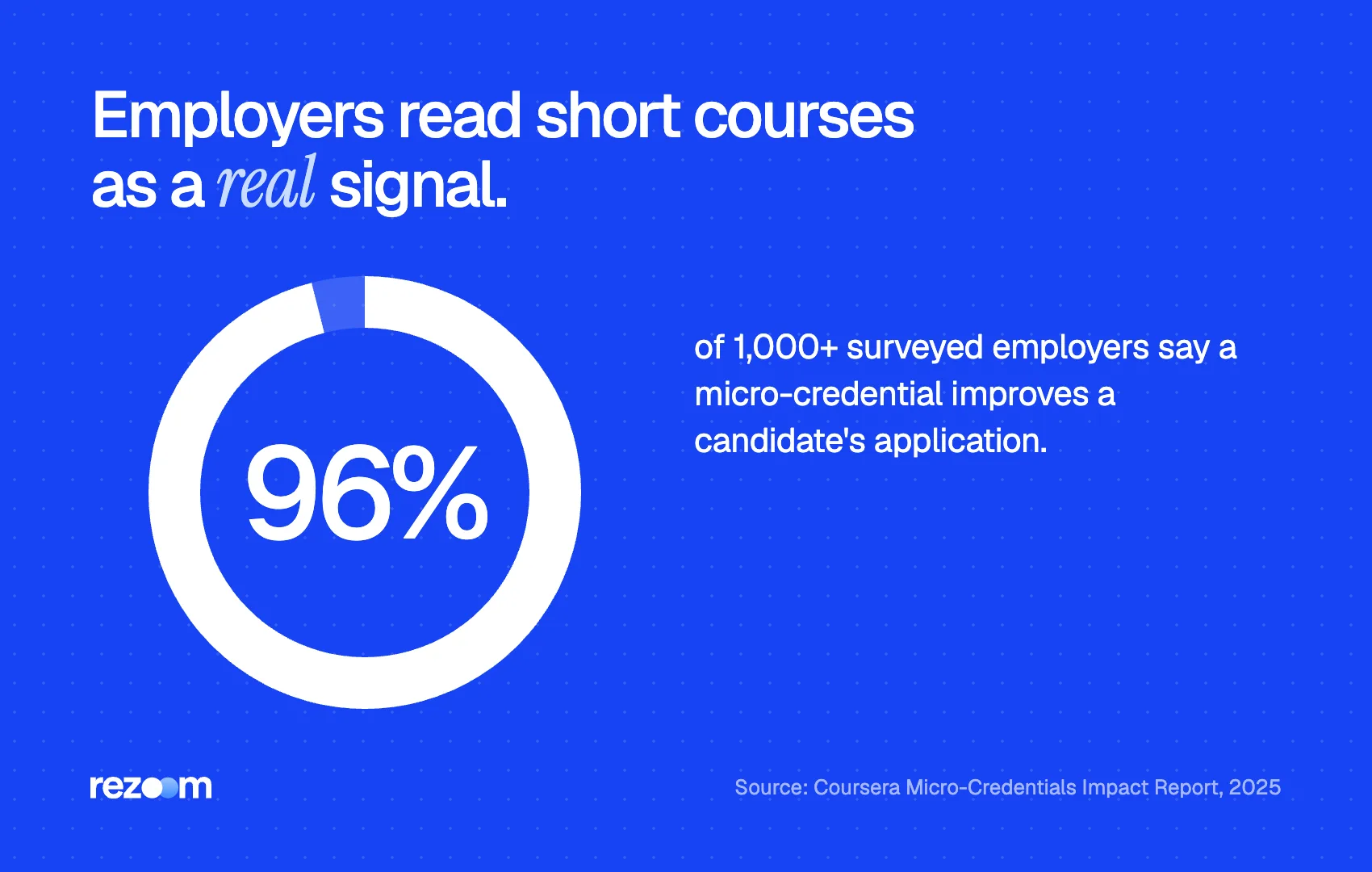
Employers also read short credentials as a signal. In Coursera's 2025 Micro-Credentials Impact Report, 96% of surveyed employers said earning a micro-credential improves a candidate's application. That survey covered over 1,000 employers worldwide and comes from a course provider, so read it as a direction rather than a guarantee.
The broader shift supports listing relevant learning. NACE reports that 70% of employers now use skills-based hiring, up from 65% the year before. Courses are one way to show a skill exists before you've used it on the job.
Which online courses are worth listing?
Use three questions. Does the job posting name the skill? Did the course require graded work, a project or an exam? Did you finish it in the last few years? Two or more yes answers earn a spot. A single yes usually belongs on LinkedIn instead.
Most guides stop at "list relevant courses." Here is a filter you can apply in seconds.
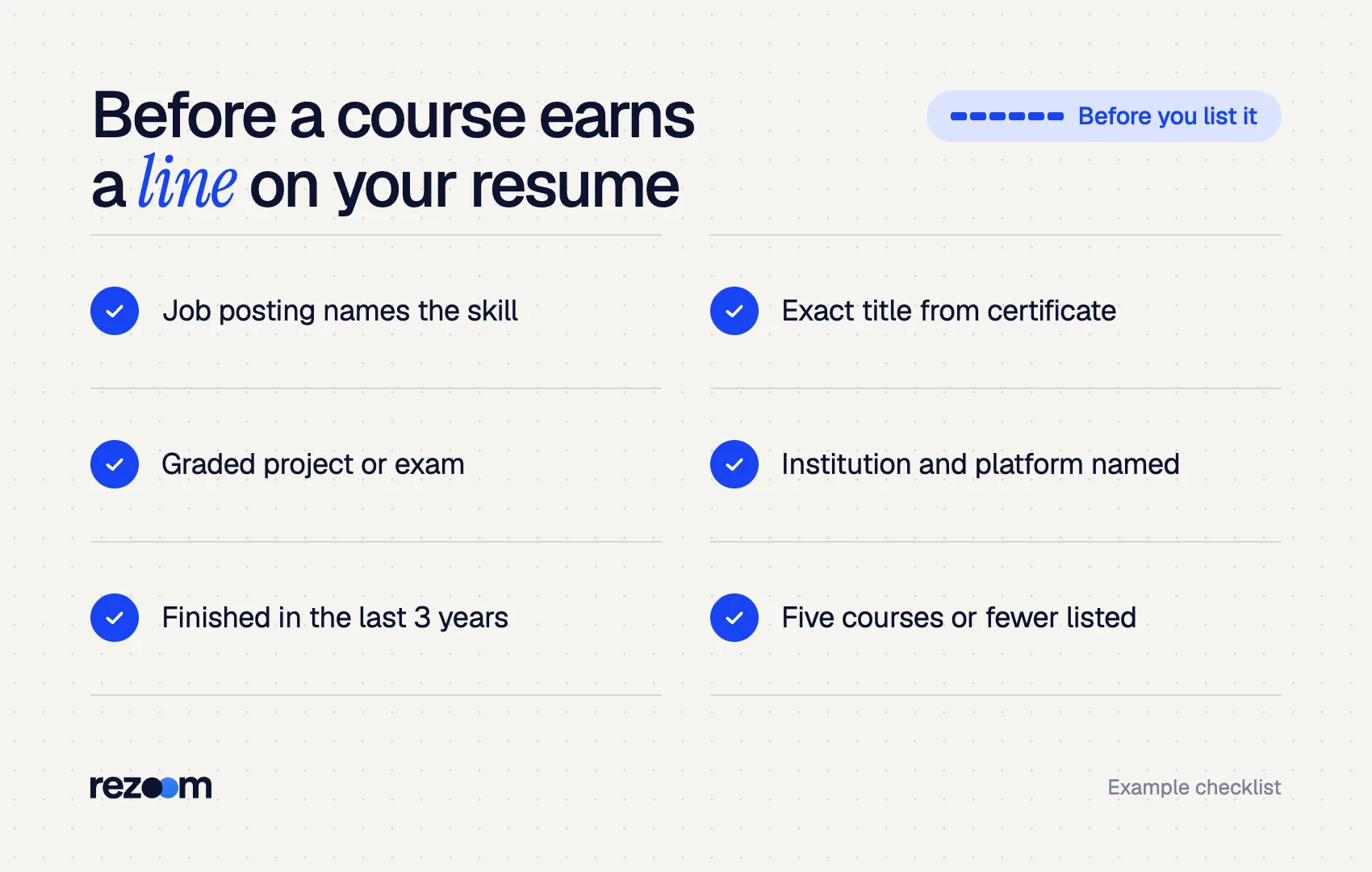
- Match: Does the job description name the skill or tool the course taught?
- Proof: Did the course end with a graded project, exam or verifiable certificate?
- Recency: Did you complete it within roughly the last three years, or does the tool still work the same way?
If a course scores two or three yes answers, list it. If it scores one, move it to your LinkedIn profile. Grinnell College's career center makes the same point, noting that students may also list online courses taken at other organizations using the same skill-focused approach as academic coursework.
Courses that rarely earn a spot include one-hour intro videos and generic "productivity" classes. Skip anything far outside your field too. Seniority also matters: once your experience proves a skill, the course that taught it can go.
Where do online courses go on a resume?
Most online courses go in a section called Professional Development or Certifications, placed after Education. A university-backed certificate program can sit in Education. A course that produced substantial work can appear as a project. Put the section higher only when the courses are your main evidence for the target role.
Choose the section by what the course is, not by how proud you are of it. This table covers the common cases.
| Course type | Best section | Example |
|---|---|---|
| Single course with a certificate | Professional Development | Google Data Analytics course, Coursera |
| Multi-course certificate from a university | Education | Certificate in Project Management, eCornell |
| Course with a graded capstone project | Projects (plus a short PD line) | Sales dashboard built in a Tableau course |
| Proctored industry exam | Certifications | AWS Certified Cloud Practitioner |
| Free intro module, no assessment | LinkedIn only | Two-hour "Intro to Excel" video |
Proctored exams are certifications, not courses. If you have both, see our guide to certifications on a resume. Courses that are part of a degree belong under relevant coursework instead.
If the course was a full coding program, our sibling guide to a coding bootcamp on a resume covers that format.
How do you format online courses on a resume?
Write the exact course title, then the institution that created it, the platform and the completion month and year. Add one bullet only when the course produced a result you can name, such as a project, score or tool you now use. Keep each entry to one or two lines.
Use the course title exactly as it appears on the certificate. Recruiters and background checks may look it up, and a reworded title looks like a different course.
Name both the institution and the platform when they differ, such as "University of Michigan via Coursera." The university name carries more weight than the platform alone.
PROFESSIONAL DEVELOPMENT
- Google Data Analytics Professional Certificate | Google via Coursera | Feb 2026
- SQL for Data Science | UC Davis via Coursera | Nov 2025
- Excel: Advanced Formulas and Functions | LinkedIn Learning | Aug 2025
Python for Everybody Specialization | University of Michigan via Coursera | Jan 2026
- Wrote a Python script that cleans and merges weekly sales exports, now used by my current team
The second format works when a course changed how you work. That bullet is stronger than the certificate itself, because it shows the skill in use.
Mirror the posting, not the syllabus
Applicant tracking systems match terms from the job description. If the posting says "SQL" and "Tableau," make sure those exact words appear in the course title or your bullet. Then confirm them in your skills section.
How many online courses should you list on a resume?
Three to five is enough for most resumes. Pick the courses that match the target job most closely and drop the rest. If you need more than five to show readiness, group related courses under one specialization line instead of listing each one separately.
More online courses on a resume do not mean more credibility. Past five lines, the section starts to read like a transcript, and the strongest course gets lost.
Group related courses when you can. "Front-End Developer Professional Certificate (9 courses)" takes one line and says more than nine separate ones.
Keep a full list in a master resume, then pick the best three for each targeted resume.
Use the exact course title shown on your certificate do: Name the institution, such as "Duke University via Coursera" do: List only finished courses, or mark one as "In progress"
Paste certificate URLs into the resume body dont: List ten courses from the same beginner track dont: Call a single online course a "degree" or "diploma"
Can you list online courses you haven't finished?
An in-progress course shows current effort. That helps when you're pivoting and the job asks for a tool you're learning now.
Abandoned courses are different. If you dropped one halfway, leave it off. If you learned something real from it, show that skill in a project instead.
Before you send the final version, run your file through the Rezoom ATS resume checker to confirm the course titles and skills match the posting's keywords.

Frequently asked questions
Is it OK to put Coursera courses on a resume?
Yes, when they match the job. Name the partner university or company first, such as "IBM via Coursera," and list the completion month.
Should I list free online courses on my resume?
List free online courses on a resume only if they required graded work or a project and match the role. A free course with a real capstone beats a paid one you only watched.
Do employers care about online certificates?
Many do. Coursera's 2025 employer survey found 96% said a micro-credential improves an application, though that is a provider's own research.
Where do I put LinkedIn Learning courses on a resume?
Put them in Professional Development, one line each. Most LinkedIn Learning courses are short, so list only those tied to the target job.
Should online courses go under Education?
Only multi-course certificate programs from a university, or ones you completed instead of a degree. Single courses fit better under Professional Development.
How do I list online courses on a resume with no experience?
Place Professional Development or Projects directly after your summary. Pair each course with something you built, so the course has proof behind it.



Comments