

Summary
List a coding bootcamp on a resume in your Education section with the program name, provider, location or "Remote", and completion month. If you have no tech job yet, move it near the top and pair it with a Projects section, because recruiters judge bootcamp graduates on what they built. Add one to three bullets per entry, link a GitHub or portfolio, and drop the bootcamp's marketing language.
A coding bootcamp on a resume belongs in your Education section, written like any other program: name, provider, dates and two or three skill bullets. The bootcamp gets you a second look. Your projects and GitHub decide whether you get the interview.
That split matters because bootcamp grads compete with candidates who hold computer science degrees. The fix is not hiding the bootcamp. It is placing it where it helps and backing it with proof.
This guide gives you a decision rule for placement, copy-ready formats, and fixes for the tricky cases: unfinished programs, part-time study and degree holders.
Should you put a coding bootcamp on a resume?
Yes, if the bootcamp taught skills the job asks for. It shows structured, recent technical training, which matters most for career changers and people without a computer science degree. List it once in Education, then prove the skills through a Projects section with linked code. Leave it off only when it is unrelated to the role.
Yes, in almost every case where you are applying for a technical role. Bootcamps fill a real gap. The Bureau of Labor Statistics says that educational requirements for web developers and digital designers range from a high school diploma to a bachelor's degree. That range leaves room for non-degree training.
Software developer roles are stricter. BLS notes that software developers typically need a bachelor's degree in computer and information technology or a related field. So a bootcamp alone rarely carries a software engineering application. Projects and skills have to do the rest.
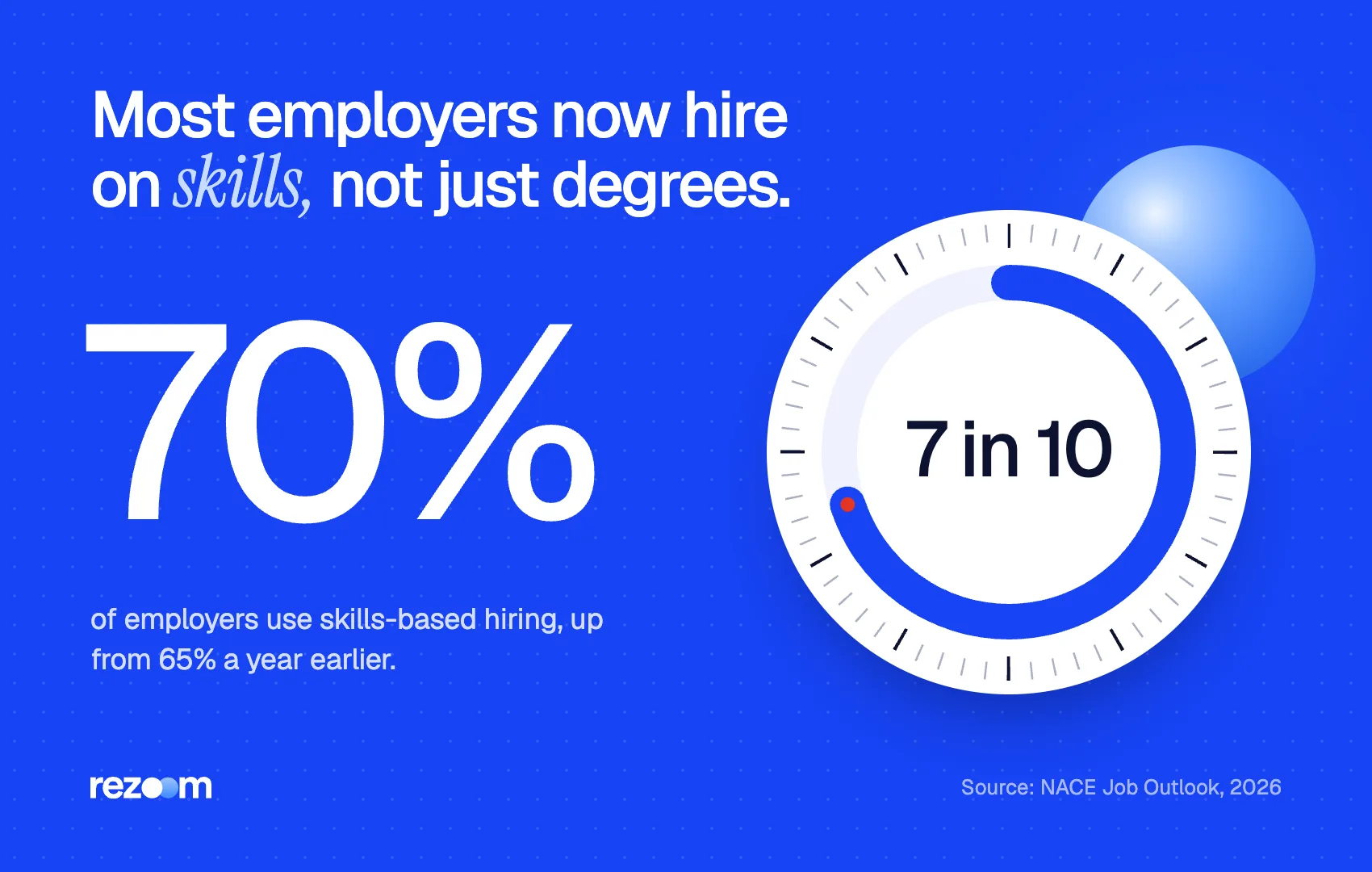
Employers are increasingly open to that evidence. NACE's Job Outlook 2026 survey found that 70% of employers use skills-based hiring, up from 65% a year earlier. A bootcamp entry plus visible work is how you speak that language.
Bootcamp grads are also less common than you might think. In Stack Overflow's 2025 Developer Survey, only 5.2% of developers said they learned to code through a coding bootcamp in the past year, against 32.7% who used online courses or certifications. That makes the credential distinctive, but only if you present it clearly.
Where does a coding bootcamp go on a resume?
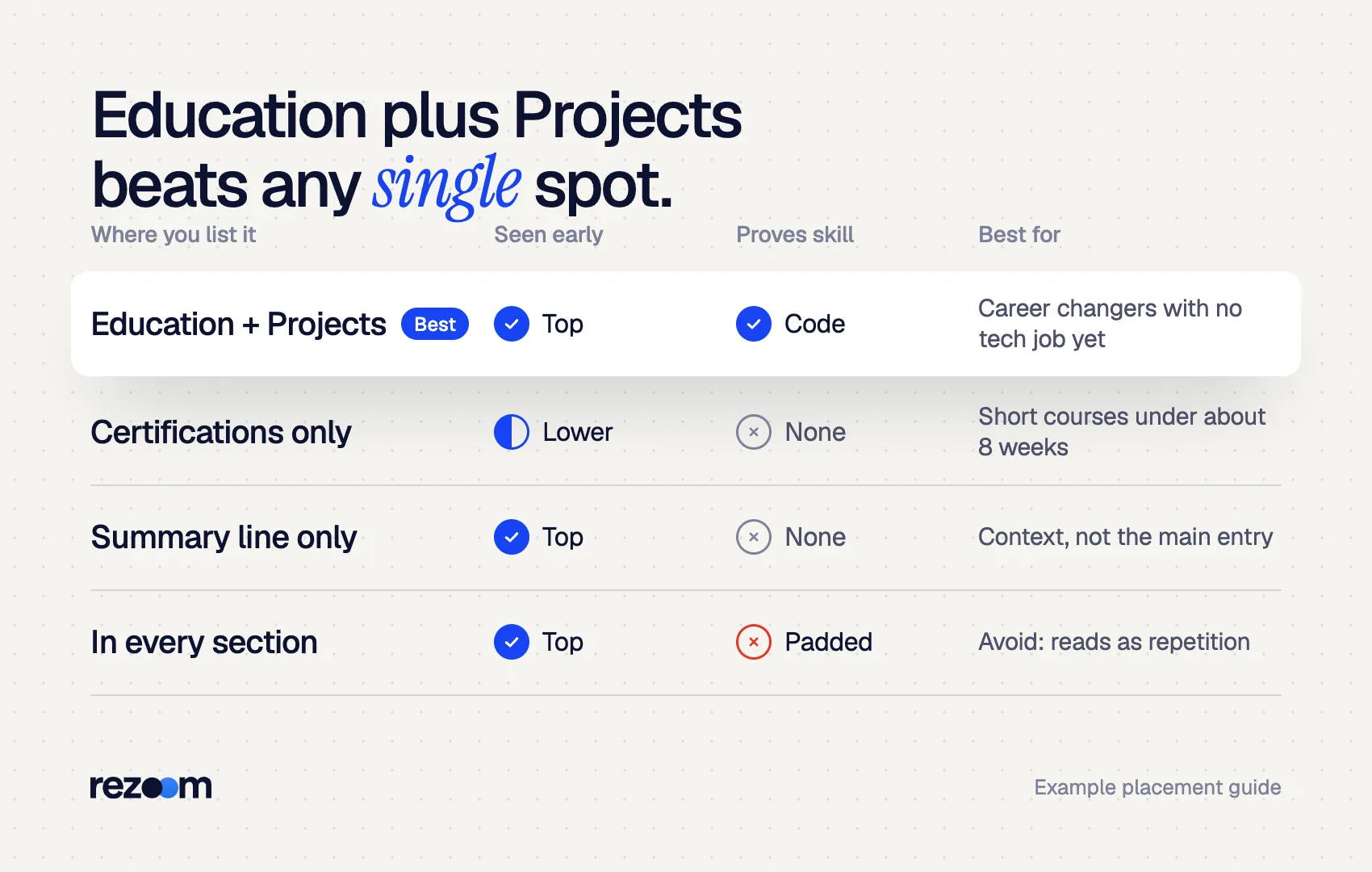
Put the bootcamp in Education by default. If it is your only tech training and you have no tech job yet, place Education right below your summary and add a Projects section after it. If you already work in tech, keep it in Education below your degree, or under Professional Development.
Use this decision rule. Your strongest evidence goes highest on the page. For most bootcamp grads, that means the bootcamp and its projects sit above unrelated work history.
| Your situation | Where the bootcamp goes | What goes right after it |
|---|---|---|
| Career changer, no tech job yet | Education, directly under the summary | Projects section with 2–3 builds |
| Recent grad with an unrelated degree | Education, bootcamp listed above the degree | Projects, then work history |
| Already in a tech or tech-adjacent job | Education, below your degree | Experience stays at the top |
| Short course (under about 8 weeks) | Professional Development or Certifications | Skills section |
If you are switching fields, the bootcamp is the bridge, so it belongs near the top. Our career change resume guide shows how to frame the rest of your history around it.
Don't list the same bootcamp in three sections. Mention it once in Education. Then let Projects and Skills show what it produced.
How do you format a coding bootcamp in the Education section?
Write the program name first, then the provider, location or "Remote," and the month and year you finished. Add one to three bullets on the stack you used and the capstone you shipped. Keep the language factual: technologies, hours if impressive, and a measurable result where you have one.
Treat the entry like a degree line. Recruiters skim, so the program title and dates should be scannable at a glance. For more on ordering degrees and programs, see how to list education on your resume.
Full-Stack Web Development Certificate | Example Coding Academy, Remote | Mar 2026
- 600-hour program covering JavaScript, React, Node.js, Express and PostgreSQL
- Built and deployed a capstone booking app with a 4-person team using Git and agile sprints
- Portfolio: github.com/samcarter
Software Engineering Bootcamp (Part-Time) | Example Tech School, Chicago, IL | Jan 2025 – Aug 2025
- Completed 24-week evening program in Python, Django and REST API design while working full time
- Capstone: inventory tracker used to manage stock for a local nonprofit food pantry
Note what these entries leave out. They skip the bootcamp's tagline and course-by-course lists. They also skip claims like "intensive, immersive, job-ready." Those words are marketing, and recruiters discount them.
Write the hours, not the adjectives
"Intensive 12-week program" tells a recruiter nothing they can check. "600-hour program" does. If your bootcamp published total instructional hours, use that number. If it did not, list the technologies and let the capstone carry the weight.
How do you turn bootcamp projects into resume bullets?
Give each project its own entry in a Projects section: project name, stack, and a link. Then write two bullets that say what the app does, what you built personally, and one result such as users, load time or test coverage. Lead with your contribution, not the assignment description.
Projects are where a coding bootcamp on a resume earns its interview. A hiring manager can't test your bootcamp certificate. They can open your repository.
Use a dedicated Projects section, placed right after Education. Our guide on how to list projects on a resume covers the full format, and how to put GitHub on a resume covers links.
Weak bullet: "Worked on a group project to build a web app."
Strong bullet: "Built the React front end and JWT login for a team booking app; cut page load from 3.1s to 1.2s by lazy-loading routes."
The strong version names your part, the stack and a result. If you have no real numbers, describe scope instead: number of endpoints, test coverage, or real users.
Name the specific technologies the job posting lists, such as React or SQL do: Link a live demo or a clean GitHub repository with a README do: Say what you personally built on team projects
Copy the bootcamp's project brief as your bullet dont: List every tutorial app, such as to-do lists and calculators dont: Call yourself a "senior" or "full-stack engineer" without job experience
Mirror your skills section to the same stack. A short, specific list beats a long one; see technical skills for a resume for how to group them.
How do you list a coding bootcamp you haven't finished?
An in-progress coding bootcamp on a resume is fine to list. Recruiters see "Expected" dates on student resumes every day. Add the technologies you have already used, not ones still on the syllabus.
If you left a bootcamp early, you can still show the learning honestly. Write "Coursework in JavaScript and React, Example Coding Academy, 2025." Don't use "Certificate" or a graduation date.
If you studied the remaining material on your own, list it separately. Our sibling guide on online courses on a resume shows how to present self-paced learning.
How do you list a coding bootcamp on a resume when you also have a degree?
List both in Education in reverse-chronological order, so a recent bootcamp sits above an older degree. If your degree is in computer science, the bootcamp may add little; move it to Professional Development or drop it. If your degree is unrelated, the bootcamp is your relevant training and should stay prominent.
Reverse-chronological order usually does the work. A 2026 bootcamp sits above a 2019 history degree, which puts your newest, most relevant training first.
Keep the degree even if it is unrelated. It still answers the screening question "bachelor's degree or equivalent." The bootcamp then explains your pivot.
If you send many versions of your resume, keep a master resume with every project. Then trim it into a targeted resume for each posting.
When the draft is ready, the Rezoom AI resume builder can format the Education and Projects sections and match your skills to the job description.

Frequently asked questions
Do employers take coding bootcamps seriously?
Many do, especially for web development roles, where BLS lists education requirements ranging from a high school diploma to a bachelor's degree. Employers weigh the projects and code you can show more than the bootcamp's name.
Should a coding bootcamp go under Education or Certifications?
Put a multi-month coding bootcamp on a resume under Education. Short courses of a few weeks fit better under Certifications or Professional Development.
Should I put my bootcamp in my resume summary?
Yes, if you are changing careers. A line such as "Full-stack developer trained through a 600-hour bootcamp, with three deployed React apps" sets context fast.
How do I list a bootcamp on a resume if I have no experience?
Place Education and Projects above any unrelated work history. Then list transferable work below, focusing on results like process improvements or tools you used.
Should I include the bootcamp's name if it is not well known?
Yes. Recruiters need the provider name to verify your training. A lesser-known name matters less when strong projects follow it.
Can I list bootcamp projects as work experience?
Only if it was paid or client work, such as a real project for a nonprofit. Otherwise keep it in Projects, so you don't overstate your experience.



Comments