
Summary
No AI detector for cover letters can reliably prove who wrote a letter. OpenAI withdrew its own classifier in 2023 for low accuracy, and a Stanford study found detectors misclassified 61% of essays by non-native English writers as AI. Employer surveys show hiring managers mostly judge AI use by eye, and what gets letters rejected is generic content. The safest move is a specific, verifiable letter, not a lower detector score.
An AI detector for cover letters gives you a probability, not proof. Independent research and the AI companies themselves say these tools are not reliable enough to judge who wrote a piece of text, and they flag human writing as AI more often than most people expect.
That does not mean AI use goes unnoticed. Hiring managers say they spot it, and some reject it. But the surveys point to a different trigger than detector software: letters that are generic, templated and impossible to tie to a real person.
This guide covers what the accuracy research shows, what employers actually report doing, and what to do instead of chasing a "100% human" score.
Does an AI detector for cover letters actually work?
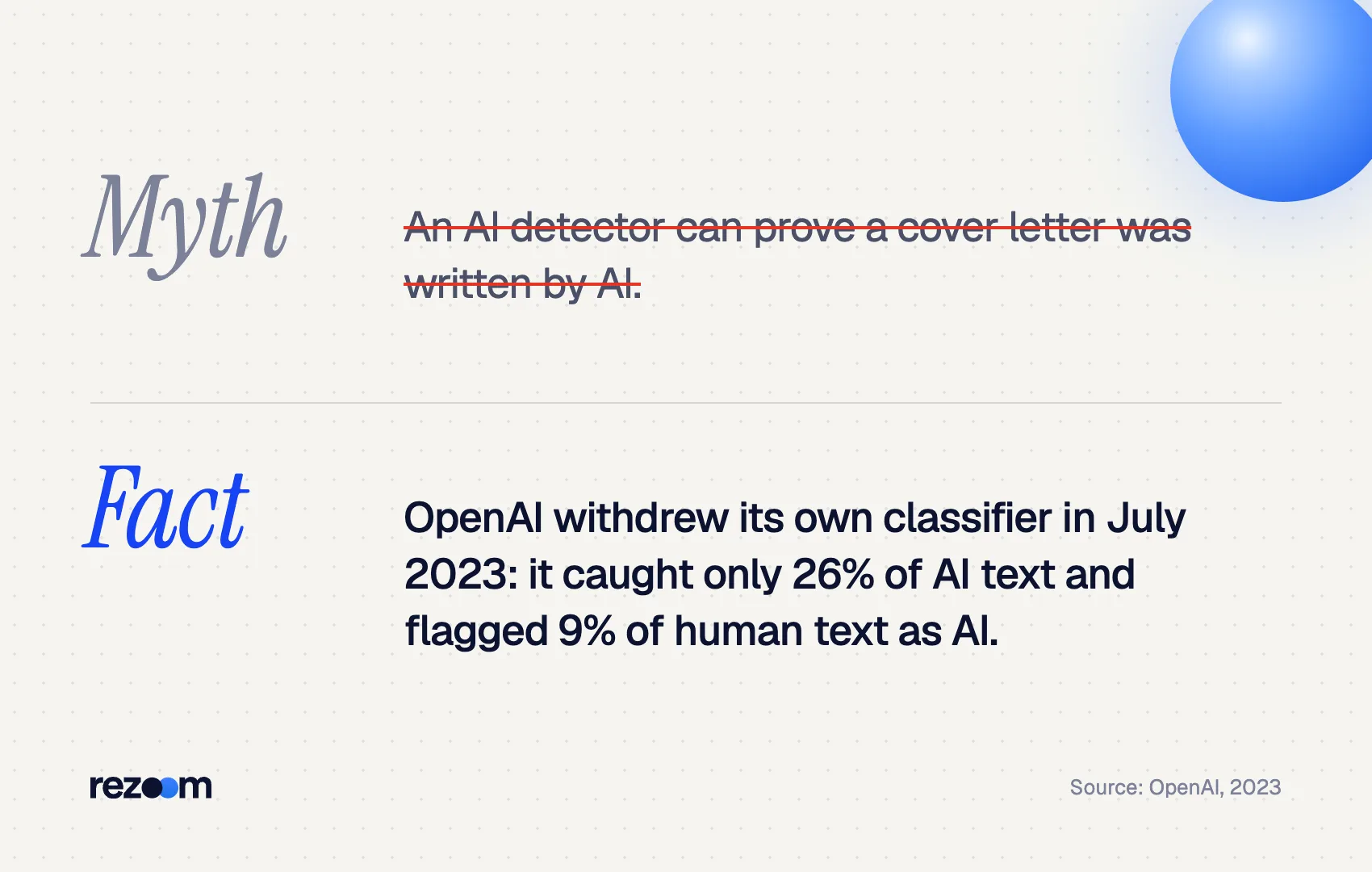
Not reliably. OpenAI shut down its own AI text classifier in July 2023 because of low accuracy: it caught only 26% of AI-written text and wrongly flagged 9% of human text. A 2023 study of 14 detection tools concluded they were neither accurate nor reliable. A detector score is an estimate, not evidence.
The clearest signal comes from OpenAI, the company behind ChatGPT. Its AI classifier correctly identified only 26% of AI-written text and labeled 9% of human-written text as AI. On July 20, 2023, OpenAI withdrew it "due to its low rate of accuracy."
OpenAI's help center is just as direct. Asked whether AI detectors work, it answers "In short, no" in its own experience. It adds that its research detector flagged texts like Shakespeare and the Declaration of Independence as AI-generated.
Independent testing agrees. A team of academic integrity researchers tested 14 tools, including Turnitin, and concluded that the available detection tools are neither accurate nor reliable. Obfuscating AI text, such as by rewording it, made their performance significantly worse.
So an AI detector for cover letters can tell you how "typical" a text looks to one model. It cannot tell an employer, or you, who actually wrote it.
Why do AI detectors flag human-written cover letters?
Detectors look for predictable, formulaic wording, and cover letters are formulaic by design. Short, polished, conventional writing scores as "AI-like." A Stanford study found seven detectors misclassified 61% of essays by non-native English writers as AI-generated, and 97.8% were flagged by at least one.
Most detectors score how predictable each word choice is. Plain, correct, conventional prose looks predictable. That describes a lot of good cover letters.
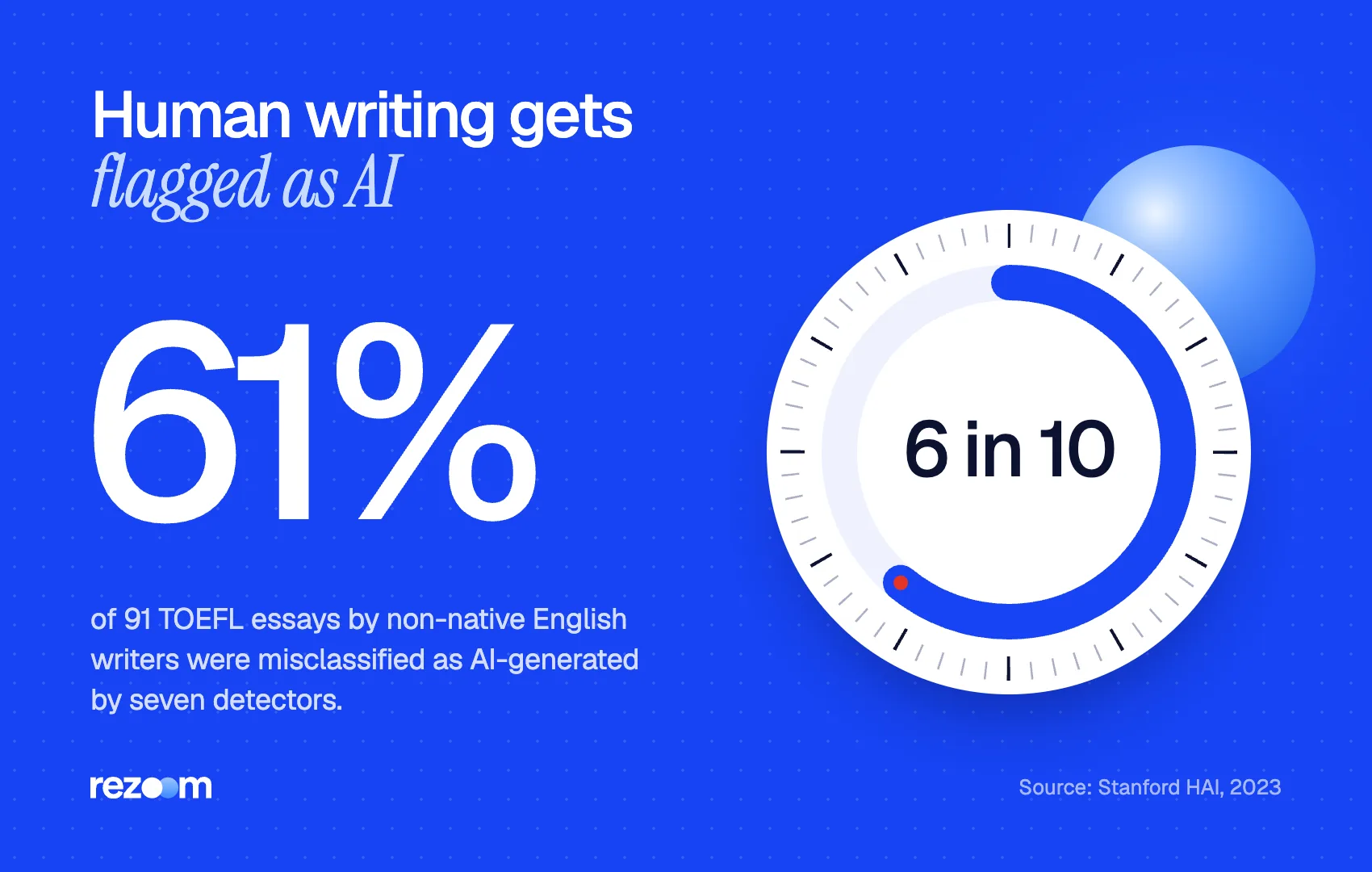
The best-known evidence is a 2023 Stanford study led by James Zou. Seven detectors misclassified 61.22% of 91 TOEFL essays written by non-native English speakers as AI-generated. All seven detectors flagged 18 of the essays, and 97.8% were flagged by at least one. Zou called current detectors "clearly unreliable and easily gamed."
Even the vendors advise caution. Turnitin reports a sentence-level false positive rate of around 4%. It tells educators never to use the score as the sole basis for a decision. A hiring manager scanning hundreds of letters has less context than a teacher who knows the student.
Cover letters have three traits that raise the risk:
- Stock phrases. "I am writing to express my interest" appears in millions of human letters, so models learned it too.
- Short length. A 250-word letter gives a detector little text to judge.
- Heavy editing. Grammar tools and careful revision smooth out the quirks that read as human.
Do employers run AI detectors on cover letters?
The surveys show employers check for AI, but mostly by judgment, not software. Insight Global found 88% of hiring managers believe they can tell when candidates used AI. No major survey we found measures how many employers run detector software on cover letters. Generic content is the main reason AI-assisted letters get rejected.
Here is what recent hiring manager surveys report. Notice what each one does and does not measure.
| Survey | Finding | What it tells you |
|---|---|---|
| Insight Global, 2025 (1,005 hiring managers) | 88% say they can tell when candidates use AI; 54% would care | Detection is mostly a judgment call |
| Resume Now, 2025 (925 HR workers) | 78% say their companies actively check for AI-generated content | The method is not specified |
| Resume Genius, 2026 | 58% have received AI-generated resumes or cover letters | AI-assisted letters are common |
| TopResume, 2025 (600 hiring managers) | 19.6% would reject an AI-generated resume or cover letter; 52% accept AI for proofreading or drafting | Light AI help is widely tolerated |
The pattern is consistent. Most hiring managers accept AI as a writing aid, a minority penalize it, and "checking" usually means reading closely. Capterra's principal HR analyst put it plainly: when candidates use AI to refine a resume or cover letter, "most employers won't bat an eye". The concern is using AI to mask missing skills.
For the resume side of this question, see our guide on whether employers can detect an AI resume. For the broader ethics, read is it bad to use AI for your resume.
What makes a cover letter read as AI-written?
Generic content, not a detector score. In Resume Now's 2025 survey, 53% of HR workers were frustrated by templated messages with no unique relevance to the role, and 62% said AI resumes without personalization often lead to rejection. Letters without names, numbers or a real reason for the company read as machine-made.
The Resume Now data is the most useful here. 62% said AI-generated resumes without personalization often lead to rejection, and 78% said personalized details signal genuine interest and fit. Generic content was a top rejection reason for 36%.
That gives you a concrete test. Read each sentence and ask: could any other applicant send this unchanged? If yes, it reads as AI, whoever wrote it.
Generic: I am excited to apply for the Marketing Coordinator position at your esteemed company, where I can leverage my passion for innovative marketing solutions.
Specific: Your spring campaign for the Riverside location tripled event sign-ups. I ran a similar push for a 12-location gym chain last year, lifting class bookings 34% in eight weeks.
Generic: I am a detail-oriented team player with strong communication skills and a proven track record of success.
Specific: At Harbor Dental, I rebuilt our appointment reminder process in Google Sheets, cutting no-shows from 14% to 8% over two quarters.
The specific versions are not just harder to flag. They also give the interviewer something to ask you about. Our list of cover letter mistakes covers the other habits that make letters feel generic.
Should you run your own cover letter through an AI detector?
You can, but treat the score as noise. A "likely AI" result on a letter you wrote proves nothing, and rewriting to chase a lower score often makes writing worse. Do not use "humanizer" or detector-evasion tools. Check instead whether every sentence is specific to you, the role and the company.
Running a free AI detector for cover letters will not hurt you. The risk is what you do with the result. People who get a high score often swap clear words for odd ones, add errors on purpose or paste the letter into a "humanizer."
Skip all three. Evasion tools try to hide authorship rather than improve the letter, and readers notice clumsy phrasing faster than any software. If the letter misrepresents your experience, no rewording fixes that.
A better self-check takes five minutes:
- Highlight every sentence that names a company, product, number, tool or person.
- Delete or rewrite any paragraph with no highlights.
- Confirm every claim matches your resume and that you can explain it out loud.
- Read it aloud. Rewrite any line you would never say.
Name the company, the role and one specific reason you want it do: Use real numbers you can explain in an interview do: Keep your drafts and notes so you can show your process do: Use AI to outline, tighten and proofread your own content
Paste the letter into a humanizer or detector-evasion tool dont: Add typos or odd word choices to look human dont: Send a letter that would fit any company unchanged dont: Let AI add achievements you did not have
How do you make an AI-assisted cover letter clearly yours?
Write the facts yourself and let AI handle structure. Give the tool your real achievements, numbers and reasons for applying, then edit the draft until every paragraph contains something only you could write. Specific, verifiable details protect you better than any detector result.
The safest workflow puts your input first. Draft three facts before you open any AI tool: one achievement with a number, one reason this company fits, and one skill the posting asks for.
Then use AI for what it does well: ordering ideas, trimming words and catching errors. Our guides to ChatGPT cover letter prompts and whether ChatGPT can write a cover letter show prompts that keep the model from inventing details.
Keep your version history
Write in Google Docs or Word with version history on. If anyone questions your letter, the edit history shows your drafts and changes over time. That record is stronger evidence than any detector score, and it costs nothing.
Our guide to using an AI cover letter generator shows how to build a first draft from your resume and the job description, so the specifics come from your own experience. Start with a tailored resume in the Rezoom AI resume builder, and the letter has real material to work with.
What should you do if an employer says your letter was flagged?
Stay calm and offer evidence of your process: drafts, version history and the notes behind each claim. Explain how you wrote it and which tools you used, if any. You can also note that detector makers, including OpenAI and Turnitin, warn their scores should not be the sole basis for a decision.
This is rare, but it happens. A short, factual reply works better than a defensive one.
Thank you for letting me know. I wrote this letter myself and used a grammar tool to proofread it. I am happy to share my drafts and document history, and to talk through any example in it. The 34% booking increase, for instance, came from a campaign I planned and ran at FitLine Gyms in 2025.
If you did use AI to help, say so plainly and describe how. Most hiring managers accept AI as a drafting aid. What they want is proof the experience is real.
Frequently asked questions
Can employers tell if a cover letter is written by AI?
Many believe they can: 88% of hiring managers in Insight Global's 2025 survey said so. In practice they spot generic, templated content rather than prove AI authorship. Specific, personal letters rarely raise the question.
What is the most accurate AI detector for cover letters?
No tool has proven reliable enough to judge authorship. OpenAI withdrew its own classifier for low accuracy, and a 2023 study of 14 tools found none accurate or reliable. Treat any score as a rough estimate.
Why does my human-written cover letter show as AI?
Cover letters use conventional phrases and polished grammar, which detectors read as predictable. Short texts and non-native English writing are flagged more often, as the Stanford study showed.
Is it bad to use AI to write a cover letter?
Not for most employers. In TopResume's survey, 52% of hiring managers said AI for proofreading or drafting support is acceptable. Problems start when the letter is generic or claims experience you do not have.
Should I use an AI humanizer on my cover letter?
No. Humanizers aim to hide authorship, not improve the letter, and often produce awkward phrasing. Add specific facts from your own experience instead.
Do applicant tracking systems detect AI-written cover letters?
None of the surveys above shows applicant tracking systems running AI detection as a standard step. An ATS parses and stores your documents; people read the cover letter.

Comments