Quick Learner Cover Letter: 12 Proof Lines That Beat the Cliché
Write a quick learner cover letter line that proves it: a 3-part formula, 12 copy-ready lines by situation, better synonyms, a sample paragraph and mistakes.

On this pageShould you say you're a quick learner in a cover letter?
- Should you say you're a quick learner in a cover letter?
- How do you prove you're a quick learner in a cover letter?
- Quick learner cover letter lines by situation
- What can you say instead of "quick learner"?
- Where does the quick learner line go in your cover letter?
- What mistakes make a quick learner claim fall flat?
- How do you check your quick learner cover letter before you send it?
- FAQ
- Sources
Don't just write "I'm a quick learner." Prove it with one sentence that names what you learned, how fast you learned it and what you did with it, such as "I learned Salesforce in 10 days and logged 40 calls in my first week." Put that line in a body paragraph that matches a skill from the job post, and tie it to the employer's own tools or training.
A quick learner cover letter line works only when it proves the claim. Name the skill you learned, how fast you learned it and the result, then tie it to the job. "I learned Salesforce in 10 days" beats "I'm a quick learner" every time.
Below you'll find a proof formula and 12 copy-ready lines by situation. You also get stronger words, a sample paragraph and the mistakes that make managers skim past it.
Quick answers by situation
| Your situation | What to say/do | Example line |
|---|---|---|
| New grad, first full-time job | Use a class, lab or internship tool you learned fast | "I learned R in one semester and ran the lab's survey analysis." |
| Career change | Show a past jump into a new field | "I moved from retail to payroll and passed my first audit in month two." |
| The job uses software you don't know | Name a similar tool you learned fast | "I learned Asana in a week, so I expect to pick up Monday.com quickly." |
| No work experience | Use school, volunteer or club proof | "I trained 12 new volunteers after just three weeks on the team." |
| Internal transfer | Use a process you learned at the same company | "I took over our returns system in five days when a coworker left." |
| Back after a gap | Show a recent course or certificate | "I finished Google's IT Support course in eight weeks this spring." |
Should you say you're a quick learner in a cover letter?
Yes, but only with proof. The phrase "quick learner" alone reads as a cliché. and career centers tell students to show evidence instead of naming traits. Employers do value the skill. Half of the employers in the World Economic Forum's 2025 survey called curiosity and lifelong learning a core skill. So keep the idea and replace the label with a fact.
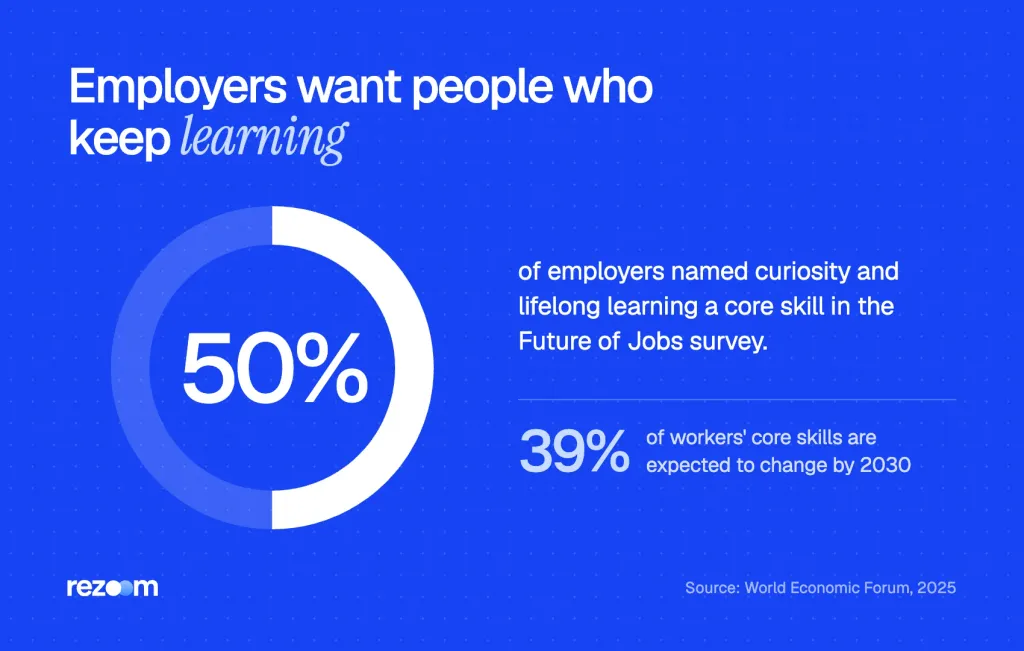
Hiring managers want people who can learn on the job. In the World Economic Forum's Future of Jobs Report 2025, 50% of employers1 named curiosity and lifelong learning as a core skill. The same report says employers expect 39% of workers' core skills to change by 2030.
But the words "quick learner" don't prove anything. The Muse's Sara McCord put it bluntly in her list of cover letter clichés3: saying you learn quickly "isn't going to knock anyone's socks off." Her fix is a stat or a story.
What hiring managers actually look for
NACE, the national association of college career offices and campus recruiters, hears the same thing from employers each year. Its CEO said this in the 2026 Spring Update release on skills new grads should show2:
It is not enough for candidates to simply list their skills: Employers want to see examples.
Shawn VanDerziel, NACE, 2026
University career centers say it too. The University of Illinois Career Center tells students to "show, don't tell"4 and to back every skill with evidence. If you've already added proof to your resume with our guide on how to show you're a quick learner on a resume, the cover letter is where you tell the story behind it.
Fast learner or quick learner on a resume? Use synonyms recruiters believe, a ramp-up formula and copy-ready bullets that prove how fast you learn new tools.
How do you prove you're a quick learner in a cover letter?
Use a three-part proof sentence: what you learned, how fast you learned it. and what you did with it. Add a link to the new job, such as their software or training plan. One proof sentence like "I learned Epic in two weeks and trained three nurses on it" replaces the whole cliché.
Strong quick learner cover letter lines follow one pattern. They name a real skill, a time frame and a result. Then they point that pattern at the new job.
- Pick the skillChoose a tool, process or subject you learned recently, ideally one close to the job post.
- Add the timeSay how long it took: "in two weeks," "by my second shift," "in one semester."
- Show the resultAdd what you did with it: a task done, a number hit, people trained.
- Point it at the jobName the employer's tool or need, so the reader sees the same speed on their team.
Fill-in-the-blank template
Use this template when you don't know where to start. Fill each bracket with a real fact from your work, school or volunteer life.
"When [situation], I learned [skill or tool] in [time frame]."
"Within [time], I [result with a number if you have one]."
"I'd bring the same speed to [employer's tool, task or training program]."
Why a time frame matters
A time frame turns an opinion into a fact the reader can check. "Fast" means nothing to a stranger, but "in my first two weeks" does.
If you don't remember the exact days, use a unit you do remember. "By my third shift" or "before the end of my first project" is honest and still specific. Never stretch a time frame you can't back up in an interview.
Quick learner cover letter lines by situation
Match the proof to your situation. New grads can use class tools and internships, career changers can show a past jump into a new field. and internal applicants can name a company process. Each line below follows the skill, time and result formula. and you can swap in your own facts.
These 12 lines are ready to copy and edit. Change the tool, the time and the result so every detail is true for you.
Entry-level and new grad
"In my capstone, I learned Tableau in two weeks and built the dashboard our client still uses." "During my internship, I learned the CRM by day three and handled 30 customer tickets in my first week."
Career change
"After eight years in teaching, I learned QuickBooks in a month and now run the books for two small clients." "When I moved from hospitality to logistics, I learned our routing software in one week and cut late deliveries on my route."
New software you haven't used
"I haven't used Workday yet, but I learned ADP in five days and now process payroll for 60 staff." "I picked up Figma in one weekend for a class project, so I expect to ramp up on Sketch fast."
No work experience yet
If you have no job history, school and volunteer work still count. Our guide to a cover letter with no experience shows how to build the whole letter around that kind of proof.
"As a new food bank volunteer, I learned the intake system in two shifts and then trained the next five volunteers." "I taught myself basic Python over one summer and wrote a script that sorts our club's sign-up list."
A cover letter with no experience fails two ways — a concession up front, then a list instead of proof. Here is the fix, with examples and a template.
Internal transfer and back after a gap
- Line 9 (internal): "When our team lead left, I learned the vendor ordering process in four days and kept every order on time."
- Line 10 (internal): "I already know our ticket system, and I learned the billing module in one week while covering for a coworker."
- Line 11 (gap): "During my two years at home, I finished a medical billing certificate in 12 weeks."
- Line 12 (gap): "I returned to work in March and was cleared to run the front desk alone by my second week."
What can you say instead of "quick learner"?
Use a stronger verb or phrase, then back it with proof. Good swaps include "ramped up in," "picked up," "self-taught," "adapted quickly to" and "trained others on." The word matters less than the fact after it. so pick the one that fits your example and skip trait labels like "fast learner."
A synonym alone won't fix the cliché. Still, a precise verb makes your proof sentence read faster. For a longer list, see our guide to another word for quick learner.
| Instead of | Try | Works best when |
|---|---|---|
| "I'm a quick learner" | "I ramped up on [tool] in [time]" | You learned a system at a job |
| "I learn fast" | "I picked up [skill] by [point in time]" | The skill was informal or hands-on |
| "I'm adaptable" | "I adapted to [change] within [time]" | A process or team changed around you |
| "I'm eager to learn" | "I'm already learning [their tool] through [course]" | You lack a tool the job lists |
| "Fast learner" | "Self-taught in [skill]" | You learned it on your own time |
| "I catch on quickly" | "I trained [number] others on [skill] after [time]" | You can teach it |
The last swap is the strongest. If you taught a skill soon after you learned it, you proved speed and mastery in one sentence.
A cover letter tailored to every job post, in minutes.
Where does the quick learner line go in your cover letter?
Put your proof in the first body paragraph, right after you name the skill the job needs most. Then mention it again in one short line near the close if the job involves training or new tools. Keep it out of the first sentence, because the opening should say which job you want and why.
Most letters run three to five short paragraphs on one page. The University of Minnesota's College of Liberal Arts advises a body of three to five brief paragraphs5 that stays under one page. So your proof gets one or two sentences, not a whole paragraph of praise.
| Part of the letter | What it does | Quick learner role |
|---|---|---|
| Opening | Names the job and your hook | Skip the claim here |
| First body paragraph | Matches your top skill to the job | Put your proof sentence here |
| Second body paragraph | Adds a second skill or story | Use a second example if you have one |
| Closing | Restates fit and asks for a talk | One short line, if the job has a training period |
Need the full structure first? Start with our guide on how to write a cover letter, then add your proof line to the body.
Sample paragraph you can adapt
Here is a short body paragraph from Jordan, a recent grad applying for an operations role. It uses the formula once and points it at the employer.
"Your posting asks for someone who can learn your inventory system fast." "Last summer, I learned NetSuite in my first week as an intern at a local distributor." "By week three, I ran the daily stock report on my own and caught a $4,000 count error." "I'd bring that same ramp-up speed to your team and your SAP rollout."
Want more models? Browse our student cover letter examples to see how other students connect class and internship proof to a job. For a full letter, open the college graduate cover letter example.
College graduate cover letter example
See how a new grad turns internship proof into a one-page letter.
What to say if they push back
Your proof line often comes up in the interview. So be ready to explain how you learned. and how you'd learn their tool.
Interviewer: "Your letter says you learned NetSuite in a week. Walk me through that."
"First I watched the vendor's training videos, then I asked my manager for three real tasks."
Interviewer: "We use SAP. That's a lot bigger."
"It is, so I'd start with the training plan and shadow your lead on the first close."
What mistakes make a quick learner claim fall flat?
The biggest mistakes are claiming the trait without proof, stacking clichés like "hard-working quick learner," using an example from years ago and hiding a skill gap you should name. Each one makes the line easy to skim past. Instead, use one recent, specific example tied to a tool or task the job lists.
Do
- Give one recent example with a time frame.
- Name the employer's tool or task in the same paragraph.
- Use a number when you have one, such as people trained or tasks done.
Don’t
- Write "I'm a hard-working, detail-oriented quick learner."
- Use an example from more than five years ago if you have a newer one.
- Promise you'll "learn anything" without saying how.
Before and after: the same line, rewritten
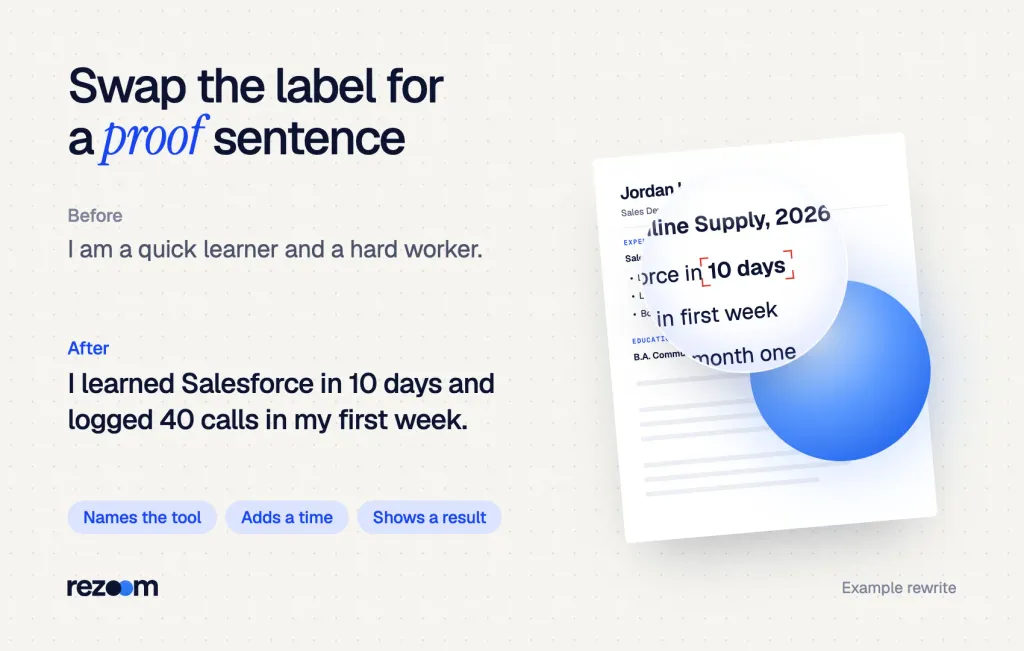
A trait claim gives the reader nothing to check. This rewrite adds the tool, the time and a result. so the manager can picture you on the job.
Before: "I am a quick learner and a hard worker."
After: "I learned Salesforce in 10 days and logged 40 calls in my first week."
If the job lists a tool you've never used, say so in one line and then show a fast example. Honesty plus proof reads as confidence. Hiding the gap only means it comes up later in the interview.
How do you check your quick learner cover letter before you send it?
Read the proof line against the job post. Check that it names a real skill, a time frame and a result, that it sits in a body paragraph and that you can explain it in an interview. Then match it to your resume, so the same proof appears in both documents.
Your letter and resume should tell the same story. so the result should appear in both.
Before you send the letter
Match the proof on your resume
If you're a student, our student and entry-level resume examples show how to turn class projects and part-time jobs into bullets. A new grad can start from the college graduate resume example and add the same learning proof under an internship.
College graduate resume example
See how a new grad lists internship results and tools learned on one page.
Draft it faster
If you'd like a first draft to edit, the AI cover letter builder writes a letter from the job post and your resume. Then swap in your own proof line, because that one sentence should always be yours.
Tailored to the job post, checked against ATS.
Frequently asked questions
Is it OK to say "quick learner" in a cover letter?
Yes, but only with proof right after it. A line like "I learned Excel macros in two weeks" works far better than the phrase alone.
What is a good example of a quick learner cover letter sentence?
"In my internship, I learned the CRM by day three and handled 30 tickets in my first week." It names the skill, the time and the result.
Where should I mention being a quick learner in my cover letter?
Put it in the first body paragraph, next to the skill the job needs most. You can add one short line near the close if the job has a training period.
What can I say instead of quick learner?
Try "ramped up on," "picked up," "self-taught in" or "trained others on." Follow it with a real example and a time frame.
How do I show I'm a quick learner with no experience?
Use school, volunteer or club examples. For example, say how fast you learned a lab tool or how soon you trained new volunteers.
Should I mention software I don't know yet?
Yes, if the job lists it. Say you haven't used it, then name a similar tool you learned fast or a course you've started.
Sources
We opened and read each page below. The small numbers in the text point here. Pages that carry no publication date show n.d.
- World Economic Forum2025
50% of employers named curiosity and lifelong learning a core skill, and employers expect 39% of workers' core skills to change by 2030.
- NACE2026
NACE's CEO says employers want to see examples of skills, not just a list of them.
- The Muse2025
Saying you are a fast learner is a cover letter cliché; include a stat or story instead.
- University of Illinois Career Centern.d.
Show, don't tell: give evidence for each skill, and avoid mass-produced or AI-generated letters.
- University of Minnesota College of Liberal Artsn.d.
A cover letter body should be three to five brief paragraphs and stay within one page.
Mohammad has spent more than ten years designing consumer products and leads product at Rezoom, deciding what gets built and what gets left out. His guides cover the whole job search, from resume sections and cover letters to interview answers and career moves.
Goodi, M. (2026, November 22). Quick Learner Cover Letter: 12 Proof Lines That Beat the Cliché. Rezoom. https://rezoom.io/quick-learner-in-cover-letter/