Data Entry Clerk Marisol Quintero-Adeyemi
Data Entry Clerk, Freight Documentation
[email protected] | (915) 555-0118 | El Paso, United States
Profile
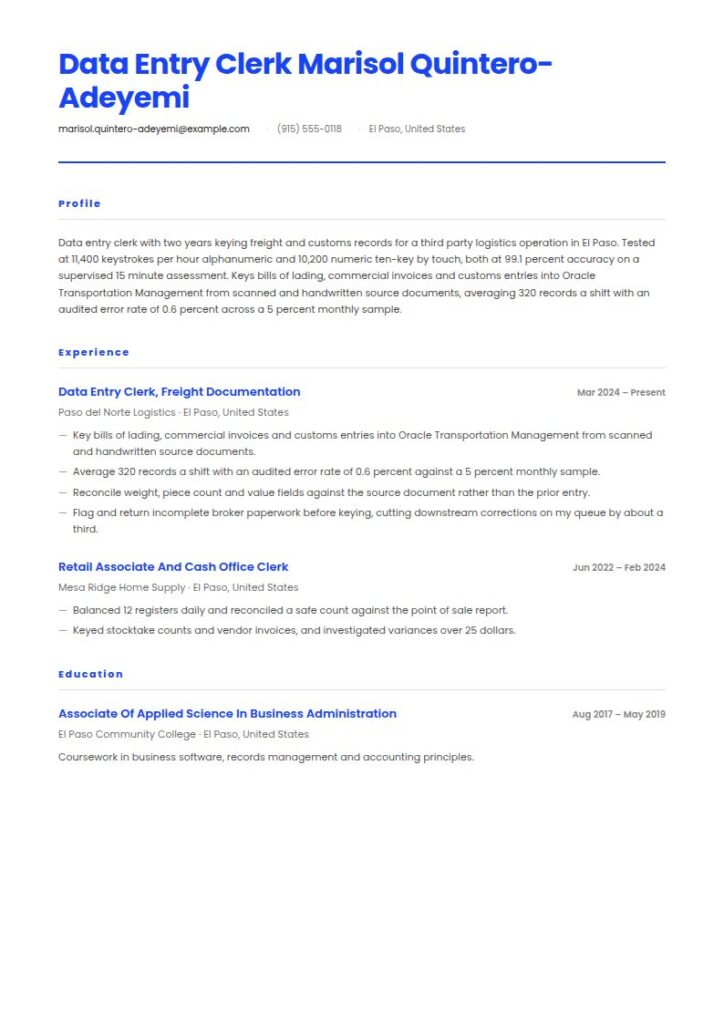
Data entry clerk with two years keying freight and customs records for a third party logistics operation in El Paso. Tested at 11,400 keystrokes per hour alphanumeric and 10,200 numeric ten-key by touch, both at 99.1 percent accuracy on a supervised 15 minute assessment. Keys bills of lading, commercial invoices and customs entries into Oracle Transportation Management from scanned and handwritten source documents, averaging 320 records a shift with an audited error rate of 0.6 percent across a 5 percent monthly sample.
Work Experience
03/2024 - Present, Data Entry Clerk, Freight Documentation, Paso del Norte Logistics, El Paso, United States
- Key bills of lading, commercial invoices and customs entries into Oracle Transportation Management from scanned and handwritten source documents.
- Average 320 records a shift with an audited error rate of 0.6 percent against a 5 percent monthly sample.
- Reconcile weight, piece count and value fields against the source document rather than the prior entry.
- Flag and return incomplete broker paperwork before keying, cutting downstream corrections on my queue by about a third.
06/2022 - 02/2024, Retail Associate and Cash Office Clerk, Mesa Ridge Home Supply, El Paso, United States
- Balanced 12 registers daily and reconciled a safe count against the point of sale report.
- Keyed stocktake counts and vendor invoices, and investigated variances over 25 dollars.
Education
08/2017 - 05/2019, Associate of Applied Science, Business Administration, El Paso Community College, El Paso, United States
Coursework in business software, records management and accounting principles.
Skills
Alphanumeric data entry, 11,400 KPH at 99.1 percent, 80
Ten-key by touch, 10,200 KPH at 99.1 percent, 80
Source document reconciliation, 75
Oracle Transportation Management, 70
Microsoft Excel, lookups and pivot tables, 65
OCR correction in Adobe Acrobat, 70
Languages
English, native
Spanish, native
Certificates
09/2024, Microsoft Office Specialist, Excel Associate, Microsoft
Summary
A data entry specialist resume is a one page document stating your tested keystrokes per hour with the accuracy percentage attached, the systems and record types you key, and your audited error rate. This guide gives you three adaptable versions, the numbers an employer will retest you on, and current Bureau of Labor Statistics pay and projections for a declining occupation.
Data Entry Specialist resume examples by experience level
A data entry specialist resume is a one page document that states how fast you key, how accurately you key, and what you key into. Everything else on the page is supporting material.
That is unusual among office jobs, and it is the thing to build the resume around. Almost every other administrative claim is unverifiable until someone calls a reference. Yours is verifiable in fifteen minutes on a test, which means an unsupported speed claim is not a small exaggeration. It is a number you will be asked to reproduce.
Resume guide for a data entry specialist resume
This guide and the corresponding data entry specialist resume example will cover:
- How to write a data entry specialist resume, section by section
- How to state keystrokes per hour and words per minute so the numbers hold up
- Three adaptable summaries: clerk, specialist and data quality lead
- Quality sampling, double key verification and what an audited error rate looks like
- Why this occupation is shrinking, and the three moves out of it that pay more
How to write a data entry specialist resume
Six sections: contact header, summary, a tested speed and accuracy block, experience, systems and skills, and education with certifications. One page. This job has never rewarded a two page resume.
| Section | What it is answering | Where it goes |
|---|---|---|
| Speed and accuracy | Will this person pass our test? | Its own block, directly under the summary |
| Systems | Which platform can they key into on day one? | Named individually, never as "data entry software" |
| Record types | Claims, invoices, orders, charts, forms, survey instruments? | Inside every experience bullet |
| Quality | What is their audited error rate, against what sample? | One bullet per role, with the sample size |
Learn the arithmetic behind the numbers you are quoting
Keystrokes per hour and words per minute are the same measurement in different units. The industry convention counts one word as five keystrokes, so words per minute multiplied by 300 gives you keystrokes per hour: 40 words per minute is 12,000 keystrokes per hour, and 10,000 keystrokes per hour is a little over 33 words per minute.
Two things follow. First, quote whichever unit the posting uses, and be able to convert on request, because an interviewer who hears both from you and finds they disagree will assume you copied them from somewhere.
Second, your raw typing speed and your data entry keystroke rate will not match, and that is normal rather than suspicious. Keying into a form means tabbing between fields, validating, and correcting, so a person typing prose at 74 words per minute may key alphanumeric records at 13,200 keystrokes an hour. Say which is which.
Run the file through the free Rezoom ATS resume checker before you send it. Large back office employers filter on the speed figure itself, so it needs to be machine readable.
Choosing the best resume format for a data entry specialist resume
Reverse chronological, one page, one column. The only structural departure from a standard administrative resume is the speed and accuracy block, which sits above your experience rather than in a skills list at the bottom.
That placement is deliberate. A hiring coordinator screening forty applications for a keying role is looking for one number and one percentage. Making them hunt for it at the bottom of page one is how a qualified file gets set aside.
If you have gaps or a short history, the format still does not change. Temporary and agency placements are normal in this occupation and hiding them behind a functional layout reads worse than listing them.
Include your contact information
| ✅ Right | ❌ Wrong |
|---|---|
| Marisol Quintero-Adeyemi | Marisol Quintero-Adeyemi |
| Data Entry Specialist, 13,200 KPH alphanumeric at 99.4% verified accuracy | Detail oriented professional with fast typing skills |
| Ten-key by touch, double key verification, HIPAA trained | Experienced in data entry and office software |
| (915) 555-0118, [email protected], El Paso, TX | (915) 555-0118, [email protected] |
Put the speed and the accuracy in the header line together. A speed without an accuracy percentage is not a claim anyone in this field takes seriously, because anyone can key fast if the output does not have to be right.
Make use of a summary
Four lines: your tested speed with its accuracy, the record types you handle, the systems you key into, and your audited error rate with the sample it came from.
Data entry clerk with two years keying freight and customs records for a third party logistics operation in El Paso. Tested at 11,400 keystrokes per hour alphanumeric and 10,200 numeric ten-key by touch, both at 99.1 percent accuracy on a supervised 15 minute assessment. Keys bills of lading, commercial invoices and customs entries into Oracle Transportation Management from scanned and handwritten source documents, averaging 320 records a shift with an audited error rate of 0.6 percent across a 5 percent monthly sample.
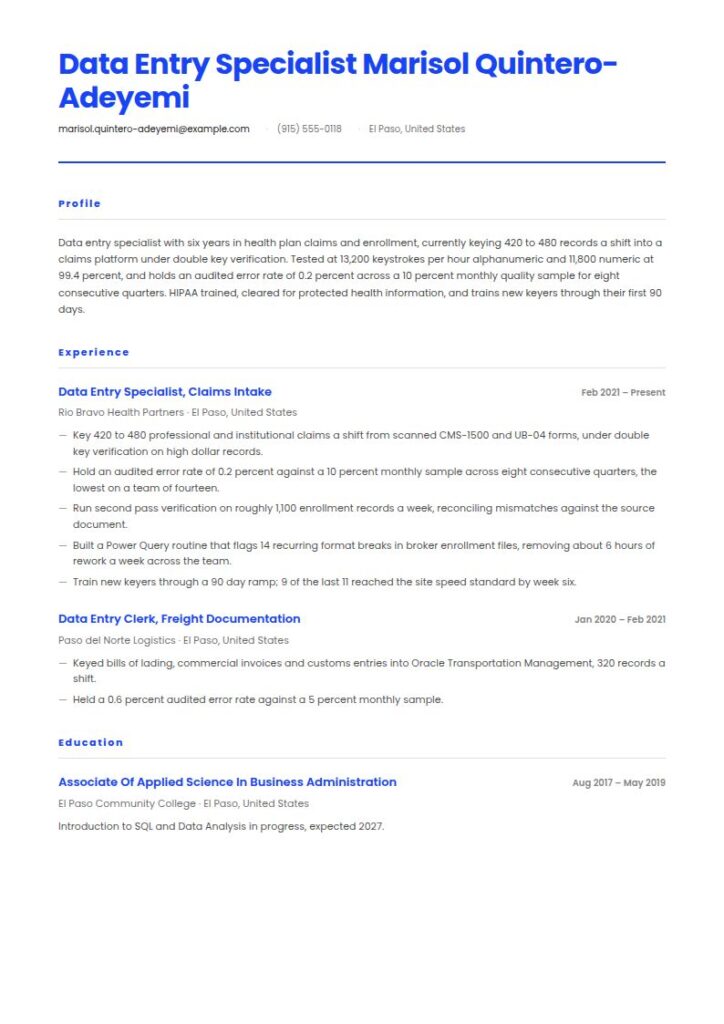
Data entry specialist with six years in health plan claims and enrollment, currently keying 420 to 480 records a shift into a claims platform under double key verification. Tested at 13,200 keystrokes per hour alphanumeric and 11,800 numeric at 99.4 percent, and holds an audited error rate of 0.2 percent across a 10 percent monthly quality sample for eight consecutive quarters. HIPAA trained, cleared for protected health information, and trains new keyers through their first 90 days.
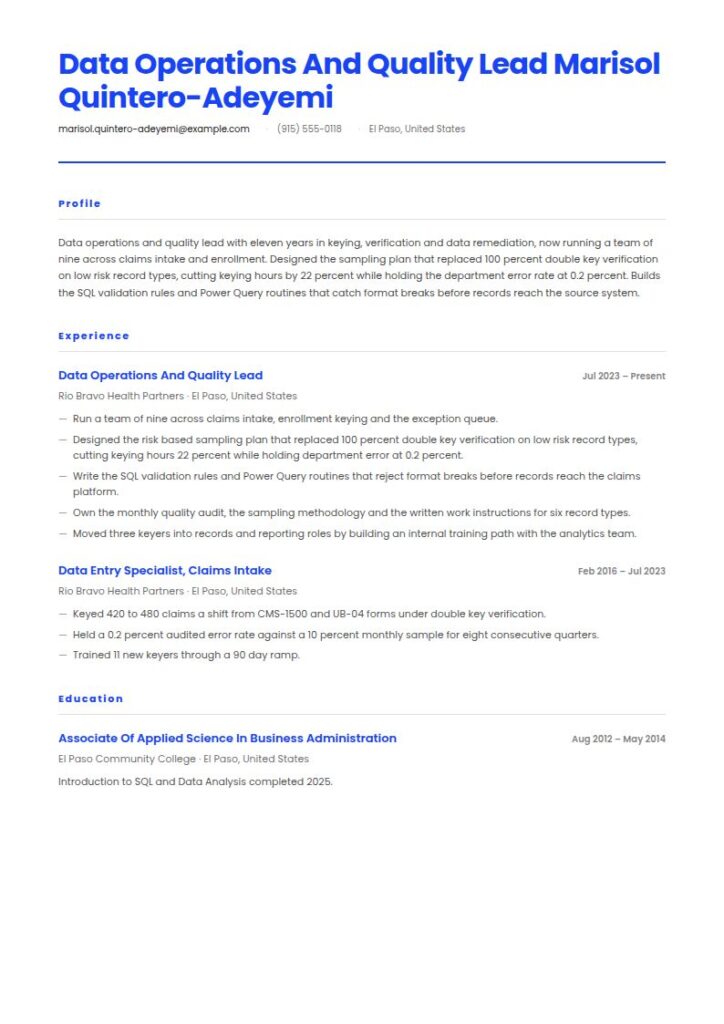
Data operations and quality lead with eleven years in keying, verification and data remediation, now running a team of nine across claims intake and enrollment. Designed the sampling plan that replaced 100 percent double key verification on low risk record types, cutting keying hours by 22 percent while holding the department error rate at 0.2 percent. Builds the SQL validation rules and Power Query routines that catch format breaks before records reach the source system.
Right vs wrong: the same data entry specialist summary, twice
| ✅ Right | ❌ Wrong |
|---|---|
| Tested at 13,200 keystrokes per hour alphanumeric at 99.4 percent accuracy. | Fast and accurate typist with excellent attention to detail. |
| Keys 420 to 480 claims a shift under double key verification. | Responsible for entering high volumes of data daily. |
| Audited error rate of 0.2 percent across a 10 percent monthly sample. | Consistently maintains a high standard of quality. |
The right column survives a test. The wrong column is what every other applicant wrote, and it is also what gets contradicted the moment somebody sits you in front of a keyboard.
Outline your experience
Employer, sector, record type, volume and dates, then three to five bullets with a number in each.
| Instead of | Use |
|---|---|
| Entered data into the company system | Keyed 420 to 480 professional claims a shift into Facets from scanned CMS-1500 forms |
| Maintained a high level of accuracy | Held 0.2 percent audited error against a 10 percent monthly sample for 8 quarters |
| Reviewed documents for accuracy | Ran second pass double key verification on 1,100 enrollment records a week |
| Used Microsoft Excel | Built Power Query routines that flagged 14 recurring format breaks before submission |
| Helped train new staff | Trained 11 new keyers through 90 day ramp; 9 hit the speed standard by week six |
Data Entry Specialist, Claims Intake, Rio Bravo Health Partners, El Paso TX, February 2021 to Present
Key 420 to 480 professional and institutional claims a shift into the claims platform from scanned CMS-1500 and UB-04 forms, working under double key verification on high dollar records.
Hold an audited error rate of 0.2 percent against a 10 percent monthly quality sample, the lowest on a team of fourteen, across eight consecutive quarters.
Run second pass verification on roughly 1,100 enrollment records a week and reconcile mismatches against the source document rather than the prior keyer's output.
Built the Power Query routine that flags 14 recurring format breaks in broker enrollment files, which removed about 6 hours a week of rework across the team.
Train new keyers through a 90 day ramp; 9 of the last 11 reached the site speed standard by week six.
Two habits separate this from a generic clerical history. Name the actual document you key from, because keying from a clean digital feed and keying from a handwritten form are different jobs. And give the volume per shift, not per year, since per shift is the unit a supervisor staffs against.
State your tested speed, accuracy and verification method
This is the block that exists only on this resume, and it is the reason the page gets read.
Three numbers, each with the conditions attached. A speed without a test length is not a number. An accuracy figure without a sample size is not a number either.
Tested speed and accuracy
Alphanumeric data entry: 13,200 keystrokes per hour at 99.4 percent, 15 minute supervised assessment, March 2026 Numeric ten-key by touch: 11,800 keystrokes per hour at 99.6 percent, 10 minute assessment, March 2026 Typing: 74 words per minute at 98.5 percent, 5 minute test, March 2026 Verification method: double key verification on high dollar and high risk records; single key with 10 percent audit sample on standard records Audited error rate: 0.2 percent across a 10 percent monthly sample, 8 consecutive quarters
Say who tested you and when, and be ready to be retested
Three details turn a speed claim into evidence: the test length, the date, and who administered it. A 15 minute supervised assessment at your employer is stronger than an online typing game, and an employer proctored test taken this year is stronger than one from four years ago.
Retest yourself before you start applying. Speed drifts, and so does accuracy, and the figure you quoted in 2023 is not the figure you will produce in a hiring office in 2026.
If you are asked to key from a handwritten or poor quality scan in the test and you have only ever keyed from clean digital source, say so before you start rather than after you see the score. It is a different skill and interviewers know it.
Double key verification deserves a line of its own, because the phrase tells a hiring manager what environment you came from. It means two operators key the same record independently and the system compares the two, so discrepancies surface before the record lands. Employers that use it are usually regulated, usually pay more, and usually will not train it from scratch.
Build a snapshot of your key skills
Ten to fourteen entries in three groups: keying and verification, systems, and the adjacent work that makes you promotable.
Keying and verification: Alphanumeric data entry, Ten-key by touch, Double key verification, Blind entry, Source document reconciliation, Quality sampling plans, Batch balancing
Systems: Claims platform keying, Oracle Transportation Management, SAP data entry, Salesforce record creation, Microsoft Excel including Power Query, Adobe Acrobat and OCR correction
Formats and standards: CMS-1500 and UB-04 forms, EDI 837 and 834 files, CSV and fixed width imports, ICD-10 and CPT code fields, HIPAA handling of protected health information
Adjacent: Basic SQL SELECT and JOIN, Pivot tables and lookups, Duplicate detection and record matching, Written work instructions
The adjacent group is not decoration. It is the argument that you should be hired into something that is not shrinking, which the next section explains.
List your education and certifications
Education is short. This occupation typically hires on a high school diploma, so put your energy into the certifications and the training that name a regulated environment.
Certifications: HIPAA Privacy and Security training, completed annually, most recent 2026. Microsoft Office Specialist, Excel Associate, Microsoft (2024). Lean Six Sigma Yellow Belt, employer delivered (2025).
Associate of Applied Science, Business Administration, El Paso Community College, El Paso TX, 2019
Coursework in progress: Introduction to SQL and Data Analysis, El Paso Community College, expected 2027
The line naming a course in progress is doing real work. It tells a hiring manager that you are moving toward data quality and analysis rather than staying where the openings are disappearing.
Choose the right layout and design
Single column, 10 or 11 point, one page, PDF unless the portal asks for a document file. No graphics, no skill bars, and above all no rating your own accuracy out of five stars, which is a percentage being replaced by a picture.
Keep the speed block as plain labeled lines rather than a table if you can, because tables are where parsers most often drop the numbers you most want read.
Quote speed and accuracy together, always, with the test length and date. Name the systems and the source documents individually. Give your audited error rate with the sample size behind it. Say whether you work under double key verification or single key with sampling. Put volume per shift, not per year. Add one line showing movement toward data quality, reporting or analysis.
Do not claim a speed you have not tested this year, because you will be tested. Do not write "fast and accurate" without numbers; it is the single most common line in this occupation's applicant pool. Do not list "Microsoft Office" as a skill with no version of what you actually do in it. Do not describe confidential records in a way that identifies anyone. Do not pad a keying resume to two pages.
Data entry specialist job market and outlook
This is a declining occupation, and a resume written honestly about that does better than one written as though it were not.
| Measure | Value |
|---|---|
| Data entry keyers, 2025 employment | 131,800 |
| Projected employment, 2035 | 98,200 |
| Projected change, 2025-35 | -25.5 percent, or -33,600 jobs |
| Median annual wage, May 2025 | $41,340 |
| Typical entry-level education | High school diploma or equivalent |
Source: U.S. Bureau of Labor Statistics, Employment Projections, fastest declining occupations, 2025-35 projections with May 2025 wage data.
One of the fastest declining occupations in the country
Data entry keyers are projected to fall from 131,800 jobs in 2025 to 98,200 by 2035, a decline of 33,600 positions or 25.5 percent, and word processors and typists are projected to fall 34.4 percent over the same period, from 40,400 to 26,500 (BLS Employment Projections, 2025-35).
For comparison, secretaries and administrative assistants, a much larger occupation, is projected to decline by only 2 percent over the same decade while still producing about 314,400 openings a year (BLS Occupational Outlook Handbook, 2025-35 projections).
That gap is the whole strategy. Pure keying volume is being absorbed by optical character recognition, electronic data interchange and automated intake. What is left is exception handling, verification, remediation and quality control, which is work that requires somebody who understands the records. Write the resume for that part.
Three moves out, all of which start from work you are probably already doing:
| Move | What it is | BLS reference point |
|---|---|---|
| Data quality and remediation | Exception queues, duplicate matching, validation rules, source reconciliation | Stays within the administrative pay band but survives automation |
| Records and coding | Medical records specialists: 200,700 jobs in 2025, projected to grow 8 percent, about 14,000 openings a year, median $51,140 | BLS Occupational Outlook Handbook, May 2025 and 2025-35 projections |
| Reporting and analysis | Excel, Power Query, SQL, then analyst work | Data scientists: 275,600 jobs in 2025, projected to grow 35 percent, median $120,230 |
Source: U.S. Bureau of Labor Statistics, Occupational Outlook Handbook, May 2025 wage data and 2025-35 projections, published 27 August 2026.
What salary you can expect as a data entry specialist
The median annual wage for data entry keyers was $41,340 as of May 2025 (BLS Employment Projections, May 2025 wage data). Word processors and typists, a closely related and faster declining occupation, had a median of $49,280 over the same period.
The nearest large occupation, secretaries and administrative assistants, had a median annual wage of $48,310 as of May 2025, with the lowest 10 percent under $35,360 and the highest 10 percent over $77,720 (BLS Occupational Outlook Handbook, May 2025).
Two things move pay inside the keying band. The first is the sector: healthcare and social assistance employs 32 percent of secretaries and administrative assistants and professional, scientific and technical services another 11 percent (BLS Occupational Outlook Handbook, May 2025), and regulated keying inside those sectors pays above general clerical work because the record has consequences.
The second is the verification environment. Keyers cleared for protected health information, working under double key verification, or holding a sampling and audit responsibility sit at the top of the band, and all three of those are things a resume can state plainly. The move that changes the number materially, though, is the one out of pure keying: medical records specialists had a median of $51,140 as of May 2025 against $41,340 for data entry keyers (BLS Occupational Outlook Handbook and Employment Projections, May 2025).
Key takeaways for a data entry specialist resume
- Put tested speed and accuracy together in the header and again in their own block.
- Give the test length, the date and who administered it, and retest before you apply.
- Name the systems and the source documents, not "data entry software".
- State your audited error rate with the sample size and the number of quarters behind it.
- Say whether you work under double key verification or single key with sampling.
- Give volume per shift, because that is what a supervisor staffs against.
- Add one line of movement toward data quality, records or analysis, because the pure keying job is shrinking by a quarter this decade.
Build your data entry specialist resume in 15 minutes.
Related administrative resume examples
- Administrative assistant resume
- Administrative coordinator resume
- Office clerk resume
- Office assistant resume
- Office administrator resume
- Office secretary resume
- Office manager resume
- Receptionist resume
- Customer service representative resume
- Virtual assistant resume
- Executive assistant resume
- Personal assistant resume
Pair it with a matching data entry specialist cover letter.
Data entry specialist resume questions, answered
What speed should I put on a data entry specialist resume?
Whatever you tested this year, with the accuracy percentage and the test length beside it. Common employer standards sit between 8,000 and 12,000 keystrokes per hour for alphanumeric work and 8,000 to 10,000 for numeric ten-key, but the figure that matters is yours, proctored and recent, because you will be retested.
Is keystrokes per hour or words per minute better?
Use the unit the posting uses. They are the same measurement: one word counts as five keystrokes, so words per minute multiplied by 300 gives keystrokes per hour. Quote both if you have both tested, and make sure they agree when converted.
What does ten-key by touch mean and does it matter?
It means entering numbers on a numeric keypad without looking at your hands, which is the standard for invoice, claims and financial keying. It matters enough that many postings test it separately from alphanumeric speed, so give it its own line with its own accuracy figure.
How do I write a data entry resume with no experience?
Test yourself first, on a proctored assessment if you can get one, and lead with that number. Then write any work where you handled records accurately under a rule: retail cash handling and reconciliation, stocktaking, patient or student registration, survey administration, transcription, volunteer records. Add the systems you can already use and a HIPAA or privacy training certificate if you hold one.
Is data entry a dying career?
It is genuinely shrinking. Data entry keyers are projected to fall 25.5 percent between 2025 and 2035, from 131,800 jobs to 98,200 (BLS Employment Projections, 2025-35). The work that remains is verification, exception handling and remediation rather than raw volume. Treat the resume as a bridge: state the keying numbers because they are what gets you hired now, and add the Excel, reporting or records line that gets you hired into something growing next.
What is double key verification and should I mention it?
Two operators key the same record independently and the system compares the results, so discrepancies are caught before the record is committed. Mention it if you have worked under it. It signals a regulated, higher paying environment and it is not something employers like to train from scratch.