Reason for Leaving on Resume: When to Add a Line and What to Write
Do you need a reason for leaving on resume entries? Usually not. See when one short line helps: layoffs, contracts, moves, caregiving gaps, with examples.

On this pageShould you put a reason for leaving on your resume?
- Should you put a reason for leaving on your resume?
- When does a short reason for leaving on resume lines help?
- How do you word a reason for leaving on resume entries?
- What does a retail resume with a reason line look like?
- How is the resume different from the application form and the interview?
- When should you leave the reason off your resume?
- FAQ
- Sources
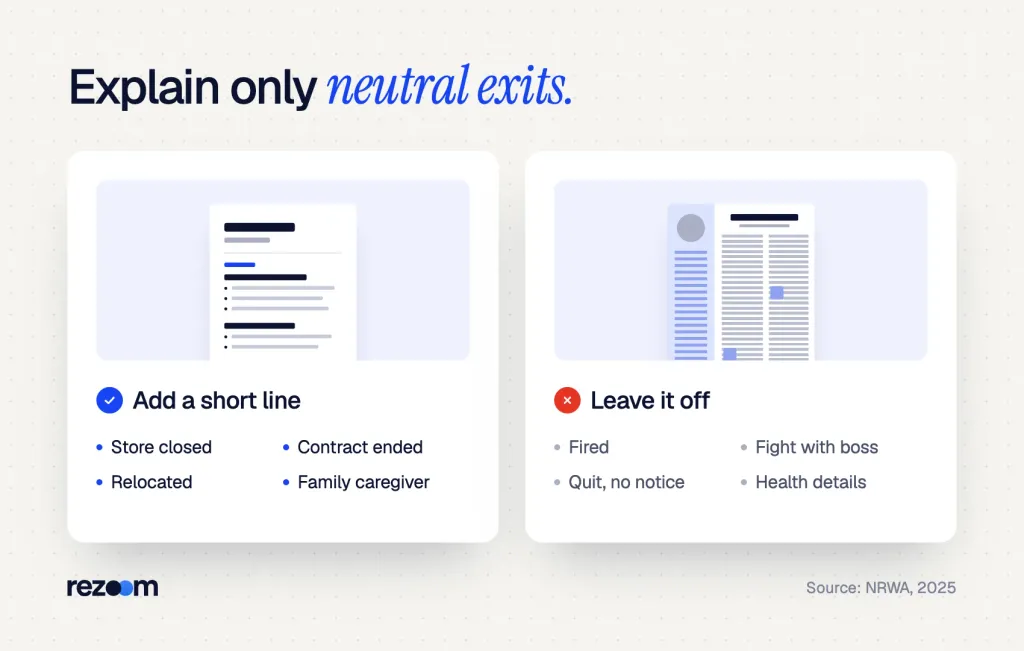
Most resumes should not state why you left a job. Recruiters expect the reason on the application form or in the interview, not on the page. Add one short, neutral line only when it explains something the dates would make look worse: a layoff or store closure, a contract or seasonal end, a move, a caregiving gap or a very short stint. Never explain a firing on the resume.
You usually don't need a reason for leaving on resume entries. Leave it off by default. Add one short, neutral line only when it explains a layoff, a contract end, a move, a caregiving gap or a short stint that the dates alone would make look bad.
A resume sells what you did, not why you stopped. So a reason belongs there only when it removes a doubt. The application form and the interview are where employers ask for the full answer.
Quick answers by situation
| Your situation | What to do on the resume | Example line |
|---|---|---|
| Laid off or store closed | Add a short note on the last bullet | Store closed in March 2026; stayed through final inventory |
| Seasonal or contract job | Label the title, no reason needed | Seasonal Cashier (Holiday 2025) |
| Moved to a new city | Put it beside the location or dates | Austin, TX (relocated to Denver, 2025) |
| Caregiving or health gap | Add a one-line gap entry | Family caregiver, Jun 2024 to Mar 2025 |
| Fired or quit after a conflict | Say nothing on the resume | (No line; prepare the interview answer) |
| Quit after a few weeks | Often leave the job off | (Drop it if it adds no skill) |
Should you put a reason for leaving on your resume?
No, not as a rule. Career experts agree that the reason for leaving a job does not go on a resume, the same way salary does not. Recruiters will ask on the application or in the interview. Add a brief line only when the dates raise a question that a neutral fact answers, such as a layoff or a contract end.
Resume writers are blunt about this. In a 2025 roundup by the National Résumé Writers' Association, a university career director put it in one line.
Salary and reason for leaving a job are not included in a resume.
Cheryl Minnick, University of Montana, via the National Résumé Writers' Association
Pierce College's career center gives the same advice: skip reasons for leaving and focus on your accomplishments2. It names one exception, the federal resume, which asks for more detail than a private-sector one.
Why the default is "leave it off"
- Space: every line you spend on an exit is a line you don't spend on results.
- Tone: a reason can read as an excuse, even when it is fair.
- Timing: the employer will ask anyway, so you lose nothing by waiting.
- Control: in an interview you can add context; on paper the line sits alone.
But "leave it off" is a default, not a law. If a reader would see your dates and assume the worst, one neutral fact can keep you in the yes pile.
When does a short reason for leaving on resume lines help?
A short line helps when the true reason is neutral and the dates look worse without it. The five common cases are a layoff or closure, a contract or seasonal job that ended on schedule, a move to a new city, a caregiving or health gap, and a short stint that ended for reasons outside your control.
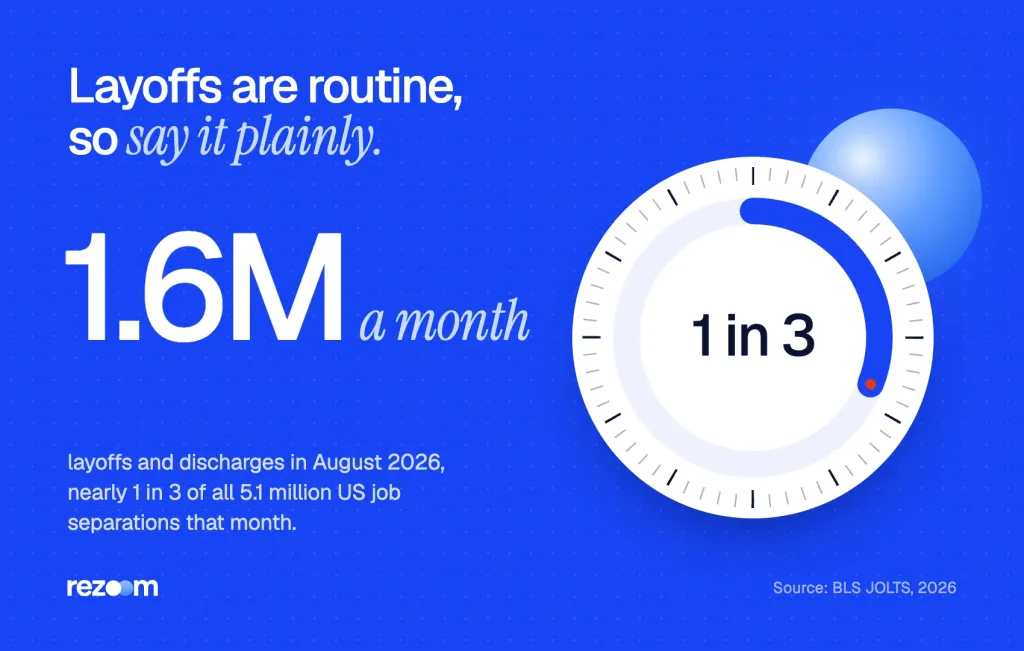
Layoffs are routine, so recruiters don't judge them the way job seekers fear. The BLS counted 1.6 million layoffs and discharges in August 2026 alone4, nearly 1 in 3 of all 5.1 million job separations that month. That means a "store closed" note reads as normal, not as a red flag.
Layoffs, closures and restructuring
If your whole store, team or company was cut, say so in a few words. Job Doc columnist Elaine Varelas also suggests putting the reason at the end of the role, not beside the title3, so your results come first. Our guide to a resume after being laid off covers the rest of the page.
Contract, seasonal and temp work
Here you don't need a reason at all. Just label the job "Seasonal," "Contract" or "Temporary" in the title, and the end date explains itself. Our page on how to list contract work on a resume shows the formats.
Relocation, caregiving and short stints
- Relocation: a move explains why a strong job ended. Put it next to the city or the dates.
- Caregiving or health: a one-line gap entry beats a blank year. Keep the detail private.
- Short stints: if a job lasted weeks and ended because the store closed or the role changed, a short note helps. If you just left, see the last section.
LinkedIn found that 51% of hirers are more likely to contact a candidate who gives context about a career break6. So a single line on a gap can do real work.
How do you word a reason for leaving on resume entries?
Keep it to one neutral fact, ten words or fewer, with no blame and no feelings. Put it in one of three spots: in parentheses in the title or date line, as the last bullet of the job, or as its own gap entry. Then make the bullets above it strong, so the reason reads as context, not as the headline.
The wording matters more than the reason. "Position eliminated in company-wide cuts" sounds calm. "Let go after new management came in" sounds like a grudge.
- Pick the factName what happened in plain words: store closed, contract ended, relocated, family caregiving.
- Cut it to ten wordsDrop the story, the names and the feelings. Keep only the fact and a date if it helps.
- Choose the spotUse the title or date line for labels, the last bullet for layoffs, and a gap entry for breaks.
- Add proof of valueIf you stayed to the end, trained others or got a rehire offer, add it to the same line.
Fill-in-the-blank template
[JOB TITLE] ([SEASONAL / CONTRACT / TEMPORARY]) | [EMPLOYER], [CITY] | [START] to [END]
[STRONGEST RESULT WITH A NUMBER].
[NEUTRAL FACT: STORE CLOSED / ROLE ELIMINATED / CONTRACT ENDED] in [MONTH YEAR]; [WHAT YOU DID AT THE END].
Ready-to-use lines by reason
| Reason | Where it goes | Line you can copy |
|---|---|---|
| Layoff | Last bullet | Role eliminated in a company-wide restructuring, May 2026 |
| Store closure | Last bullet | Store closed in March 2026; stayed through final inventory |
| Contract end | Job title | Inventory Associate (6-month contract) |
| Seasonal job | Job title | Seasonal Sales Associate (Holiday 2025) |
| Relocation | Location or date line | Phoenix, AZ (relocated to Denver, 2025) |
| Caregiving | Gap entry | Family caregiver; returned to work full time in 2025 |
Read your line and ask if it answers "will this happen again?" A closure, a move or a finished contract says no. If your line invites a follow-up question, cut it and save the story for the interview.
What does a retail resume with a reason line look like?
Picture a cashier whose store closed after eight months. The resume lists the job like any other, with three or four strong bullets, then one closing line: "Store closed in March 2026; stayed through final inventory." The reader sees a solid worker and a neutral end, not a short, unexplained stint.
Retail is a good test case, because turnover is high. Quits in retail trade ran at a 3.0% monthly rate in August 20264, against 1.9% for all jobs. And the BLS expects about 521,300 cashier openings a year5 from 2025 to 2035, all from workers who leave the job.
Store closure example
SAM CARTER
Cashier | Denver, CO | sam.carter@email.com
Cashier, Lakeside Market, Denver, CO | Jul 2025 to Mar 2026
Handled 200+ transactions a shift with a balanced drawer on 98% of closes.
Signed up 140 customers for the loyalty card in 6 months, top 3 in the store.
Trained 4 new cashiers on the POS system and returns policy.
Store closed in March 2026; stayed through final inventory at the manager's request.
The last bullet does two jobs: it explains the end date, and it proves the manager trusted Sam. To see a full page built the same way, open our retail cashier resume example.
Retail cashier resume example
A full cashier resume with measurable bullets you can adapt before you add a reason line.
Caregiving gap example
Sales Associate, Hill Street Outfitters, Austin, TX | Mar 2022 to May 2024
Family caregiver | Jun 2024 to Mar 2025
Full-time care for a parent; returned to work in April 2025.
Stock Associate, Northside Home, Austin, TX | Apr 2025 to now
Want more layouts for store roles? Browse our retail resume examples for associates, stock clerks and managers. For a longer break, our guide on how to explain an employment gap has more wording.
Free ATS score, the text the software extracts and your missing keywords. No sign-up.
How is the resume different from the application form and the interview?
The resume shows a reason only when it helps, in ten words or fewer. The application form often has a required "reason for leaving" field, so you answer every job in a short phrase. The interview asks "why did you leave?" out loud, so you give two or three sentences and then pivot to the new job.
Each place asks a different question. Mix them up and you either overshare on the resume or leave an application field blank.
| Where | Is a reason expected? | How long | Example for a store closure |
|---|---|---|---|
| Resume | No, only to explain dates | 10 words or fewer | Store closed in March 2026 |
| Application form | Yes, often a required field | 2 to 5 words | Store closure |
| Interview | Yes, asked out loud | 2 to 3 sentences | "The store closed in March. I stayed to finish inventory, and now I want a team with room to grow." |
The application field has its own rules, such as what to write when you were fired or why "personal reasons" can backfire. Our guide to the reason for leaving on a job application covers that form line by line.
Reason for leaving on job application examples for layoffs, contracts, school, moves and firing, plus what HR verifies and the words never to type.
Keep all three versions consistent
If your resume says "store closed," your form can't say "quit." So write your three versions side by side before you apply. Our list of reasons for leaving a job gives honest phrasings you can reuse in all three.
Many employers confirm only dates and title when someone calls. Still, make sure your resume dates match your pay stubs or W-2s. A date gap of a few months looks worse than any honest reason.
When should you leave the reason off your resume?
Leave the reason off when it is negative or private: a firing, a fight with a manager, a quit without notice, a health detail, or a job you left after a few weeks. These belong in the interview, where you can add context and show what you learned. On the resume, let the dates stand and the bullets carry the weight.
Varelas makes the firing rule plain: "If you were separated for issues with your performance, however, you wouldn't put that on a resume." The same goes for a bad boss or a toxic team. Our guide on whether to put a job you were fired from on your resume helps you decide if the job stays at all.
Do
- State a neutral fact such as "store closed" or "contract ended."
- Put the reason at the end of the job entry.
- Label seasonal and contract jobs in the title.
- Keep your resume, form and interview story the same.
Don’t
- Write "fired," "terminated" or "let go" on the resume.
- Blame a manager, a coworker or the company.
- Share health or family details beyond "caregiving."
- Explain every job; most need no reason at all.
Very short jobs
If you quit a job after a few weeks and it added no new skill, you can often leave it off. Our guide on whether to put a job you quit after a month on your resume walks through the trade-off. Several short jobs in a row are a different issue, covered in our page on job hopping on a resume.
Include a job I was fired from on my resume? Usually yes. Use this 3-factor rule, see what to write, and learn how to explain it in an interview.
What to say if they push back
Whatever you leave off the resume, expect a question in the interview. Prepare these answers before you apply.
- "Why did you leave Lakeside Market?" Give the fact, then what you did at the end.
- "Why is there a gap in 2024?" Say "family caregiving," the end date, and that it is resolved.
- "Were you let go?" If yes, say so in one sentence and move to what you learned.
Interviewer: "Your resume doesn't say why you left your last job. Were you let go?"
"Yes. My manager let me go after I missed two shifts during a family emergency."
Interviewer: "What would you do differently?"
"I would tell my manager right away and swap shifts. I've done that at my current job for a year."
Our guide on how to explain being fired in an interview has more scripts for that moment.
Your cover letter can also carry one positive line about a move or a return to work, so the resume stays clean. Our retail cover letter examples show how to fit that line in without sounding defensive.
Retail cashier cover letter example
A cashier cover letter that frames a fresh start in one positive line.
Final check before you send
Before you send your resume
If you want a quick start, Rezoom's AI resume builder turns your job history into strong bullets. Then you add the one reason line, if you need it.
Free plan, no card.
Frequently asked questions
Do you put a reason for leaving on a resume?
Usually not. Recruiters expect the reason on the application form or in the interview. Add one short line only for a layoff, closure, contract end, move or caregiving gap that the dates alone would make look bad.
How do you say you were laid off on a resume?
Add a last bullet such as "Role eliminated in a company-wide restructuring, May 2026." Keep it to one neutral fact and let your results come first.
Should I write "fired" on my resume?
No. Never write "fired," "terminated" or "let go" on a resume. Prepare a short, honest answer for the application form and the interview instead.
How do I show a seasonal job ended on a resume?
Label the job title, such as "Seasonal Cashier (Holiday 2025)." The label explains the end date, so you don't need a reason line.
How do I explain a caregiving gap on a resume?
Add a one-line entry with the dates, such as "Family caregiver, Jun 2024 to Mar 2025," and a note that you returned to work. Keep medical or family details private.
Is the reason for leaving on a resume the same as on an application?
No. A resume shows a reason only when it helps, while an application form often requires one for every job. Keep both versions consistent with each other.
Sources
We opened and read each page below. The small numbers in the text point here. Pages that carry no publication date show n.d.
- National Résumé Writers' Association2025
Career experts advise that salary and the reason for leaving a job are not included in a resume
- Pierce College Career Center2025
Leave reasons for leaving off the resume and focus on accomplishments, except on a federal resume
- Boston.com Job Doc, Elaine Varelas2021
Label contract roles, put any reason at the end of the role and leave performance-related separations off the resume
- U.S. Bureau of Labor Statistics, Job Openings and Labor Turnover Survey2026
In August 2026 there were 5.1 million separations, including 1.6 million layoffs and discharges and 3.1 million quits, and the retail trade quits rate was 3.0%
- U.S. Bureau of Labor Statistics, Occupational Outlook Handbook2026
About 521,300 cashier openings are projected each year from 2025 to 2035, all from replacing workers who leave
- LinkedIn2022
51% of hirers say they are more likely to contact a candidate who gives context about a career break
Mohammad has spent more than ten years designing consumer products and leads product at Rezoom, deciding what gets built and what gets left out. His guides cover the whole job search, from resume sections and cover letters to interview answers and career moves.
Goodi, M. (2026, October 29). Reason for Leaving on Resume: When to Add a Line and What to Write. Rezoom. https://rezoom.io/reason-for-leaving-on-resume/