Are You Currently Employed on Job Application? How to Answer
Currently employed on job application forms: how to answer if you work part-time, freelance, are on leave, laid off or quitting, and which end date to use.

On this pageWhat does it mean to be currently employed on job application forms?
- What does it mean to be currently employed on job application forms?
- How do you answer if you are part-time, freelance or on leave?
- Does it hurt to say no on the currently employed question?
- What if you are about to quit or were just let go?
- What do you say to "may we contact your current employer"?
- Can an employer find out if you lie about being employed?
- How do you fill in the current employer and end date fields?
- What should you check before you submit?
- FAQ
- Sources
The "are you currently employed" question asks if you have a paid job today. Say yes if you work for pay right now, even part-time, as a freelancer or while on leave. Say no if your job has ended, then add a short, true note. Employers can check your dates, so keep the form, your resume and your interview answers the same.
The currently employed on job application question asks if you have a paid job today. Say yes if you work for pay right now, even part-time or for yourself. Say no if your job has ended, and add a short, true note.
It looks like a simple yes or no box. But life is not always that neat. You may be on leave, getting severance, freelancing or one week from your last shift.
So this guide sorts each case, shows what to type and gives you lines for the phone screen.
Quick answers by situation
| Your situation | What to say/do | Example line |
|---|---|---|
| Full-time or part-time job now | Yes | "Yes, part-time cashier, 20 hours a week." |
| Self-employed or freelance | Yes, list your business | "Yes, self-employed graphic designer." |
| On medical, parental or other leave | Yes, you still have the job | "Yes, on leave, returning in March." |
| Laid off, with or without severance | No, unless you are still on payroll | "No. My role ended in a layoff in May." |
| Gave notice, still working | Yes, add your last day | "Yes, my last day is June 14." |
| Let go last month | No, keep the note short | "No. I left in April and I'm ready to start now." |
What does it mean to be currently employed on job application forms?
It asks if you hold a paid job on the day you apply. Any paid work counts: full-time, part-time, temp, contract or your own business. School, unpaid work and job hunting do not count. The answer helps the employer plan your start date and decide if they can call your current boss.
The question is about today, not your career. If you earn a paycheck or invoice clients right now, you are employed. If your last day has passed, you are not.
Many online forms show this as a checkbox in the work history section. For example, one applicant system lets you mark a job as current with a simple yes or no toggle6. If you check yes, the end date field often turns into "Present."
Why employers ask
Most employers ask for plain, practical reasons. They are not always trying to screen you out.
- Start date: if you have a job, you may need to give two weeks' notice. See our guide to the earliest start date on job application forms.
- References: a yes answer often leads to "may we contact your current employer?"
- Background check: they want to know which dates to verify.
- Context: a no answer tells them to look for your reason for leaving.
How do you answer if you are part-time, freelance or on leave?
If you get paid for work right now, answer yes. That includes part-time jobs, gig work, freelance clients and your own business. If you are on leave and still hold the job, answer yes too. Then use the job title and notes fields to show what kind of work it is.
The rule is simple: paid work today means yes. But each case needs a slightly different note, so here is how to handle the common ones.
| Situation | Answer | What to add |
|---|---|---|
| Part-time job | Yes | Hours per week, if asked |
| Freelance or gig work | Yes | Business name or "Self-employed" |
| Student with a campus job | Yes | The job, not the school |
| Student with no job | No | Your graduation date |
| On leave (medical, parental) | Yes | Nothing extra unless asked |
| Seasonal job that ended | No | The season dates |
Part-time, gig and seasonal work
A part-time job is still a job. So if you work 15 hours a week at a store, check yes and list that store as your current employer.
Gig work counts too. If you drive or deliver for an app, list "Self-employed, delivery driver" with the app named in the description.
Are you currently employed? Yes
Current employer: Main Street Grocery
Job title: Cashier (part-time, 20 hours a week)
Notes: "I'm looking for a full-time role with more hours."
Self-employed and freelance
If you run your own business, you are employed. Put your business name or "Self-employed" in the employer field, then name your role.
Be ready for one wrinkle. You can't give a boss as a reference, so offer a client instead.
Are you currently employed? Yes
Current employer: [Your business name] / Self-employed
Job title: [Freelance role, e.g. bookkeeper]
Start date: [Month, year] to Present
Reference: "[Client name], a client since [year], can speak to my work."
Students and people on leave
School is not a job, so a full-time student with no paid work answers no. But if you also work at the campus library, answer yes and list that job.
If you are on medical or parental leave, you still hold the job. So answer yes. You don't have to share why you are on leave.
Does it hurt to say no on the currently employed question?
Saying no is common and it does not end your chances. Millions of people apply for jobs between roles. A short, true note on why you left and when you can start helps more than the yes or no. In some places, such as New York City, employers can't refuse you just for being unemployed.
Saying no can feel risky. But you are far from alone.
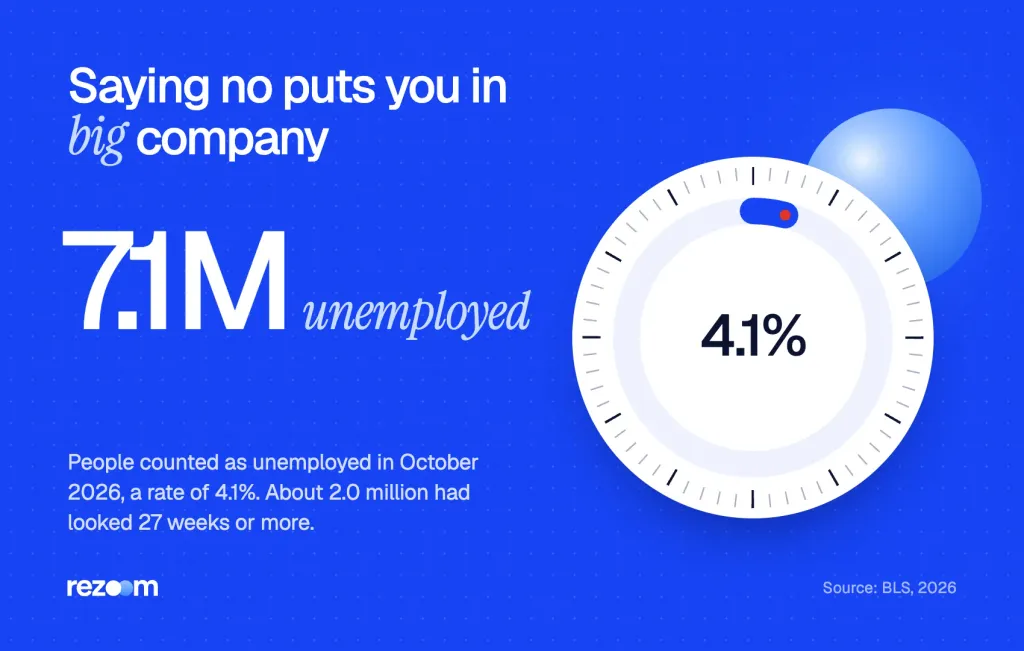
In October 2026, the Bureau of Labor Statistics1 counted 7.1 million unemployed people, a rate of 4.1%. About 2.0 million of them had looked for work for 27 weeks or more. So recruiters see "no" every day.
Some places protect unemployed applicants
A few places go further. The NYC Commission on Human Rights2 lists unemployment status as a protected class in employment. That means a New York City employer can't turn you down just because you don't have a job right now.
Rules like this vary by city and state. This is general information, not legal advice, so check your local rules if you think a "no" cost you the job.
Answering no when you were laid off
A layoff is not your fault, and most hiring managers know it. Answer no, then give the plain reason in one line.
Severance can blur the picture. If your job ended and you got a lump sum, you are not employed. If your company still keeps you on payroll through a set date, check your separation papers for your official last day and use that date.
Are you currently employed? No
Notes: "My role ended in a company-wide layoff in May 2026. I'm ready to start right away."
If you have been out of work for a few months, list a course, a certificate or volunteer work in the notes. It shows you kept busy. Our guide on how to explain an employment gap has more lines.
47% of workers have a career break but only 20% mention it — so hiring managers fill the blank themselves. How to explain an employment gap by length.
What if you are about to quit or were just let go?
If you gave notice but still work there, answer yes and give your last day. If your employer let you go, answer no. Keep the note short and true, and save the full story for the interview. Don't list a job as current after your last day just to look employed.
Timing questions trip people up. The test is still the same: what is true on the day you hit submit?
You gave notice or plan to quit
If you still work there, you are employed. Answer yes, and if the form has a notes field, add your last day. That helps the recruiter plan your start date.
If you have not told your boss yet, you still answer yes. Then say no to "may we contact your current employer" for now.
Your employer let you go
If your last day has passed, answer no. Then use the reason for leaving field with calm, neutral words. Our guide on how to answer reason for leaving on application when fired shows exact wording.
Are you currently employed? No
Reason for leaving: "Not a fit for the role. I learned to ask for clearer goals early, and I'm ready to start now."
Reason for leaving on job application forms: short phrases to type, what to write if you were fired, and whether a reason for leaving belongs on your resume.
Free ATS score, the text the software extracts and your missing keywords. No sign-up.
What do you say to "may we contact your current employer"?
You can say no or "not yet" if your boss does not know you are looking. Most employers accept this and wait until they make an offer. Offer a past manager or a coworker as a reference instead, and say you are happy to allow the call once there is an offer.
This follow-up often comes right after you check yes. Saying no is normal, and it rarely hurts you. Our full guide to may we contact your current employer covers every case.
What to say if they push back
- "We always call current employers." Stay calm: "I understand. I'm glad to allow it once we reach an offer."
- "Can you give us anyone there?" Offer a safe name: "A former coworker who has since left can speak to my work."
- "Why the secrecy?" Keep it simple: "My manager doesn't know I'm looking yet, and I want to leave on good terms."
- "Is something wrong at your job?" Stay positive: "No, I'm just ready for the next step."
Interviewer: "I see you said we can't contact your current employer. Why is that?"
"My manager doesn't know I'm looking yet. I'd like to tell her myself first."
Interviewer: "We usually check before we move forward."
"That makes sense. I can give you two past managers now, and you can call my current one after an offer."
Can an employer find out if you lie about being employed?
Yes, often. Many employers run an employment check that confirms your dates and job title, and services like The Work Number pull that data straight from payroll. Most employers in a 2026 HireRight survey found discrepancies during screening. A false answer can cost you the offer, or the job later.
It can be tempting to say yes when you are not working. But your dates leave a trail, and employers check it.
The Work Number, run by Equifax, says its records include "dates of employment, title, salary history, and pay frequency"3 from more than 4.88 million employers. So a recruiter can see when your last job ended.
HireRight's 2026 benchmark report4 found that most companies uncovered candidate discrepancies in the past year. Employment checks were the most likely place to find them.
When you sign the application, you are affirming that everything on it is accurate.
Edmonds College Career Services
Do
- Answer based on the day you apply.
- Use your real last day from your pay stubs or papers.
- Add one short line of context when you answer no.
Don’t
- List an old job as "Present" to look employed.
- Stretch end dates to hide a gap.
- Share why you are on medical leave.
How do you fill in the current employer and end date fields?
For a job you still hold, enter the employer name, your start month and year, and "Present" or the current-job checkbox as the end date. If the form demands a date, use the current month. For a job that ended, use your real last month and year.
Dates matter more than most people think. They are the first thing a background check confirms.
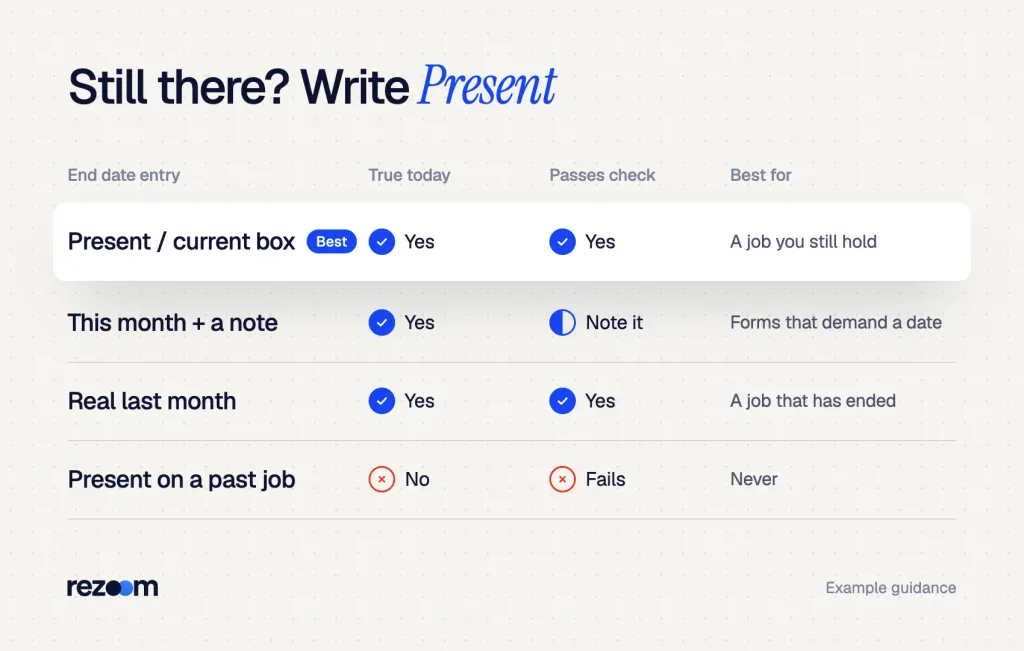
- Name the employerUse the legal or common company name, and the city.
- Add your start dateMonth and year are enough on most forms.
- Mark it currentCheck the "I currently work here" box, or type "Present" in the end date.
- Handle forced datesIf the form demands a month, enter this month and add "still employed" in notes.
- Match your resumeUse the same dates, titles and employer names everywhere.
Some systems ask for a month and year even for a current job. One applicant system tells applicants: "Even if you are currently employed, please input a month and year"6 in the dates fields. In that case, use the current month.
Keep your resume in sync
The form and your resume should tell the same story. If you work part-time at a store, browse our retail resume examples to see how current jobs show "Present" next to the dates.
For a close match, these retail cashier resume examples list a current role first, with hours and results.
Retail cashier resume example
See how a current cashier job reads with Present as the end date.
If you need to build or fix your resume fast, our AI resume builder formats current roles for you. Your letter can then explain your status in one line, as in these retail cover letter examples.
This retail cashier cover letter example shows how to mention a current part-time job and your start date without fuss.
Retail cashier cover letter example
A short letter that names a current job and when you can start.
Keep a short list of every job with its exact start and end month. Then copy from it each time you apply. This one habit stops most date mismatches.
What should you check before you submit?
Before you submit, confirm your answer is true for today, your dates match your resume and your notes give one calm line of context. Decide in advance whether your current employer can be contacted. Then you can answer the same way on the form, in your letter and on the phone.
Being currently employed on job application forms is not a trick question. If you answer it the same way everywhere, it reads as honest and calm.
Before you submit the form
Once the form is done, make sure your resume tells the same story.
Tailored to the job post, checked against ATS.
Frequently asked questions
Does part-time work count as currently employed?
Yes. Any paid work counts, including part-time, temp and gig jobs. List the job and add your hours if the form asks.
Am I currently employed if I am on leave?
Yes, if you still hold the job. Medical, parental and other leave all count, and you don't have to say why you are on leave.
Am I employed if I am getting severance?
Usually not, if your job has ended and you got a lump sum. If your company keeps you on payroll through a set date, check your papers for your official last day.
Should I say I am employed if I am self-employed?
Yes. Put your business name or "Self-employed" as the employer, then offer a client as a reference.
What do I put for end date if I still work there?
Type "Present" or check the current-job box. If the form needs a month, use the current month and note that you still work there.
Will saying no hurt my chances?
Not by itself. Millions of people apply between jobs, and a short, true note on why you left matters more than the box.
Sources
We opened and read each page below. The small numbers in the text point here. Pages that carry no publication date show n.d.
- Bureau of Labor Statistics2026
In October 2026, 7.1 million people were unemployed, a rate of 4.1%, and 2.0 million had been jobless 27 weeks or more.
- NYC Commission on Human Rightsn.d.
New York City lists unemployment status as a protected class in employment.
- The Work Number (Equifax)n.d.
The Work Number data covers dates of employment, title, salary history and pay frequency from 4.88 million-plus employers.
- HireRight2026
Most companies found candidate discrepancies in screening, most often in employment verifications.
- Edmonds College Career Servicesn.d.
Signing a job application affirms that everything on it is accurate.
- ExactHiren.d.
Some application systems use a yes or no current employer field and still ask for a month and year for current jobs.
Mohammad has spent more than ten years designing consumer products and leads product at Rezoom, deciding what gets built and what gets left out. His guides cover the whole job search, from resume sections and cover letters to interview answers and career moves.
Goodi, M. (2026, November 16). Are You Currently Employed on Job Application? How to Answer. Rezoom. https://rezoom.io/are-you-currently-employed-on-job-application/