Willing to Work Overtime? How to Answer on Applications and in Interviews
Willing to work overtime? How to answer the yes/no box and the interview question honestly, with sample answers, limits that work and your FLSA pay rights.

On this pageWhat does "willing to work overtime" mean on a job application?
- What does "willing to work overtime" mean on a job application?
- What counts as overtime under federal law?
- How much overtime do production jobs really involve?
- How do you answer "Are you willing to work overtime?" in an interview?
- What should you say if you can't work overtime?
- Can an employer make you work overtime?
- How do you prepare before you apply?
- FAQ
- Sources
When a job application asks if you are willing to work overtime, check yes if you can cover extra hours some weeks, and use the comment field to state real limits. In the interview, say yes, then give your limits and a past example. Under federal law, non-exempt workers earn time and a half after 40 hours in a workweek, and most employers can make overtime mandatory.
If an application asks whether you are willing to work overtime, answer yes when you can cover extra hours in busy weeks. If you have firm limits, still check yes and add one line on what you can do. Only answer no if extra hours are truly impossible.
Below you'll find what the box means, what the law says about overtime pay, and word-for-word answers for forms and interviews. Our example is Sam, who is applying for a production job on a factory floor.
Quick answers by situation
| Your situation | What to say/do | Example line |
|---|---|---|
| You can work extra hours | Check yes and add a short example | "Yes. I covered extra shifts during peak season at my last job." |
| You can, with notice | Check yes and name the notice you need | "Yes, with 24 hours' notice so I can arrange childcare." |
| You're in school | Check yes and give your open days | "Yes on weekends and after 3 p.m. on weekdays." |
| You have a second job | Give your real cap | "I can add up to 5 hours a week outside my other shift." |
| You can't work any extra hours | Answer no, then offer what you can do | "Not right now, but I'm fully reliable for every scheduled shift." |
| The job lists mandatory overtime | Only apply if you can do it | "I saw overtime is required in peak months, and that works for me." |
What does "willing to work overtime" mean on a job application?
The question asks if you can work more than your regular schedule when the business needs it. Most forms use a yes/no box, and some add a comment field. Employers use it to screen for jobs with busy seasons, short staffing or set overtime. A yes does not promise unlimited hours. It tells them you can help when it counts.
Employers ask because some jobs run on extra hours. Warehouses, plants, hospitals and stores all face peak weeks, sick calls and rush orders. So the hiring team wants to know who can stay late before they hire.
The question often sits next to the availability on a job application section. It also tends to appear near your earliest start date and a question about reliable transportation.
Availability on job application forms: what to put, what open availability means, how many hours to list, plus examples for students and parents.
The yes/no box
Many online forms use a knockout filter. If the job needs overtime and you check no, the system may drop your application before a person reads it. So if you can work extra hours even some of the time, check yes.
But don't check yes if you can never stay late. A false yes gets you hired into a schedule you can't keep, and that ends badly for both sides.
The comment field
If the form gives you a text box, use it to set clear limits. Keep it to one or two lines. Name what you can do first, then your limit.
Yes. I can work extra hours [on which days or times], with [how much notice] notice.
I can add up to [number] hours a week because of [school / childcare / a second job].
Here's how Sam filled it in for a plant job:
Yes. I can work extra hours on weekdays and Saturdays, with 24 hours' notice. I can add up to 8 hours a week while I finish my evening certificate class.
What counts as overtime under federal law?
Under the Fair Labor Standards Act (FLSA), covered non-exempt workers earn at least time and a half for hours over 40 in a workweek. The law sets no cap on hours for workers 16 and older. Some states add daily overtime rules. Salaried white-collar staff can be exempt if they meet salary and duties tests.
The US Department of Labor says covered workers get at least time and one-half their regular rates of pay1 for hours over 40 in a workweek. A workweek is a fixed period of seven days in a row. Also, an employer can't average two weeks together to avoid paying overtime.
So if Sam earns $20 an hour, extra hours pay $30 each. Here's the math for a few weeks:
| Hours in the week | Regular pay | Overtime pay | Total |
|---|---|---|---|
| 40 | $800 | $0 | $800 |
| 45 | $800 | $150 | $950 |
| 50 | $800 | $300 | $1,100 |
Weekends, holidays and the 8-hour day
The federal law counts hours per week, not per day. The DOL notes that the FLSA does not require extra pay for work on Saturdays, Sundays or holidays2 as such.
But some states go further. California pays time and a half for hours over 8 in a workday and double the regular rate6 for hours over 12 in a day. So check your state's labor department page before you start.
Exempt vs. non-exempt jobs
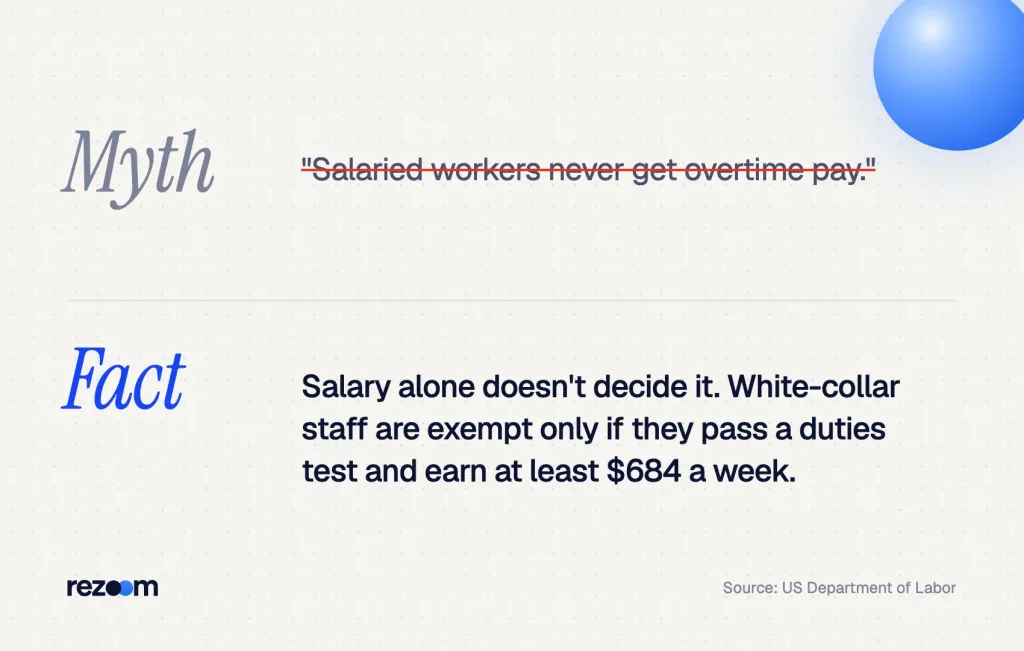
Not everyone earns overtime pay. Most executive, administrative and professional staff are exempt if they pass a duties test and earn at least $684 per week3, which is $35,568 a year.
A 2024 rule tried to raise that floor. But a court struck it down, and the DOL officially rolled it back in 2026, so the federal level is back to $684 per week4. Hourly production, warehouse and retail jobs are almost always non-exempt.
Is there a limit on overtime hours?
There is no limit in the Act on the number of hours employees aged 16 and older may work in any workweek.
US Department of Labor, Wage and Hour Division
That means federal law lets an employer schedule as many hours as it needs, as long as it pays for them. Teens under 16 have strict hour limits, and some states and union contracts add their own rules.
How much overtime do production jobs really involve?
In manufacturing, overtime is a normal part of the job. The Bureau of Labor Statistics found production and nonsupervisory workers in manufacturing averaged 3.8 overtime hours a week in 2025. Transportation equipment plants led at 5.3 hours. So if you apply to a plant, expect the overtime question and plan your answer.
The Bureau of Labor Statistics tracks overtime in factories. In 2025, production and nonsupervisory workers in manufacturing averaged 3.8 hours of overtime a week5. Transportation equipment plants, like auto and aircraft makers, led at 5.3 hours.
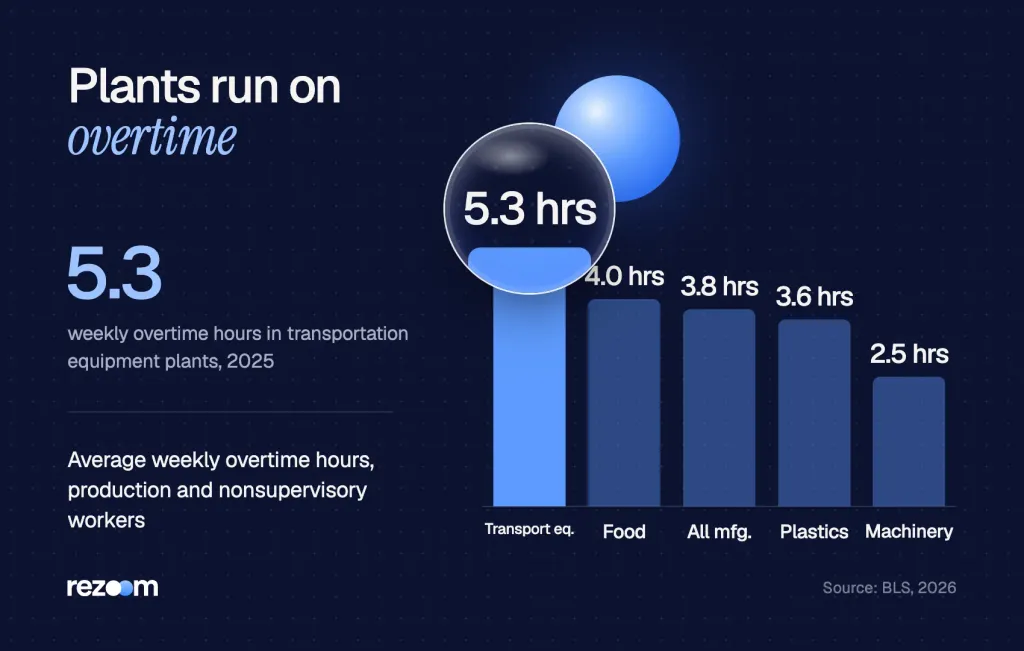
That is an average, so some weeks run at zero and some run at 10 or more. If you are willing to work overtime in a plant, you'll likely see it during model changes, big orders and holiday peaks.
Show it on your resume
If you've worked overtime before, put it on your resume. A line like "Covered 6 to 10 overtime hours a week in peak season with zero safety incidents" answers the form question before anyone asks it. Browse these production resume examples to see how others list shift work.
For an hourly floor role, this production worker resume example shows how to put shift flexibility, output numbers and safety in one clean page.
Production worker resume example
See how to show shift flexibility, output and safety on one page.
If the job ad says "overtime as needed" or "rotating shifts," repeat that phrase in your resume summary. Then the hiring manager sees the match in the first few seconds.
How do you answer "Are you willing to work overtime?" in an interview?
Say yes first, if it's true. Then give a short past example and state any real limit, like notice or a weekly cap. Ask how often overtime happens so you both know what to expect. Keep it under 30 seconds and sound calm, not reluctant. Honest limits rarely cost you the job.
Interviewers want two things. First, they want to know you'll help in a crunch. Second, they want to know you won't quit when the schedule gets tough.
Career site 4 Corner Resources warns that a flat no can make you look less flexible or committed8. So even if you have limits, start with what you can do.
- Lead with yesSay "Yes" or "Yes, I can" in the first few words if it's true.
- Add proofGive one past time you stayed late or picked up a shift, and what it achieved.
- Name your limitState notice, days or a weekly cap in one sentence, without long excuses.
- Ask a questionAsk how often overtime comes up and how far ahead it's scheduled.
Sample answer: a full yes
"Yes, I'm willing to work overtime when the line needs it." "At my last plant, I worked 6 to 8 extra hours a week during our holiday rush, and we shipped every order on time." "How often does overtime come up here, and how much notice do people usually get?"
Sample answer: yes, with limits
"Yes, I can stay late most weeks if I get a day's notice." "I pick up my son on Tuesdays and Thursdays, so those two days I need to leave on time." "Monday, Wednesday, Friday and Saturdays are open, and I'm happy to take extra shifts then."
If you're applying for a warehouse role, expect this question next to others on lifting, safety and speed. Our list of warehouse interview questions covers the rest.
Warehouse interview questions with 16 sample answers: safety, pick rate, forklifts, a customer complaint, the warehouse assessment test and what to ask them.
Free ATS score, the text the software extracts and your missing keywords. No sign-up.
What should you say if you can't work overtime?
Tell the truth, give one short reason and lead with what you can offer instead. Students can name the days they're free. Parents can name notice they need. Workers with a second job can give a weekly cap. If you can't do any overtime and the job needs it, it's better to know now than after you start.
Real limits are common. School, childcare, a second job or a health need all cap your hours. The key is to sound reliable, not unwilling.
When you're in school
"I'm in classes Monday to Thursday until 2 p.m., so I can't stay past my shift on those days." "But I'm free Friday afternoons and all weekend, and I can pick up extra hours then."
When you have a second job
Name your cap as a number. "Up to 5 extra hours a week" sounds planned, while "it depends" sounds vague.
If the employer later asks for a reference from your other job, have your supervisor's name for the job application ready.
What to say if they push back
- "Overtime here is mandatory in peak season." Ask for detail: "How many weeks a year, and how much notice? Then I can plan for it."
- "Everyone on this team stays late." Offer what you can: "I can cover two late nights a week and every Saturday."
- "We need someone with no limits." Be honest: "Then I may not be the best fit for this shift. Is there a shift with fixed hours?"
Interviewer: "During peak season, overtime is mandatory. Is that a problem?"
"Not if I can plan for it. How many weeks does peak usually run?"
Interviewer: "About six weeks, starting in October."
"Then I'll set up extra childcare for those weeks. Could I get my overtime days a few days ahead?"
Can an employer make you work overtime?
Usually, yes. Federal law sets no cap on hours for workers 16 and older, so most employers can make overtime mandatory and discipline you if you refuse. Some states, union contracts and rules for certain jobs add limits. But the employer must pay non-exempt workers time and a half for hours over 40.
California's labor department puts it plainly. An employer may set your schedule and may discipline an employee, up to and including termination6, for refusing scheduled overtime. One exception there is the seventh day in a row, which you can turn down.
SHRM notes that unless a union contract says otherwise, employers can require their employees to work overtime7 as long as they pay the right rate. So if a posting says "mandatory overtime," take it at its word.
How to answer honestly without losing the job
Do
- Check yes if you can work extra hours at least some weeks.
- State real limits as days, hours or notice.
- Ask how often overtime happens and how it's scheduled.
- Give a past example of staying late to help the team.
Don’t
- Promise unlimited hours you can't keep.
- Give a long list of personal reasons.
- Agree to unpaid overtime on an hourly job.
- Check no out of habit when you could do some extra hours.
If an interviewer asks whether you'd work extra hours "off the clock," that's a red flag for an hourly job. Non-exempt workers must be paid for all hours worked, so ask how the company tracks time.
How do you prepare before you apply?
Decide your real limit before you open the form, so your yes/no box, comment, resume and interview answer all match. Read the posting for words like "mandatory overtime" or "rotating shifts." Then add one overtime example to your resume and practice your answer out loud.
Most problems start when your answers don't match. Sam checked yes, wrote "up to 8 hours a week," and then told the interviewer the same thing. That consistency builds trust.
Before you answer the overtime question
Match your cover letter and emails
If the job asks for a cover letter, one line about schedule flexibility helps. These production cover letter examples show how to mention shift and overtime work without sounding desperate.
If you send your application by email, put the role and your name in a clear email subject line for a job application. Then the hiring manager finds it fast.
Your answer will sound more natural if you've said it before. So practice interview answers out loud and time yourself to stay under 30 seconds.
Practice out loud with an AI voice coach.
Frequently asked questions
Should I check yes if I'm willing to work overtime only sometimes?
Yes. Check yes and use the comment field to say when you can work extra hours. A yes means you can help when needed, not that you'll work every week.
Does saying no to overtime hurt my chances?
It can on jobs where overtime is built in, like plants and warehouses. On jobs with fixed hours, an honest no with a clear offer of what you can do rarely hurts.
Do I get paid more for overtime?
If you are a non-exempt worker covered by the FLSA, you earn at least time and a half for hours over 40 in a workweek. Some states also pay daily overtime.
Can I be fired for refusing overtime?
In most states, yes, if the overtime is scheduled and paid. Some states, union contracts and certain jobs add limits, so check your state's labor department.
Do salaried employees get overtime?
Some do. Salaried workers are exempt only if they meet a duties test and earn at least $684 a week. Salaried workers who miss either test still earn overtime.
What is a good answer to "are you willing to work overtime"?
Say yes if it's true, give one past example and state any limit in one sentence. Then ask how often overtime comes up.
Sources
We opened and read each page below. The small numbers in the text point here. Pages that carry no publication date show n.d.
- US Department of Labor, Wage and Hour Division2019
Covered non-exempt workers earn at least time and one-half for hours over 40 in a workweek, and the FLSA sets no hour limit for workers 16 and older.
- US Department of Laborn.d.
The FLSA does not require overtime pay for work on Saturdays, Sundays, holidays or regular days of rest.
- US Department of Labor, Wage and Hour Divisionn.d.
The standard salary level for the white-collar overtime exemption is $684 per week, or $35,568 a year.
- Proskauer Rose LLP2026
The DOL rolled back the 2024 overtime rule in May 2026, so the federal salary threshold is back to $684 per week.
- US Bureau of Labor Statistics2026
Manufacturing production and nonsupervisory workers averaged 3.8 overtime hours a week in 2025, with transportation equipment at 5.3.
- California Department of Industrial Relations, Labor Commissionern.d.
California pays daily overtime after 8 hours, double time after 12, and lets employers discipline workers who refuse scheduled overtime.
- SHRM2020
Unless a union contract says otherwise, employers can require overtime as long as they pay the appropriate overtime rate.
- 4 Corner Resourcesn.d.
4 Corner Resources advises a balanced answer and warns that a flat no can suggest you are not flexible or committed.
Mohammad has spent more than ten years designing consumer products and leads product at Rezoom, deciding what gets built and what gets left out. His guides cover the whole job search, from resume sections and cover letters to interview answers and career moves.
Goodi, M. (2026, November 19). Willing to Work Overtime? How to Answer on Applications and in Interviews. Rezoom. https://rezoom.io/willing-to-work-overtime-on-job-application/