
Summary
You do not need your full street address on a resume. List your city and state instead, which gives recruiters the location signal they need without exposing private details. Add a ZIP code only for local, in-person jobs where proximity helps. For remote roles, city and state or "Remote, US" is enough. If you are moving, write "Relocating to City, State" with a date, and give your full address later on application forms.
Should I put my address on my resume? Not the full street address. List your city and state instead, because that is all a recruiter needs to judge location, and the rest is private information you give later on official forms.
That short answer covers most people. The details change with the job, though. A local in-person role, a remote role, and a move across the country each call for a slightly different header line.
This guide gives you a rule for each situation, copy-ready header lines, and the one piece of research most advice skips: how distance from the job can affect callbacks.
Should I put my address on my resume in 2026?
No, not your full street address. City and state is the modern standard. It shows recruiters where you are for commute, time zone, and pay-band purposes. Your full address goes on the application form or onboarding paperwork after you are hired.
So the real answer to "what address on my resume?" is a location, not a mailing address. Full mailing addresses on resumes date from the era of mailed applications and letters. Today, recruiters reach you by email and phone, so your street and house number do no work on the page.
Career coach Cynthia Pong told NPR that job seekers should not worry about adding a home address, and that city and state is enough when location matters. Federal guidance points the same way. USAJOBS, updated in June 2026, lists full name, email address, and phone number as the contact details a federal resume must include.
Some university templates still show a full address. Harvard's resume guide, for example, puts address, email, and phone number in its sample header. That is fine if you want it, but it is no longer expected.
Location still matters, though. Recruiters filter by it, and many jobs have in-office days. That is why you should keep city and state, even when you drop the street.
What should you show instead of a full address?
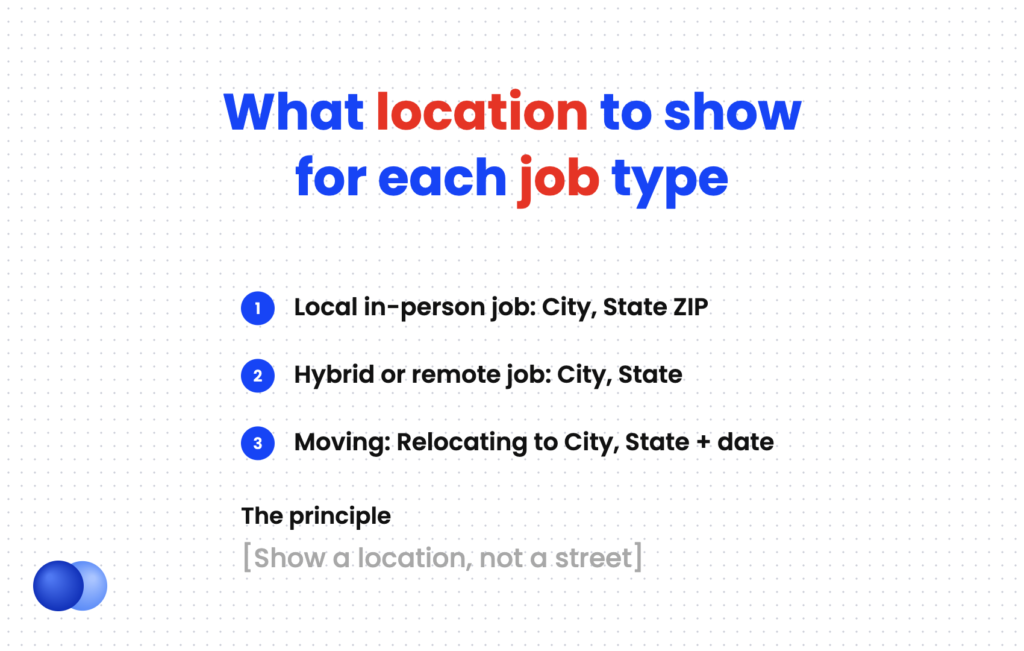
Match the location line to the job. Use city, state, and ZIP for local in-person roles. Use city and state for hybrid and most other roles. Use city and state or "Remote, US" for remote jobs. Use "Relocating to City, State" with a date when you are moving. Leave off the street address in all cases.
Use this table as your decision rule.
| Your situation | What to write | Example |
|---|---|---|
| Local, in-person job | City, State ZIP | Columbus, OH 43215 |
| Hybrid or general job | City, State | Columbus, OH |
| Remote job | City, State or region | Columbus, OH (Remote) |
| Moving to the job's city | Relocation line with date | Relocating to Denver, CO (June 2026) |
| Long commute to the job | Metro area | Greater Columbus Area |
| Resume posted on a public job board | City, State only | Columbus, OH |
The ZIP code is optional. It helps only when recruiters search by radius or when the job values being close by, such as retail, healthcare, schools, and local government.
Local in-person role Maria Chen | Columbus, OH 43215 | (614) 555-0187 | [email protected]
Remote role Maria Chen | Columbus, OH (Remote) | (614) 555-0187 | [email protected] | linkedin.com/in/mariachen
Relocating Maria Chen | Relocating to Denver, CO (June 2026) | (614) 555-0187 | [email protected]
For the full layout of name, links, and contact details, see our resume header guide. If you are adding a profile or portfolio link, our guides on LinkedIn on your resume and how to add a hyperlink to a resume show the clean formats.
Can the address on my resume affect callbacks?
Yes, in some jobs. A field experiment by economist David Phillips found low-wage employers called back applicants who lived farther away about 14% less often. Callback rates fell by 1.1 percentage points per mile of distance. Showing city and state instead of a street keeps attention on your qualifications.
Most guides mention "bias" in general terms. The best evidence is specific.
Phillips sent 2,260 fictional resumes to 565 low-wage job openings in Washington, D.C. Applicants from distant neighborhoods received 14 percent fewer callbacks than those living nearby. Callback rates fell by 1.1 percentage points for every mile an applicant lived from the job, holding neighborhood affluence constant.
Harvard Business Review summarized the takeaway: address information on resumes can exacerbate inequality when jobs sit far from certain communities.
The study covered low-wage roles in one city, so the exact numbers will not apply everywhere. The practical lesson still holds. A street address invites assumptions about commute and neighborhood. City and state gives the location signal without the extra detail.
Use the metro area for long commutes
If you live in a suburb 30 miles from the job, write the metro name, such as "Greater Chicago Area." It is accurate, it matches how recruiters search, and it avoids an early judgment about your commute. Then show up to the interview on time and prove the distance is not an issue.
How should you list your address for a remote job?
For a remote job, list city and state or a region such as "Remote, US." Employers still need your state for payroll taxes, time zones, and pay bands, and many remote roles are limited to certain states. Leaving location off entirely can get your resume filtered out of location-based searches.
Remote does not mean location-free. Many remote postings say "Remote, US only" or list eligible states. Recruiters also filter by time zone for team overlap.
Keep your city and state and add "(Remote)" if you want to signal that you are open to it. NPR's source noted that a full home address may suggest you are not interested in a remote or hybrid situation, which is one more reason to leave the street off.
Our guide to a resume for remote jobs covers the rest of the remote-ready header and the skills recruiters look for.
What if you are relocating for the job?
Put a relocation line in your header, such as "Relocating to Austin, TX (August 2026)." It tells the recruiter you plan to be local, and it shows up in location searches. Only use a future address once you have one. Explain the move briefly in your cover letter, and be ready to discuss timing.
A header that shows only your current city can get you screened out of jobs across the country. A relocation line fixes that.
Be precise and honest. Write the month you will arrive if you know it. If you already signed a lease, you can list the new city as your location. If you have not, stick with "Relocating to."
Avoid using a friend's address in the new city to look local. If a recruiter asks about your commute or start date, the story falls apart. The cover letter is the right place for one or two sentences about why you are moving. See our cover letter for a resume guide for how to frame it.
Move planned, no date yet Jordan Reyes | Relocating to Austin, TX | (512) 555-0143 | [email protected]
Move date set Jordan Reyes | Relocating to Austin, TX (August 2026) | (512) 555-0143 | [email protected]
Lease signed in the new city Jordan Reyes | Austin, TX | (512) 555-0143 | [email protected]
Is it risky to put your full address on your resume?
It can be. Resumes get posted on job boards, forwarded, and stored for years, so anything on them should be safe for strangers to see. Job scammers seek personal information. The FTC warns that fake recruiters ask for details like your driver's license or bank information before any interview.
Your resume leaves your control the moment you upload it. A full street address, combined with your name, phone, and work history, gives a stranger a lot to work with.
The FTC warns that job scammers want your money, personal information, or both. Red flags include requests for your driver's license, Social Security number, or bank details before an interview. In 2026 the agency added that real employers will never contact you by generic text, WhatsApp, or Telegram messages about jobs.
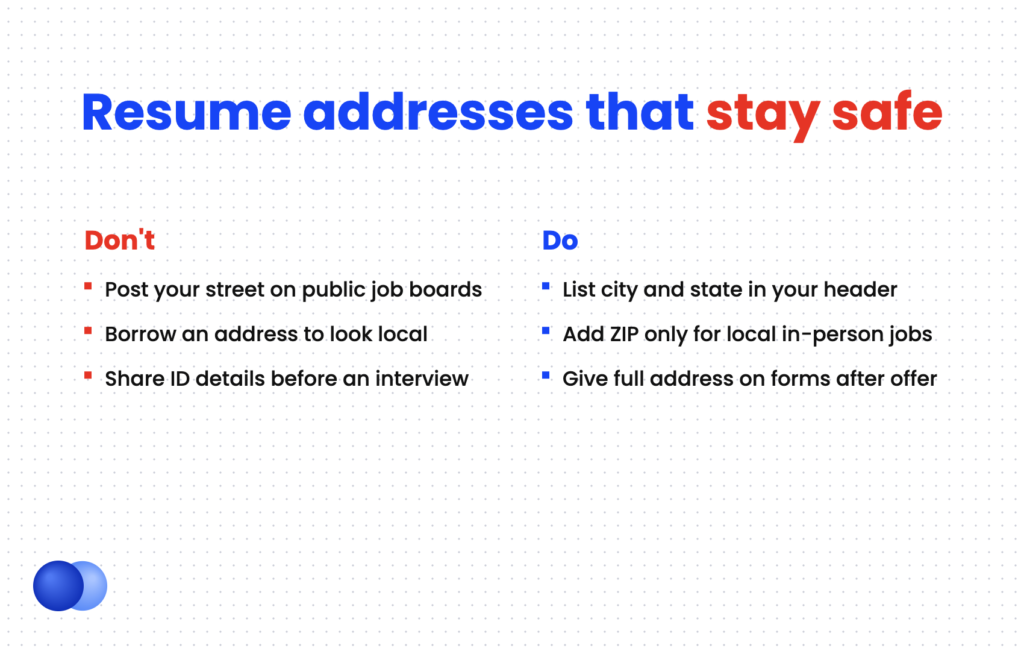
List city and state in your header do: Add a ZIP code for local, in-person jobs do: Write "Relocating to City, State" with a date when moving do: Give your full address on official forms after an offer
Post your street address on public job boards dont: Borrow someone else's address to look local dont: Leave location off entirely for remote jobs dont: Share ID or bank details before a real interview
The same privacy logic applies to other personal details. See our guides on putting a photo on your resume and whether to put US citizen on your resume.
When your header is set, Rezoom's AI resume builder formats the contact line for you and keeps it ATS-readable.
Frequently asked questions
Do employers need your address on a resume?
No. Employers need a way to contact you and a sense of where you are. City and state covers both. They collect your full address on application forms or during onboarding.
Will an ATS reject my resume without a full address?
No. An ATS parses location from your city and state, and many application forms ask for your address separately. Leaving off the street will not cause a rejection.
Should I put my ZIP code on my resume?
Only for local, in-person jobs where recruiters may search within a radius. For remote, hybrid, and most other roles, city and state is enough.
Should I put my address on my resume if I live far away?
List your city and state or your metro area. If you plan to move, add a relocation line with a date, and explain the move briefly in your cover letter.
Is it unprofessional to leave the address off a resume?
No. City and state is now the common standard, and career coaches and federal guidance treat a full street address as optional.
Should students put their campus or home address?
Use the city and state where you want to work or where you will be during the job. If that is your campus town for a term-time role, list that. Otherwise, list your home city.



Comments