

Summary
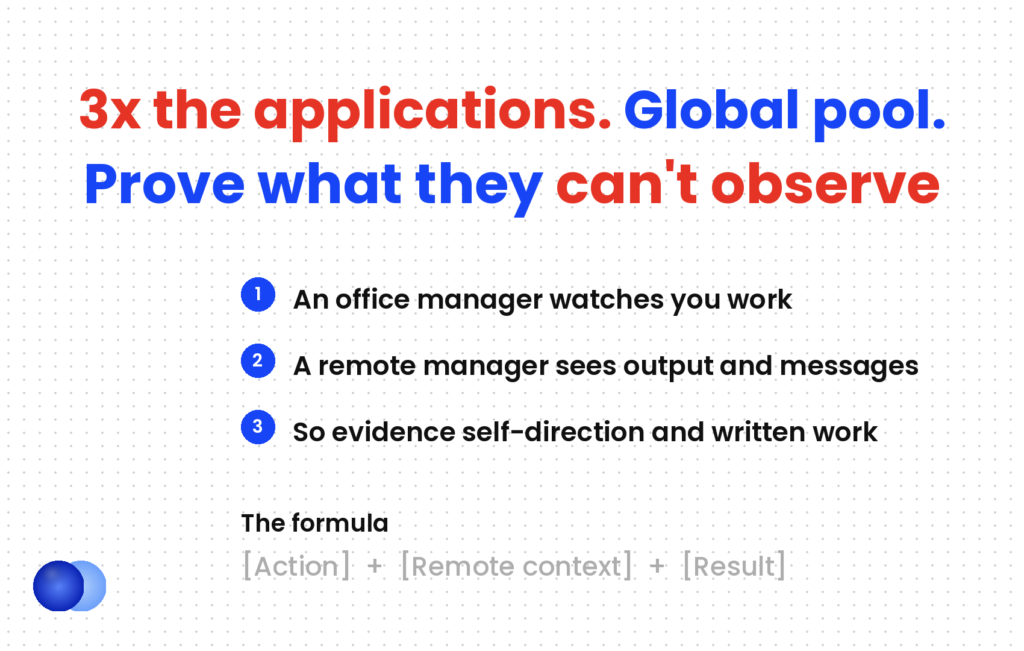
Remote postings receive three to five times more applications than equivalent on-site roles, because the talent pool is global. What separates the shortlist is evidence of the things a remote manager cannot observe — self-direction and written communication. An in-office resume never had to prove those, because presence implied them.
A resume for remote jobs has a job the on-site version never had. An office manager can watch you work. They see you arrive, solve something at a whiteboard, stay late on a deadline. None of that needs to appear on a resume, because the job itself supplies it.
A remote manager sees output and messages. That is the entire evidence base — which is why a resume for remote jobs has to prove the two things presence used to imply: that you direct yourself, and that you write clearly.
That reframe explains why the standard advice works, and it is more useful than the advice alone.
How competitive are remote roles?
Substantially more than equivalent on-site jobs. Remote postings receive three to five times more applications, because the talent pool is global rather than local. Around 65% of US companies now offer remote or hybrid arrangements, so the volume is not going down.
In practice, the competitive maths is the reason the resume has to work harder.
The pool is global. An on-site role in Dallas draws candidates who can get to Dallas. The remote equivalent draws everyone.
Published figures agree. Remote postings consistently attract three times the applications of comparable on-site roles, and some analyses put it at five.
Employers are now selective rather than sceptical. Nobody is asking whether remote work functions. They are asking who does it well, which is a different question with a different answer on your resume.
One claim to treat carefully: several sources assert that applicant tracking systems filter out over 75% of remote applications before a human sees them. No primary study supports that figure — the 75% ATS rejection myth covers where it came from, and it circulates in a new costume every year. The competition here is real and it is human.
What should you add?
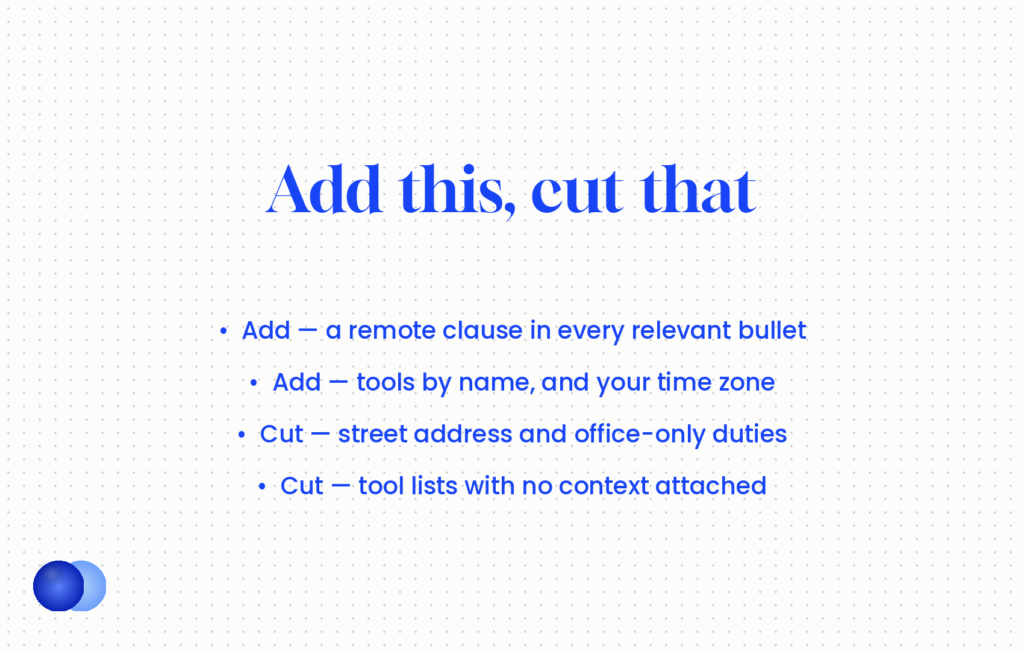
A remote-context clause in every relevant bullet, the collaboration tools by name, your time zone in the contact block, and explicit remote intent in the summary. The pattern is Action plus Remote Context plus Result — not a separate "Remote Skills" section.
A resume for remote jobs needs four additions, in order of impact:
1. Remote intent in the summary. Replace a street address with "Working remotely from Dubai (GMT+4)" or state it in the first line. An employer should not have to infer it.
2. A remote-context clause in each bullet. "Across three time zones", "in a distributed team of twelve", "asynchronously". This is the single highest-value change, and it does the work a separate skills list cannot.
3. The tools by name. Slack, Notion, Linear, Loom, Jira, Asana, Confluence, Zoom. Named tools are what a recruiter searches for, and generic phrasing matches nothing.
4. Your time zone. In the contact line. Where a posting states an overlap requirement, this removes a friction point before it becomes one.
| Weak | Strong |
|---|---|
| "Worked with a distributed team" | "Coordinated a 12-person team across 3 time zones in Linear and Slack, shipping 94% of sprint commitments" |
| "Strong communication skills" | "Wrote the async weekly update three departments planned from, replacing two standing meetings" |
| "Proficient in collaboration tools" | "Ran quarterly planning entirely in Notion and Loom, with no synchronous sessions" |
| "Self-motivated" | "Led the warehouse migration end to end with weekly written updates and no daily standups" |
Each strong version follows the same formula: action, remote context, result.
Prove the thing they cannot watch
The phrase that does the most work on a remote resume is some version of "with no daily standups" or "with minimal oversight". A remote hiring manager's real worry is not whether you have used Slack — it is whether you deliver without someone checking. A bullet that names a project you drove to completion and explicitly says how little supervision it required answers the question they cannot ask directly.
What should you cut?
A full street address, office-centric tools nobody uses remotely, and anything implying physical presence. Also cut vague tool lists with no context — a scattered stack with no indication of where you used it matches keywords without proving anything.
Broadly, four things cost space and earn nothing:
The street address. City and country is enough, and for a remote role even that is context rather than location. A full postal address reads as a document written for a different era.
Office-centric tools and duties. Desk phone systems, in-person reception coverage, meeting-room booking. If it only exists in an office, it dates you for this particular application.
Two that cost you credibility
Unattributed tool lists. "Slack, Zoom, Asana, Trello, Monday, Notion, Jira" with no context matches a keyword scan and convinces nobody. Two tools with a result beat seven in a row.
Anything implying presence as a value. "Always first in the office", "available in person for urgent issues". These were selling points once and they are the opposite now.
On-site framing: "Project Manager, Acme Corp. Responsible for managing cross-functional projects and coordinating with stakeholders. Skills: communication, organisation, Microsoft Office."
Remote framing: "Project Manager (Remote), Acme Corp. Ran six cross-functional projects for a distributed team spanning GMT-5 to GMT+8, coordinating entirely in Jira and Notion. Replaced the weekly status meeting with a written update that cut coordination time by about four hours a week across fourteen people."
Same job. The second names the setup, the tools, the spread, and a result that written communication produced — which is the competence under evaluation.
What if you have no remote experience?
Reframe what you have. Freelance projects, online coursework, cross-location collaboration, anything you delivered independently. The competencies transfer even when the job title does not say remote, and employers do not assume the transfer — you have to state it.
Most people have more remote-relevant evidence than they think, filed under other labels.
Cross-location work. Did you coordinate with a team in another office, another country, another time zone? That is distributed collaboration whether or not you were at a desk.
Freelance or contract work. Almost always self-directed, usually asynchronous, frequently across locations. The freelance resume covers how to structure that history so it parses cleanly.
Documentation you owned. A process you wrote down that other people then followed is written communication at work — the most directly relevant skill there is.
Independent delivery of anything. A project you ran with minimal supervision demonstrates the competence regardless of where you sat.
The rule underneath all four: employers do not assume office skills transfer to remote settings. Connect the dots explicitly in your first section rather than hoping a reader makes the inference for you.
Add "(Remote)" after the company name in your work history for any role that genuinely was. It is instantly scannable and it means a recruiter does not have to read a bullet to establish it.
Build a separate "Remote Skills" section. It reads as a claim rather than evidence, and the same content woven into experience bullets with results is far more persuasive.
What do remote hiring managers actually screen for?
Demonstrated tool proficiency and collaboration ability. Surveys put the figures at around 92% requiring evidence of remote tool proficiency and 83% prioritising remote collaboration skills — which makes generic capability claims the most common reason a qualified candidate gets filtered.
When screening a resume for remote jobs, three competencies carry most of the weight:
Asynchronous written communication. In a distributed team, clear documentation and written updates replace a large share of meetings. This is the skill that most often separates candidates.
Self-management. Delivery without supervision, and the judgement to know when to escalate.
Digital fluency. Not that you have heard of the tools, but that you have run real work through them.
Notice that all three are the qualities an in-office manager observes rather than assesses. That is exactly why they have to be argued on paper for a remote role.
Employers don't assume office skills will transfer to remote settings. Connect the dots directly in your resume's first section.
What about the format?
The same rules as any resume, with one addition. Single column, standard headings, one or two pages, no tables or graphics. The addition is a link block — portfolio, GitHub, LinkedIn — because a remote employer evaluates you through artefacts rather than through a room.
Finally, nothing exotic here, and the fundamentals matter more rather than less at this level of competition.
Single column, conventional section headings, month-and-year dates. Resume format types covers why the functional layout fails and why hybrid works, and none of that changes for remote roles.
The one genuine addition is your digital presence. A remote employer cannot meet you in a hallway, so a portfolio link, a GitHub with real commits, or a LinkedIn profile that matches your resume does work that no bullet can. Keep the LinkedIn profile consistent with what you send, because discrepancies cost more when the document is most of what they have.
Then check that the remote vocabulary actually landed. An AI resume checker against a specific remote posting shows whether the terms extracted, which matters more here because the posting's language is unusually standardised — "asynchronous collaboration", "distributed teams", "cross-functional", "self-directed" recur across postings and are exactly what a search targets.
Frequently asked questions
How do you write a resume for remote jobs?
Add a remote-context clause to each relevant bullet, name the collaboration tools you actually used, put your time zone in the contact line, and state remote intent in the summary. The formula is action, remote context, result.
Are remote jobs more competitive?
Considerably. Remote postings receive three to five times more applications than equivalent on-site roles, because the talent pool is global rather than local.
Should I have a separate "Remote Skills" section?
No. It reads as a claim rather than evidence. Weave the same content into your experience bullets with tools, time zones and measurable outcomes attached.
What should I remove from a resume for remote jobs?
A full street address, office-centric tools and duties, unattributed tool lists, and anything framing physical presence as a strength.
What if I have never worked remotely?
Reframe what transfers — freelance work, cross-location collaboration, documentation you owned, any project you delivered independently. Employers do not assume the transfer, so state it explicitly.
Should I put my time zone on my resume?
Yes, in the contact line. Where a posting states an overlap requirement, it removes a friction point before anyone has to ask.
Which tools should I list?
The ones you have genuinely used, by name — Slack, Notion, Linear, Loom, Jira, Asana, Confluence, Zoom. Two named tools with a result attached beat seven listed without context.
Do remote employers screen resumes differently?
They screen for different evidence. Surveys put around 92% requiring demonstrated remote tool proficiency and 83% prioritising remote collaboration, which are competencies an office manager observes rather than assesses.



Comments